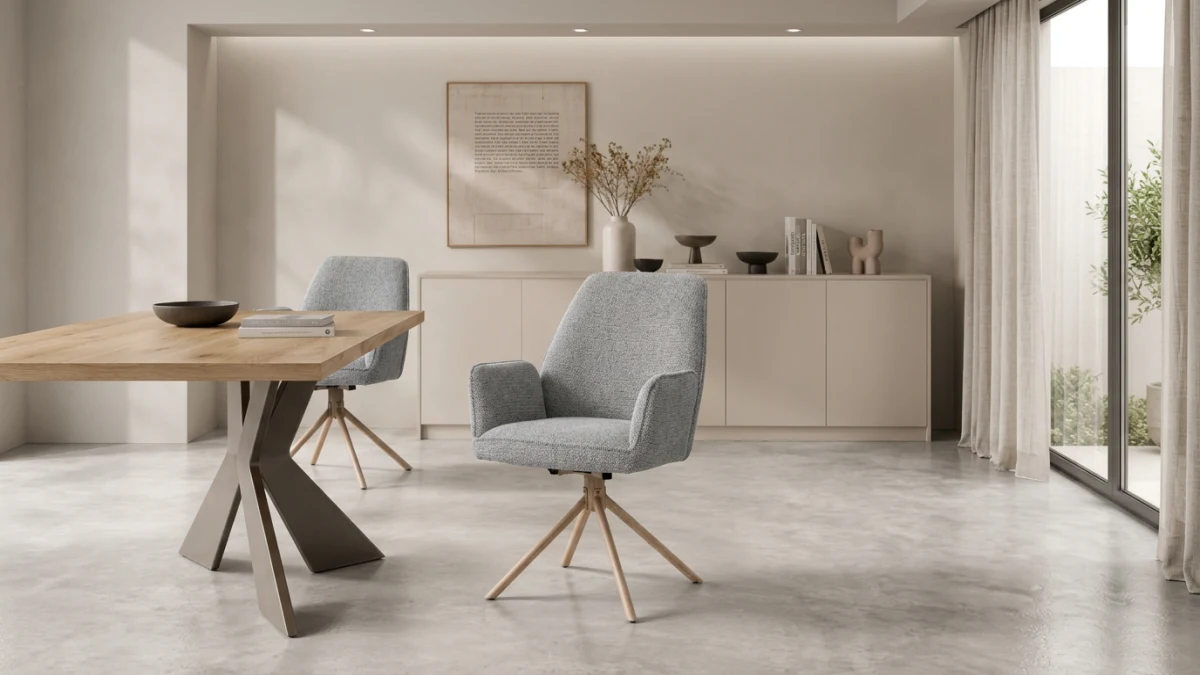
180-Degree Swivel Dining Chairs with Auto-Return: Technical Engineering, Ergonomics, and B2B Sourcing Guide
A 180-degree swivel dining chair with auto-return utilizes an internal mechanical swivel core that allows the seat shell to rotate 90 degrees left and right, automatically returning smoothly to its front-facing baseline when unoccupied. This mechanism eliminates table pushback, protects dining surfaces and delicate flooring, and preserves uniform alignment across dining rooms, hospitality venues, and contemporary European residential spaces.
Why Are Swivel Dining Chairs with Auto-Return Becoming Essential in Modern European Dining Spaces?
Modern European residential and commercial architecture prioritizes spatial efficiency, fluid living layouts, and visual cleanliness. In open-plan kitchens and compact dining spaces across Germany, the Netherlands, the UK, and Switzerland, traditional static dining chairs present recurring functional friction. Diners must physically slide chair legs across hardwood or tiled floors to sit down or stand up, creating floor friction, acoustic noise, and physical spatial bottlenecks between tables and walls.
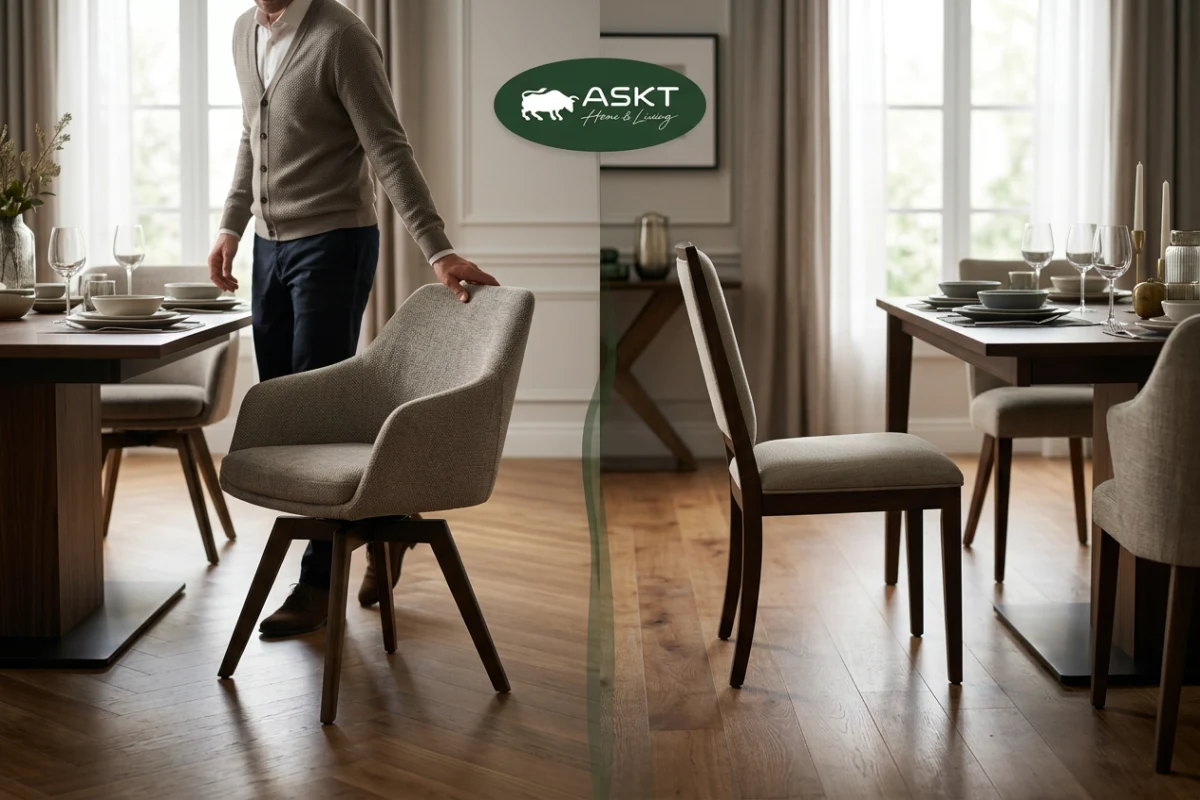
Integrating swivel dining chairs with auto-return directly resolves these spatial bottlenecks. By allowing 90 degrees of smooth rotation in either direction, diners can enter and exit the dining setting effortlessly without displacing the metal base of the chair. When the user stands up, the auto-return swivel chair mechanism guides the seat shell back into precise alignment with the dining table.
| Spatial and Functional Benefit | Technical and Commercial Impact |
|---|---|
| Effortless Ingress and Egress | Eliminates floor dragging, scraping, and acoustic disturbance |
| Constant Visual Alignment | Keeps dining rooms, hospitality spaces, and showrooms neat |
| Floor Clearance Preservation | Minimizes required pull-out clearance behind tables |
| Surface Protection | Prevents chair armrests from bumping against table edges |
| Ergonomic Dynamic Seating | Facilitates natural conversation angles across open-plan spaces |
For commercial spaces such as hotel dining rooms, restaurants, and corporate meeting areas, this self-centering behavior delivers substantial operational savings. Staff do not need to spend time straightening misaligned chairs after dining services or meetings. For furniture wholesalers, importers, and retailers, offering a curated line of functional dining chairs addresses clear consumer demand for ergonomic dining comfort paired with an uncluttered aesthetic.
How Does a 180 Degree Swivel Chair Dining Room Mechanism Differ from a 360-Degree Free Swivel Base?
When sourcing swivel seating, purchasing managers must differentiate between 360-degree free rotation mechanisms and dedicated 180-degree auto-return mechanisms. While 360-degree swivels are standard in home office task chairs, they present distinct operational drawbacks when paired with dining tables.
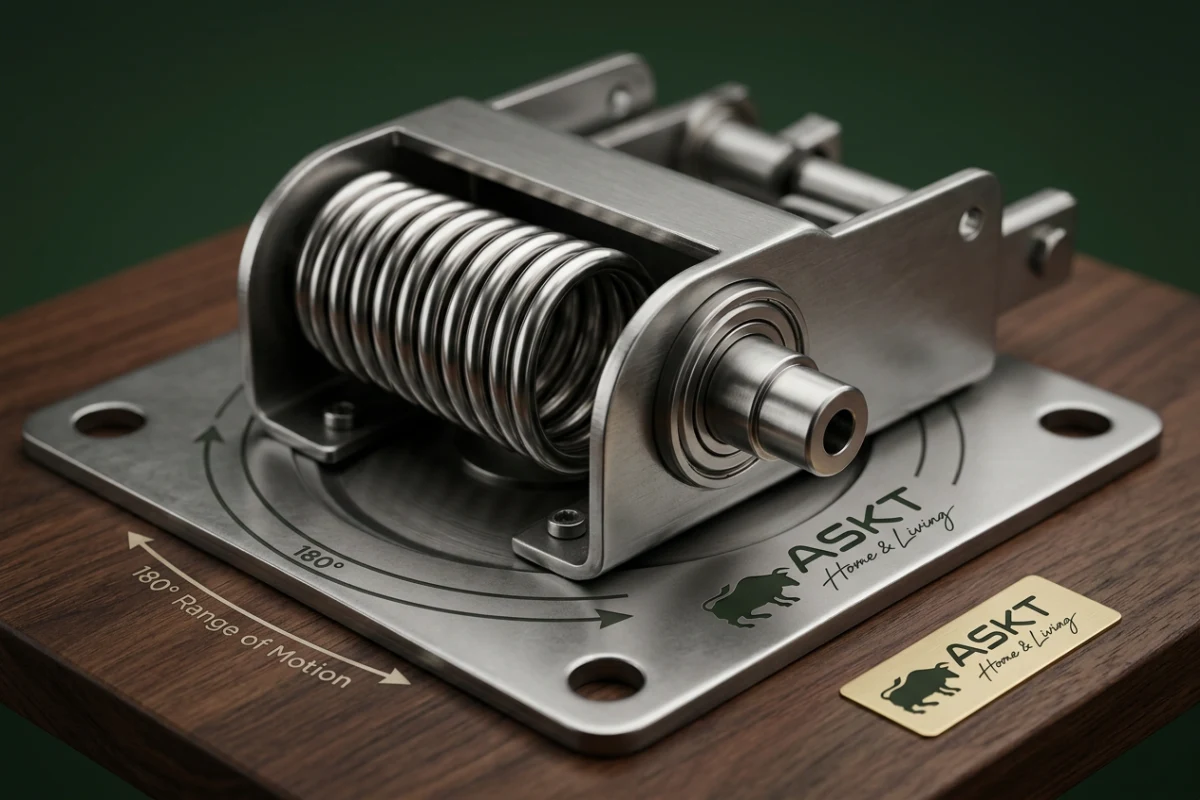
A standard 360-degree swivel lacks a directional brake or resting position. In a dining environment, users frequently leave chairs facing uneven angles, colliding with adjacent armrests or bumping against ceramic, solid wood, or sintered stone table tops. In contrast, an auto-return swivel chair mechanism uses an internal torsional spring unit and mechanical indexing guide that restricts the rotation arc to 180 degrees total (90 degrees to the left and 90 degrees to the right) and exerts a controlled dampening counter-torque to re-center the seat.
Mechanical Comparison: Auto-Return vs. 360-Degree Swivel vs. Static Leg Frames
- 180-Degree Auto-Return Swivel: Features an internal torsion return mechanism. The rotational limit is 180 degrees total (90 degrees left and 90 degrees right). Returns automatically to center with controlled resistance. Ideal for dining rooms, meeting rooms, restaurants, and high-traffic open living areas.
- 360-Degree Free Swivel: Operates on an unconstrained ball bearing turntable. Rotates an unguided 360 degrees with zero centering guidance. Higher risk of table-edge collisions and visual disorder; best suited for task setups and casual bar areas.
- Static Four-Leg Frame: Offers fixed 0-degree positioning with no rotational movement. Requires substantial pull-out clearance behind the chair, creating higher floor wear and frequent acoustic scraping noises.
For a 180 degree swivel chair dining room application, the return mechanism must offer a balanced rotational torque. If the spring tension is calibrated too tightly, the chair feels stiff when rotating to converse with adjacent diners. If the tension is calibrated too loosely, the chair fails to return to baseline smoothly or snaps back abruptly, compromising user comfort and stability.
What Structural Engineering and Quality Factors Govern Auto-Return Mechanisms?
Durability in functional dining furniture depends on metal fatigue resistance, bearing quality, and welding integrity. Commercial furniture buyers and importers serving the European market must ensure that chairs comply with European standard testing protocols, including EN testing for structural durability, dynamic strength, and safety.
An auto-return swivel mechanism consists of several precision components subject to high dynamic loads:
- Mounting Base Plate: Cold-rolled steel plates bolted directly to the underside of the seat shell or internal metal skeleton.
- Central Spindle and Bearing Unit: Precision steel ball bearings or heavy-duty self-lubricating polymer sleeves that sustain vertical axial weight while facilitating low-friction rotational movement.
- Torsional Return Core: Calibrated spring steel modules or mechanical indexing assemblies engineered for repetitive rotation cycles.
- Connecting Flange: Solid steel interface joining the mechanism to the outer chair base, such as spider bases, pyramid legs, or tubular metal legs.
| Quality Checkpoint | Testing Focus | Critical Acceptance Criteria |
|---|---|---|
| Rotational Durability | Repetitive Swivel Cycle Durability | Smooth rotation without jamming or spring fatigue |
| Static Weight Capacity | Seating Static Load and Strength | Sustained downward load without frame deformation |
| Impact Resistance | Seating Drop and Structural Testing | No weld seam failure or base plate cracking |
| Surface Protection | Powder Coating Durability | Smooth finish, adhesion, and oxidation resistance |
In professional furniture manufacturing, metal frames and swivel connection plates are welded with precision to ensure consistent penetration depth and clean seam lines without micro-cracks. This prevents structural joint failures during cyclic loading. Powder coating applied over pre-treated metal frames provides a durable finish that resists surface oxidation and chipping under standard indoor commercial and domestic use.
How Do Functional Swivel Dining Chairs Resolve Floor Protection and Clearance Issues?
In standard residential dining rooms across Europe, clearance between the edge of a dining table and the nearest wall or sideboard is often restricted. When diners use traditional static chairs, pushing back the chair requires deep dynamic clearance, creating bottlenecks in dining spaces and open-plan kitchen environments.
Swivel dining chairs with auto-return reduce the required clearance envelope significantly. Because the legs remain anchored to the floor during ingress and egress, the overall operational footprint is restricted to the rotation radius of the seat shell. Diners can turn the seat shell sideways and step out comfortably without pushing the entire chair backward.
| Flooring Type | Recommended Glide Material | Protection Characteristics |
|---|---|---|
| Solid Wood and Oiled Parquet | High-Density Soft Felt Glides | Non-marking, cushioned contact that prevents surface scratches |
| Ceramic Tiles and Sintered Stone | Low-Friction Polymer Glides | Wear-resistant, durable glide action over textured grouting |
| Luxury Vinyl Tile (LVT) and Laminate | Smooth Synthetic Glides | Balanced friction to prevent scuffing and pressure marking |
| Uneven Rustic Timber and Slate | Articulating Leveling Feet | Threaded height micro-adjustment to eliminate frame rocking |
Stationary base positioning eliminates repetitive abrasive friction on sensitive European flooring materials, including oiled oak parquet, engineered laminate, polished marble, and luxury vinyl tile. To maximize floor protection, commercial suppliers equip swivel chair bases with specialized glides tailored to specific floor coverings.
How Can Upholstery Materials and Pocket Spring Seating Be Integrated for Maximum Comfort?
Functional swivel dining chairs are increasingly utilized as multi-purpose seating in modern open-plan homes, supporting extended dinners, remote working, and casual entertaining. Therefore, ergonomic lumbar support and advanced seating construction are critical differentiators for European retailers.
Pocket Spring Seating vs. Conventional Foam Padding
Many entry-level swivel chairs rely solely on standard cut polyurethane foam over a curved plywood base. Over extended periods of daily sitting, cut foam can compress permanently, leading to uncomfortable contact with the rigid substrate. Premium functional dining chairs integrate independent pocket springs within high-resilience molded foam layers.
- Independent Pocket Springs: Individual barrel-shaped steel coils enclosed in fabric sleeves provide point-elastic pressure distribution, conforming to the user's pelvic contours while retaining dimensional recovery for years.
- High-Resilience Molded Foam: High-density foam encases the spring core, dampening mechanical vibrations from the swivel mechanism and ensuring supple, resilient seating comfort.
- Curved Ergonomic Shell: Ergonomically contoured plywood or reinforced internal metal skeletons support correct spinal posture during long dining sessions.
Performance Fabric Criteria for B2B Importers
When furniture brands develop swivel chair programs, fabric durability and stain resilience dictate post-sale customer satisfaction. Fabrics must undergo rigorous mechanical testing for commercial and domestic compliance:
| Fabric Performance Parameter | Testing Focus | Commercial Sourcing Benefit |
|---|---|---|
| Abrasion Resistance | Martindale Rub Test | Prevents bald spots and pile wear under frequent swivel friction |
| Colour Fastness | Light and Rubbing Fastness | Resistance to UV light fading and dye transfer |
| Stain and Liquid Barrier | Water-Repellent and Easy-Clean Finish | Hydrophobic protection allowing easy cleanup of daily spills |
| Pet-Friendly Weave Structure | High-Density Scratch Resistance | Tight yarn structure that resists snagging and thread pulling |
At ASKT, textile development focuses on durable, high-performance upholstery. Easy-clean, water-repellent, and pet-friendly fabrics maintain their soft tactile feel while providing robust barrier protection against daily stains, making them well suited for high-traffic dining environments. Additionally, upholstery ranges featuring recycled yarn options allow European retailers to align with sustainable sourcing standards.
What Supply Chain Factors Should Sourcing Managers Evaluate for Swivel Dining Chairs Wholesale?
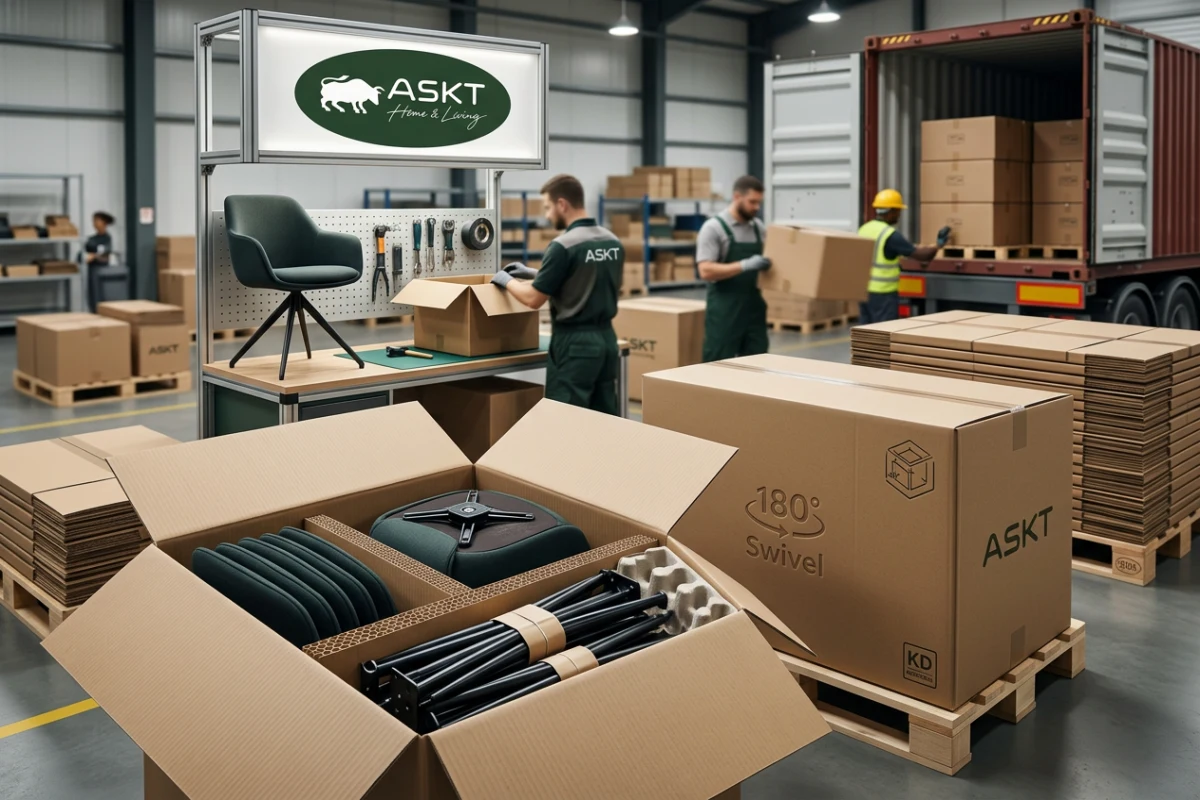
Wholesaling swivel dining chairs requires a meticulous approach to structural packaging, knocked-down (KD) engineering, and container optimization. Because swivel mechanisms add weight and specific structural geometry to chair bases, inefficient packaging directly inflates international freight costs per unit.
| Sourcing Parameter | Fully Assembled Structure | Optimized KD Modular Structure |
|---|---|---|
| 40ft HQ Container Capacity | Substantially Lower Seat Count | Maximized Loading Density (Up to 2-3x Increase) |
| Sea Freight Cost Per Unit | Higher Unit Landed Cost | Optimized to Baseline Logistics Costs |
| Assembly Complexity | Zero Assembly Required | Intuitive Bolt Assembly (4 to 8 Bolts; Under 5 Minutes) |
| Packaging Protection | Bulky Outer Carton Dimensions | Flat-Packed with High-Density Edge Protection |
| Warehouse Storage Efficiency | High Cubic Volumetric Footprint | Compact, Stackable Pallet Storage |
Sourcing Checklist for B2B Furniture Buyers
- Evaluate Modular Compatibility: Source chair programs that utilize standardized mounting footprints across multiple seat shells and metal bases. This modular approach allows purchasing teams to mix and match fabric shells with swivel or static bases, meeting container volume requirements while offering diversified catalog SKUs.
- Audit Mechanical Fastener Durability: Ensure KD swivel connections utilize high-tensile machine bolts paired with integrated locking washers or thread-locking treatments to prevent bolts from loosening under repetitive swivel torque.
- Review Sustainable Packaging Materials: Minimize single-use plastics and expanded foam. Adopt reinforced corrugated master cartons paired with honeycomb paper edge protection and protective dust sleeves to align with European packaging regulations.
- Verify Production Factory Capability: Confirm that manufacturing facilities maintain automated cutting, robotic welding infrastructure, standardized assembly lines, and material traceability throughout the production cycle.
How Does Partnering with a Specialist Functional Dining Chairs Supplier Reduce Procurement Risk?
Sourcing functional furniture across long supply chains carries inherent commercial risks, from dimensional inconsistencies and mechanism noise to fabric dye lot variance. Sourcing teams in Germany, Switzerland, the Netherlands, and the UK need manufacturing transparency rather than vague sales assurances.
A dining chair is not merely a visual design piece; it is an engineering assembly that must deliver lasting comfort, impeccable finish consistency, efficient container packing, and reliable mechanical performance. When a consumer experiences a wobbling swivel or a degraded return mechanism, product returns directly impact a retailer's brand equity.
A professional functional dining chairs supplier mitigates these risks through disciplined engineering processes:
- Product Consistency: Utilizing automated batch-cutting machinery, precision hole punching, and standardized assembly jigs to maintain tight tolerances across large production runs.
- In-House Pre-Shipment Quality Testing: Conducting cycle testing on swivel mechanisms, fabric abrasion audits, dynamic drop tests, and carton drop testing prior to container dispatch.
- Modular Sourcing Support: Providing flexible OEM and ODM development across dining chairs, dining tables, bar chairs, and lounge furniture, enabling buyers to coordinate finishes across full dining room collections.
- Logistics and Container Optimization: Engineering flat-pack KD geometries to minimize dead air inside shipping containers, reducing sea freight costs per chair.
| Quality Control Parameter | Factory Verification Protocol |
|---|---|
| Swivel Mechanism Smoothness | 100% manual spin-and-return inspection prior to packaging |
| Metal Frame Weld Integrity | Visual and structural seam inspection on robotic weld batches |
| Seating Structure Durability | Dynamic cyclic loading and drop testing verification |
| Hardware and Thread Alignment | Calibrated torque checks on all KD threaded inserts and bolts |
Frequently Asked Questions About Swivel Dining Chairs
How does the 180-degree auto-return mechanism work without electricity?
The auto-return mechanism operates completely mechanically. Inside the steel spindle housing, a heavy-duty torsional spring or mechanical indexing cam engages when the seat rotates. When the occupant stands up, the stored mechanical energy gently guides the seat shell back to its factory-calibrated neutral front-facing position without motors or external power sources.
What is the weight capacity and durability standard for swivel dining chairs?
Commercial-grade swivel dining chairs manufactured for European markets are engineered to support dynamic and static user loads under standardized EN test protocols. Cold-rolled steel plates, reinforced spindles, and robust weld joints ensure the base maintains structural integrity under heavy repetitive loading.
Can the auto-return swivel mechanism squeak over time, and how is this prevented?
Squeaking is prevented by utilizing sealed, self-lubricating bearing cartridges, high-density polymer bushings, and stable synthetic lubricants during factory assembly. This eliminates metal-on-metal friction and ensures smooth, quiet operation across thousands of rotation cycles.
Are 180-degree swivel dining chairs suitable for commercial restaurant and contract projects?
Yes. In hospitality and contract dining environments, auto-return swivel chairs provide effortless entry and exit in compact spaces while keeping the dining room orderly. Sourcing teams should select high-abrasion commercial fabrics and durable metal bases tested for commercial use.
If you are evaluating dining chair or dining table suppliers for the European market, ASKT provides professional OEM and ODM development, rigorous quality control, and optimized export logistics. Explore swivel chair options and customisation possibilities at ASKT to build commercially successful dining furniture collections for your market.