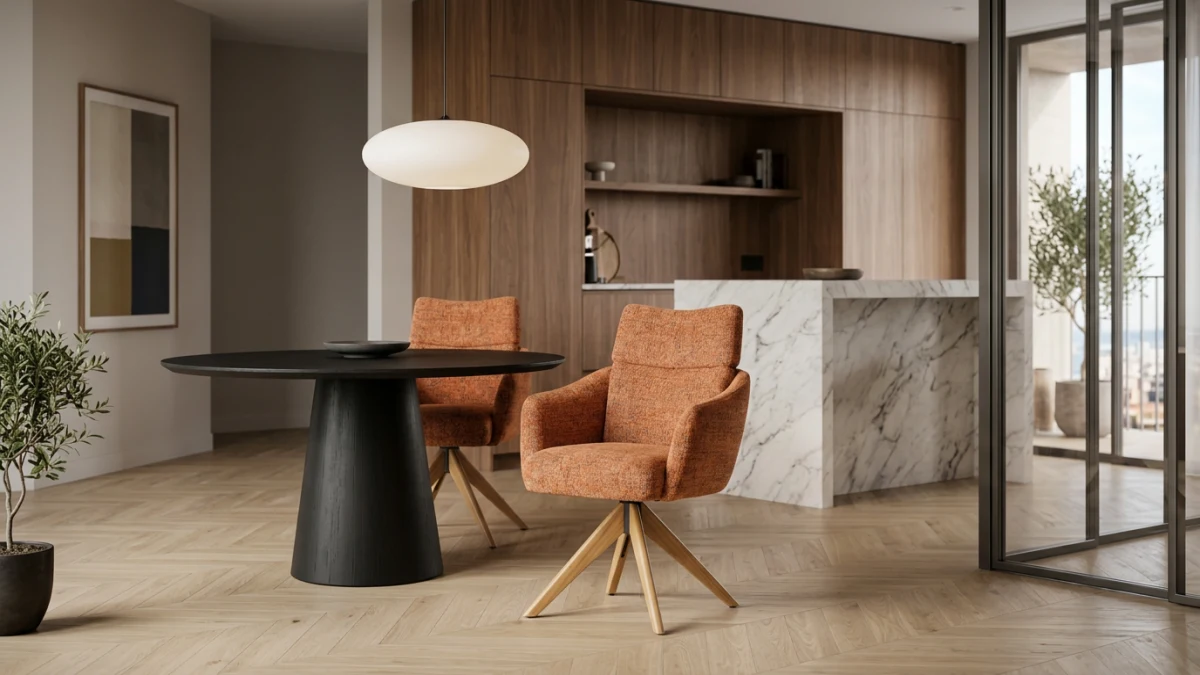
180 vs 360 Degree Swivel Dining Chairs: A B2B Retail Sourcing Guide
When evaluating 180 vs 360 degree swivel dining chairs for commercial retail collections, the core distinction centres on alignment control versus unrestricted movement. A 180-degree auto return swivel dining chair uses an internal spring or damper mechanism to automatically re-centre the seat toward the dining table when vacated, preserving visual order and preventing tabletop impact. In contrast, 360-degree rotating dining chairs provide continuous rotation for multi-directional living spaces at a lower hardware cost. For European retailers, 180-degree models drive higher margins in mid-to-premium segments, while 360-degree models serve entry-level volume lines.
What is the fundamental mechanical difference between 180-degree and 360-degree swivel systems?
Understanding the functional differences between swivel dining chair systems begins with the mechanical components installed beneath the upholstered seat shell. The internal mechanism directly influences everyday ergonomics, structural stability, hardware longevity, and customer satisfaction rates across both domestic and contract environments.
A standard 360-degree rotating dining chair uses a continuous turntable swivel plate or a central bearing column. This mechanism incorporates a ring of steel ball bearings housed between two pressed metal plates or inside a hub housing. The user can rotate continuously through a full 360-degree circle without encountering internal mechanical stops or directional resistance. When the diner turns the seat to exit the dining table, the chair shell remains fixed at whatever exit angle it was left until someone physically repositions it.
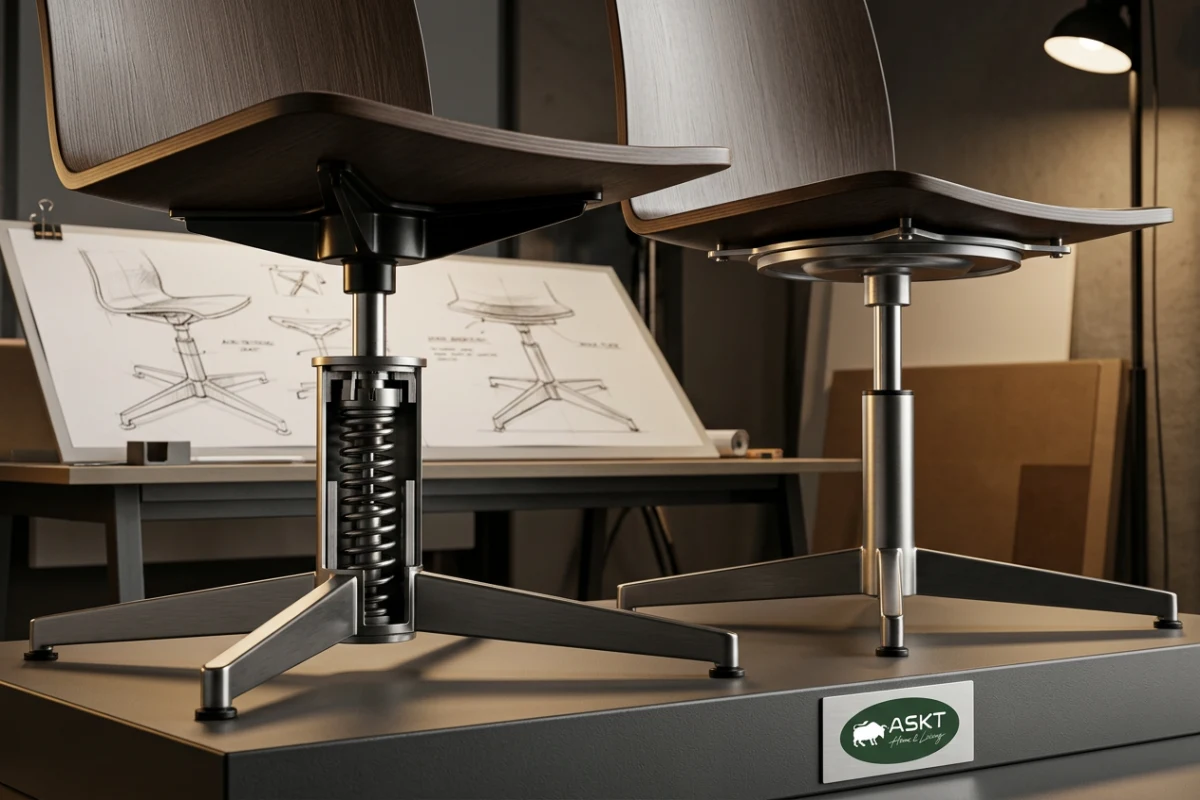
In contrast, a 180-degree auto return swivel dining chair contains a directional return assembly housed inside the central swivel hub. This system incorporates an internal torsion spring, twin-track mechanical stop, or dampening cartridge. The mechanism permits the seated user to rotate approximately 90 degrees to the left or 90 degrees to the right from the centreline. As soon as the diner stands up and removes their body weight from the seat, the internal spring mechanism engages, gliding the seat shell back to its original forward-facing position.
| Feature | 180° Auto-Return Mechanism | 360° Free-Swivel Mechanism |
|---|---|---|
| Rotational Range | ±90° from centre (180° total arc) | Continuous 360° rotation |
| Internal Hardware | Steel ball bearings, torsion spring or damper, centring stop | Steel ball bearing race within dual plates |
| Resting Position | Automatically resets to forward centre | Stays at the angle of exit |
| Showroom Upkeep | Self-aligning; zero manual resetting required | Requires regular manual alignment by staff |
| Table Edge Protection | Controlled arc reduces accidental table impact | Free rotation can swing into table edges |
| Hardware Cost | Higher due to multi-part dampening assembly | Lower due to standard turntable construction |
| Ideal Commercial Tier | Mid-to-high retail and commercial hospitality | Entry-to-mid retail and casual spaces |
From a manufacturing perspective, building a reliable auto return swivel dining chair requires precise engineering tolerances. If the internal return spring is set with excessive tension, the seat snaps back abruptly, creating potential pinch risks or an uncomfortable user experience. Conversely, if the tension is too loose, the mechanism struggles to overcome the friction of heavy upholstered seat shells and pocket spring cushions. An experienced swivel dining chair manufacturer balances spring tension, bearing lubrication, and structural alignment to ensure smooth, silent, and steady return action over years of daily use.
Why does the auto return swivel dining chair solve floor layout and showroom clutter?
For commercial furniture buyers, showroom visual merchandising plays an essential role in retail sales performance and brand perception. Dining chairs displayed in disarray create visual clutter and disrupt traffic flow across retail sales floors.
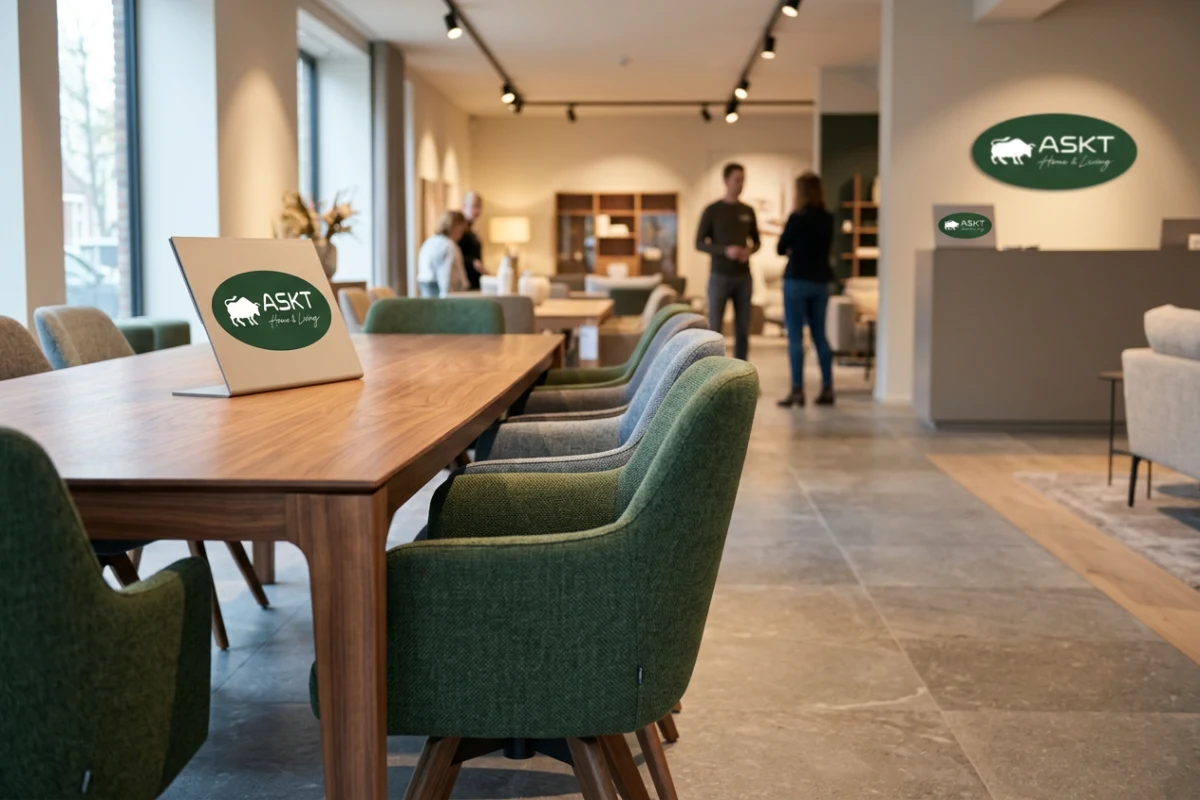
In high-traffic furniture showrooms across Germany, the Netherlands, the UK, and other European markets, 360-degree free-swivel chairs inevitably end up pointing in random directions throughout the day. When display chairs remain turned sideways or backwards, seat backs obstruct customer aisles and spoil the presentation of matching dining tables, sintered stone surfaces, and oak veneer collections. Retail staff must spend valuable time repeatedly walking through dining vignettes to manually straighten and align every chair.
An auto return swivel dining chair eliminates this operational headache entirely. Because the seat shell automatically returns to face the tabletop at a clean 90-degree angle, retail displays maintain an orderly, disciplined look throughout business hours. This self-centring capability delivers three clear advantages for furniture retailers and commercial buyers:
- Permanent Showroom Order: Floor displays stay visually tidy and uniform throughout peak shopping periods without requiring constant staff intervention.
- Tabletop Surface Protection: Freely rotating chairs can accidentally swing into dining table aprons, sintered stone edges, or solid wood corners. Restricting rotation to a controlled 180-degree arc with an auto-centring return significantly reduces showroom and residential impact damage.
- Optimized Walkway Clearance: In contemporary open-plan homes where dining areas merge with living rooms or kitchens, self-aligning chairs keep armrests and seat backs aligned under the table apron, ensuring open walkways are never blocked.
For retail category managers, selecting the right swivel mechanism is not merely an aesthetic choice; it directly affects customer perception of product quality and overall brand value on the retail floor.
How do 180° and 360° mechanisms perform in swivel mechanism durability testing?
Commercial durability is a top priority for professional furniture buyers. Swivel dining chairs experience complex rotational shear and dynamic lateral loads that static four-legged chairs never face. Reliable suppliers evaluate both mechanism types through rigorous swivel mechanism durability testing to ensure long-term structural integrity.
During durability testing, mechanical assemblies undergo multi-cycle rotational fatigue tests, off-centre drop tests, and dynamic load-bearing evaluations. These testing procedures reveal distinct stress points between 180-degree and 360-degree mechanisms:
- Rotational Cycle Durability: High-grade swivel mechanisms must withstand tens of thousands of continuous rotation cycles under heavy seat loads without developing bearing looseness, structural play, grinding noises, or spring fatigue.
- Torsion Stop Resistance: In 180-degree chairs, users occasionally rotate against the internal mechanical stop at the 90-degree limit. The internal metal stop must withstand repeated shear forces created by user momentum without cracking, deforming, or misaligning the central shaft.
- Bearing Race Integrity: In lower-grade 360-degree turntables, thin stamped metal races can deform under uneven body weight distribution, leading to bearing binding, metal wear, and irregular rotation.
- Weld Seam and Joint Stability: Continuous swivelling exerts torsional leverage against the mounting weld between the swivel plate and the metal leg base. Robust manufacturing processes utilize precise welding techniques to create uniform structural joints that prevent wobble, metal fatigue, and joint failure over extended service lifecycles.
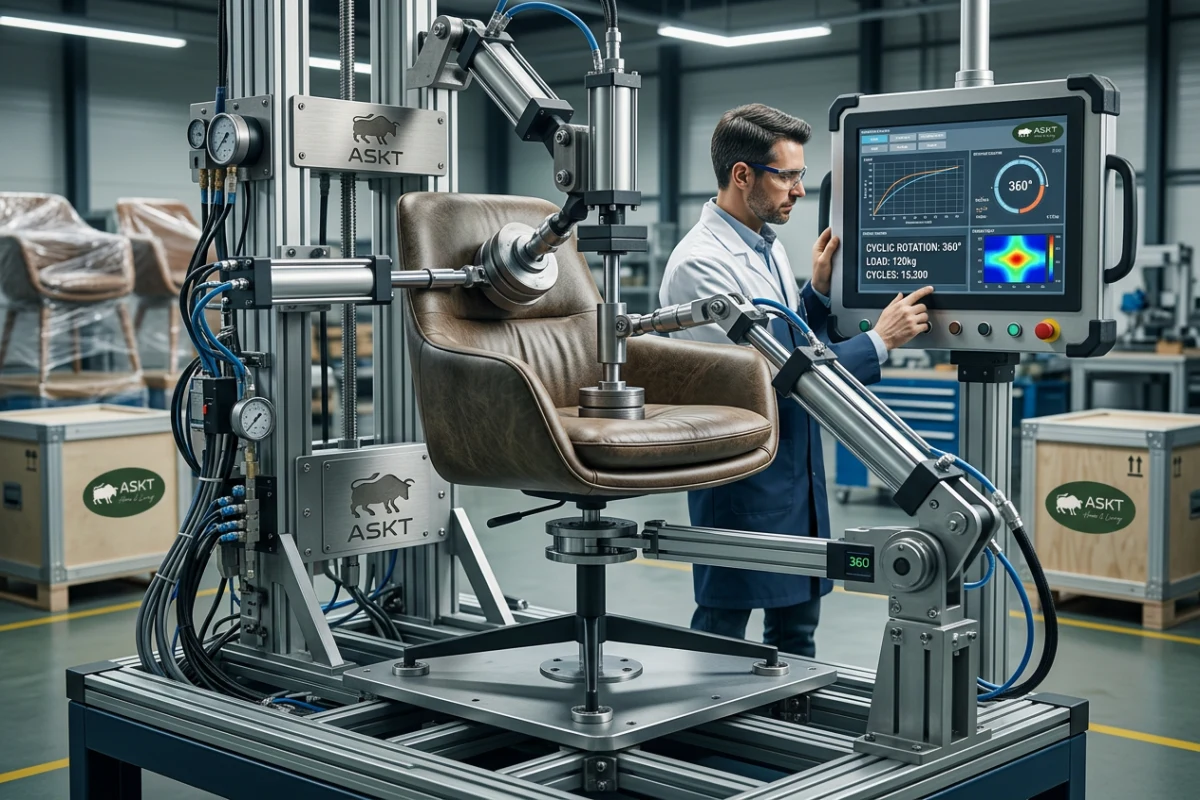
When evaluating test documentation and factory audit reports, commercial buyers should examine the structural integration between the swivel mechanism and the metal base frame. A high-performance swivel plate attached to thin-walled metal legs or secured with low-grade fasteners remains vulnerable to premature failure. Dependable dining chair designs utilize reinforced steel mounting plates, heavy-gauge steel leg connections, and self-locking fasteners to maintain rigid structural stability throughout the product lifecycle.
What are the cost structures, packaging implications, and retail margins for both types?
Professional purchasing teams must weigh factory unit costs against shipping density, retail price positioning, and warranty reserve allocations. Analysing total landed costs is vital for successful rotating dining chairs B2B sourcing.
1. Hardware and Manufacturing Cost Differences
A commercial-grade 180-degree auto-return swivel cartridge involves higher manufacturing costs than a standard 360-degree turntable bearing. This cost difference arises from the internal spring steel, precision dampening channels, and reinforced mounting housings. When integrated into the completed chair assembly, this hardware upgrade increases factory unit costs moderately compared to standard continuous-swivel alternatives.
2. Knock-Down (KD) Engineering and Packaging Optimization
Swivel dining chairs are naturally bulkier than conventional fixed-leg chairs. Sourcing success depends heavily on Knock-Down (KD) frame engineering that protects shipping volume while facilitating straightforward final assembly:
- Modular KD Base Construction: Space-saving packaging structures separate the fully upholstered seat shell from the metal swivel base. This configuration enables efficient nesting of seat shells and compact stacking of metal spider legs inside export cartons.
- Container Loading Efficiency: A well-engineered KD swivel chair design maximizes unit counts inside 40-foot High Cube (40HC) shipping containers. Inefficient, non-KD swivel bases waste significant container volume, resulting in lower unit yields and inflated per-unit ocean freight expenses.
- Sustainable Protective Packaging: Replacing generic single-use foam wrap with corrugated edge protectors, honeycomb paper padding, and reinforced cardboard corner buffers protects powder-coated metal legs and delicate upholstery seams during international transit while aligning with European packaging sustainability initiatives.
3. Retail Price Positioning and Margin Opportunities
Across European furniture markets—including Germany, the Netherlands, the UK, and Switzerland—consumers recognize 180-degree auto-return chairs as a functional, premium upgrade:
- 360-Degree Swivel Chairs: Often positioned in entry-to-mid retail price categories. They serve as accessible, volume-driving options for casual dining and multi-functional spaces, delivering steady sales turnover.
- 180-Degree Auto-Return Swivel Chairs: Positioned in mid-to-high retail price tiers. They function as design-led dining pieces that command premium retail pricing, allowing retailers to achieve healthier gross profit margins per square metre of display floor.
Retailers can elevate commercial margins by curating mixed dining collections that feature 180-degree auto-return mechanisms on signature upholstered armchairs, supported by volume-oriented 360-degree models in complementary styles.
Which consumer demographics and dining space profiles match 180° vs 360° models?
Deciding whether to stock 180-degree auto-return or 360-degree free-swivel dining chairs depends on target consumer lifestyles, residential floor plans, and specific commercial end-use environments.
Profile A: Modern Open-Plan Homes (Best Suited for 180° Auto-Return)
In modern European housing where the dining area directly overlooks the open kitchen and living room, visual cleanliness is a major purchasing driver for homeowners.
- Target Need: A neat, orderly appearance when viewed from adjacent living and kitchen areas.
- Usage Dynamics: Diners turn outward to leave the table, expecting the chair to self-align beneath the tabletop apron without manual adjustments.
- Recommended Specification: A 180-degree auto-return swivel mechanism paired with durable, easy-clean, or waterproof performance fabrics, high colour fastness, and ergonomic pocket spring seat cushions.
Profile B: Multi-Functional Living & Social Spaces (Best Suited for 360° Swivel)
In compact apartments, studio flats, casual breakfast nooks, or home office hybrid setups, users demand complete rotational freedom.
- Target Need: The flexibility to rotate fully toward kitchen islands, work desks, or entertainment areas without lifting or shifting the chair base.
- Usage Dynamics: Frequent, multi-directional rotation across different focal points throughout the room.
- Recommended Specification: A heavy-duty 360-degree bearing plate mounted on a wide four-star metal spider base with scratch-resistant powder coating.
Profile C: Commercial Hospitality and Boardrooms (Best Suited for 180° Auto-Return)
In boutique hotels, fine-dining restaurants, executive conference spaces, and upscale meeting rooms, chairs undergo continuous guest turnover throughout the day.
- Target Need: Consistently aligned seating layouts and reduced room-turnaround labour for hospitality staff.
- Usage Dynamics: High-frequency seating and standing cycles requiring automatic reset to the table centreline.
- Recommended Specification: A commercial-grade 180-degree auto-return mechanism tested for high-cycle durability, upholstered in abrasion-resistant, pet-friendly, or stain-resistant contract fabrics.
Sourcing checklist: How should furniture retail buyers audit a swivel dining chair manufacturer?
When importing container volumes of swivel seating from China, retail product managers, category buyers, and quality control teams should systematically inspect mechanical components, metal frames, and manufacturing processes. Use the following structured checklist during supplier evaluations and pre-shipment quality inspections:
1. Swivel Mechanism Hardware Inspection
- Steel Plate Thickness: Verify that the upper and lower metal mounting plates of the swivel unit have sufficient gauge thickness to prevent bending or warping under dynamic user weight.
- Bearing Lubrication & Dust Sealing: Ensure high-viscosity synthetic grease is properly sealed inside dust-protected bearing housings to prevent lubricant leakage onto showroom floors or domestic rugs.
- Return-to-Centre Accuracy: Test multiple production samples to confirm that the auto-return mechanism consistently resets the seat shell to dead centre without catching, stuttering, or over-swinging.
- Acoustic & Operational Smoothness: Rotate the chair under full adult body weight to verify silent operation, checking for any metal-on-metal friction, clicking sounds, or internal component play.
2. Metal Base Frame & Finish Verification
- Weld Seam Integrity: Inspect the structural joints connecting the central swivel hub to the metal spider legs, ensuring clean, continuous welding free of surface cracks, porosity, or rough spatter.
- Powder Coating Adhesion: Check the powder coating finish for uniform coverage, smooth texture, and strong surface adhesion to prevent scratching, chipping, or flaking around high-wear leg joints.
- Protective Floor Glides: Ensure integrated floor glides (such as durable nylon or felt pads) are securely fitted into the leg tips to safeguard hardwood, tile, and laminate flooring against scratches.
3. Factory Quality Infrastructure & Process Control
- In-House Mechanical Testing: Confirm that the swivel dining chair manufacturer operates dedicated in-house cyclic rotation testing rigs and load-testing equipment to continuously monitor production batch quality.
- Upholstery & Cushion Construction: Verify high-resilience foam or pocket spring seating construction, ensuring proper foam density and fabric seam reinforcement capable of withstanding rotational shear forces.
- Packaging Drop & Pressure Testing: Confirm that flat-pack KD export cartons undergo carton drop testing to verify that internal cardboard buffers, corner guards, and honeycomb dividers protect the swivel assembly during container ocean freight.
Strategic Comparison: 180° Auto-Return vs 360° Swivel Dining Chairs
To assist retail merchandising and procurement teams in structuring balanced dining chair assortments, the following matrix summarizes the key commercial and operational criteria:
| Commercial Factor | 180° Auto-Return Swivel Chairs | 360° Free-Swivel Chairs |
|---|---|---|
| Primary Market Segment | Mid-to-premium retail, design showrooms, commercial dining | Entry-to-mid retail, promotional lines, compact flats |
| Showroom Merchandising | Keeps dining vignettes perfectly aligned automatically | Requires regular manual alignment by store associates |
| Tabletop Impact Protection | High; controlled rotation reduces edge collisions | Moderate; continuous rotation can bump table aprons |
| Hardware Complexity | Multi-component assembly with spring/damper systems | Streamlined dual-plate ball bearing construction |
| Landed Cost Structure | Moderate hardware premium reflected in FOB pricing | Lower FOB pricing; maximizes entry-level competitiveness |
| Margin Potential | Higher cash margins through premium design positioning | High-volume unit turnover with standard retail markups |
Choosing between 180-degree auto-return and 360-degree swivel dining chairs depends on your brand's market positioning, showroom presentation requirements, and target customer profiles. By partnering with an experienced manufacturing specialist, furniture retailers can optimize container loading, maintain consistent quality control, and deliver reliable rotating dining collections tailored to European market demands.
Sie sind unsicher, welche Mechanik zu Ihrem Sortiment passt? Senden Sie uns Ihr Zielsegment.