
BSCI REACH FSC Dining Chair Manufacturer China: B2B Sourcing Guide
For European furniture importers, wholesale distributors, retail buying groups, and contract furniture specifiers, sourcing dining chairs from overseas manufacturers involves far more than comparing aesthetic silhouettes or initial unit prices. Today, regulatory scrutiny across the European Union and the United Kingdom demands verified accountability across social standards, chemical safety, and raw material origins. Commercial buyers placing dining furniture on the market face substantial legal and financial responsibility. Incomplete certifications or non-compliant materials can trigger customs delays at major ports, compulsory product recalls, distributor penalties, and brand erosion.
Selecting a qualified BSCI REACH FSC dining chair manufacturer China is one of the most effective ways to mitigate regulatory risk and establish a transparent, sustainable supply chain. When sourcing upholstered, metal-frame, or wooden dining chairs, procurement specialists must ensure that factory claims are backed by authentic audits, third-party laboratory test reports, and unbroken chain-of-custody documentation. This comprehensive guide outlines how professional B2B purchasing managers can evaluate Chinese manufacturing partners, verify essential compliance credentials, and align technical product specifications with European commercial standards.
Navigating Core European Compliance Demands for Dining Seating
European product compliance is multidimensional. A modern dining chair is an assembly of diverse components: solid wood legs, curved plywood seat shells, steel or aluminium frames, internal polyurethane foam cushions, structural adhesives, mechanical swivel units, and textile or synthetic leather upholstery. Each of these components falls under specific legal directives and consumer safety frameworks in destination markets such as Germany, the Netherlands, the UK, Poland, Switzerland, and Ireland.
Importers and brand owners are legally defined as the economic operators introducing goods into the European market. Consequently, liability for non-compliant furniture rests with the buyer rather than the overseas factory. To protect their commercial operations, sourcing professionals organize supplier evaluation around three core compliance pillars:
- Social and Ethical Standards: Verifying that production facilities uphold fair wages, transparent working hours, occupational safety, and ethical labour conditions.
- Chemical Safety and Environmental Health: Ensuring that textiles, foams, finishes, and bonding adhesives do not contain restricted substances, toxic heavy metals, or harmful volatile compounds.
- Forestry Traceability and Legal Wood Sourcing: Guaranteeing that all solid timber, veneers, and engineered wood substrates originate from responsibly managed, legally harvested forests.
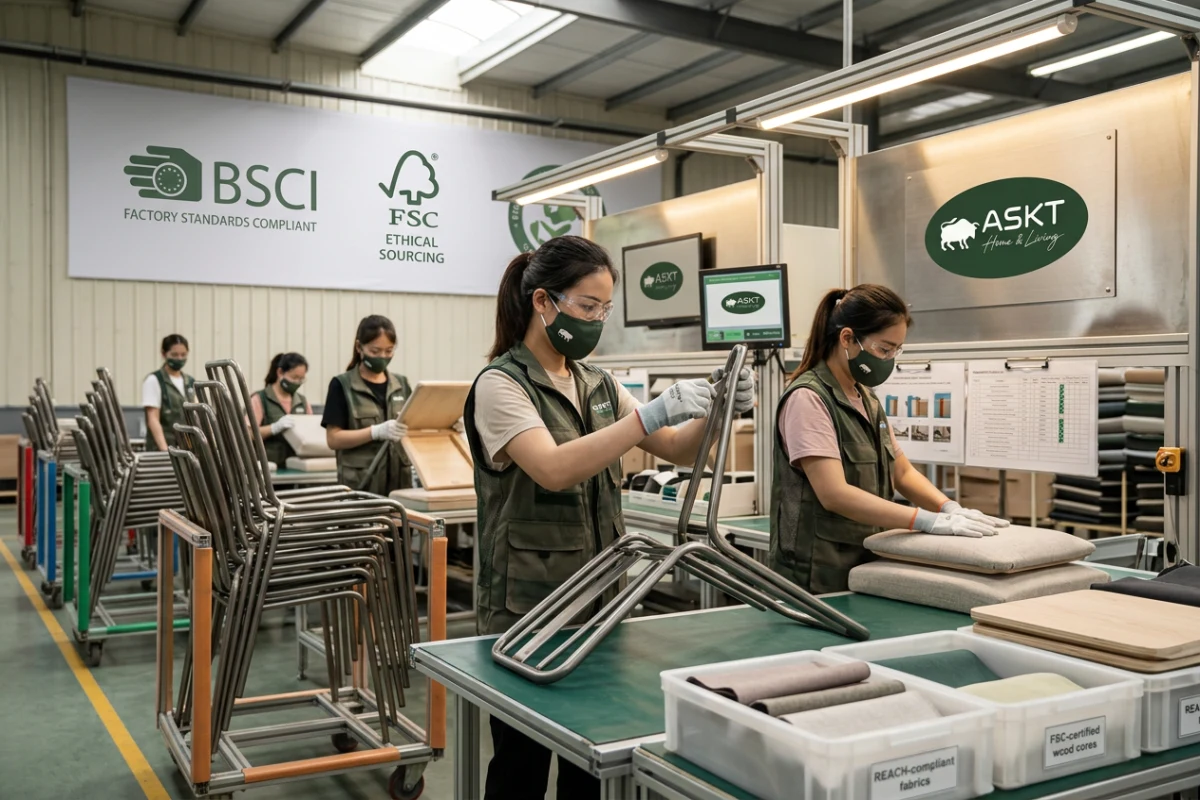
When evaluating prospective partners, purchasing teams must differentiate between general self-declarations and verified third-party documentation. Authentic compliance requires active factory audit cycles, certified management systems, and batch-level material traceability.
BSCI Social Audits: Evaluating Factory Working Conditions and Worker Safety
Corporate social responsibility and transparent labor practices have become mandatory procurement criteria across European retail chains and contract furnishing channels. The Business Social Compliance Initiative (BSCI), managed by amfori, provides a standardized auditing methodology to monitor and improve social performance throughout global supply chains. When auditing a BSCI audited dining chair factory, procurement teams assess how well the manufacturer manages employee welfare, workplace health, and operational governance.
Dining chair manufacturing involves several distinct industrial processes: mechanical timber processing, CNC sheet cutting, metal tube bending and robotic welding, electrostatic powder coating, foam shaping, upholstery cutting, and manual assembly. Each manufacturing station presents operational risks that require formal management protocols. Independent BSCI audits evaluate facilities across eleven core principles, emphasizing occupational health and safety (OHS), fair remuneration, and lawful working hours.
| BSCI Audit Evaluation Area | Practical Dining Chair Production Checkpoints | Impact on B2B Sourcing Reliability |
|---|---|---|
| Occupational Health & Safety | Machine guarding, dust extraction, PPE usage, fire safety | Reduces production downtime, accident risks, and operational disruption |
| Fair Working Hours & Compensation | Documented attendance records, transparent overtime tracking | Stabilizes workforce retention and maintains consistent assembly quality |
| Environmental Protection Systems | Safe storage and disposal of adhesives, finishes, and metal waste | Prevents environmental non-compliance and local regulatory shutdowns |
| Ethical Business Behaviour | Verifiable production logs without duplicate or falsified records | Ensures honest communication and reliable supply chain data |
Inside a well-managed factory, process automation and worker safety reinforce one another. For example, automated fabric cutting tables and robotic welding arms not only reduce dimensional variance across chair frames but also remove operators from repetitive physical hazards. In wood preparation areas, proper dust collection systems protect air quality during CNC routing and sanding of bentwood shells. In upholstery workshops, dedicated ventilation systems protect technicians handling water-based contact adhesives. A transparent supplier readily provides its current amfori BSCI audit summary report, complete with the corresponding DBID number and audit cycle rating, allowing buyers to verify findings directly through the amfori platform.
REACH Compliance: Managing Chemical Safety in Upholstery, Foams, and Finishes
Regulation (EC) No 1907/2006, universally known as REACH, governs the registration, evaluation, authorization, and restriction of chemical substances across the European Union. For furniture buyers, REACH compliance is vital because upholstered dining chairs incorporate a wide array of synthetic and chemical elements in their coverings, padding, frame coatings, and structural bonding.
When ordering REACH certified upholstery dining chairs, sourcing teams must verify that all materials comply with the candidate list of Substances of Very High Concern (SVHC). Under REACH, substances on the SVHC list must not exceed a concentration of 0.1% weight-by-weight (w/w) in any individual article or component. Furthermore, materials must satisfy the mandatory restrictions outlined in REACH Annex XVII, which restrict specific substances such as azo colorants, phthalate plasticizers, organotin compounds, and heavy metal pigments.
| Chair Component | Critical Chemical Risks to Screen | Testing and Verification Standard |
|---|---|---|
| Upholstery Fabric / PU / Velvet | Aromatic amines from azo dyes, phthalates, DMFa, PFAs | OEKO-TEX® STANDARD 100 / REACH SVHC screening reports |
| Polyurethane Foam Cushions | Short-chain chlorinated paraffins (SCCPs), flame retardants | Laboratory chemical emission and composition test reports |
| Bonding Glues and Adhesives | Free formaldehyde, volatile organic compounds (VOCs) | Low-VOC emission declarations and Material Safety Data Sheets |
| Metal Frame Powder Coating | Lead, cadmium, hexavalent chromium compounds | Heavy metal migration screening and surface finish testing |
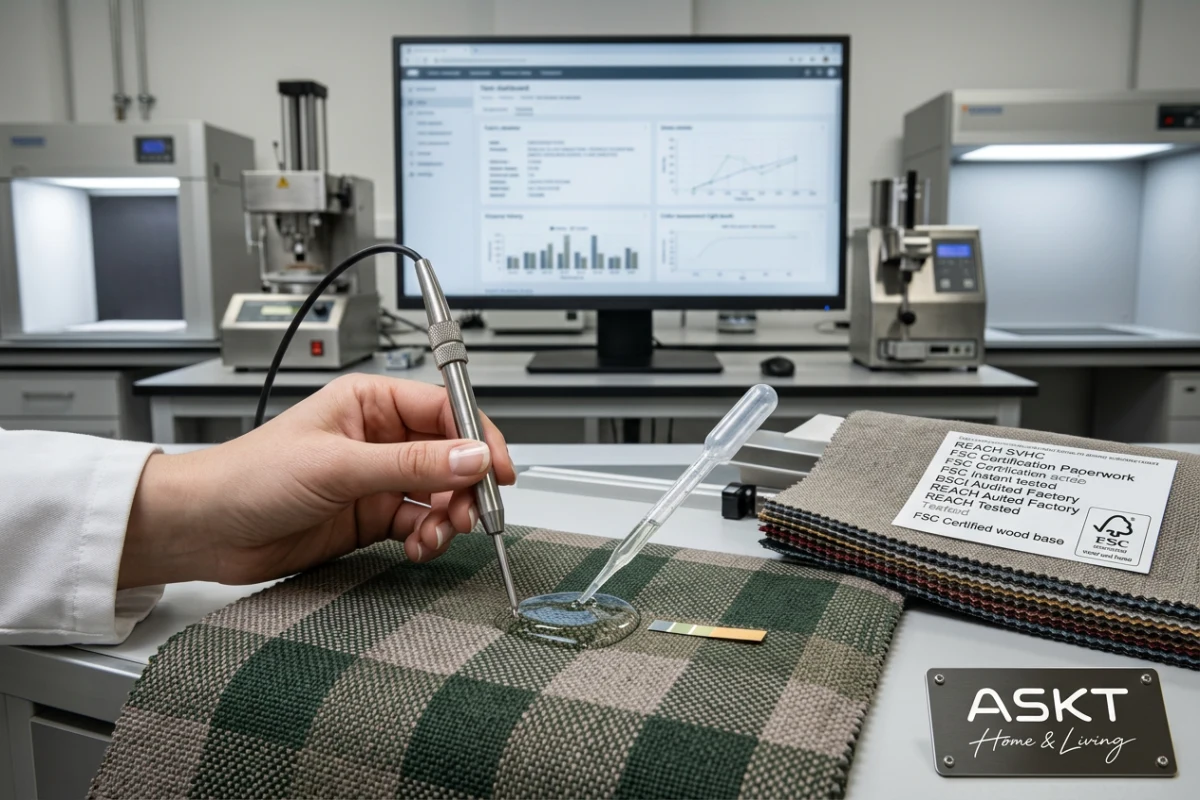
Upholstery fabrics represent the most visible component of a dining chair and the surface with direct skin contact. In high-frequency dining environments, fabrics must combine technical performance—such as high Martindale abrasion resistance, pill resistance, and colour fastness to light and rubbing—with complete chemical safety. Many leading European buyers specify OEKO-TEX® STANDARD 100 certified fabrics, which provide an additional guarantee that yarns, dyes, and functional surface treatments (such as water-repellent or easy-clean coatings) are free from harmful irritants.
Internal cushioning also requires careful specification. High-resilience polyurethane foams and pocket spring seating systems must maintain their elasticity and structural recovery without relying on banned chemical extenders or hazardous flame retardants. Reputable manufacturers work with accredited testing houses such as SGS, TÜV, or Intertek to conduct periodic chemical screenings, providing clear test reports for each material batch.
FSC Certification: Ensuring Timber Traceability and Legal Wood Sourcing
Forestry sustainability has moved to the forefront of international trade regulations. With stringent timber import directives and the implementation of the European Union Deforestation Regulation (EUDR), commercial furniture buyers must demonstrate that all wood-based components are legally sourced and completely traceable to sustainable forest management units.
Partnering with an FSC certified furniture manufacturer China provides commercial buyers with the Chain of Custody (CoC) certification required to market timber products legally in Europe. The Forest Stewardship Council (FSC) tracks forest products along the entire value chain—from certified timber harvesting and sawmilling to component fabrication, final chair assembly, and packaging.
In dining chair manufacturing, wood verification applies to two main categories of timber components:
- Engineered Bentwood and Plywood Shells: Ergonomic curved chair backs and seat bases are predominantly manufactured from multi-layer plywood pressed from birch, poplar, or eucalyptus veneers. An FSC-certified supply chain ensures that all veneer plies and bonding resins comply with certified wood origins.
- Solid Wood Legs, Frames, and Veneers: For dining chairs featuring solid oak, beech, ash, or natural oak veneer accents, buyers must verify the precise botanical species, harvest origin, and invoice-level FSC claim categories (such as FSC 100% or FSC Mix).
To ensure full compliance, buyers should verify that the manufacturer maintains an active FSC Chain of Custody certificate code in the global FSC database. When commercial shipments are finalized, the supplier must state its unique FSC certificate code and the specific FSC claim directly on commercial invoices and packing lists. Without these explicit transactional references, imported dining chairs cannot be commercially advertised or sold as FSC-certified within European retail networks.
Essential Furniture Compliance Documentation China: Sourcing Checklist
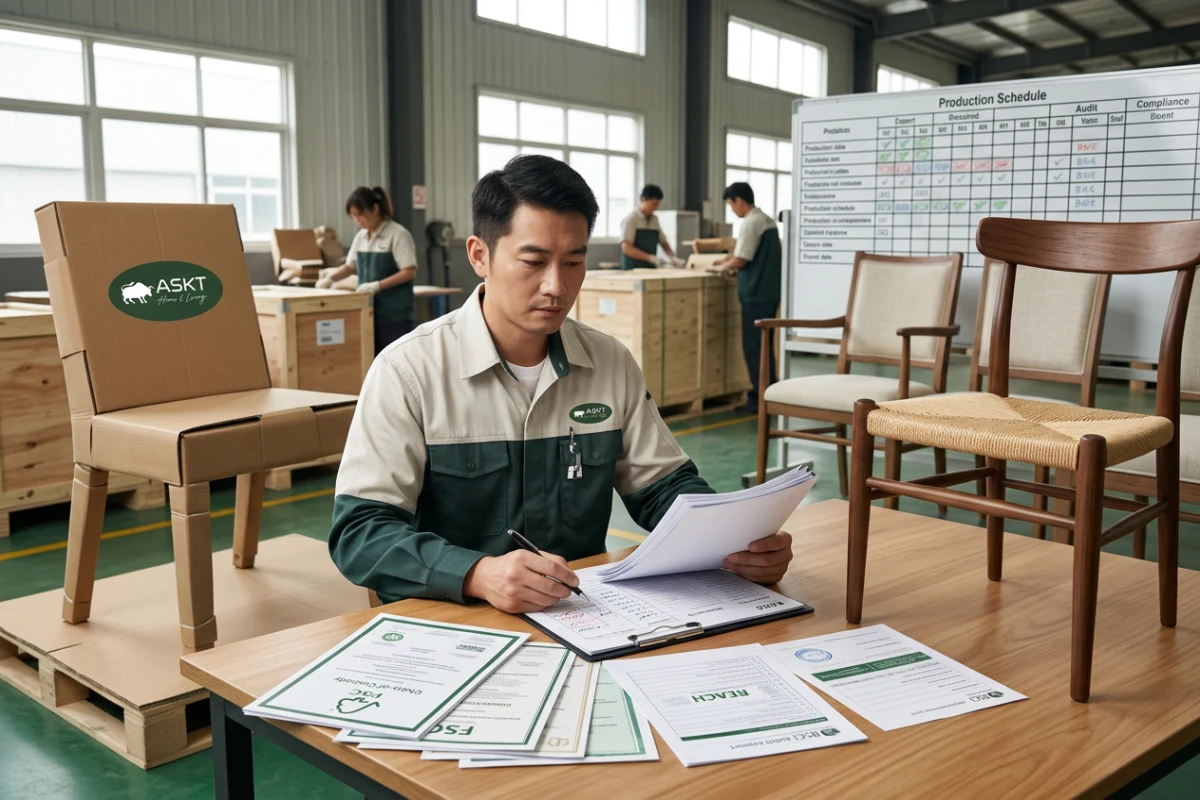
To avoid customs hold-ups, retail audit rejections, or commercial disputes, European purchasing teams should establish a standardized protocol for collecting and auditing furniture compliance documentation China before confirming production orders or releasing final balance payments.
| Compliance Pillar | Required Document / Evidence | Verification Criteria for Sourcing Managers |
|---|---|---|
| Factory Social Audit | amfori BSCI Audit Summary Report | Valid audit validity window, verified DBID number, satisfactory audit grade |
| Chemical Material Safety | REACH SVHC Screening / OEKO-TEX® Certificate | Issued by an accredited laboratory within the past 12 months for the specific fabric/foam |
| Timber Chain of Custody | FSC Chain of Custody (CoC) Certificate & Invoice | Active status on info.fsc.org; correct FSC claim notation on commercial shipping documents |
| Structural Safety & Strength | EN 12520 / EN 16139 Test Reports | Full pass on static load, seat fatigue, back durability, and stability testing |
| Material Safety Data Sheets | MSDS for Adhesives, Paints, and Powder Coatings | Verifies non-toxic chemical formulations and absence of restricted solvents |
When reviewing compliance packages, procurement teams should confirm that testing certificates match the exact product specifications, materials, and model numbers listed on the commercial purchase contract. Establishing this documentation dossier early in the development cycle ensures smooth customs clearance across European container ports.
Avoiding Common Pitfalls in Overseas Compliance Verification
Verifying overseas supplier documentation requires diligence. Sourcing specialists frequently encounter documentation irregularities that can lead to non-compliance if not identified during the factory vetting stage:
1. Conflating Factory Audits with Product-Level Certifications
A common misconception is assuming that a factory-level audit covers individual product compliance. A BSCI audit evaluates the factory's operational environment, human resources, and safety systems; it does not test whether a chair's upholstery fabric meets REACH limits or whether its frame passes European mechanical strength standards. Conversely, a REACH chemical test on a fabric sample does not verify factory social compliance. Professional buyers must maintain separate verification tracks for factory audits, chemical testing, and structural safety.
2. Expired or Borrowed Laboratory Test Reports
Material formulations, fabric mills, and foam suppliers often evolve over time. Test reports older than twelve to twenty-four months may no longer represent current production batches. Furthermore, some trading entities submit laboratory reports issued to third-party sub-suppliers without establishing an unbroken contractual link to the actual finished product. Buyers should insist on test reports issued directly to the manufacturing partner or backed by verifiable supply chain audit trails, cross-checking report authenticity via the testing laboratory's online verification portal.
3. Overlooking Internal Substrates and Fasteners
While external upholstery and outer frame finishes typically receive thorough scrutiny, internal components must not be neglected. Internal structural plywood, inner pocket spring casings, non-woven lining fabrics, and internal bonding glues are equally subject to chemical and timber traceability regulations. A robust compliance protocol examines the full bill of materials (BOM), ensuring that every concealed substrate meets relevant European standards.
Structural Durability, Engineering, and Mechanical Testing
In addition to social, chemical, and forestry standards, dining chairs must satisfy rigorous European mechanical performance requirements. Seating intended for domestic use should meet the requirements of EN 12520, while furniture destined for commercial, hospitality, or contract environments must adhere to EN 16139.
Achieving mechanical durability requires deliberate engineering and precise manufacturing controls across the chair structure:
- Metal Frame Integrity: Precision tube bending, reinforced mounting plates, and continuous weld seams prevent joint failure under repetitive dynamic loads. High-quality metal frames typically feature automated powder coating finishes that resist corrosion and surface scratching.
- Seat Cushion Construction: High-density resilient foam paired with integrated pocket spring units delivers ergonomic support, prevents permanent seat indentation, and maintains shape over extended commercial usage.
- Mechanism Reliability: For modern swivel dining chairs or auto-return designs, internal bearing mechanisms must undergo thousands of rotation cycles to ensure smooth, noise-free operation without loosening.
- Knock-Down (KD) Engineering: Well-engineered KD structures utilize high-tensile steel hardware, reinforced threaded inserts, and clear assembly geometry. This ensures simple assembly for end customers while maintaining structural rigidity equal to fully welded designs.
By uniting structural testing with regulatory compliance, buyers protect their brands against consumer returns, warranty claims, and negative product reviews.
Packaging Optimization, Logistics Efficiency, and Sustainability
Sourcing dining chairs from China requires careful consideration of packaging engineering and transport logistics. Efficient packaging design protects products across long maritime transits while minimizing shipping volume and environmental impact.
European retailers and e-commerce brands increasingly demand sustainable packaging solutions that reduce single-use plastics and comply with national packaging waste regulations. Compliant manufacturers implement several packaging optimizations:
- Reduced Plastic Packaging: Replacing traditional expanded polystyrene (EPS) foam blocks with recyclable honeycomb cardboard edge protectors, corrugated corner guards, and biodegradable protective sleeves.
- Knock-Down (KD) Packaging Efficiency: Designing dining chair frames and seat shells to nest securely within compact master cartons, significantly increasing container loading quantities (cbm efficiency) and lowering freight costs per unit.
- Drop-Test Validation: Conducting standard transit testing (such as ISTA 1A or 3A protocols) to verify that packaging protects delicate upholstery seams, powder-coated legs, and veneer surfaces against vibration, compression, and handling shocks during parcel delivery.
Optimized packaging reduces freight expenditures, lowers carton damage rates, and supports corporate sustainability targets for European importers.
ASKT: Your Transparent Manufacturing Partner for Compliant Dining Furniture
With over 20 years of furniture manufacturing experience, ASKT specializes in the design, engineering, and export of contemporary dining chairs, dining tables, bar chairs, and contract seating for the European market. Serving wholesalers, retail chains, purchasing groups, e-commerce brands, and contract buyers across Germany, the Netherlands, the UK, Poland, Switzerland, Ireland, and beyond, ASKT operates as an integrated supply chain partner dedicated to quality control and production transparency.
ASKT combines contemporary European design aesthetics with efficient, scalable manufacturing processes:
- Robust Production Capabilities: Operating specialized workshops equipped with precision fabric cutting equipment, CNC metal processing, robotic welding stations, and automated upholstery assembly lines.
- Material Performance and Chemical Safety: Offering an extensive portfolio of high-performance fabrics, easy-clean textiles, pet-friendly materials, and OEKO-TEX® certified upholstery options that satisfy REACH chemical safety parameters.
- Structural Excellence: Engineering durable dining chairs featuring pocket spring cushioning, robust metal frames, smooth swivel and auto-return mechanisms, and reinforced KD structures tested to European durability standards.
- Sustainable Sourcing and Packaging: Supporting timber traceability protocols and delivering optimized, plastic-reduced packaging designs that maximize container loading density and reduce shipping footprints.
- OEM and ODM Customization: Providing flexible customization across frame finishes, upholstery fabrics, colours, dimensions, private labeling, and custom packaging to meet precise brand requirements.
By maintaining rigorous internal quality control protocols and open documentation practices, ASKT helps B2B buyers navigate international compliance smoothly and build profitable, long-term furniture programs.
Conclusion: Building a Low-Risk, Sustainable Sourcing Strategy
Successfully importing dining chairs into European markets requires a sourcing strategy that balances aesthetic design, commercial ergonomics, mechanical durability, and strict regulatory compliance. By partnering with a qualified manufacturer capable of delivering authenticated BSCI social audit reports, REACH chemical compliance documentation, and FSC timber traceability, procurement managers eliminate operational vulnerabilities and protect their business reputation.
Whether you are expanding an existing dining furniture collection or developing an exclusive OEM/ODM product line, working with an experienced, transparent manufacturer ensures your products arrive on schedule, on budget, and fully compliant with European standards. Ask for the compliance documentation relevant to your products to explore our manufacturing capabilities, discuss custom specifications, or review active testing reports for our dining seating collections.