Which Chinese Chair Manufacturers Offer Flexible MOQ for European Buyers?
For European buyers seeking Chinese chair manufacturers flexible MOQ, professional partners utilize modular structural design, such as the KINEXA modular furniture system. This engineering approach decouples seat shells from interchangeable metal and wooden bases. It allows importers to mix and match styles within a single container, reducing inventory risks while maintaining production efficiency and cost-effectiveness.
Why do traditional Chinese chair manufacturers demand high MOQs from European buyers?
To understand why many traditional Chinese chair manufacturers demand high Minimum Order Quantities (MOQs), you must look at the economics of the factory floor. Traditional furniture manufacturing relies heavily on batch production. Setting up a production line—whether it involves adjusting automated tube-bending machines, configuring powder coating lines, or recalibrating batch cutting machinery for fabrics—requires significant downtime. For a factory, a machine that is not running is a machine that is losing money. High MOQs of 200 to 500 pieces per colour or SKU allow factories to amortize these setup costs over a larger volume.
Furthermore, the raw material supply chain in China imposes its own constraints. Fabric mills typically demand minimum runs per custom colour weave. Frame component suppliers, steel tube extruders, and foam molders operate under similar volume requirements. When a European buyer asks for a small batch, the manufacturer faces a dilemma: either pay a premium for small-batch raw materials, which destroys the price advantage, or hold excess inventory in their own warehouses. Consequently, most traditional factories choose the simpler route of enforcing high MOQs.
For European wholesalers, e-commerce brands, and category managers, these rigid thresholds create substantial business hurdles. Sourcing a new contemporary indoor collection under these terms requires tying up capital in massive inventories, increasing warehousing costs in high-rent European logistics hubs, and facing the high market risk of unsold stock if a design does not perform as expected. This makes finding furniture manufacturers China low MOQ options a high priority for modern buying groups.
How does the KINEXA modular furniture system redefine flexible MOQs in Chinese factories?
To bridge the gap between European demand for lower inventory risk and Chinese manufacturing efficiency, progressive B2B supply chain partners have turned to modular engineering. The most prominent example of this approach is the KINEXA modular furniture system. This system decouples the production of the seat shell from the production of the base, fundamentally changing how MOQs are calculated.
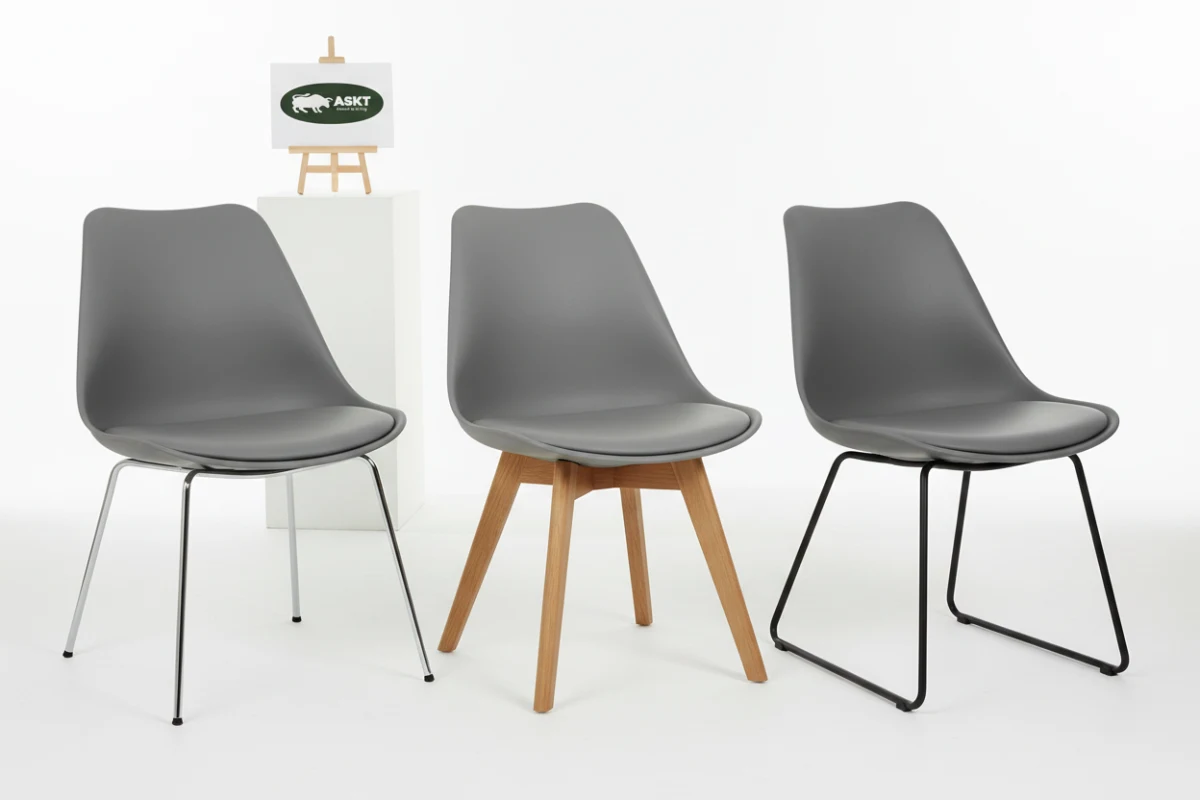
Under a modular framework, a manufacturer mass-produces a select range of highly-engineered, standardized seat shells. These shells are built using advanced internal structures, such as ergonomic plywood frames or steel reinforcements with integrated pocket spring seating systems. Because the internal dimensions and fastening points of these shells are identical, they can be paired with a wide array of interchangeable bases, including:
- Auto-return swivel mechanisms for premium dining room use.
- Classic four-legged tapered steel tube frames.
- Elegant solid oak veneer legs for Scandinavian-style interiors.
- Sleek metal sled bases for contemporary design appeal.
This structural standardization allows a dining chair supplier Europe flexible MOQ options that were previously impossible. Instead of requiring hundreds of units of a single finished chair configuration, a manufacturer utilizing modular engineering can produce standardized shells and allow the buyer to distribute those shells across three or four different base designs and fabric finishes in a single container. This strategy effectively reduces the individual SKU MOQ to a manageable level, while still maintaining the batch production efficiencies that keep unit prices competitive.
What manufacturing technologies secure product consistency in flexible manufacturing?
When a factory shifts from mass production to flexible, low-MOQ runs, the risk of human error and product inconsistency typically increases. To mitigate this risk, professional Chinese chair manufacturers have invested heavily in automated and digital manufacturing technologies. These technologies ensure that a chair manufactured in a batch of 50 is identical in dimensions, weld strength, and stitching quality to one produced in a run of 5,000.
Key technological advancements on the factory floor include:
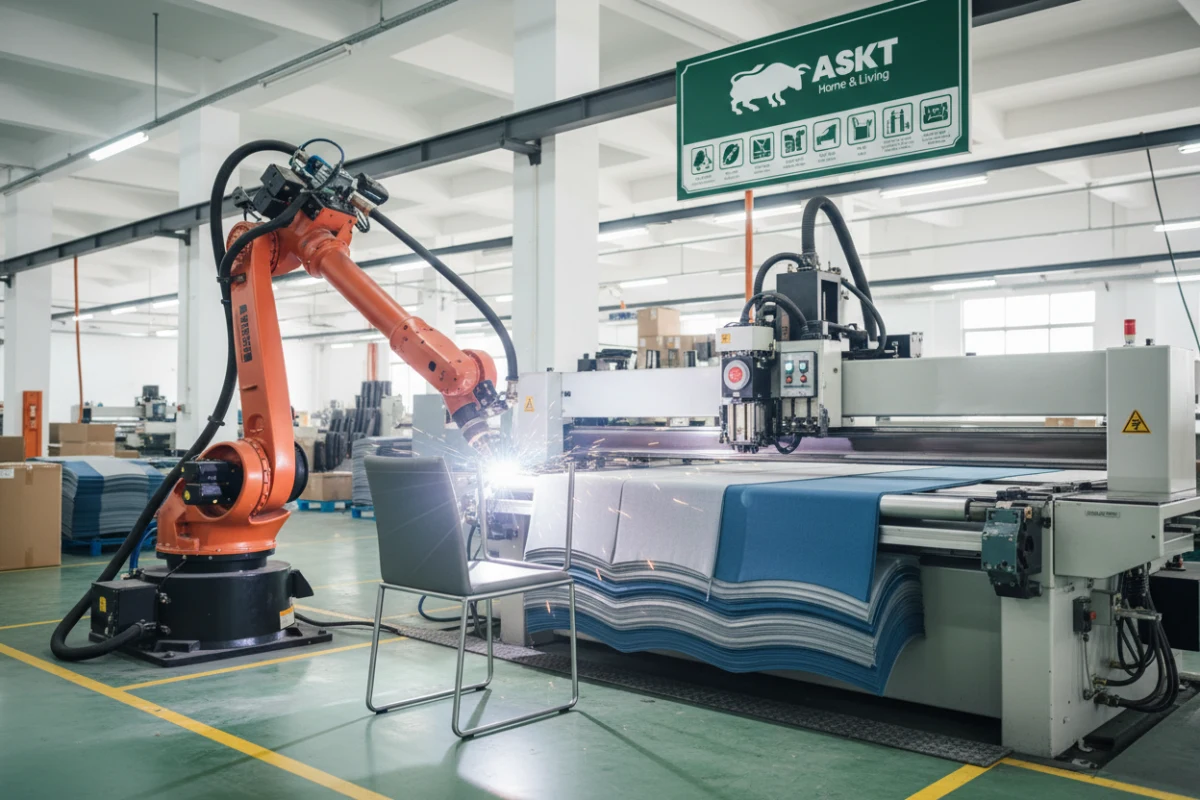
- Automated Welding Robotic Arms: In metal-framed dining chairs, the structural integrity of the frame depends entirely on the quality of the welds. Robotic welding arms execute highly precise, consistent welds under exact thermal parameters, preventing joint failures and micro-cracks.
- CNC Fabric Cutting Systems: These machines cut upholstery fabrics with sub-millimeter precision based on digital CAD files. This eliminates the dimensional variations that occur with manual fabric cutting, ensuring a consistent, tight fit over the foam shell.
- Automated Board Punching: Specialized machinery for batch punching wooden boards and installing structural nuts ensures that the connection points between the seat shell and base are perfectly aligned every time.
- Powder Coating Line Consistency: Automated electrostatic powder coating lines ensure an even coating thickness on metal frames, protecting them from corrosion, scratching, and colour degradation over long-term use.
Crucially, these automated setups can store digital profiles for hundreds of different designs. When a factory transitions from one small-batch order to another, the operator simply loads the new digital profile into the robotic welder or CNC cutter. This digital setup dramatically reduces the downtime associated with physical tool changes, making the production of wholesale dining chairs China custom MOQ orders economically viable and qualitatively flawless.
Furthermore, these operations must be conducted under ethical working conditions. High-performing B2B manufacturers maintain full BSCI (Business Social Compliance Initiative) social compliance certifications. This ensures that workers are provided with appropriate safety gear and that all materials, such as glues used in the upholstery process, are eco-friendly and safe.
How do material performance and compliance impact European sourcing?
For professional European category managers and procurement directors, flexible MOQs are meaningless if the products do not meet strict European regulatory and qualitative standards. Sourcing dining furniture requires careful compliance with chemical safety, structural strength, and ethical manufacturing codes.
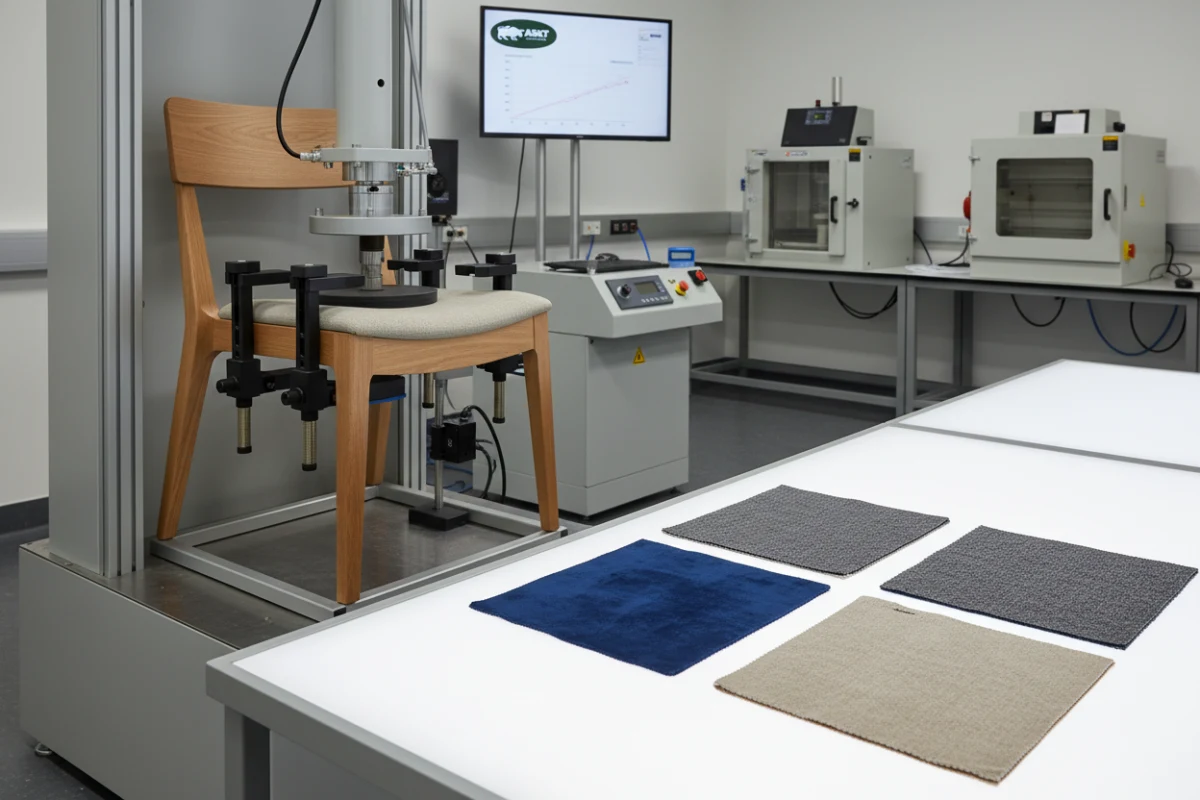
First, consider fabric safety and durability. Contemporary European consumers expect materials that are free from harmful substances. Additionally, the physical durability of the fabric must be verified through standardized testing. Fabrics must undergo rigorous evaluations for abrasion resistance, colour fastness, and breathability. For commercial, hospitality, or high-frequency residential applications, high-performance waterproof, easy-clean, and pet-friendly fabrics are utilized. These textiles achieve a delicate balance between a premium, soft-touch tactile feel and high durability, ensuring that the upholstery remains clean and breathable under high-use conditions.
Second, the physical structure of the chairs must undergo product testing to verify load-bearing capacity and stability. Legitimate B2B partners conduct comprehensive testing to satisfy European market demands for structural integrity, ensuring that metal frames, welds, and wood joins do not fail under pressure. This commitment to quality control minimizes the risk of customer returns and protects the brand reputation of the importer.
How can buyers optimize container loading and calculate total sourcing costs?
Sourcing under a flexible MOQ model requires a detailed understanding of logistics and total land cost calculations. Sourcing managers must look beyond the FOB (Free on Board) price of the chair to evaluate how packaging efficiency and container utilization affect their bottom-line profitability.
Upholstered dining chairs are naturally bulky items. Shipping them pre-assembled is highly inefficient, as you are essentially paying to transport air across the ocean. To combat this, professional manufacturers design their products with optimized KD (Knocked-Down) structures. A clever KD design allows the seat shells and metal bases to nest tightly together inside the master carton, often doubling or tripling the number of units that can fit into a standard 40-foot High Cube (HQ) container.
Additionally, packaging protection must be designed to withstand long ocean transits and rough handling in domestic parcel networks, especially for e-commerce retailers. Leading Chinese chair manufacturers utilize sustainable, plastic-reduced packaging systems. Rather than relying on bulky foam, they use high-density honeycomb paper corner protectors. Honeycomb cardboard offers exceptional shock absorption, is 100% recyclable, and takes up significantly less space inside the carton, allowing for more compact packaging dimensions.
By partnering with a Chinese chair manufacturer that understands these logistical nuances, European wholesalers can easily mix different product categories—such as matching contemporary dining tables, dining benches, and bar chairs—into a single container. This multi-category loading strategy allows the buyer to build complete, coordinated dining collections without committing to excessive volumes of any single SKU.
Traditional vs. Flexible Chinese Furniture Manufacturers
The table below highlights the operational and logistical differences between traditional batch-focused factories and modern flexible manufacturers using modular engineering:
| Sourcing Metric | Traditional Chinese Manufacturers | Flexible Modular Manufacturers (e.g., KINEXA) |
|---|---|---|
| SKU MOQ Requirement | High (typically 200–500 pieces per color) | Low (typically 30–50 pieces per configuration) |
| Component Strategy | Dedicated production for every individual design | Decoupled seat shells and interchangeable bases |
| Upholstery Customization | Limited; requires massive fabric rolls per run | Diverse; pre-approved custom fabrics and colours |
| Logistics Structure | Fully assembled or basic packing with high volume loss | Advanced KD (Knocked-Down) nesting for high container loading |
| Target Buyer Profile | Mass-market importers with massive regional warehouses | Wholesalers, e-commerce brands, contract buyers |
| Product Consistency | Highly dependent on manual labor skill | Controlled by CNC cutting, robotic welding, and digital profiles |
Sourcing contemporary dining furniture from China does not have to mean taking on high inventory risks. For European wholesalers, retailers and project buyers looking for reliable dining furniture supply from China, ASKT can help turn product ideas into commercially stable collections.