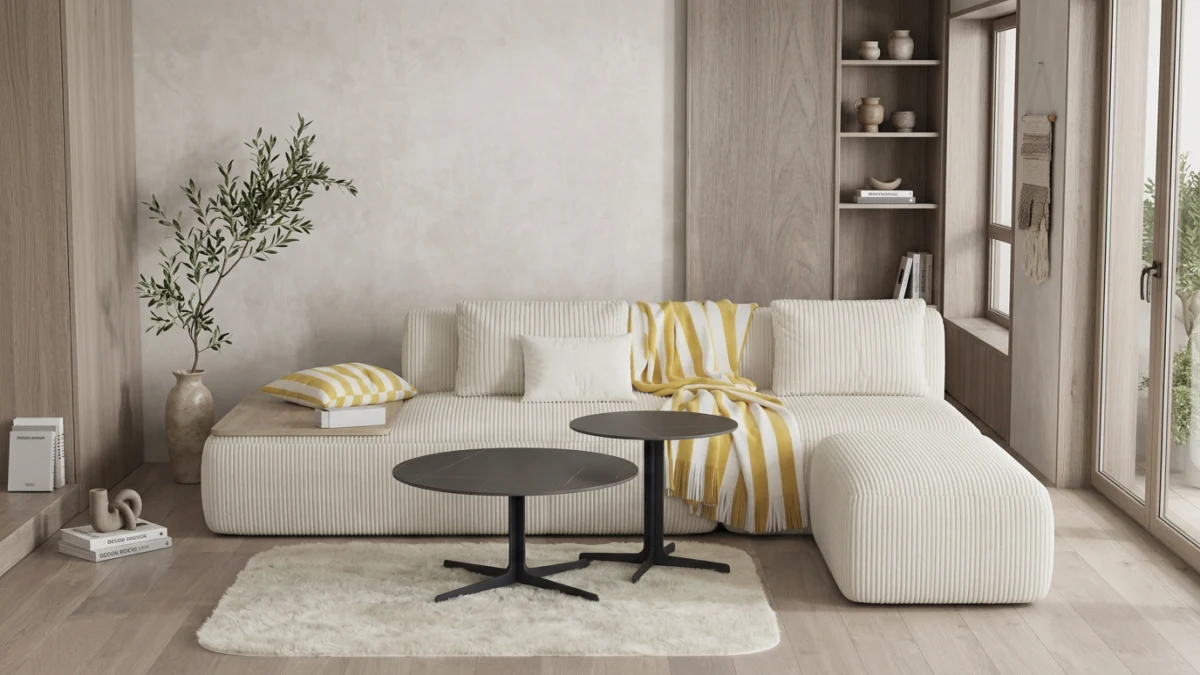
Coffee Table Design Trends 2026: What Hotel Designers Are Specifying
For 2026, hotel interior designers and FF&E specifiers are prioritising organic rounded silhouettes, tactile mixed-material pairings such as sintered stone and metal, and versatile modular nesting configurations built for rigorous commercial hospitality environments. Rather than standalone decorative items, commercial coffee tables are specified as multifunctional anchors engineered for high traffic, structural stability, stain resistance, and straightforward maintenance across guestrooms, open lobbies, and executive lounges.
What Are the Core Coffee Table Design Trends 2026 Across Hotel Public Spaces and Guest Suites?
Commercial hospitality interiors for 2026 demonstrate a distinct shift towards tactile richness, sculptural simplicity, and architectural fluidity. In contemporary hotel design, coffee tables serve as the operational and aesthetic anchor of social lounges, waiting zones, and luxury guest suites. To meet evolving guest behaviours—where public lobbies double as casual co-working hubs, evening cocktail lounges, and informal meeting zones—hotel interior designers are moving away from rigid, single-purpose tables toward dynamic, highly resilient furniture pieces.
The dominant coffee table design trends 2026 reflect three overarching design imperatives: organic geometry, hybrid functionality, and material endurance. Specifiers for European hotel groups are demanding pieces that eliminate sharp corners, encourage flexible seating configurations, and maintain an immaculate surface appearance despite continuous daily use.
To understand the broader direction of commercial hospitality furniture trends 2026, professional buyers and specifiers are tracking specific structural and visual evolutions:
- Sculptural, Biophilic Forms: Soft pill shapes, organic curves, and asymmetric rounded silhouettes replace rigid square and sharp rectangular tables. These fluid geometries enhance pedestrian traffic flow in busy hotel lobbies and reduce physical wear and tear on edges.
- Low-Profile and Nested Proportions: Hospitality seating is trending toward deeper, lower lounge seating. Consequently, coffee tables are specified at lower heights and frequently paired in multi-tier nesting arrangements that can be reconfigured on demand.
- Tactile Material Juxtaposition: Designers are pairing industrial metal frame bases with ultra-durable sintered stone tops, textured oak veneer, or fluted accents to introduce sensory contrast without sacrificing commercial cleanability.
- Integrated Spatial Flexibility: Rather than specifying large, monolithic centrepieces, designers favour modular hotel lounge furniture groupings featuring cluster arrangements, integrated handles, or lightweight satellite side tables that hotel staff can reposition easily for private events.
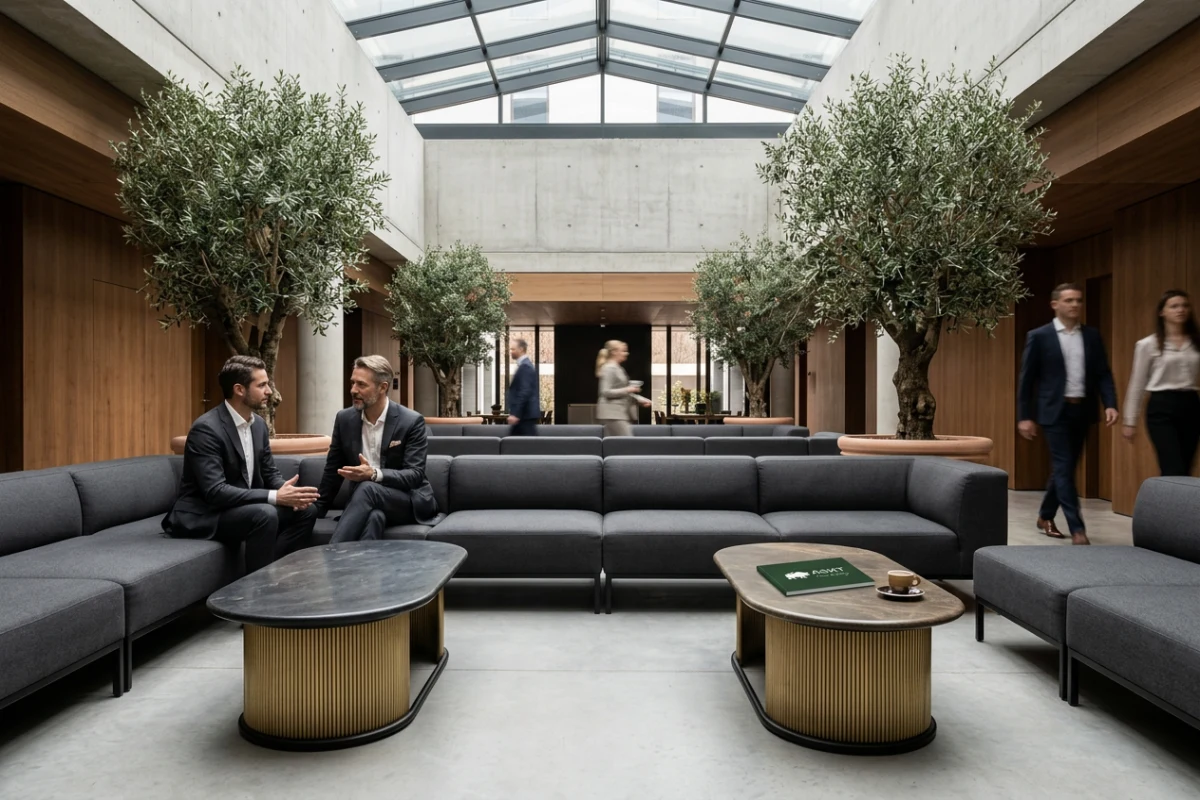
Why Are Hospitality Interior Designers Prioritising Organic Silhouettes and Low-Profile Proportions?
The movement towards soft curves and grounded proportions in hospitality furniture trends 2026 is driven equally by spatial ergonomics and operational necessity. In a busy hotel lobby, lounge, or executive suite, furniture layout directly dictates human movement and guest comfort. High-traffic hospitality zones suffer from constant circulation bottlenecks when furnished with angular, sharp-cornered tables.
From an interior design standpoint, organic rounded silhouettes create a natural visual ease, softening expansive architectural spaces constructed from concrete, glass, and steel. When guests enter an open-plan atrium or an expansive hotel lobby, curved furniture groupings visually demarcate intimate conversation zones without requiring physical partitions.
From an FF&E operational perspective, curved and low-profile coffee tables offer measurable advantages:
- Enhanced Flow and Guest Safety: Eliminating sharp 90-degree corners significantly reduces corner-impact incidents for guests moving through dimly lit lounges or navigating tight spaces with luggage.
- Reduced Edge Damage: Sharp furniture edges in high-frequency commercial environments are prone to chipping, veneer peeling, and denting from vacuum cleaners, luggage carts, and guest bags. Rounded table perimeters deflect glancing impacts much more effectively.
- Sightline Optimisation: Low-profile tables preserve clear architectural sightlines across expansive lobby landscapes, allowing natural light to penetrate deeper into the interior while maintaining an unobstructed view of key hotel focal points like reception desks and bars.
- Harmonisation with Modern Low Seating: Contemporary contract lounge chairs and modular modular seating systems feature lowered seat pan heights. Standard residential table heights feel disproportionate and ergonomically awkward beside contemporary low-slung lounge furniture.
| Design Feature | Traditional Contract Coffee Tables | 2026 Hospitality Specified Trends |
|---|---|---|
| Primary Geometry | Rigid rectangular and square shapes | Asymmetric organic, pill, and softened oval forms |
| Standard Height | Taller, standard residential height profiles | Low-profile and stepped heights for nesting |
| Traffic Impact | Higher risk of edge chipping and guest bumps | Fluid pedestrian circulation and impact deflection |
| Spatial Adaptability | Static placement, singular central focal point | Dynamic clustering, nesting, and modular multi-point use |
| Base Architecture | Heavy four-leg timber or box-section metal | Open-frame powder-coated steel, plinths, cantilevered forms |
How Do Contract Coffee Tables Sintered Stone and Mixed Materials Perform in High-Traffic Hospitality Environments?
Material specification in hospitality projects is where aesthetic vision meets commercial longevity. Hotel owners and asset managers operate on multi-year refurbishment cycles, meaning any specified coffee table must endure thousands of hot beverage cups, spilled acidic drinks, caustic commercial sanitising sprays, and accidental impacts without deteriorating. For this reason, contract coffee tables sintered stone surfaces have emerged as the industry benchmark for hotel public spaces and contract dining furniture.
Sintered stone provides an engineered solution that replicates the luxurious veining of natural marble—such as Calacatta, Sahara Noir, or travertine—while eliminating natural stone's inherent vulnerabilities. Natural marble is porous, highly susceptible to acidic etching from wine, lemon juice, or coffee, and vulnerable to deep scratching. Sintered stone, formed through extreme temperature and pressure manufacturing processes, delivers non-porous performance, superior scratch resistance, and total heat immunity.
In addition to sintered stone, 2026 hospitality specifications frequently combine tactile oak veneer elements with precision-engineered metal frames. Sourcing teams and contract buyers must evaluate each material's technical performance profile:
- Sintered Stone Slab Performance: Specifying robust sintered stone slabs ensures optimum impact resistance while controlling overall product weight. The surface is non-porous, easy to clean, and completely resistant to standard commercial cleaning chemicals.
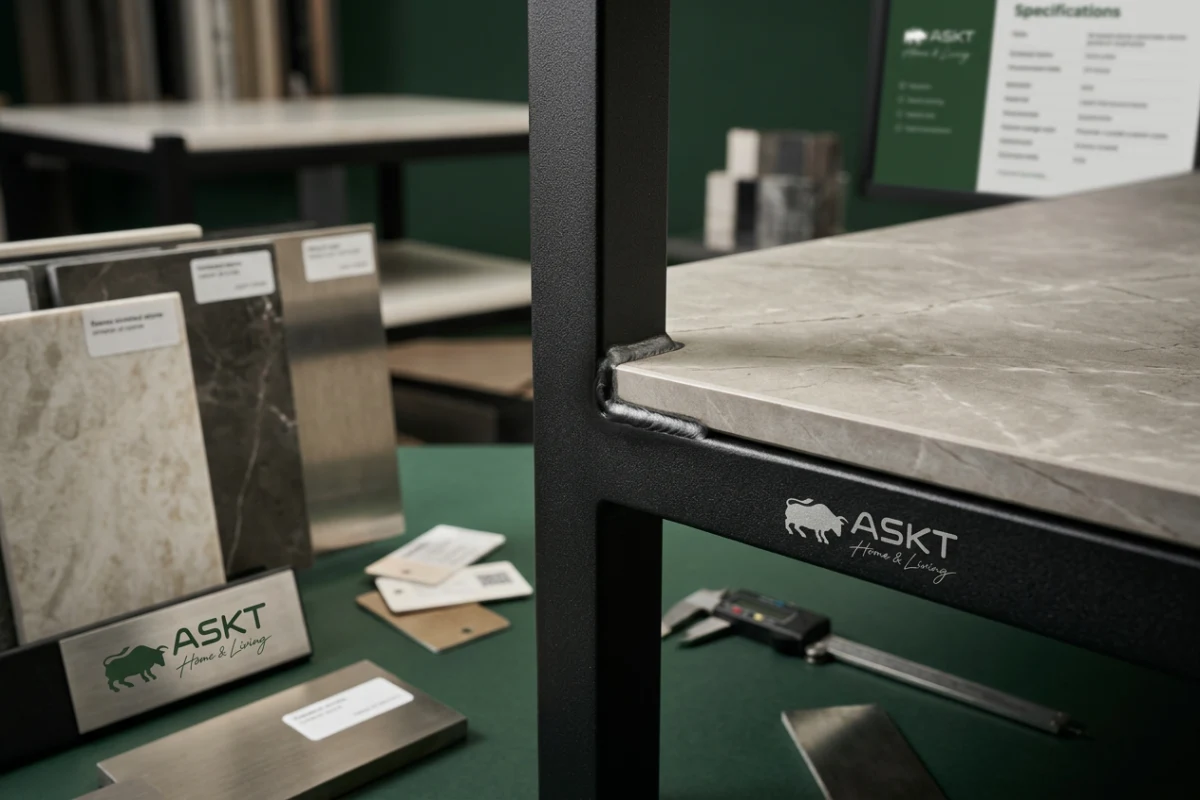
- Precision Metal Frames and Powder Coating: Contract coffee table bases require robust metal framing treated with high-durability electrostatic powder coating. This prevents oxidation, chipping, and rust, even in coastal hotel properties or areas subjected to frequent wet mopping.
- Commercial Oak Veneer Substrates: When natural warmth is required, designers specify high-grade oak veneer bonded to high-density moisture-resistant cores, sealed with commercial lacquers that provide moisture barriers against liquid penetration.
How Does Modular Hotel Lounge Furniture Shape Multi-Zone Lobby and Lounge Layouts?
The traditional concept of a hotel lobby as a static waiting area has become obsolete. Modern hotel properties operate 24/7 multifunctional spaces that shift seamlessly from morning breakfast and remote laptop working to afternoon meetings, evening dining, and late-night cocktail service. To accommodate these evolving usage patterns, specifiers demand modular hotel lounge furniture and coffee table groupings that support rapid spatial transformation.
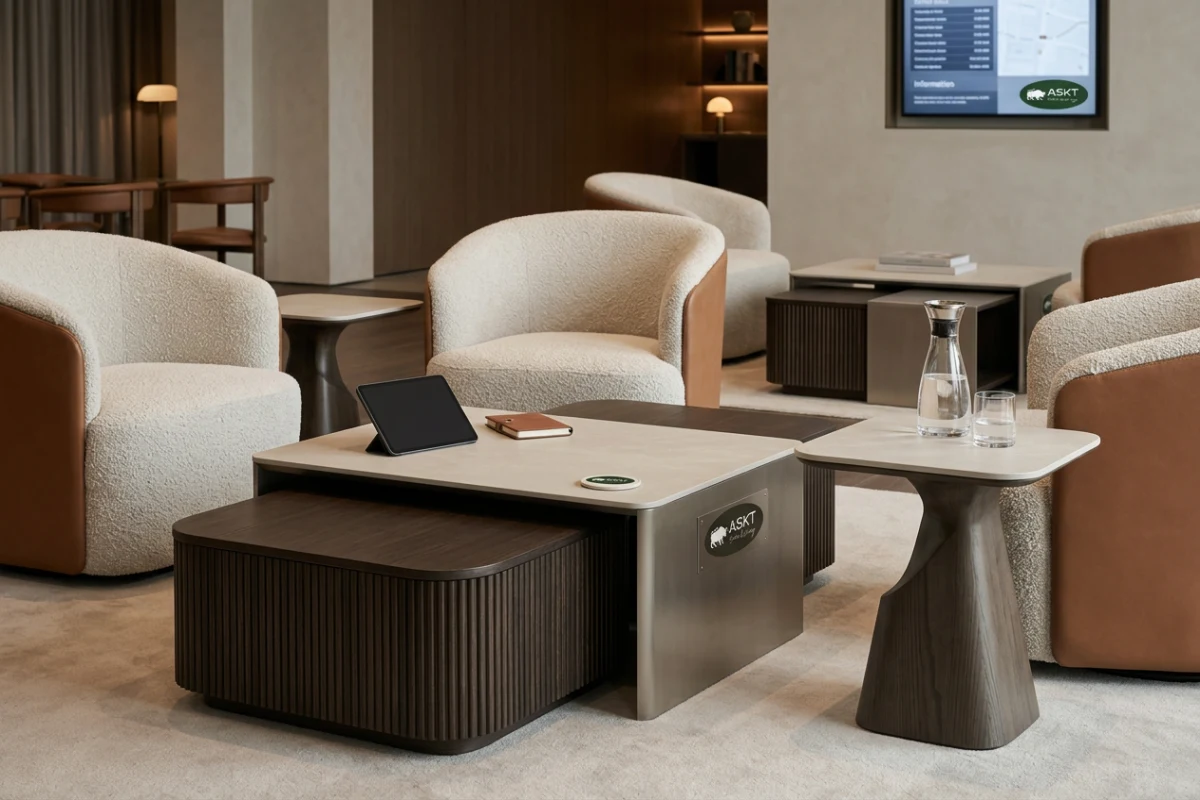
Modular coffee table systems rely on tiered nesting configurations, paired satellites, and multi-height assemblies. Rather than placing a single rectangular table in front of a sofa, designers specify a cluster of two or three complementary tables with differing diameters, heights, and material finishes.
This modular approach provides four key operational benefits for hotel management and interior designers:
- Dynamic Function Partitioning: A nesting set consisting of a low, wide sintered stone centre table paired with a taller, compact oak veneer satellite table allows one guest to place drinks on the main surface while another uses the elevated satellite table for a laptop or tablet.
- Flexible Event Management: Hotel staff can quickly disaggregate nested clusters into individual side tables distributed around lounge chairs during high-capacity cocktail events, and reassemble them into unified centerpieces for regular daytime operations.
- Visual Layering and Depth: Mixing textures within a single modular cluster—such as pairing a dark sintered stone top with a warm natural oak veneer secondary table on matte black metal frames—creates architectural richness that elevates the property's design standing.
- Optimised Logistics and SKU Management: Standardised modular bases and interchangeable tabletops allow purchasing managers to standardise hardware components across multiple property zones while varying finishes to match specific guestroom or lobby colour schemes.
What Exact Hotel Coffee Table Specifications Ensure Long-Term Durability and Structural Stability?
Specifying contract furniture requires rigorous technical standards that far exceed domestic furniture requirements. A coffee table specified for an upscale hotel lobby must withstand continuous load shifts, repeated dragging across carpeted or hard floors, and aggressive daily cleaning protocols. When European purchasing groups, contract furniture buyers, and project specifiers compile hotel coffee table specifications, they focus on specific structural thresholds, testing parameters, and engineering details.
Structural Frame Integrity and Fastening Engineering
In commercial spaces, tables are frequently pulled or pushed by guests and housekeeping staff by their tabletops rather than lifted. If the connection between the base and tabletop relies solely on adhesive or basic wood screws, premature failure occurs quickly.
- Direct Mechanical Fastening: Contract specifications require threaded metal-to-metal inserts embedded directly into reinforced sub-tops, securing the frame via high-tensile machine bolts to prevent loosening caused by micro-vibrations.
- Precision Metal Welding: For steel frames, automated welding ensures clean, full-penetration weld seams without brittle spots or visible weld splatter that could compromise powder coat adhesion.
- Knock-Down (KD) Structural Rigidity: When KD (knock-down) structures are specified for logistics efficiency, the interlocking metal joints must feature heavy-gauge internal reinforcement plates to prevent lateral sway or frame deformation under off-centre loading.
Stability, Load Bearing, and Compliance Testing
European contract standards require comprehensive product testing to verify safety and longevity before installation:
- Overturning and Stability Thresholds: Under standard EN testing frameworks for non-domestic furniture, contract tables must undergo vertical and horizontal edge load testing. A downward vertical force applied at the perimeter must not tip the table, ensuring guest safety when someone leans heavily on the edge.
- Load-Bearing Capacity: Contract coffee tables should maintain certified static load capacities across the central span and along cantilevered perimeters to prevent sagging or joint fatigue.
- Sub-Surface Glides: Heavy-duty, non-marking, height-adjustable levelling glides made from durable polymers are essential. These glides protect flooring, eliminate table wobble on uneven tiles, and resist detachment when the table is slid across carpets.
| Specification Component | Residential Standard (Avoid for Hotels) | Commercial Contract Specification (2026 Target) |
|---|---|---|
| Tabletop Material | Standard lacquered board or unsealed porous stone | Sintered stone / Commercial sealed Oak Veneer |
| Stain & Acid Resistance | Low (absorbs oils, stains from coffee/wine) | Zero absorption, chemical and stain resistant |
| Frame Construction | Lightweight thin hollow tube | Heavy-gauge steel with reinforced wall thickness |
| Welding & Joining | Manual spot welds, direct wood screws | Full seam welding, internal reinforcement plates, machine bolts |
| Base Finish | Basic spray paint or light decorative plating | High-grade electrostatic powder coating (abrasion resistant) |
| Floor Protection | Stick-on felt pads (easily dislodged) | Integrated threaded non-marking adjustable glides |
How Can European FF&E Specifiers and Purchasing Groups Mitigate Cross-Border Sourcing Risks?
Sourcing contract furniture collections for multi-room hotel developments or chain refurbishments involves complex supply chain dynamics. For European furniture importers, product managers, and project procurement teams operating across Germany, the Netherlands, the UK, and the wider European region, the primary sourcing risks are product inconsistency across large production batches, freight damage, shipment delays, and packaging non-compliance.
To successfully execute large-scale OEM and ODM contract projects, purchasing teams must structure their supplier evaluation and procurement workflow around transparent quality control, modular manufacturing logic, and logistics optimisation.
1. Prototype Development and Sample Verification Protocol
Never commit to volume production based solely on digital renderings. Reliable contract suppliers build functional prototypes to evaluate structural rigidity, weld finishes, glide fitment, and sintered stone edge profiles. Rigorous sample development allows product managers to verify tactile finishes under project-specific lighting and perform physical drop and load testing prior to factory sign-off.
2. Standardisation and Modular Logic
High Minimum Order Quantities (MOQs) and complex SKU management create significant inventory risk for European buyers. By implementing modular manufacturing systems—such as standardising universal metal frame bases that accommodate interchangeable sintered stone or oak veneer tops in varying sizes—buyers can achieve container optimisation, combine orders across multiple projects, and reduce production lead times without sacrificing design variety.
3. Packaging Engineering and Sustainable Protection
Transit damage represents one of the largest hidden costs in contract furniture procurement. High-density sintered stone tops and precision powder-coated frames require engineered protection:
- Paper-Based Protection and Heavy-Duty Edge Guards: Replacing single-use plastics with high-strength recyclable honeycomb paper boards, reinforced corner protectors, and heavy-duty corrugated outer cartons ensures that heavy stone tops survive container transit, intermodal freight, and site handling.
- Drop Testing Protocols: Finished packaged goods should pass standardised drop tests (simulating drops from multiple orientations) before container loading to ensure carton integrity.
- Container Space Maximisation: Utilizing precision-engineered KD structures enables flat-packing, dramatically increasing container loading capacity, lowering per-unit freight costs, and directly reducing the carbon footprint per delivered table.
4. Direct Factory Quality Control Transparency
Professional contract procurement requires verified manufacturing workflows. Sourcing directors should look for manufacturing partners equipped with high-precision batch processing machinery, automated welding, and certified social compliance. Direct factory oversight guarantees batch-to-batch colour fastness, consistent powder coating thickness, and flawless edge beveling across large production runs.
When evaluating contract coffee table suppliers for upcoming hospitality fit-outs, align your supply chain with partners who combine European aesthetic sensibilities with robust, transparent manufacturing capabilities. If you are developing custom furniture specifications or planning your next hospitality project rollout, explore how the latest 2026 Hotel Furniture Trends can be tailored to meet your property's exact architectural and commercial performance requirements.