Commercial Coffee Table Safety Standards: Rounded Edges, Stability, Glass Thickness, and Guestroom Risk Reduction
Commercial coffee table safety standards in the hospitality sector require strict engineering controls, including impact-absorbing rounded edges, verified anti-tipping base stability, certified toughened glass thickness, and heavy-duty structural joints. Adhering to commercial furniture compliance mitigates guest injury liabilities, minimises luggage impact damage, and prevents premature FF&E replacement across high-traffic hotel rooms and public guest lounges.
Why Are Commercial Coffee Table Safety Standards Critical for Hospitality Projects?
Commercial hospitality environments subject furniture to frequency and variety of stress far beyond standard residential use. In a hotel guestroom, a coffee table functions simultaneously as an occasional workstation, footrest, temporary luggage stand, and room-service dining platform. When FF&E (Furniture, Fixtures, and Equipment) buyers specify tables without verified commercial ratings, properties face immediate operational risks and legal liabilities.
Applying established Commercial Coffee Table Safety Standards ensures that every table entering a hotel room satisfies fundamental performance pillars:
- User Safety and Liability Mitigation: Reducing laceration hazards, severe contusion risks, and catastrophic shattered glass failures in poorly lit guestrooms.
- Structural Longevity: Preventing loose fastenings, leg deflection, or joint collapse caused by guests sitting on low table edges.
- Luggage and Trolley Impact Resistance: Resisting heavy corner strikes from hard-shell suitcases, housekeeping carts, and vacuum cleaners.
- Commercial Surface Durability: Preventing liquid penetration, chemical degradation from industrial sanitising agents, and heat marking from hot beverage service.
In European contract hospitality procurement, selecting commercial-grade furniture is not merely an aesthetic choice—it is a preventative risk management protocol. Contract tables manufactured to non-domestic specifications undergo testing for static load capacity, vertical and horizontal fatigue, and impact resilience. For hotel brands, purchasing managers, and project contractors, comprehensive compliance represents verifiable proof of due diligence against personal injury claims.
| Operational Factor | Domestic Standard Tables | Hospitality Contract Tables |
|---|---|---|
| Intended Daily Use | 2–4 cycles per day | Continuous, multi-user turnover |
| Dynamic Weight Capacity | 20–40 kg uniformly distributed | 75–120+ kg localized edge load |
| Impact Resistance | Light accidental bumps | Heavy luggage and utility trolley strikes |
| Cleaning Resistance | Standard household cleaners | Daily industrial disinfectants and detergents |
| Fastening Engineering | Standard wood screws / light brackets | Threaded metal inserts, welded subframes |
By prioritizing purpose-built contract tables, hotel operators reduce long-term maintenance overheads while safeguarding brand reputation.
How Does Guestroom Table Rounded Edges Safety Prevent Accidents and Operational Damage?
Sharp 90-degree table corners represent one of the highest physical injury hazards in hotel guestrooms. Dim ambient lighting, unfamiliar room layouts, and restricted walkways between beds and lounge seating create frequent accidental impact scenarios for guests of all ages. Specifying tables with guestroom table rounded edges safety engineering effectively neutralizes these hazards at the manufacturing stage.
Corner and edge profiling affects both human biomechanical safety and material structural integrity:
- Impact Force Dissipation: A sharp 90-degree corner concentrates mechanical impact force onto a minuscule surface area, resulting in deep tissue trauma or lacerations upon body contact. In contrast, an engineered radius edge distributes impact kinetic energy across a curved contour, dramatically reducing peak pressure.
- Surface Edge-Chipping Resistance: Rigid vertical corners on veneered MDF, sintered stone, or glass chip easily when struck by wheeled luggage. A rounded profile (radius corner or bullnose bevel) deflects impact angles, keeping the material intact.
- Finish Adhesion Longevity: Powder coatings, lacquers, and edge bandings adhere poorly to razor-sharp 90-degree edges due to surface tension during curing. Chamfered or radius edges provide uniform coating thickness, preventing premature peeling and moisture ingress.
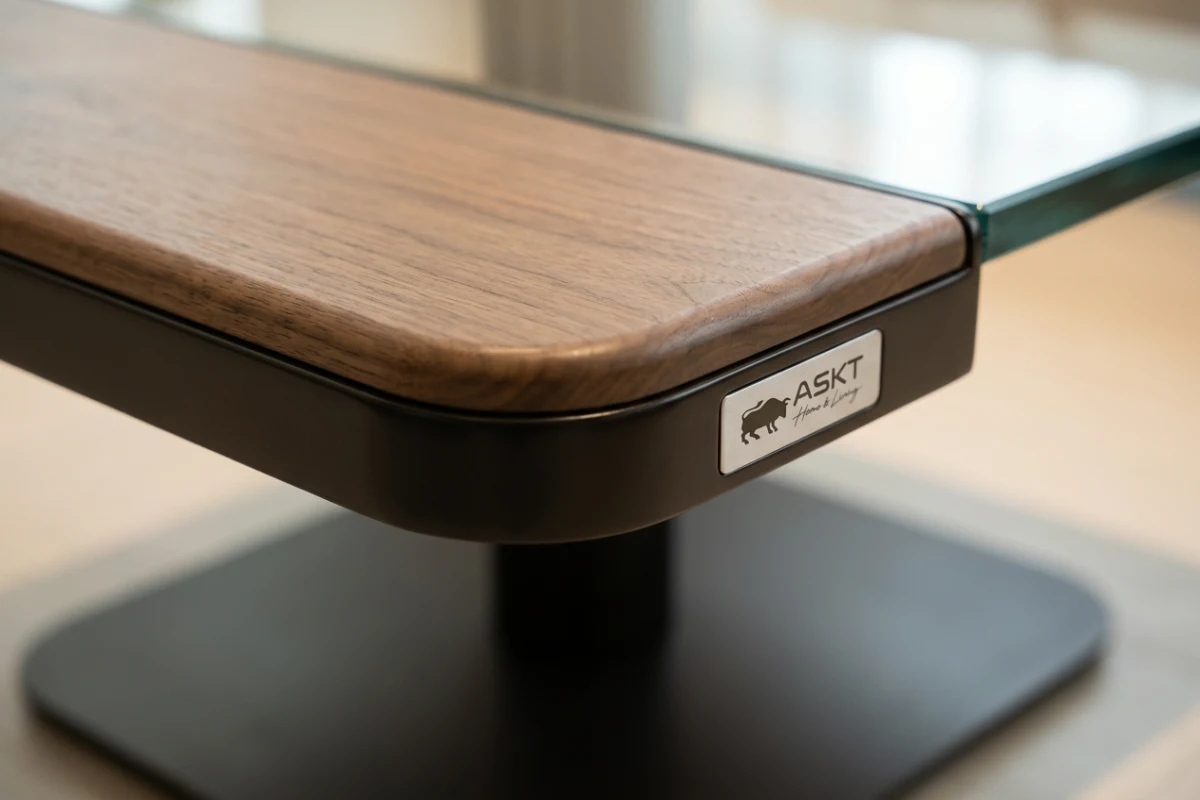
When detailing technical specifications for contract coffee tables, FF&E buyers should require precise edge profiles based on the table's placement:
- Radius Corners (R10 to R50 mm): The external 90-degree intersection of rectangular or square tops is machined into a continuous curve. An R25 mm radius is recommended for compact hotel rooms where clearance corridors are under 800 mm.
- Bullnose / Half-Bullnose Profiling: The vertical edge of the tabletop is fully or partially rounded in cross-section, eliminating sharp top and bottom transitions.
- Chamfered / Bevelled Edges (30° to 45°): A precision angle milled along the edge to soften acute transitions, commonly applied to solid wood and compact laminate tops.
- Organic Circular and Elliptical Geometries: Selecting round, oval, or pebble-shaped coffee tables inherently removes angular corner liability while improving guestroom traffic flow.
What Protocols Define Hotel Coffee Table Stability Testing and Structural Rigidity?
Table instability in a commercial guestroom creates immediate liabilities. A guest leaning heavily on one side of a table to stand up, or a toddler pulling down on the perimeter edge, can tip an unbalanced unit, spilling boiling beverages or causing blunt impact trauma. Rigorous hotel coffee table stability testing confirms that furniture remains grounded under aggressive off-centre vertical and lateral loads.
European safety standards evaluate stability through repeatable mechanical testing methods:
- Vertical Edge Overturning Test: A vertical downward force (typically 200 N to 450 N) is applied to the outermost perimeter of the tabletop to ensure the opposing base legs or pedestal do not lift from the floor plane.
- Horizontal Static Force Test: Lateral force is applied horizontally at the top edge to verify resistance to sliding or tipping under side impact.
- Fatigue and Sustained Loading: Sustained cyclic downward loads simulate years of guests resting heavy luggage or sitting on the table top.
Achieving high stability in contract coffee tables requires precise engineering of the base geometry, weight distribution, and metal frame assembly:
- Footprint-to-Height Ratio: The base stance must cover a sufficient percentage of the tabletop perimeter. For cantilevered or single-pedestal tables, the base plate must feature heavy solid steel ballast rather than hollow stamped metal.
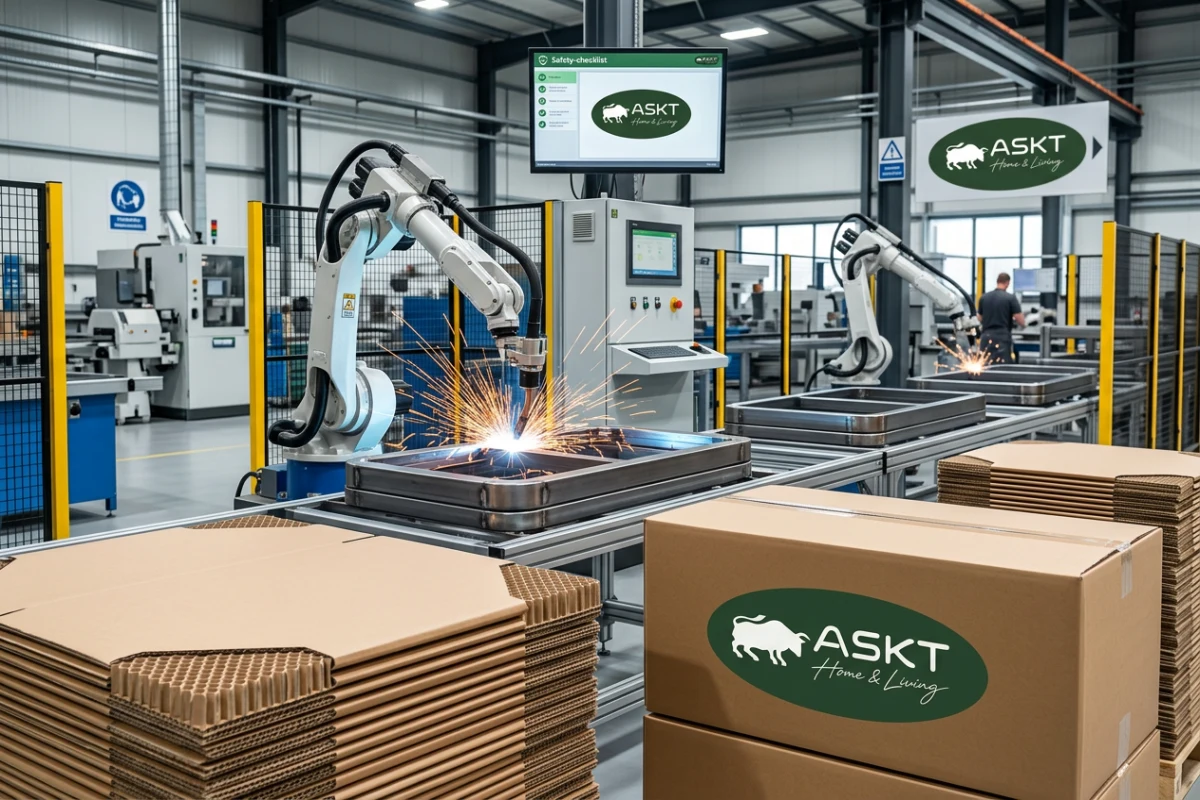
- Robotically Welded Steel Subframes: High-stress hospitality tables utilise seamless robotic arm welding across all leg-to-apron junctions. Unlike manual spot welding, robotic seam welds provide structural consistency and eliminate weld fatigue.
- KD (Knock-Down) Joint Integrity: If tables are shipped KD to optimise freight volume, the connecting hardware must use steel-threaded metric inserts and interlocking brackets rather than wood screws driven directly into composite substrates.
- Floor Levelling Glides: Heavy-duty, non-marking adjustable glides compensate for minor floor unevenness, ensuring zero structural wobble on hard tile, timber, or luxury carpet.
| Coffee Table Base Architecture | Stability Rating | Footprint Efficiency | Best Hospitality Application |
|---|---|---|---|
| Four-Leg Perimeter Frame | Excellent | Standard | Standard double/twin guestrooms, suites |
| Heavy Base Plate Single Pedestal | Good (with steel ballast) | High (maximum legroom) | Lounge seating nooks, armchair companions |
| Interlocking Metal Trestle / X-Base | Superior | Moderate | High-traffic public lobbies, family suites |
| Cantilever / C-Table Structure | Moderate (requires counterweight) | Extreme (slides over sofa) | Bedside/sofa laptop tables (light tasks) |
What Are the Hospitality Coffee Table Glass Thickness and Material Guidelines?
Glass remains a popular tabletop material in hospitality design due to its visual lightness and reflective qualities. However, non-compliant glass poses severe safety and maintenance hazards. Sourcing managers must strictly control hospitality coffee table glass thickness and tempering specifications to prevent catastrophic failure.
Annealed (float) glass must never be specified for hospitality furniture. When float glass fractures, it breaks into large, dagger-like shards capable of causing critical lacerations. Commercial specifications demand Toughened Safety Glass (Tempered) or Laminated Safety Glass.
Key glass engineering rules for hotel procurement include:
- Minimum Thickness for Supported Glass (4-sided frame): 8 mm minimum. Supported glass resting entirely within a continuous steel or timber perimeter channel can withstand standard dynamic guestroom loads at 8 mm.
- Minimum Thickness for Frameless / Top-Mounted Glass: 10 mm to 12 mm minimum. When the glass overhangs or rests only on point fixings (pedestals or corner legs), a 10 mm to 12 mm thickness is mandatory to resist flexural deflection and edge shear.
- Thermal and Impact Toughening: Commercial glass tops must undergo thermal tempering, increasing surface compressive stress to at least 69 MPa. Upon impact failure, tempered glass disintegrates into small, granular, blunt-edged fragments, substantially reducing injury severity.
- Edge Polishing and Processing: All glass perimeters must receive flat-polished, pencil-polished, or bevelled edge processing to eliminate micro-fractures generated during cutting.
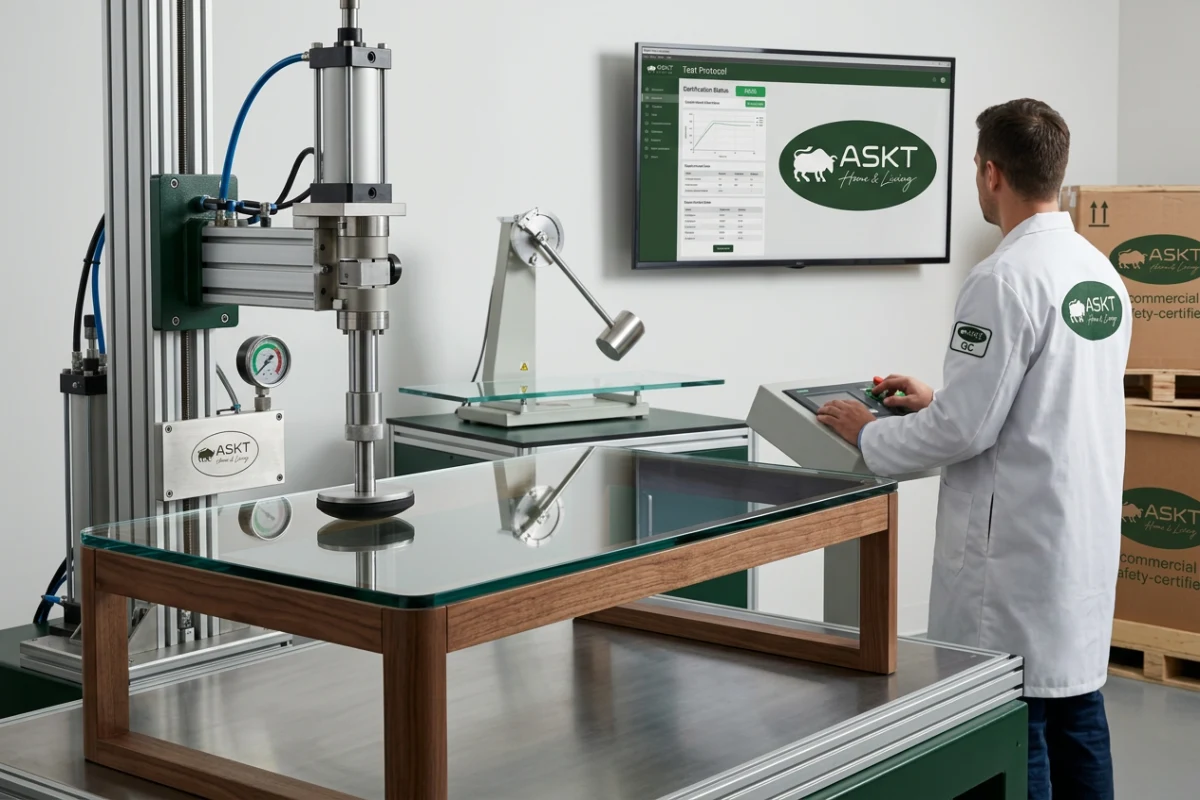
While toughened glass remains a viable specification, European contract projects increasingly evaluate high-performance alternative surfaces, such as sintered stone and engineered oak veneers. Sintered stone, manufactured under extreme pressure and heat, provides the structural rigidity of natural marble without the porosity, brittleness, or staining vulnerabilities.
| Surface Material Specification | Impact Resistance | Thermal Shock Resistance | Scratch Resistance | Maintenance Overhead |
|---|---|---|---|---|
| 10mm Toughened Safety Glass | Moderate (shatters if edge struck) | High | Moderate (susceptible to micro-scratches) | High (shows fingerprints/smudges) |
| 12mm Sintered Stone (Ceramic) | High (resistant to heavy loads) | Superior (withstands hot cookware) | Superior (Mohs scale 6–8) | Minimal (non-porous, stain-proof) |
| High-Pressure Laminate (HPL) | High (flexible core) | Moderate | Moderate (resistant to surface scuffs) | Low (wipes clean easily) |
| Engineered Oak Veneer on MDF | Moderate (dents under heavy blunt force) | Low (requires coasters) | Low to Moderate | Moderate (requires protective lacquer) |
How Can Procurement Teams Execute Hotel FF&E Coffee Table Risk Reduction During Sourcing?
Procurement managers and FF&E specifiers must implement strict quality management workflows to eliminate defective or non-compliant furniture before mass production begins. Achieving consistent hotel FF&E coffee table risk reduction requires moving beyond aesthetic catalog reviews to inspect physical samples, verify manufacturing equipment, and inspect packing integrity.
European project teams should employ a multi-stage sourcing verification protocol:
1. Technical Drawing and Specification Sign-Off
Never approve a purchase order based solely on 3D renderings. Demand comprehensive 2D CAD engineering drawings detailing:
- Exact corner radii (e.g., "Corners R15mm, Edge Chamfer 2mm").
- Wall thickness of steel tube framing (commercial minimum is typically 1.2 mm to 1.5 mm).
- Method of tabletop fastening (e.g., metric machine screws into threaded inserts vs wood screws).
- Glass tempering identification marks permanently etched onto unexposed edge zones.
2. Physical Sample Approval and Destruction Testing
Always commission a pre-production sample for destructive testing before releasing container production. In your factory sample evaluation:
- Apply concentrated lateral and vertical forces to verify zero joint creaking or weld flexing.
- Inspect underside finishes: ensure raw timber cores are sealed against humidity changes.
- Validate powder coating adhesion using cross-hatch tape testing to confirm paint will not flake when hit by luggage.
3. Packaging and Container Loading Verification
Transit damage accounts for significant project delays and hidden structural micro-fractures in contract furniture. Contract coffee tables must be packed using drop-tested, eco-conscious packaging structures that safeguard corners:
- Reinforced honeycomb paper corner protectors that absorb corner drops.
- Reduction of single-use expanded polystyrene (EPS) plastics in favour of recyclable corrugated edge profiles, meeting European Green Policy expectations.
- Strict KD flat-pack optimization to prevent transit shifting, increase container loading density, and lower logistical freight costs per room key.
How Does ASKT Engineer Contract Coffee Tables for European Hospitality Compliance?
At ASKT, we approach contract furniture manufacturing through the lens of structural engineering, European market compliance, and sourcing transparency. With over 20 years of manufacturing and export experience serving Germany, the Netherlands, the UK, Poland, Switzerland, and Ireland, ASKT understands the exact commercial pain points encountered by hotel project buyers, FF&E contractors, and furniture wholesalers.
Our manufacturing infrastructure is purpose-built to eliminate quality variation and ensure compliance across high-volume contract runs:
- Robotic Arm Metal Welding: ASKT utilizes automated welding robotic arms for all metal coffee table frames and dining bases. This guarantees continuous weld penetration, clean joints without burrs, and high structural fatigue resistance across hundreds of guestroom suites.
- Advanced CNC Batch Processing: High-precision automated punching and cutting machinery ensures that every wooden panel, sintered stone slab, and metal leg component matches CAD tolerances within fractions of a millimetre.
- Comprehensive Material Control: Our supply chain integrates certified materials, ranging from OEKO-TEX® Standard 100 functional textiles for upholstered elements to high-grade sintered stone and engineered oak veneers. All adhesives and finishes are non-hazardous, formaldehyde-free, and safe for guestroom indoor air quality.
- Sustainable Honeycomb Protection: ASKT develops custom flat-pack packaging featuring honeycomb paper corner shielding and minimal plastic use, passing strict transit drop tests while aligning with corporate ESG guidelines.
- B2B Purchasing Efficiency: Through modular component systems and transparent quality workflows, ASKT enables buyers to customize table dimensions, powder-coat metal finishes, and top materials with low inventory risk and verified container consolidation.
By uniting European design insight with transparent Chinese manufacturing execution, ASKT delivers commercial coffee tables and dining furniture that satisfy rigorous durability standards, protect project margins, and eliminate guestroom safety hazards.
For project buyers seeking reliable hotel FF&E production, explore how ASKT engineers certified Commercial Coffee Table Safety solutions for high-traffic European hospitality developments.