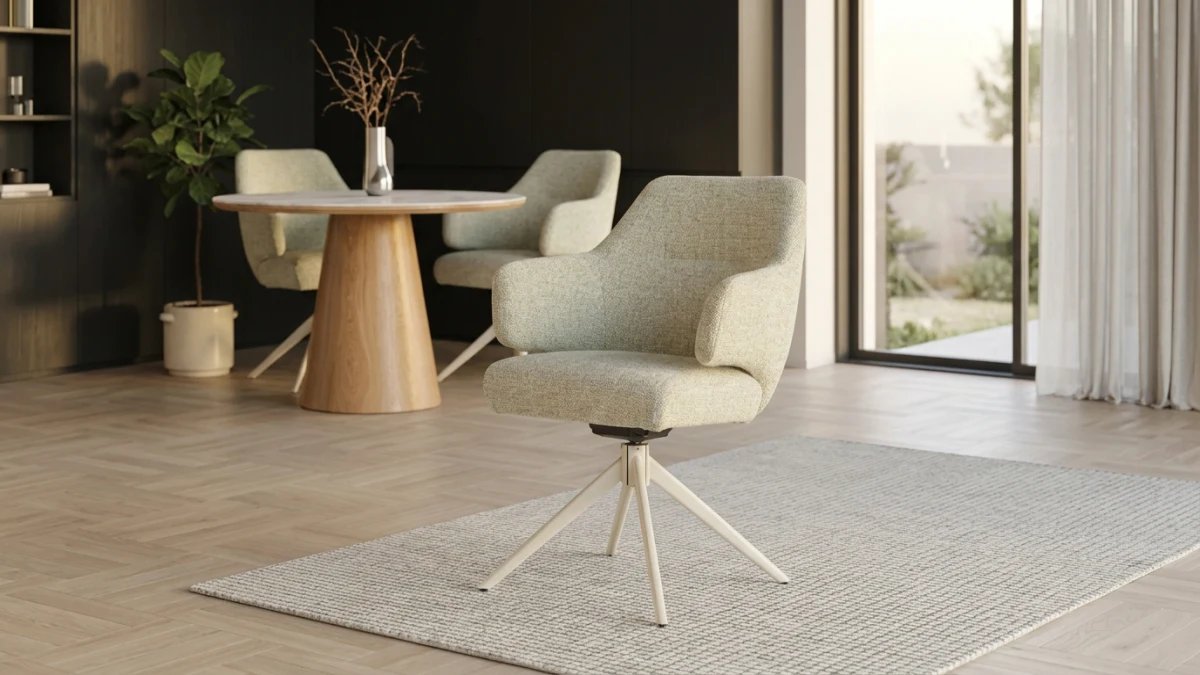
Craftsmanship and Automation in Dining Chair Manufacturing: The Complete B2B Engineering and Sourcing Guide
Modern dining chair manufacturing combines automated fabric cutting, board punching, and robotic welding with skilled manual upholstery and inspection to deliver maximum batch consistency, worker safety, and structural reliability for European B2B buyers. By deploying precision machinery for upstream component preparation and reserving master craftsmanship for ergonomic shaping and surface finishing, manufacturers eliminate dimensional deviations across high-volume production runs while preserving refined tactile detailing and compliance with European furniture durability standards.
Why Is the Balance Between Craftsmanship and Automation Essential in Dining Chair Manufacturing?
For commercial furniture importers, retail chains, and contract project buyers across Germany, the Netherlands, the UK, and the wider European market, dining chairs present a unique manufacturing challenge. A dining chair is simultaneously a structural load-bearing frame, a tactile comfort product, and a visual centerpiece in commercial dining spaces and residential homes. Total reliance on pure manual craftsmanship often results in tolerance variations, batch discrepancies, and prolonged lead times. Conversely, complete automation often strips away the delicate touch required to fit high-grade upholstery around complex curved shells.
Achieving the strategic balance between craftsmanship and automation in furniture production resolves this tension. Automated furniture production delivers micron-level mechanical repeatability in frame geometries, bolt patterns, and fabric nesting. Handcrafting, on the other hand, contributes the sensory discernment needed to calibrate foam densities, manipulate leather tensions, and perform rigorous hand inspections.
| Production Stage | Automated Production Scope | Handcrafted Artisan Scope |
|---|---|---|
| Fabric Preparation | Computerized nesting and multi-ply cutting | Grain inspection and tension calibration |
| Internal Shells | Batch board punching and connector placement | Multi-layer foam wrapping and crowning |
| Frame Fabrication | Robotic arm welding and jigged tube bending | Detail filing and manual weld visual verification |
| Upholstery & Assembly | Standardized base fastening | Complex contour pleating, piping, and corner tucking |
| Quality Assurance | Automated cycle load testing | Sensory seam alignment and KD fitting checks |
When these two disciplines work in unison, European sourcing teams gain lower return rates, predictable container loading volumes, and resilient margins across multi-season programmes.
Which Upstream Stages in Dining Chair Manufacturing Rely on Automated Furniture Production?
Upstream manufacturing forms the structural and dimensional baseline of any dining chair. In a modern factory setting, automating these initial stages is vital to eliminate human fatigue and prevent dimensional drift across thousands of components.
1. Computer-Controlled Fabric and Cover Cutting
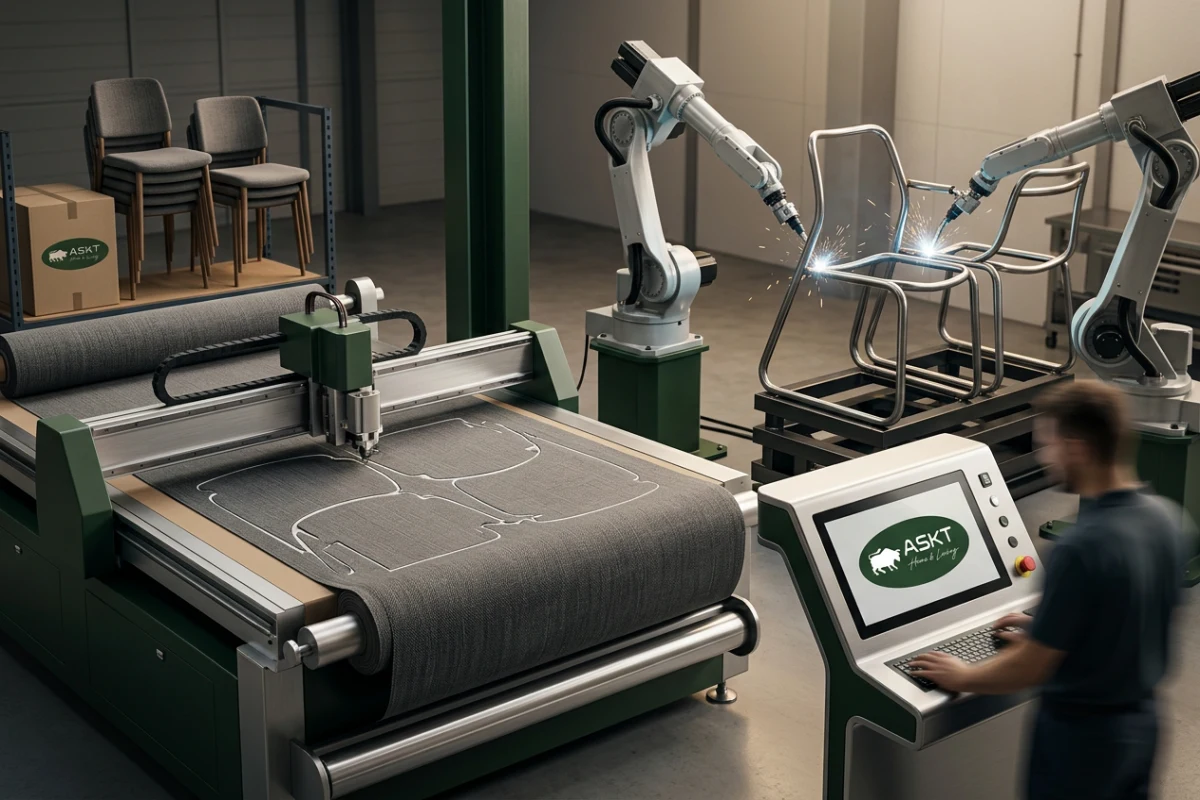
Manual fabric cutting with traditional handheld rotary blades introduces variable margins, jagged edges, and fabric stretching, especially across complex woven textiles, velvet, and recycled polyester blends. Automated fabric cutting systems utilize computerized nesting software to lay out pattern pieces with maximum yield, minimizing raw material waste.
- Precision edge sealing: Automated knife and laser heads cut multiple plies of fabric with uniform tension, preventing fraying.
- Pattern matching accuracy: For structured weaves and textured fabrics, automated optical sensors ensure identical alignment across every single chair shell.
- Yield optimization: Computerized layouts optimize yield per roll, directly lowering scrap rates and stabilizing landed unit costs for OEM and ODM projects.
2. Batch Punching and Wood Component Machining
Wooden shells, curved multi-layer plywood backrests, and internal seat boards require exact mounting points. Automated punching machines are used for batch processing of wooden boards. This automated punching ensures that:
- Every screw hole and connector slot matches the engineering drawings to within fractions of a millimeter.
- Fastener centers align identically with metal subframes and swivel plates across high-volume production runs.
- Structural stress points around bolt apertures do not splinter or split during assembly.
3. Automated Fastener Installation
Installing connection hardware manually can lead to loose fittings or skewed thread angles that cause stripped bolts during end-user assembly. Advanced nailing machines automate the installation of four-legged pronged nuts and heavy-duty structural fasteners into wooden seat bases. Applying consistent hydraulic force drives each fastener perpendicular to the board surface at uniform depth, preventing thread misalignment in Knock-Down (KD) hardware.
4. Robotic Arm Frame Welding
Metal frames—whether fabricated from tubular steel, tapered profiles, or box sections—must endure dynamic cycle loads. Robotic welding arms produce consistent weld seams across structural joints. Unlike manual welding, which varies based on operator technique and shift fatigue, automated robotic welding delivers:
- Complete joint penetration with uniform bead thickness, preventing cold weld faults.
- Controlled heat-affected zones that protect the tensile strength of the surrounding metal tubing.
- Flawless joint surfaces that require minimal grinding before entering powder-coating lines, resulting in uniform paint adhesion and corrosion resistance.
Where Does Manual Craftsmanship Remain Indispensable in Modern Chair Making?
While automated machinery handles geometric precision, the tactile and visual appeal of an upholstered dining chair relies entirely on skilled human handcrafting. Automated furniture production provides identical components, but experienced craftspeople bring those components together into a cohesive, comfortable seating product.
1. Layered Foam Wrapping and Contour Shaping
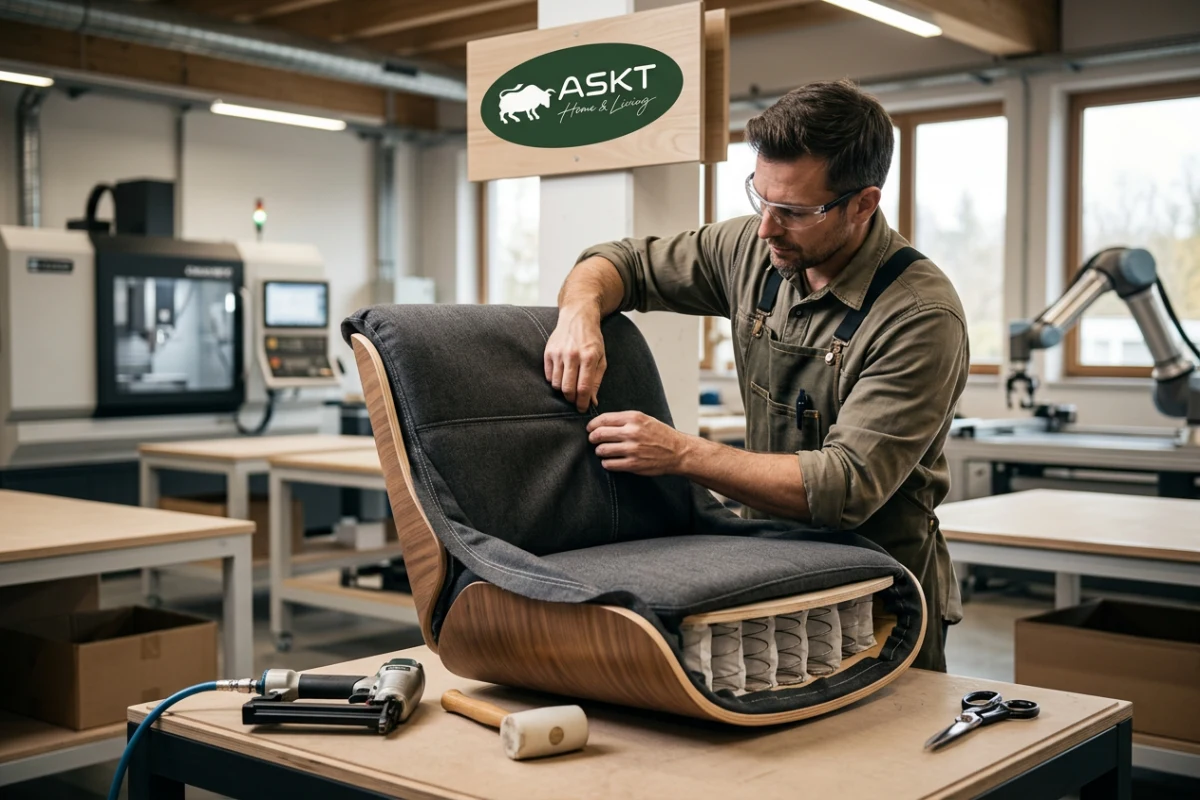
High-resilience cushioning, multi-density foam layering, and pocket spring seat constructions cannot be mechanically stretched and glued with absolute uniformity by a robot. Experienced upholstery artisans hand-fit foam envelopes over structural wooden shells to ensure:
- Ergonomic softness transitions smoothly without abrupt density steps.
- Internal springs remain centered and damped against chassis vibration.
- Cushion crowns retain their calibrated arch and rebound characteristics after thousands of sit-stand cycles.
2. Precision Tailoring, Pleating, and Tufting
Every roll of fabric, synthetic leather, or microfibre has subtle variations in elasticity and grain tension. Human artisans understand how to adjust pulling force along the perimeter seam when stretching the cover over curved seat edges and hollow backrests.
- Puckering prevention: Skilled hands manipulate tension dynamically along complex 3D radii to eliminate puckering, wrinkling, or excess fabric bunching.
- Stitch line straightness: Craftspeople guide decorative double-stitching and piping through industrial sewing machinery, ensuring continuous, parallel sightlines.
- Corner wrapping: Corners and base wraps are hand-stapled with calibrated spacing, tucking excess material neatly beneath the dust cover.
3. Knock-Down (KD) Mechanical Pre-Assembly
In modern B2B dining chair supply chains, optimizing container loading through KD engineering is mandatory for cost efficiency. However, a KD structure must fit together effortlessly for the consumer or hospitality project installer. Assembly technicians perform physical pre-alignment checks on sample jigs:
- Verifying that powder-coated metal legs align with seat inserts without requiring forced manual flexing.
- Checking that swivel mechanisms and auto-return modules rotate smoothly without catching or binding.
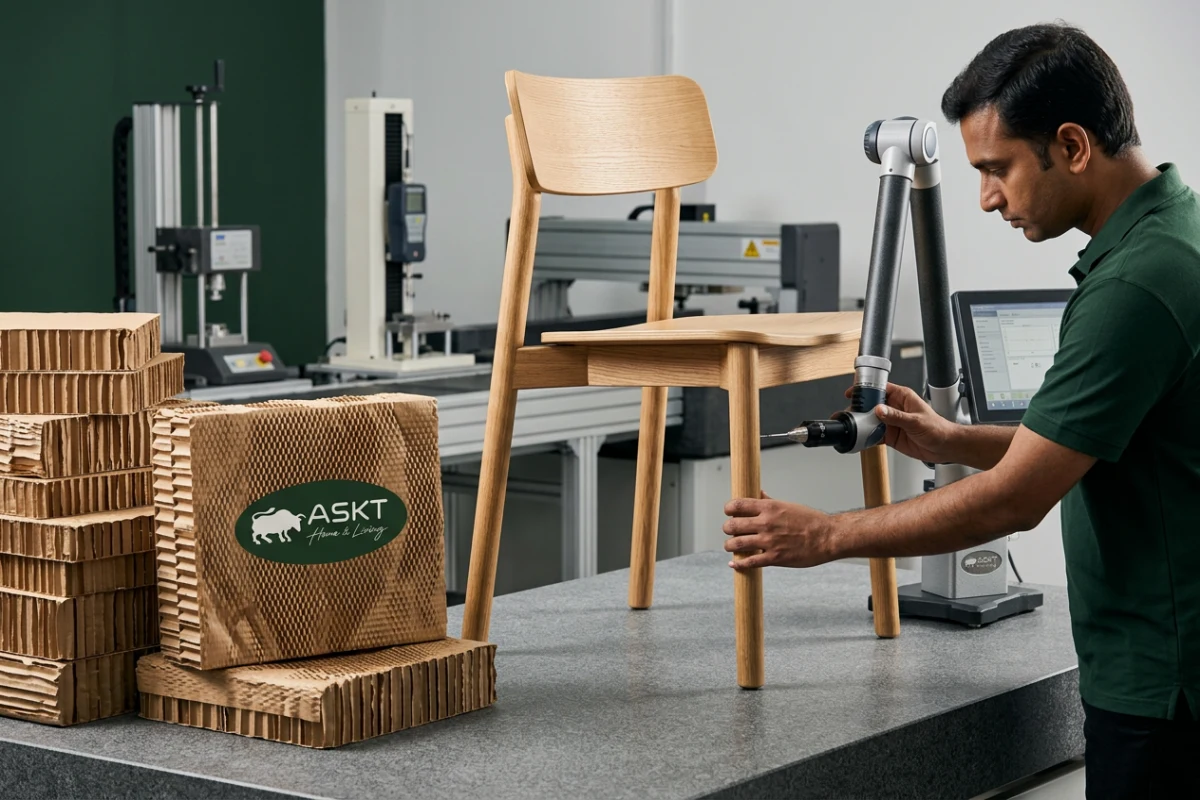
- Ensuring that protective glides and feet seat levelly on calibrated granite test surfaces.
How Does Automation Solve Furniture Manufacturing Batch Consistency Across Volume Orders?
For large-scale furniture wholesalers and retail buying groups managing thousands of SKUs across multiple retail branches, batch inconsistency is the single largest driver of operational headaches. A slight deviation in seat height, leg angle, or fabric tone creates immediate showroom return risks and high warranty costs.
| Quality Parameter | Purely Manual Manufacturing | Hybrid Automation & Craftsmanship |
|---|---|---|
| Leg Angle Tolerance | +/- 4mm to 8mm deviation | Precision +/- 0.5mm repeatability |
| Bolt Hole Centers | High risk of hole misalignment | 100% matched coordinate punching |
| Weld Seam Uniformity | Dependent on welder fatigue | Automated consistent robotic weld bead |
| Upholstery Radii | Variable edge roundness | Hand-stretched over standardized frames |
| Container Load Yield | Unpredictable carton dimensions | Exact standard KD box volume |
Eliminating Dimensional Wobble
Dining chairs resting on four legs require strict coplanarity. If metal frames are bent or welded manually without rigid automated jigs, minor heat distortion causes one leg to lift, resulting in chair wobble. Automated robotic welding arms and precision jigging fixtures hold every frame member in rigid alignment during the thermal cycle. When the chair arrives at a European retail store or contract dining hall, every single unit sits flush on the floor without the need for excessive adjustment glides.
Standardizing Knock-Down Hardware Fit
When European importers purchase KD dining chairs in 40-foot high-cube containers, end customers expect assembly in under ten minutes. If wooden inner boards are drilled by hand, hole centers can drift by several millimeters. When combined with automated wood board punching and automated four-legged pronged nut insertion, the threaded holes remain aligned with the metal sub-frame mounting plates. The buyer's customer receives hardware that threads by hand without cross-threading or mechanical jamming.
Protecting Material Performance Across Batches
Batch consistency extends beyond physical dimensions into material behavior. Advanced fabrics engineered with protective coatings and ventilation channels must maintain their waterproof, stain-resistant, and scratch-resistant properties across thousands of meters. Rigorous fabric batch testing guarantees that abrasion resistance, breathability, and color fastness meet agreed commercial specifications before fabric rolls enter automated cutting lines.
What Protocols Define B2B Dining Chair Quality Control in Combined Production Lines?
A professional B2B dining chair quality control protocol bridges the gap between automated component production and hand-finished assembly. Sourcing teams rely on documented, transparent inspection gates at every phase of the manufacturing workflow:
- Raw Material Incoming Inspection (IQC): Verification of fabric abrasion ratings, color fastness, water repellency, metal tube thickness, and environmental compliance of adhesives.
- In-Process Quality Control (IPQC): Automated weld seam checks, CNC punching tolerance verification, four-legged nut pull-out resistance tests, and seam straightness evaluations.
- Final Assembly & Mechanical Testing (OQC): Full KD assembly fit checks on granite leveling surfaces, cyclic static load tests on seat and back structures, and 360-degree swivel mechanism smoothness audits.
- Packaging and Transit Quality Control: Drop testing, vibration testing, and verification of reinforced corner buffers and honeycomb paper box packaging to prevent transit damage.
Step 1: Raw Material Incoming Inspection (IQC)
Before manufacturing begins, all structural raw materials and cover textiles pass through strict verification:
- Textile Safety & Compliance: Fabrics are verified to confirm they are free from harmful substances and safe for indoor living environments.
- Chemical Safety: Adhesives used for bonding foam to wood shells are strictly water-based, environmentally friendly, and formaldehyde-free, safeguarding both factory craftsmen and end-use indoor air quality.
- Textile Performance Testing: Incoming cloth lots undergo color fastness rubbing tests, Martindale abrasion resistance verification, and water-repellency contact angle checks.
Step 2: In-Process Quality Control (IPQC)
During automated and manual production cycles, dedicated quality controllers inspect parts immediately after automated machine steps:
- Robotic Weld Visual & Stress Tests: Weld beads are inspected for uniformity, lack of porosity, and complete edge blending.
- Board Geometry & Fastener Pull-Out: Punched wooden boards undergo dimensional sampling, and four-legged nuts are tested for pull-out torque resistance to prevent spin-out during bolt tightening.
- Upholstery Detail Inspection: Quality inspectors verify seam stitch counts per inch, check corner tuck symmetry, and inspect cover tension across seat crowns.
Step 3: Final Product Audits and Structural Testing (OQC)
Finished dining chairs undergo mechanical testing aligned with European durability requirements (such as EN 12520 standards for domestic seating):
- Static & Fatigue Load Testing: Hydraulic test rams apply cyclic loads to seat pans and backrests to verify structural joint integrity.
- Stability & Rebound Checks: Chairs equipped with auto-return swivel mechanisms are checked for 360-degree smooth rotation and precise center-return alignment.
Step 4: Packaging and Logistics Stress Testing
Even a well-manufactured dining chair can arrive damaged if packaging is inadequate. Modern B2B quality control mandates rigorous drop and transit testing:
- Eco-Conscious Packaging: Eliminating unnecessary single-use plastics by adopting recyclable honeycomb paper boards and reinforced corner buffers to absorb transit impacts.
- Container Loading Optimization: Standardized carton geometries are engineered to fit standard European pallet sizes and maximize high-cube shipping container volumes, directly lowering freight cost per chair.
How Can European Importers and Wholesalers Evaluate Hybrid Automated Production Facilities?
When sourcing dining chairs from overseas manufacturers, purchasing managers, category directors, and contract buyers need a structured framework to evaluate whether a supplier truly operates an advanced hybrid facility or merely relies on low-tier manual workshops.
| Audit Category | High-Standard Hybrid Manufacturer | High-Risk Manual Workshop |
|---|---|---|
| Metalworking & Welding | Multi-axis robotic arms & rigid jigs | Handheld welding without precision jigs |
| Wood & Fastener Assembly | Automated punching & machine nailing | Hand drilling & manual hammer nuts |
| Worker Protection & Ethics | Valid social audits, full PPE protocols | Lack of safety gear, unregulated environment |
| Chemical & Adhesive Standards | Formaldehyde-free, water-based glues | Uncertified solvent glues with strong odor |
| Packaging & Pallet Logistics | Honeycomb paper, optimized box cubing | Loose Styrofoam scraps & weak cartons |
1. Inspect the Upstream Machinery Baseline
When touring factories or reviewing factory audit documentation, evaluate the degree of automation in the primary fabrication departments:
- Does the factory operate automated fabric cutting tables to ensure pattern consistency, or are covers cut with handheld shears?
- Are wooden sub-boards punched with automated machinery, ensuring identical fastener hole coordinates?
- Does the factory deploy robotic welding cells for high-volume metal frames, or is welding performed manually across uncalibrated benches?
2. Verify Ethical Manufacturing and Social Compliance
Factory compliance and employee safety directly impact supply stability and brand reputation in European retail markets. Professional manufacturing facilities operate with strict human rights and workplace safety measures:
- Social Compliance Audits: Factories must hold valid social compliance audit certifications (such as BSCI), ensuring fair wages, reasonable working hours, and ethical employment practices.
- Worker Safety Gear (PPE): Fabric cutting technicians must wear cut-resistant gloves; upholstery operators working near adhesive spraying stations must be equipped with specialized protective respirators and protective clothing.
- Worker Skill Training: Each operator must complete formalized technical training before handling production machinery or assembly lines.
3. Review Design Exclusivity and OEM/ODM Modularity
For European furniture brands and purchasing groups, securing market distinctiveness is vital. Top-tier manufacturers support buyers with tailored engineering solutions:
- Design Exclusivity: Offering regional model protection to safeguard long-term brand equity.
- Modular Component Systems: By pairing standardized seat shells with interchangeable metal, swivel, or KD leg bases, modular design systems enable buyers to create distinct product variations, lower minimum order quantities (MOQs), and reduce warehouse inventory overhead while testing new market trends.
- Sustainable Material Options: Supporting circular economy goals through certified textiles and fabric options crafted from recycled materials, aligning directly with European environmental policies.
If you are evaluating manufacturing partners to upgrade your dining chair collections with verified batch consistency, explore how modern production lines integrate precision engineering with artisanal finishing. Join us as we celebrate the balance of traditional craftsmanship and industrial precision with September 19 Tag des Handwerks + ASKT Automated Production Resources to elevate your European sourcing strategy.