Which Dining Chair Manufacturers Offer Stable Mass Production Quality?
To secure dining chair manufacturers stable mass production quality, professional B2B buyers must evaluate factories on advanced industrial automation, validated social and material compliance standards (such as BSCI and OEKO-TEX®), and standardized modular component platforms. Choosing a partner that integrates precision machinery with transparent quality protocols ensures consistent physical dimensions, structural integrity, and aesthetic alignment across every high-volume batch.
Why is batch consistency the biggest bottleneck for high-volume furniture sourcing?
For European furniture wholesalers, retail chains, and e-commerce brands, the transition from an approved product sample to a container-level shipment is fraught with risk. In high-volume B2B environments, achieving furniture production consistency across consecutive containers is not merely a production challenge; it is a critical commercial necessity. When dealing with traditional production lines, dimensional variations of even a few millimetres, inconsistent upholstery tension, or shifting stitch lines can result in high return rates and damage a brand's market reputation.
In typical manufacturing models, hand-welded metal frames and manual fabric cutting naturally introduce human margins of error. Over a multi-week production run, fatigue and shifting manual standards inevitably create batch deviations. This is why leading European buyers seek out partners who have restructured their factories to eliminate variance.
For example, Chinese furniture factory batch consistency became a major talking point when ASKT sold over 550,000 dining chairs in the highly demanding German market alone in 2024. This achievement, widely documented by the prestigious B2B furniture trade magazine möbelmarkt, proved that combining high-volume efficiency with rigorous European quality benchmarks is the only path to reliable supply. B2B buyers do not just buy designs; they buy predictability. By partnering with an experienced manufacturer that understands these strict standards, retail chains can confidently order container loads without the fear of product defects or mismatched collections arriving at their warehouses.
How does manufacturing automation guarantee dining chair stable mass production quality?
Industrial automation is the primary tool to achieve dining chair manufacturers stable mass production quality. Manual assembly lines are highly susceptible to physical fatigue, leading to shifting tolerances over a standard manufacturing shift. To eliminate these variables, advanced manufacturers have replaced traditional manual workflows with high-end, specialized machinery.
For the structural core of upholstered chairs, advanced factories deploy automated board punching machines for batch punching of wooden boards, paired with specialized nailing machines for installing four-legged nails into the wooden boards. These automated steps ensure that the internal frame remains perfectly uniform, eliminating the structural misalignments and loose joints that cause squeaks and failures over time.
In fabric preparation, instead of manual fabric layering and cutting, factories utilize advanced automated cutting machines designed for the high-precision batch cutting of textiles. This guarantees that every fabric panel is cut to the exact millimetre, ensuring consistent upholstery tension and stitch alignment.
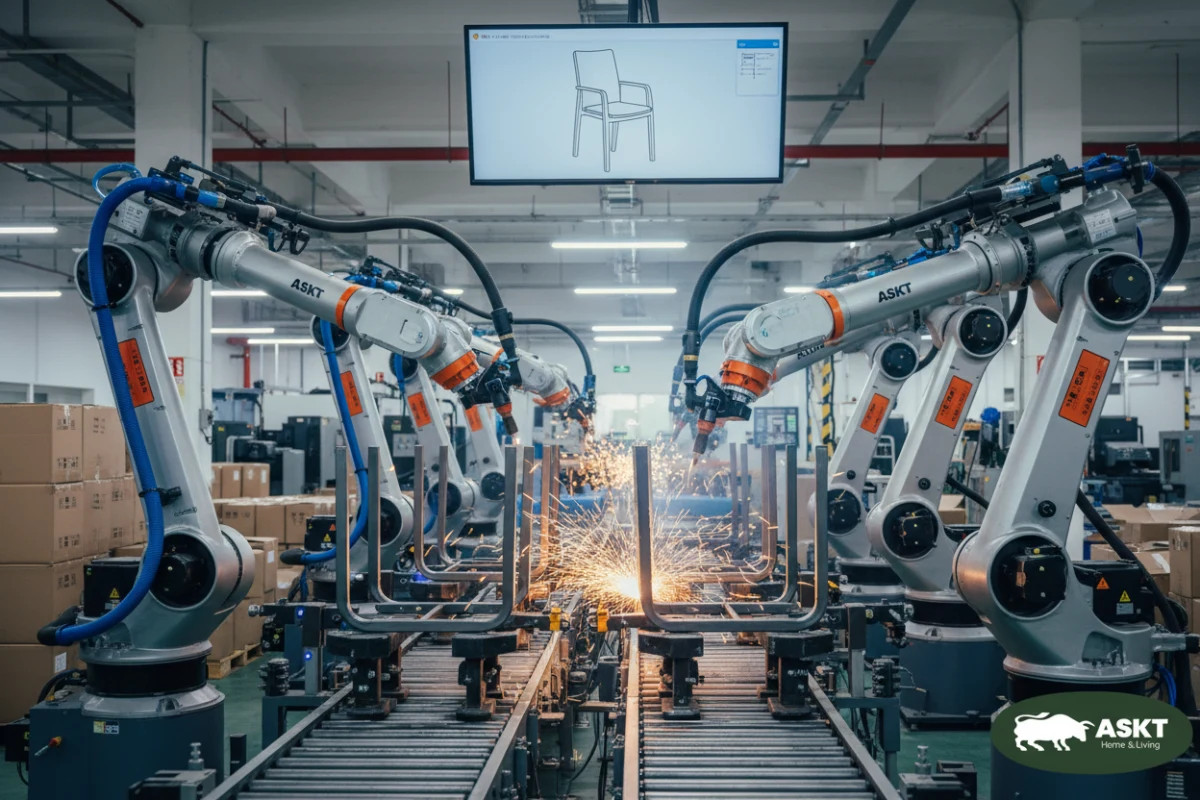
On the structural metal side, the introduction of automatic welding robotic arms has transformed frame durability. Robotic welding ensures identical, flawless weld beads across thousands of production cycles, preventing joint failure. By systematically reducing manual intervention, these technologies simultaneously lower labour costs, increase manufacturing efficiency, and provide European buyers with the structural certainty they require. This level of technology represents the absolute state of the art in modern B2B furniture production.
What quality control protocols must a professional B2B dining chair manufacturer implement?
For a dedicated B2B dining chair manufacturer, stable mass production quality requires more than just high-end machinery; it demands a structured, multi-phase dining chair supplier quality control system. Sourcing specialists must look beyond superficial factory audits and closely evaluate the actual inspection workflows executed on the factory floor.
At ASKT, this protocol is anchored in the "Test first, ship second" philosophy. This means that no batch is allowed to leave the facility without undergoing systematic stress testing. This includes structural stability testing, load-bearing tests, drop tests, and custom packaging drop testing to simulate the rigorous transit conditions of European logistics.
Let us contrast the risks of manual production with the security of a structured QC model:
| Sourcing Parameter | Traditional Manual Production | Automated B2B Manufacturing | Sourcing Value for Importers |
|---|---|---|---|
| Frame Alignment | Manual welding; variances up to 5mm | Robotic welding arms; zero variance | Fits perfectly under dining tables; zero rocking |
| Upholstery Tension | Hand-cut fabrics; uneven stitching | Automated laser fabric cutting | Uniform seam alignment across multiple containers |
| Internal Integrity | Hand-driven nails; loose structural joints | Automated board punching & nailing | Prevents structural failure and consumer complaints |
| Testing Regime | Visual checks only; high failure risk | Systematic EN12520 testing & drop tests | Guaranteed compliance with European safety laws |
| Quality philosophy | "Ship and hope" | "Test first, ship second" | Drastically reduces return rates and liability |
By executing these rigorous tests prior to packing, the factory acts as a reliable filter, catching any minor anomalies before they are loaded into containers, thereby protecting the importer's bottom line.
How do compliance certifications like BSCI and OEKO-TEX® protect B2B buyers from supply chain risks?
For modern European wholesalers and retail chains, supply chain compliance is no longer optional. Environmental, Social, and Governance (ESG) standards, alongside the European Green Policy, demand that dining chair manufacturers enforce ethical labor conditions and material safety.
To verify these claims, buyers must look for factories with validated certifications. A professional factory must be BSCI human rights certified, demonstrating a verified commitment to ethical manufacturing and workplace safety. In practice, this means providing workers with protective overalls, supplying metal cut-resistant gloves for fabric cutters, and equipping employees with specialized gas masks when working with glues.
Furthermore, chemical safety is crucial for residential and contract markets. Any glues used within the upholstered structures must be strictly environmentally friendly and formaldehyde-free. This safety extends directly to the materials: fabrics must be OEKO-TEX® STANDARD 100 certified, proving that every thread and finish has been extensively tested for harmful substances. When a manufacturer invests in these certifications, they are protecting the buyer from regulatory penalties, customs delays, and potential consumer lawsuits, turning compliance into a tangible business asset. It shows that the factory operates on a professional, globally recognized standard that respects both human health and safety.
How does material engineering prevent upholstery and frame failure at scale?
Upholstery is often the first point of failure for volume-sourced dining chairs. Under high-frequency residential or contract use, low-quality fabrics quickly show signs of pilling, color fading, and structural tearing. To combat this, advanced manufacturers leverage sophisticated material engineering.
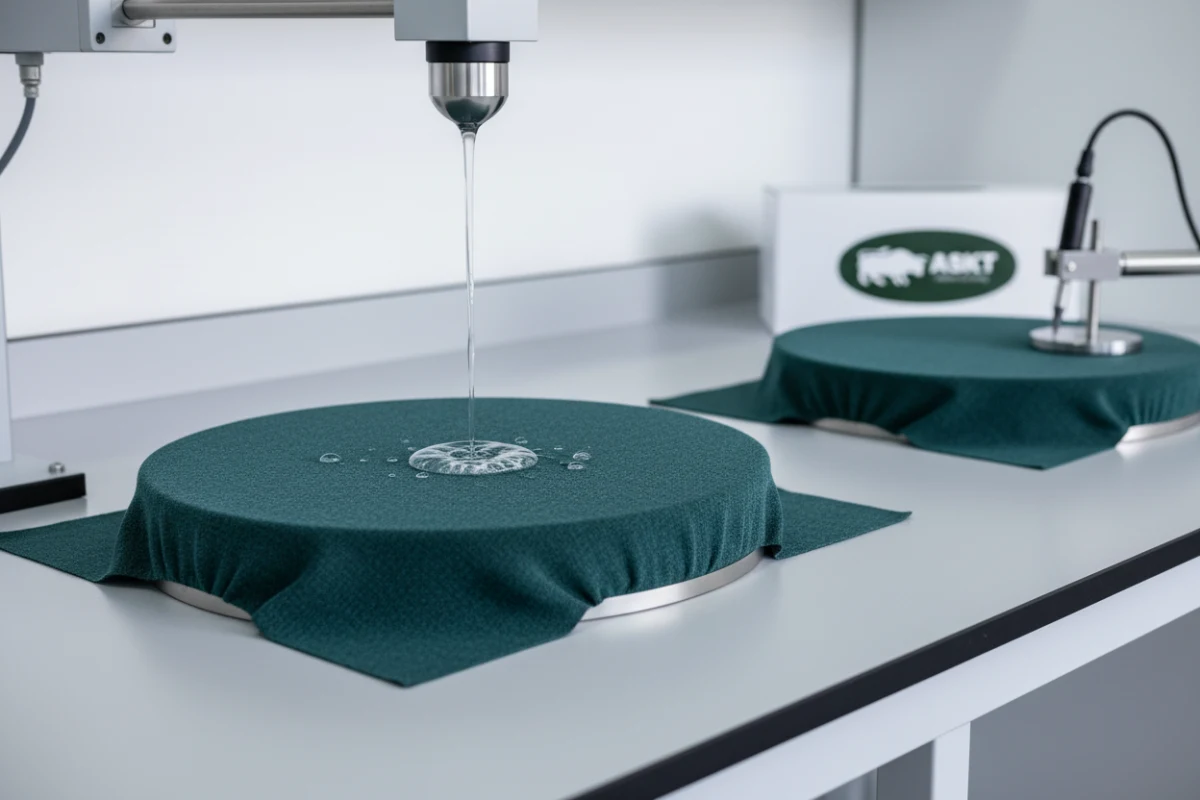
A prime example is the development of ASKT-Tex exclusive functional fabrics, highlighted in the March 2025 issue of möbelmarkt. By combining a molecular-level hydrophobic nano-coating with microscopic ventilation channels, this fabric achieves a perfect balance of performance characteristics. It is highly waterproof and stain-resistant, yet remains highly breathable and soft to the touch. This material is also pet-friendly and scratch-resistant, allowing it to withstand the daily wear and tear of modern households.
Moreover, alignment with the European Green Policy is achieved through fabrics woven from recycled plastic bottles, promoting environmental sustainability.
This material innovation is not developed in a vacuum. It is supported by deep research into consumer habits. For instance, ASKT's design language is informed by comprehensive studies of over 1,000 German households. By analyzing real dining spaces, table heights, and flooring trends, the company designs chairs that fit seamlessly into European homes. To protect their partners' market share, ASKT offers design exclusivity (Design Exclusivity), preventing competitors from diluting the value of their carefully curated collections. This structural protection ensures that importers can maintain premium margins in highly competitive retail sectors.
How can modular design solve high MOQ and inventory risks for European importers?
High Minimum Order Quantities (MOQs) and inventory bottlenecks represent major financial risks for European furniture importers. Traditional manufacturing models require buyers to order hundreds of units of a single, specific design to fill a container, tying up valuable capital and warehouse space.
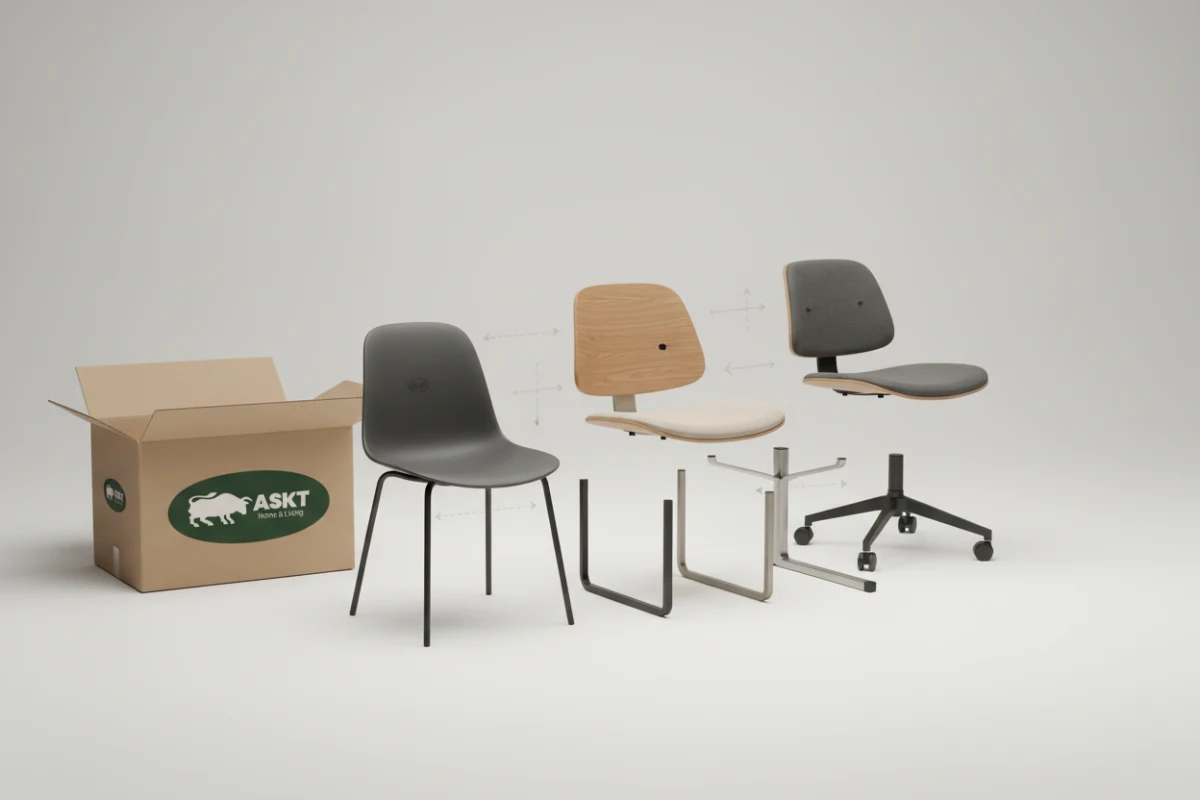
The solution lies in modular engineering. In February 2026, möbelmarkt featured the innovative KINEXA modular system. By utilizing a standardized set of seat shells and base designs, KINEXA allows buyers to mix and match components within a single container. For example, a buyer can pair three different upholstered seat shell designs with two different metal frame bases. This standardized approach dramatically lowers the MOQ per individual SKU, simplifies cost calculations, and allows importers to test new designs with minimal inventory risk.
To streamline this development process, B2B buyers can utilize the Sunbin KI conversational AI platform. This digital assistant acts as an expert product manager, employing structured inquiry pathways to translate buyer specifications into accurate, production-ready designs. This eliminates the communication errors typically associated with cross-border procurement. When combined with the "Test first, ship second" production methodology, these digital and physical systems provide a highly efficient, transparent, and secure sourcing experience for professional buyers.
For European wholesalers, retailers and project buyers looking for reliable dining furniture supply from China, ASKT can help turn product ideas into commercially stable collections. We invite you to collaborate with our design and engineering teams to establish a reliable, high-volume supply chain for your market. Contact us today to explore how we can support your business as your dedicated European B2B partners.