Before You Blame the Designer: Check These 9 Dining Chair Production Risks First
Before You Blame the Designer: Check These 9 Dining Chair Production Risks First
For Einkaufsleiter in German furniture retail
The German furniture retail environment is currently navigating a complex 'correction phase.' With stationary trade under immense pressure from rising operational costs and a slight decline in consumer spending, the focus for procurement has shifted from broad variety to aggressive SKU rationalization. In this climate, every 'Penner-Artikel' (slow-moving item) or high-return product directly erodes your net Marge (margin) and increases Lagerdruck (inventory pressure).
When a new dining chair collection fails in the showroom or—worse—results in a spike in Reklamation (complaints) after delivery, the instinctive reaction is to blame the design. However, at ASKT Furniture, with over 15 years of manufacturing experience, we have found that the root cause is rarely the aesthetic intent. More often, it is a failure in production risk management.
The Financial Impact of Production Risks
In the B2B sector, quality is not a luxury; it is a financial safeguard. A high Reklamationsquote doesn't just cost you the price of the chair; it costs you the logistics of the return, the loss of customer trust, and the administrative overhead of the claim process. To maintain a healthy Abverkauf (sell-through), procurement professionals must look beyond the CAD drawing and audit the factory's technical execution.
1. Wood Moisture Content (The 8-12% Rule)
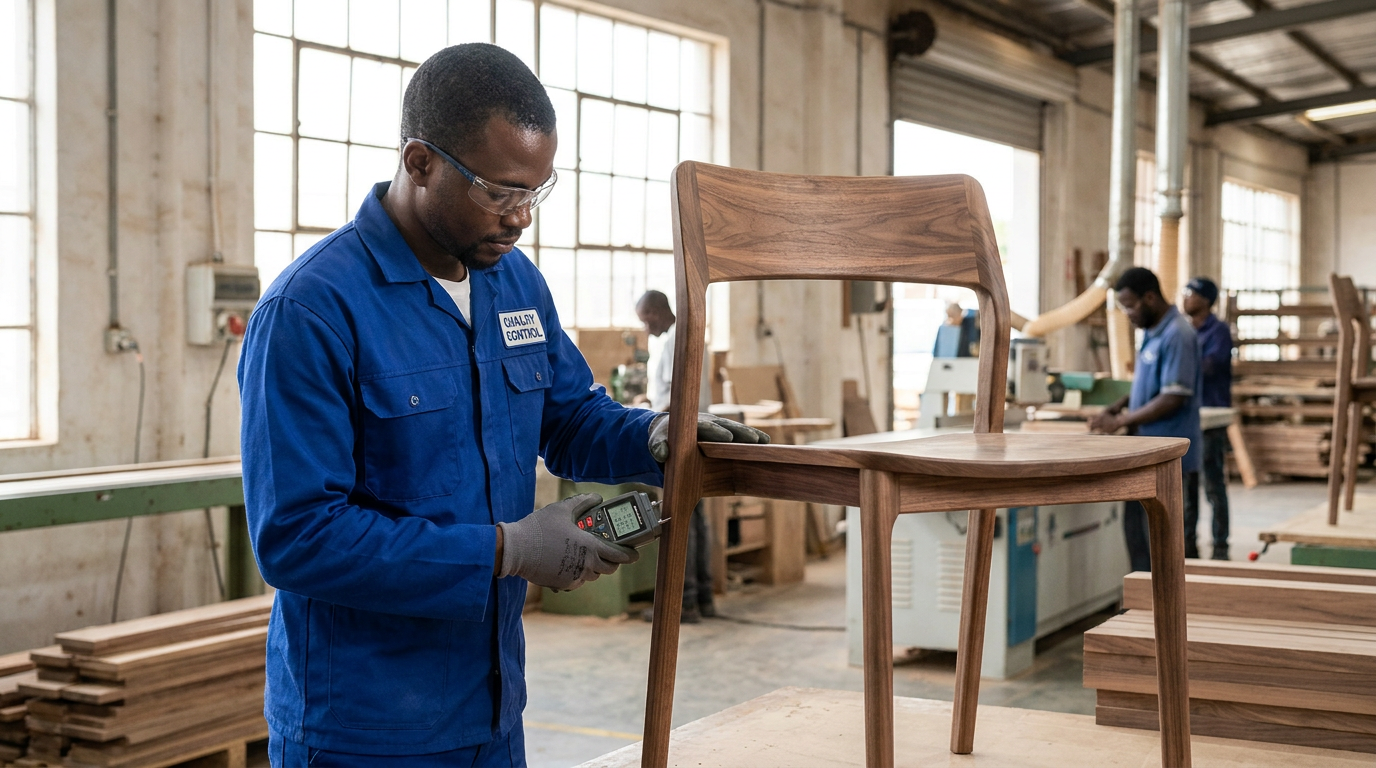
One of the most common causes of structural failure in the European market is improper kiln-drying. Wood is hygroscopic; if the moisture content is too high (above 12%) or too low (below 8%) during production, the chair will warp, crack, or develop loose joints when it hits the dry, climate-controlled environments of German homes or restaurants. ASKT Furniture ensures all timber is stabilized to meet EU environmental standards, preventing post-purchase structural shifts.
2. Joint Integrity: Mortise and Tenon vs. Dowels
For high-traffic Objektmöbel (contract furniture), the method of joinery is non-negotiable. Many manufacturers cut costs by using simple dowel joints or, worse, wood screws without reinforcement. For a chair to survive the 'lever effect' of a seated person, true mortise and tenon joinery—reinforced with corner blocks—is essential. Without this, the chair will inevitably develop 'the wobble,' leading to immediate returns.
3. Finish Adhesion and VOC Compliance
A beautiful finish that flakes off after six months is a procurement nightmare. Poor surface preparation or the use of low-grade lacquers results in poor adhesion. We recommend the 'Cross-cut test' (ISO 2409) during the sampling phase. Furthermore, ensuring the finish meets German safety standards (like DIN 4102-1 B1 for fire safety in commercial spaces) is critical for your Sortiment compliance.
4. Upholstery Foam Density and Fatigue
'Sitzkomfort' (seating comfort) is a primary driver of Abverkauf. However, if the foam density is below 30kg/m³, the seat will lose its shape within months. This 'bottoming out' is a frequent source of customer dissatisfaction. For commercial-grade seating, high-resiliency (HR) foam is the standard that protects long-term product value.
5. Frame Stress Points and EN 16139 Compliance
Is the chair actually tested? For the German market, DIN EN 16139 (strength, durability, and safety) is the benchmark. Production risks occur when the mass-produced version deviates from the tested prototype—often by thinning the wood at stress points or reducing the gauge of metal frames to save weight.
6. Hardware Quality and Loosening
In many modern designs, metal-to-wood or metal-to-metal connections are used. Low-quality screws or the absence of thread-locking compounds leads to hardware loosening over time. This is a preventable risk that ASKT Furniture mitigates through standardized hardware sourcing and ISO 9001-certified assembly processes.
7. Packaging Durability and Transit Damage
Your Marge is often lost in the 'last mile.' If the packaging is not designed for the rigors of international shipping and local German logistics, the 'Reklamationsquote' will skyrocket due to scratches and broken legs. We utilize 5-layer corrugated boxes and custom internal bracing to ensure 99% damage-free delivery.
8. Batch Consistency (The Color Variance Trap)
In large-scale projects, such as outfitting a hotel or a restaurant chain, color consistency is vital. Production risks include 'dye-lot' variations in fabric or stain inconsistencies in wood. Professional manufacturers use spectrophotometers to ensure every batch matches the master sample within a strict Delta-E range.
9. Lead-Time Volatility and Cash Flow
A 45-day lead time is a promise; a 90-day delivery is a disaster. Production risks aren't just physical; they are operational. Delays in production lead to stockouts, missed project deadlines, and tied-up capital. ASKT Furniture’s 45-day stable delivery cycle is designed to help Einkaufsleiter manage Lagerdruck effectively.
The B2B Evaluation Matrix: Residential vs. Commercial Grade
| Feature | Residential Standard | ASKT Commercial Grade (B2B) |
|---|---|---|
| Wood Moisture | 12-15% (Variable) | 8-12% (Kiln-Dried & Monitored) |
| Joinery | Dowels/Screws | Reinforced Mortise & Tenon |
| Foam Density | 20-25 kg/m³ | 30-40 kg/m³ (High Resiliency) |
| Testing | Visual Inspection | EN 16139 Level 1 & 2 |
| MOQ | High Container Loads | Flexible (200 Units) |
| Lead Time | 60-90 Days | 45 Days Guaranteed |
9-Point Pre-Order Production Audit Checklist
- Moisture Verification: Request the kiln-drying logs for the specific batch of timber.
- Joint Sectioning: Ask for a 'cut-away' sample of a joint to verify internal construction.
- Rub Test (Martindale): Ensure fabric exceeds 30,000 rubs for commercial use.
- Weight Capacity: Confirm the chair is rated for at least 110kg-150kg.
- Hardware Check: Verify the use of nylon-insert lock nuts or thread-locker.
- Finish Hardness: Perform a pencil hardness test (ASTM D3363) on the lacquer.
- Packaging Drop Test: Request a 1A or 3A ISTA drop test report.
- Certification Check: Validate ISO 9001 and CE/EN certifications.
- Sample Comparison: Compare the production sample against the 'Golden Sample' for color and weight.
FAQ: Managing Procurement Risks
Q: How does wood moisture affect my return rate in Germany? A: Central heating in German buildings creates a very dry indoor climate in winter. If wood is not dried to 8-12%, it will shrink and crack, leading to structural failure and high return rates.
Q: Why is a flexible MOQ (200 units) important for risk management? A: It allows you to test new designs in the market without committing to massive inventory, reducing Lagerdruck and financial exposure if a specific SKU doesn't perform.
Q: Can we customize designs to meet specific fire safety codes? A: Yes. ASKT Furniture provides customization services to ensure fabrics and foams meet DIN 4102-1 B1 or other international standards required for commercial projects.
Conclusion: Shifting from Designer Blame to Process Control
Successful procurement in the German furniture retail market requires a shift in perspective. Instead of focusing solely on the aesthetic appeal of a designer's vision, the Einkaufsleiter must act as a technical auditor. By identifying and mitigating these 9 production risks, you protect your Marge, stabilize your Abverkauf, and ensure that your Sortiment remains a source of profit rather than a source of complaints.
Do you want me to send you a practical evaluation checklist or decision framework for your next procurement cycle?