Dining Chair Quality Control Process in China: A Complete B2B Sourcing Guide
For European furniture importers, wholesalers, retail chains, and contract furniture buyers, sourcing seating internationally offers competitive scalability. However, managing offshore manufacturing requires systematic risk mitigation. When shipping containers arrive at distribution hubs across Germany, the Netherlands, the UK, or Poland, uncovering structural misalignments, uneven upholstery tension, flaking powder coating, or crushed carton packaging quickly erodes commercial margins. Return rates, customer complaints, and warranty claims can compromise brand equity and retailer trust.
Establishing an end-to-end dining chair quality control process in China is essential for commercial reliability. A dining chair is subjected to dynamic loads, daily friction, shifting body weights, and varied ambient conditions. Sourcing chairs that satisfy the aesthetic and structural expectations of European residential and commercial environments requires multi-tiered quality control that tracks components from incoming raw material inspection through frame fabrication, upholstery assembly, structural testing, and container loading.
Understanding the Dining Chair Quality Control Process in China for European Buyers
Unlike purely decorative interior accents, dining furniture is defined by its mechanical stability and surface resilience. An upholstered dining chair combines structural metal sub-assemblies, timber or engineered board shells, foam cushioning, pocket springs, swivel mechanisms, and technical upholstery fabrics into a single integrated unit. If any individual component fails, the overall integrity of the chair is compromised.
Many conventional purchasing workflows rely entirely on a basic final inspection once chairs are already boxed and staged in the shipping warehouse. While final checks are necessary, relying solely on end-of-line sampling creates blind spots. An inspector examining a fully assembled, boxed chair cannot examine the weld penetration underneath thick upholstery foam, verify the moisture level of the internal seat shell, or confirm the adhesive bonding strength used between the foam and frame. Deficiencies buried beneath fabric coverings often surface only after weeks of maritime transit or months of customer use.
A thorough dining chair quality control process in China operates as a multi-stage quality assurance protocol. By implementing strict incoming raw material verification, in-process production audits, and pre-shipment container audits, furniture buyers can systematically identify and eliminate defects at their root cause before batch production advances.
| Quality Control Stage | Core Inspection Focus | Primary Quality Checkpoints | Defect Prevention Goal |
|---|---|---|---|
| 1. Incoming Material Audits | Raw fabrics, foams, steel tubing, timber shells | Abrasion resistance, colour fastness, moisture content, tensile strength | Eliminates substandard raw materials before manufacturing begins |
| 2. In-Line Frame Fabrication | Metal tube bending, welding, powder coating | Robotic weld penetration, frame squareness, 4-point levelness, coating adhesion | Prevents structural cracking, frame wobble, paint flaking, and rust |
| 3. Upholstery & Mechanism Assembly | Foam gluing, stitching, swivel & auto-return hardware | Seam alignment, foam rebound, pocket spring centering, smooth rotation | Prevents seam slippage, foam sagging, rotation friction, and noise |
| 4. Pre-Shipment Inspection (PSI) | Finished product sampling, packaging, drop testing | EN durability compliance, KD hardware counts, carton drop survivability | Prevents transit damage, missing hardware, and retail quality claims |
| 5. Container Loading Audit | Stowage planning, moisture protection, carton integrity | Container cleanliness, seal inspection, weight distribution, stacking security | Prevents crushed lower cartons and transit humidity damage |
Incoming Raw Material Audits and Fabric Performance Testing
A resilient furniture quality inspection China framework begins at the receiving dock. High-volume dining chair manufacturing relies on consistent input materials, and auditing incoming raw materials prevents defects from migrating downstream into costly semi-finished components.
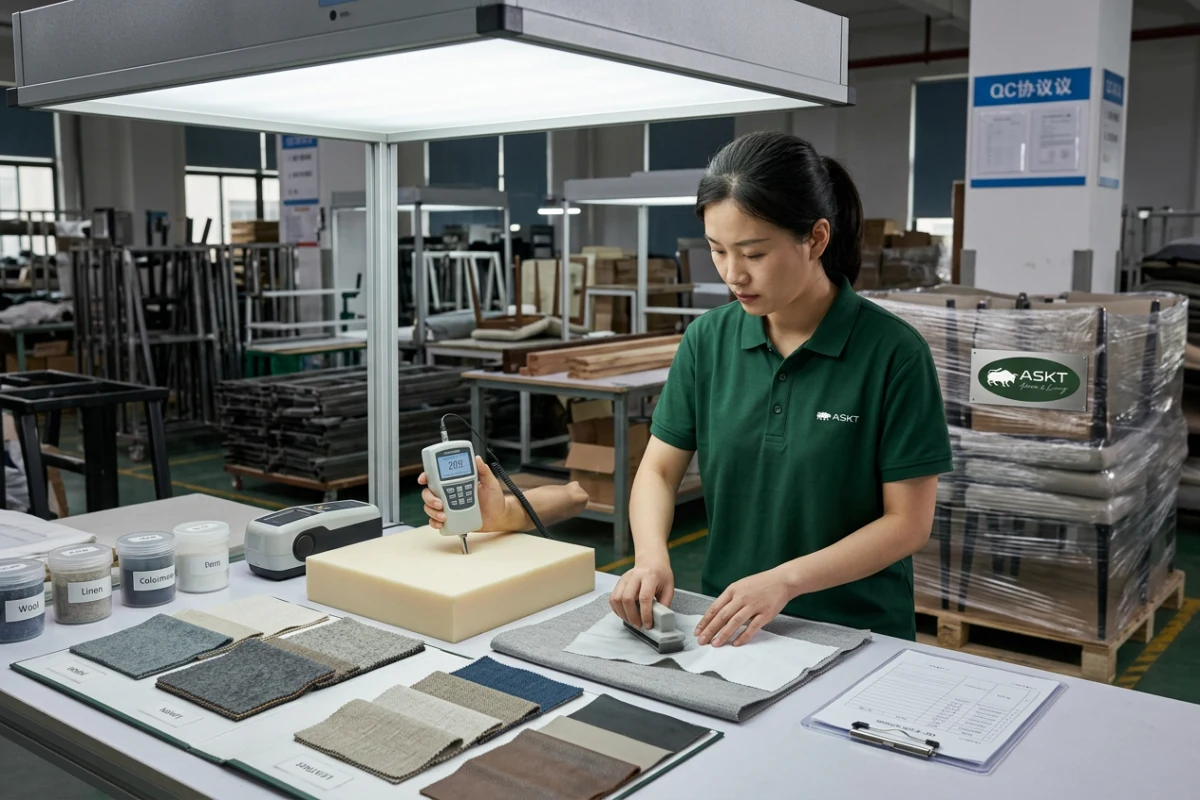
Upholstery Verification: Abrasion, Colour Fastness, and Easy-Clean Properties
Upholstery fabrics face heavy surface friction, spills, and cleaning chemicals. During incoming material audits, batch rolls of fabric, faux leather, and microfibre materials must undergo laboratory evaluation to ensure they meet European contract and residential expectations:
- Abrasion Resistance: Fabrics must be tested against standard abrasion cycles to verify that yarn structures resist pilling, thinning, and premature thread fraying under sustained rubbing.
- Colour Fastness and Crocking: Textiles undergo wet and dry crocking tests to ensure dyes do not transfer onto clothing or fade under ambient light exposure.
- Waterproof and Easy-Clean Properties: Specialized technical fabrics, such as waterproof, stain-resistant, and pet-friendly textiles, are tested for liquid repellency and surface stain release without sacrificing fabric breathability or hand feel.
- Tensile Strength and Seam Tenacity: Woven textiles must demonstrate adequate tensile resistance to avoid seam slippage when tensioned across curved ergonomic shells.
Internal Core Integrity: Foam Resilience, Pocket Springs, and Wooden Shells
Beneath the exterior fabric, the internal seating core determines ergonomic comfort and long-term shape retention. Inspecting these hidden elements before assembly is vital:
- Polyurethane Foam Inspection: Foam blocks and pre-moulded cushions are evaluated for uniform density and rebound elasticity. Virgin, high-resilience foams prevent seat sagging, whereas inconsistent or low-density foams collapse prematurely under repetitive seating cycles.
- Pocket Spring Systems: Where dining chairs integrate pocket springs for premium seating ergonomics, spring coils must be verified for correct wire gauge, heat treatment, and independent pocket encasement to guarantee balanced weight distribution.
- Timber and Engineered Shell Moisture Content: Internal plywood seat shells and solid wood components must be tested using calibrated moisture meters. Maintaining stable moisture content prevents warping, splitting, or dimensional movement caused by central heating and seasonal humidity shifts in European homes.
- Nut Inserts and Fasteners: Automated insertion of pronged tee nuts and threaded steel inserts into the seat base must be audited for correct thread pitch and flush alignment, ensuring secure, cross-thread-free KD (knock-down) frame assembly.
In-Line Frame Manufacturing and Metalwork Inspection
The structural foundation of contemporary dining chairs often relies on tubular steel, flat-bar profiles, or die-cast metal components. Conducting a structured dining chair factory audit requires close evaluation of the manufacturer's metal cutting, bending, welding, and surface treatment lines.
Metal Frame Fabrication and Robotic Welding Precision
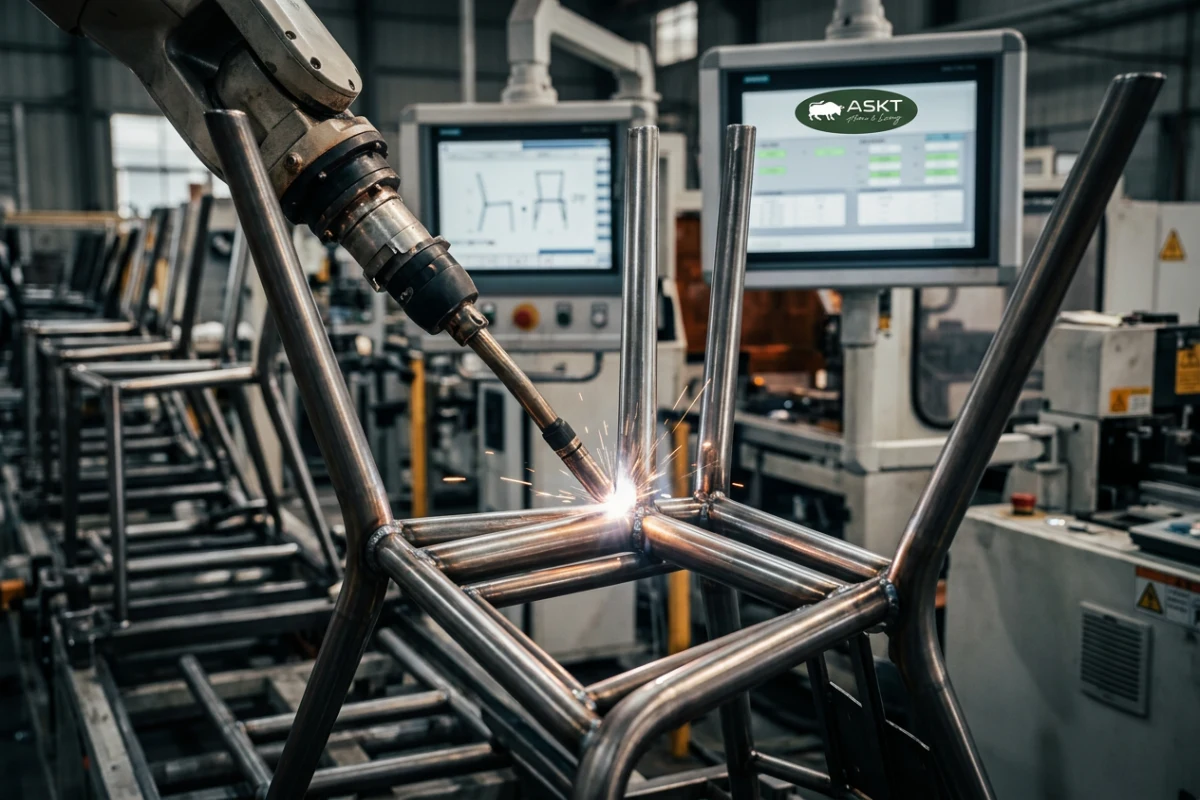
Manual metal welding can introduce human variability, such as inconsistent bead depth, burn-through, or incomplete joint penetration. Modern dining chair production incorporates automated robotic welding arms to maintain uniform weld seams across tens of thousands of units.
In-line metalwork inspection checkpoints include:
- Wall Thickness Verification: Using digital vernier calipers to verify that steel tubing meets structural thickness specifications, preventing leg bending under lateral stress.
- Robotic Welding Seam Integrity: Inspecting welded joints under bright task lighting to ensure 360-degree weld penetration, zero weld porosity, and the complete elimination of sharp slag or spatter.
- Jig Alignment and Frame Squareness: Placing welded sub-frames onto calibrated granite surface plates and precision inspection jigs to ensure all four leg contact points sit completely flat without rocking or dimensional skewing.
Surface Treatment, Powder Coating Durability, and Alignment Checks
Metal dining chair frames undergo multi-stage surface preparation before paint application. Inferior metal preparation is a primary cause of coating delamination and rust during sea freight.
In-line finishing audits verify:
- Pre-Treatment Degreasing: Metal components must pass through chemical degreasing, pickling, and phosphating wash stages to remove machining oils and create an anchor profile for paint adhesion.
- Electrostatic Powder Coating: Powder coating lines are monitored for uniform application thickness. Dry film thickness gauges check that the coating meets specified micron thresholds without orange peel textures, runs, or pinholes.
- Cross-Hatch Adhesion Testing: Quality technicians conduct cross-hatch tape adhesion tests on batch samples to ensure the cured powder coating will not chip, peel, or crack when subjected to impacts or leg contact.
Upholstery Craftsmanship and Mechanism Assembly QC
Combining upholstered seat shells with metal frames and mechanical hardware requires millimeter precision. In-line inspectors monitor this stage using an established furniture manufacturing QC checklist to enforce aesthetic and ergonomic standards.
Precision Cutting, Stitching Consistency, and Ergonomic Foam Bonding
Upholstery craftsmanship directly affects the visual quality and perceived value of the chair on the retail sales floor:
- Automated Pattern Cutting: Utilizing computerized CNC fabric cutting machines ensures accurate pattern dimensions, clean edge sealing, and consistent fabric grain alignment across large production runs.
- Adhesive Application: Foam padding must be bonded to internal shells using non-toxic, eco-friendly adhesives. Bonding must be continuous to prevent fabric bunching, bubbling, or foam shifting over time.
- Stitching Alignment and Tension: Inspectors evaluate stitch density, thread tension, and seam symmetry. Double-stitched decorative seams, piping, and tufted details must remain straight without seam puckering or thread breaks.
Swivel Mechanisms, Auto-Return Systems, and KD Assembly Checks
Modern European dining spaces increasingly demand multifunctional seating featuring 360-degree swivel mechanisms or auto-return positioning functions. These moving components require specialized quality auditing:
- Rotation Smoothness and Clearance: Swivel bearings are cycled under test loads to verify silent, fluid rotation without mechanical grinding, axial play, or wobble.
- Auto-Return Centering: Chairs fitted with auto-return memory mechanisms must return smoothly and reliably to the central resting position without abrupt snapping or deceleration failure.
- KD Hardware Alignment: For knock-down (KD) furniture, assembly jigs ensure that leg mounting holes, threaded inserts, and structural hardware align effortlessly. Bolt packs and hex keys must undergo batch verification to ensure zero missing parts in consumer packaging.
Dining Furniture Pre Shipment Inspection and Structural Performance
The final gateway before container dispatch is the dining furniture pre shipment inspection. At this stage, independent or factory quality assurance inspectors draw statistical batch samples from fully packaged lots to verify structural compliance, finishing consistency, and packaging security.
Structural Durability and EN Testing Benchmarks
Dining chairs destined for European retail distribution and commercial contract environments should be evaluated against European structural durability benchmarks (such as EN testing for seating strength, static loading, and fatigue endurance). Sampled units undergo physical testing on pneumatic test rigs:
- Seat and Back Static Load Testing: Applying heavy downward and backward forces to seat pans and backrests to ensure frames withstand extreme static loads without structural deflection or joint rupture.
- Fatigue and Durability Cycling: Applying repetitive cyclic loads (typically tens of thousands of cycles) to simulate years of daily domestic or contract use, checking for fastener loosening or frame fatigue.
- Forward, Backward, and Sideways Stability: Verifying that chair geometry prevents tipping when weight is applied to the front edge or lateral corners of the seat.
Sustainable Packaging Verification and Container Loading Audits
Packaging failure during maritime transit is a major contributor to supply chain loss. Marine shipping subjects cartons to continuous vibration, high humidity, container stacking pressure, and manual port handling. A rigorous pre-shipment audit must inspect transit packaging:
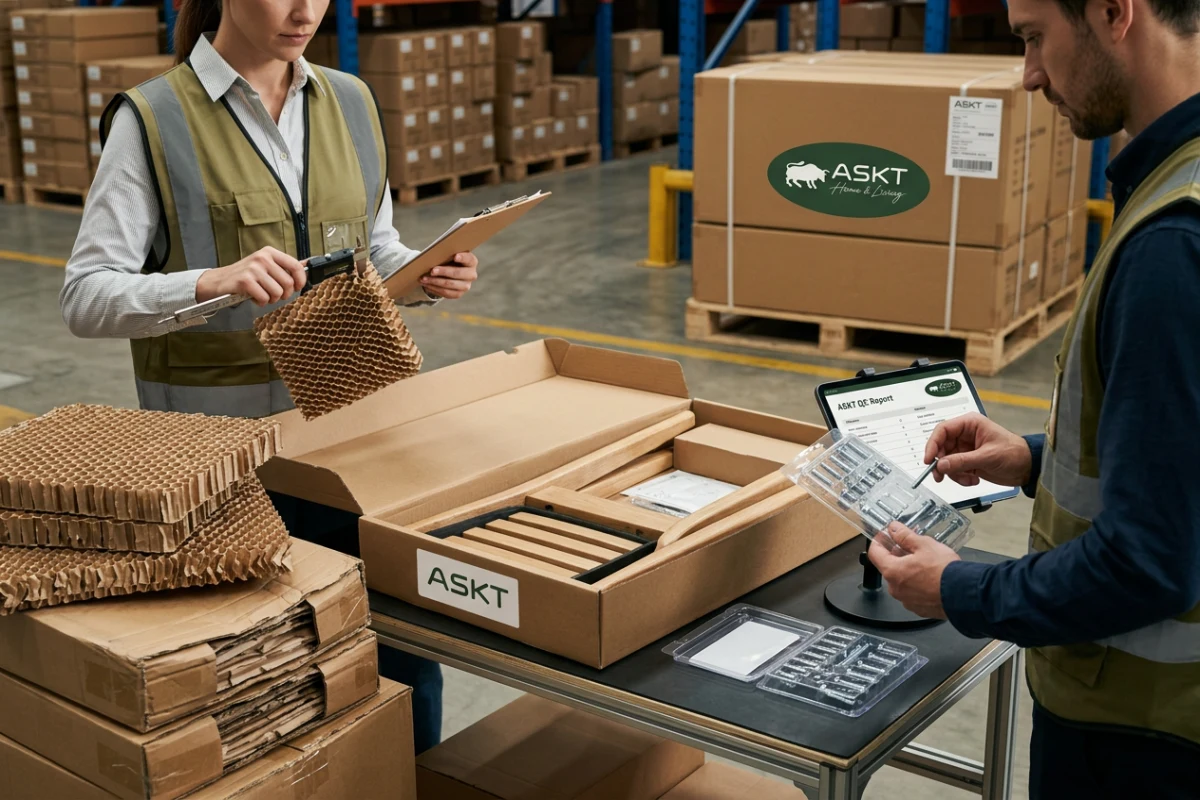
- Carton Drop Testing: Packaged chairs undergo standard carton drop tests (dropping on corners, edges, and flat faces from calibrated heights) to verify that internal protective buffers absorb kinetic impacts.
- Sustainable Packaging Materials: To support European sustainability goals and reduce single-use plastic waste, packaging designs replace excessive expanded polystyrene with structured high-density honeycomb paper protectors, corrugated edge boards, and fitted internal dividers.
- KD Protection: Individual metal legs, swivel hubs, and upholstered shells must be separated by protective sleeves to prevent surface friction, metal scratching, or fabric abrasion during transit.
- Container Loading Supervision: Final loading inspections ensure cartons are stacked according to weight distribution guidelines, container floors are dry, and desiccant packs are deployed to mitigate container rain and transit humidity.
A Practical Furniture Manufacturing QC Checklist for B2B Importers
To help your procurement team, quality managers, or third-party inspection partners audit production runs systematically, this practical checklist outlines critical verification tasks across every manufacturing phase:
| Inspection Category | Specific Verification Task | Standard & Acceptance Criteria |
|---|---|---|
| 1. Raw Materials | Fabric abrasion & crocking | Batch testing for rub resistance, zero wet/dry dye transfer |
| Foam density & resilience | Virgin high-resilience foam, uniform density, immediate rebound | |
| Timber shell moisture | Calibrated moisture meter check within safe domestic range | |
| Steel tube thickness | Digital caliper verification matching technical specification sheets | |
| 2. Metal Fabrication | Robotic weld seams | Continuous seam penetration, zero weld porosity, no sharp spatter |
| Frame levelness | Granite surface plate check: 4-point contact, <1.0mm tolerance | |
| Powder coating adhesion | Uniform dry film thickness, passing cross-hatch adhesion testing | |
| 3. Upholstery Assembly | Cutting & pattern alignment | Clean CNC cutting, straight fabric grain, symmetrical borders |
| Stitching & seam strength | Balanced thread tension, uniform stitch count, no puckering | |
| Mechanism functionality | Silent 360° swivel, smooth auto-return centering without wobble | |
| 4. Structural Testing | Static & fatigue loading | EN durability compliance, zero structural joint failure under test |
| Multi-directional stability | Forward, backward, and lateral anti-tipping stability confirmed | |
| 5. Packaging & Shipping | Drop test performance | Free-fall drop survival with zero interior component damage |
| KD hardware & instructions | Complete blister-packed hardware, clear assembly instructions | |
| Sustainable protective inner | Honeycomb paper cushioning, reinforced corner edge guards | |
| Carton markings & barcodes | Legible retail barcodes, European shipping marks, pallet arrows |
Sourcing Risk Trade-offs: Comparing Quality Assurance Models
When establishing a supply chain for dining furniture in China, European buyers typically choose between three quality control models. Evaluating the trade-offs of each approach helps purchasing managers select the optimal strategy for their commercial volume and risk tolerance:
Model A: Third-Party Pre-Shipment Inspection Only
- How it Works: Sourcing from traditional factories and hiring a third-party inspection agency to perform an AQL audit on finished, boxed goods 2 to 3 days before container loading.
- Advantages: Lower initial management overhead; standard reporting format.
- Trade-offs & Risks: Defects are discovered only when goods are already finished and packaged. Reworking defective internal frames or reupholstering finished chairs causes severe shipping delays, missed retail delivery windows, and high rework costs.
Model B: Fully In-House Factory Quality Management System
- How it Works: Partnering with an advanced OEM/ODM manufacturer that operates dedicated internal testing laboratories, automated in-line checks, and multi-stage gatekeeping.
- Advantages: Defects are identified and corrected immediately at each production station (cutting, welding, powder coating, assembly). Minimizes rework delays, ensures batch-to-batch consistency, and lowers long-term procurement risk.
- Trade-offs & Risks: Requires thorough upfront factory audits to verify that internal testing equipment is calibrated and quality procedures are consistently enforced rather than merely advertised.
Model C: Hybrid Quality Assurance (Factory Gates + Buyer Audit Milestones)
- How it Works: Combining the manufacturer's internal quality control checkpoints with milestone sign-offs by the buyer's regional sourcing specialist (e.g., initial sample approval, mid-production frame audit, and final pre-shipment container check).
- Advantages: Maximum transparency and full supply chain traceability for large-scale retail chains and private-label programs.
- Trade-offs & Risks: Requires coordinated communication and slightly longer lead-time planning during initial product development.
Enhancing Sourcing Reliability with Transparent Quality Assurance at ASKT
At ASKT, we view manufacturing quality not merely as a final checkpoint, but as an engineered discipline embedded across every stage of the production process. As a specialized B2B dining furniture manufacturer and supply chain partner with over 20 years of industry experience, ASKT supports European wholesalers, furniture retail chains, importers, e-commerce brands, purchasing groups, and contract buyers across Germany, the Netherlands, the UK, Poland, Switzerland, Ireland, and broader European markets.
Our manufacturing operations combine Chinese production efficiency with a deep understanding of European furniture standards, ergonomics, and logistics requirements. ASKT specializes in contemporary dining chairs, dining tables, bar chairs, lounge chairs, dining benches, coffee tables, and contract furniture. Our technical capabilities cover upholstered seating, metal frames, powder coating, knock-down (KD) structures, swivel mechanisms, auto-return systems, pocket spring cushioning, extension dining tables, sintered stone surfaces, and natural oak veneers.
To ensure complete manufacturing consistency, ASKT applies systematic quality control across all production workflows:
- Rigorous Material Testing: Every fabric, high-resilience foam batch, and steel profile undergoes incoming quality audits for abrasion resistance, colour fastness, moisture stability, and structural strength.
- Automated Metal Fabrication: We utilize robotic welding arms, precision CNC bending, and electrostatic powder coating lines to guarantee uniform frame geometry, clean weld seams, and durable surface finishes.
- Ergonomic Craftsmanship: Precision CNC fabric cutting, high-resilience foam padding, pocket spring integration, and smooth swivel hardware ensure consistent seating comfort and long-term durability.
- EN Testing and Drop Verification: Finished dining furniture is tested for structural durability, static load capacity, stability, and transit impact resilience using sustainable, plastic-reduced honeycomb paper packaging.
- Logistics Optimization: We design efficient KD structures and packaging geometries to maximize container utilization, reduce ocean freight costs, and minimize transit damage.
Whether you are developing bespoke OEM/ODM private-label collections, seeking reliable dining chair manufacturing, or looking to streamline your furniture procurement with transparent quality data, our engineering and product teams are ready to support your supply chain.
If you would like to explore our manufacturing capabilities, review detailed technical specifications, or request information about our quality controls and production processes, contact our sourcing team today to start a conversation about your upcoming dining furniture programs.