Dining Chair Supplier Audit Checklist Europe: Complete Factory Sourcing Guide
A dining chair supplier audit checklist Europe provides commercial furniture buyers, importers, wholesalers, and retail chains with an objective framework to assess factory capabilities, product engineering, quality control workflows, packaging durability, and supply reliability before signing volume production agreements. Implementing a structured audit minimizes import risks, guarantees structural consistency across large production batches, and protects profitability across European distribution networks.
Why is a dining chair supplier audit checklist essential for European furniture buyers?
European furniture buyers sourcing from overseas manufacturers operate in a demanding commercial landscape defined by long transit times, strict product expectations, and rigorous distribution schedules across Germany, the Netherlands, the UK, Poland, Switzerland, Ireland, and wider European markets. When purchasing container volumes of dining chairs, relying exclusively on showroom samples or digital renderings creates substantial commercial vulnerability. An initial sample produced by a master craftsman in a prototyping workshop does not guarantee that thousands of units manufactured on an active factory floor will maintain the same level of dimensional accuracy, structural strength, or upholstery finish.
Using a dedicated dining chair supplier audit checklist Europe enables purchasing managers, sourcing specialists, and category managers to inspect the actual manufacturing environment where bulk orders are processed. An on-site factory evaluation determines whether a supplier has the technical infrastructure, operational discipline, and quality management systems required to reproduce approved golden samples consistently across recurring purchase orders.
Moreover, cross-border returns, customer claims, and warehouse rework are economically disastrous for European importers. A structured audit eliminates potential defects at the manufacturing source. By verifying incoming material standards, welding stability, powder coating adhesion, internal seat construction, and carton protection before shipment, buyers safeguard their operating margins and protect brand reputation across retail stores, e-commerce channels, and contract hospitality projects.
What manufacturing machinery and production processes should you inspect during an audit?
When evaluating Chinese dining chair manufacturers, the level of workshop machinery and process standardization directly dictates product consistency. A thorough furniture factory audit checklist requires an inspection of core production departments, comparing automated and semi-automated capabilities against manual techniques that introduce human error.
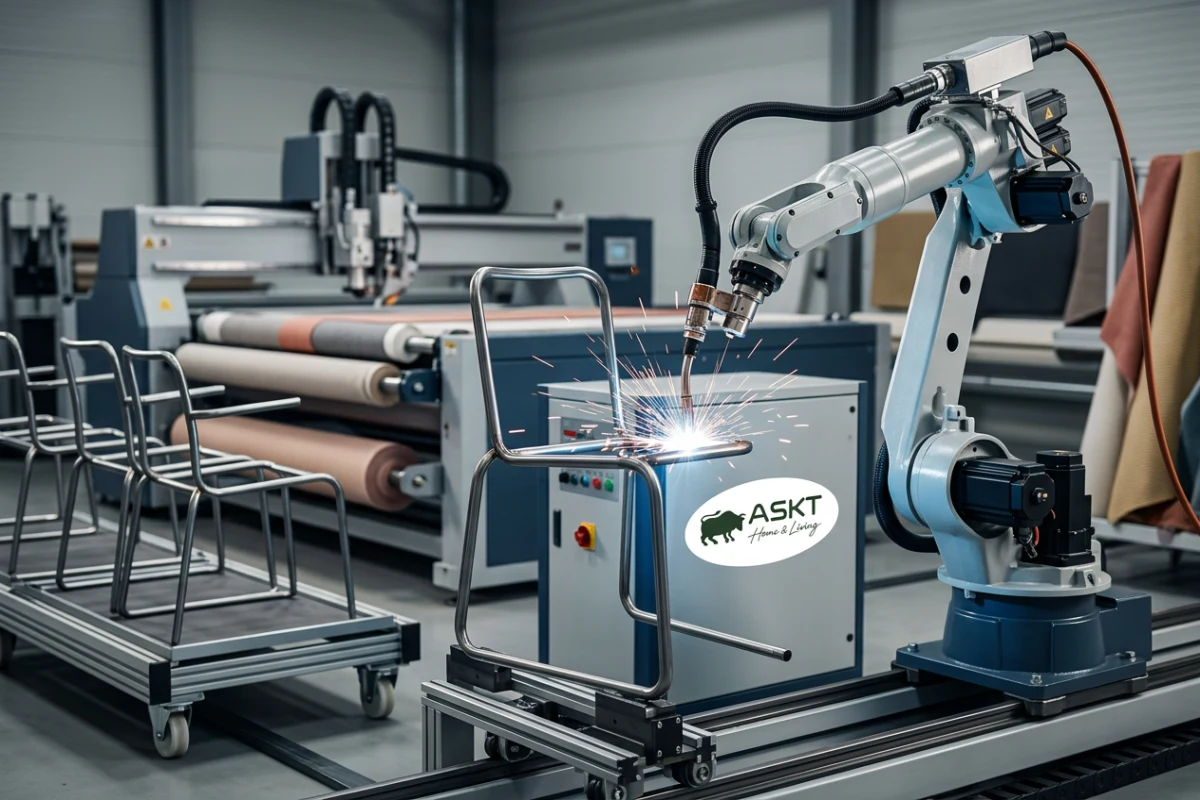
Professional dining chair manufacturing involves distinct fabrication stages across metal framing, internal shell construction, foam processing, fabric cutting, and final upholstery. During the physical walk-through, buyers should focus on specific machinery:
- Fabric and Upholstery Processing: Inspect whether the factory uses automated cutting machinery or relies solely on manual hand-cutting with shears. Automated fabric cutting machines ensure that multi-layer fabric panels maintain identical dimensions, which prevents puckering, loose corners, and asymmetrical sewing lines across bulk dining chair production.
- Wooden Shell and Internal Component Preparation: For upholstered chairs with internal curved plywood or composite shells, inspect the hole-punching and fastener insertion equipment. Dedicated board punching machines and automated four-legged insert nut nailing machines guarantee precise screw hole positioning and strong fastener retention, preventing stripped threads or loose fittings during knock-down (KD) assembly.
- Metal Frame Fabrication and Welding: Metal-frame dining chairs, cantilever bases, and dining chair legs require clean, uniform joints. Check whether the facility uses automated robotic welding arms alongside manual welding stations. Robotic welding ensures deep weld penetration and eliminates burn-through, creating structural joints capable of supporting repeated dynamic loads without cracking.
- Metal Surface Pretreatment and Powder Coating: Examine the factory's surface finishing lines. High-quality manufacturers run continuous electrostatic powder coating lines with multi-stage surface pretreatment and degreasing tanks. Proper pretreatment ensures powder coat adhesion, preventing surface peeling, flaking, or corrosion during sea freight transit and domestic use.
| Production Stage | Basic Manual Method | Advanced Automated Capability | Impact on European Buyer Quality |
|---|---|---|---|
| Fabric Cutting | Manual shears / handheld blades | Computerized multi-ply cutting machines | Uniform seam tension, zero pattern distortion, consistent batch fit |
| Shell Board Preparation | Manual hand drilling | Batch punching and automated fastener machines | Exact KD bolt hole alignment, high hardware pull-out strength |
| Metal Leg Fabrication | Manual spot welding | Automatic robotic welding arms | Consistent structural strength, clean weld beads, zero joint failure |
| Frame Surface Coating | Manual spray booth | Automated electrostatic powder coating line | Uniform coating thickness, high scratch resistance, anti-corrosion protection |
| Upholstery Assembly | Freehand stretching | Molded foam jigs and pneumatic tensioning tools | Smooth fabric edges, wrinkle-free curves, uniform piping lines |
How should European buyers assess OEM and ODM product development capabilities?
European furniture supplier selection depends heavily on an enterprise's engineering depth and design adaptability. Furniture wholesalers and retail chains frequently require custom fabric selections, exclusive metal base configurations, altered seat dimensions, or fully custom ODM models tailored to European domestic and contract living spaces.
During a factory audit, evaluate how the manufacturer translates conceptual product briefs into mass-producible dining furniture:
- Ergonomic Understanding for European Body Profiles: Review the supplier's technical drawings. Dining chairs destined for Germany, the UK, the Netherlands, and Northern Europe must conform to regional ergonomic proportions. Sourcing teams should verify seat height, seat depth, backrest angle curvature, and lumbar support to ensure comfort during prolonged dining. Furthermore, armrest clearance must be calculated accurately to slide neatly under standard European dining tables.
- Engineering of Internal Seat Structures: Low-cost chairs frequently rely on thin, low-density foam glued directly over plain boards, which leads to foam compression and sagging within months. Assess whether the manufacturer can engineer advanced seating cores, such as combining high-resilient foam with integrated pocket spring seating units or curved ergonomic inner shells that maintain elasticity and support over years of daily use.
- Mechanism Precision and Moving Parts: For chairs equipped with 360-degree swivel bases or auto-return mechanisms, audit the mechanical tolerance and assembly jigs. Swivel and auto-return mechanisms must operate smoothly and silently, returning accurately to the starting position without mechanical wobble or clicking noises.
- Customization and Material Versatility: Inspect the manufacturer's range of upholstery options. Reliable OEM/ODM partners offer extensive fabric libraries, including linen-look weaves, velvets, bouclé, easy-clean and waterproof textiles, pet-friendly abrasion-resistant fabrics, and faux leathers, alongside diverse metal finishes such as matte black, brushed steel, textured powder coats, and wood-grain transfer options.
- Sample Replication Consistency: Request to see a historical comparison between the initial prototype sample and a randomly selected unit from a mass production batch. Reputable manufacturers maintain strict technical specification sheets (tech packs) and golden sample archives to ensure production lines follow identical assembly parameters.
What in-house quality control workflows and testing procedures are necessary?
A robust b2b furniture quality control audit must examine the factory's quality management system across three mandatory operational phases: Incoming Quality Control (IQC), In-Process Quality Control (IPQC), and Final Quality Control (FQC).
1. Incoming Raw Material Inspection (IQC)
- Fabric and Leather Testing: Check whether incoming fabric rolls are inspected for color consistency, yarn defects, and structural flaws. Inquire about laboratory test reports for Martindale abrasion resistance, pilling resistance, tensile strength, and color fastness to light and rubbing.
- Foam Density and Adhesives: Verify that foam shipments are checked for uniform density and resilience. Inspect the adhesives used in foam-to-shell bonding; factories should use eco-friendly, low-VOC, and formaldehyde-free glues to prevent offensive chemical odors from accumulating inside sealed ocean shipping containers.
- Metal Tubing and Hardware: Audit the inspection logs for incoming steel tubing wall thickness, threaded bolt inserts, leveling glides, and assembly hardware.
2. In-Process Quality Control (IPQC)
- Frame Dimensional Stability and Jigs: Inspect the metal welding jigs. Clamping jigs must hold steel tubes in exact positions during welding to ensure four chair legs rest completely flat on level surfaces without diagonal rocking.
- Weld Seam Inspection: Assess how operators check weld strength, grind down spatter, and prepare surfaces before coating.
- Upholstery Stitching and Piping Alignment: Monitor active assembly lines to verify that sewing seams are straight, stitch counts per inch remain uniform, and fabric tension is distributed evenly across curved contours.
3. Structural Durability and Mechanical Testing (FQC)
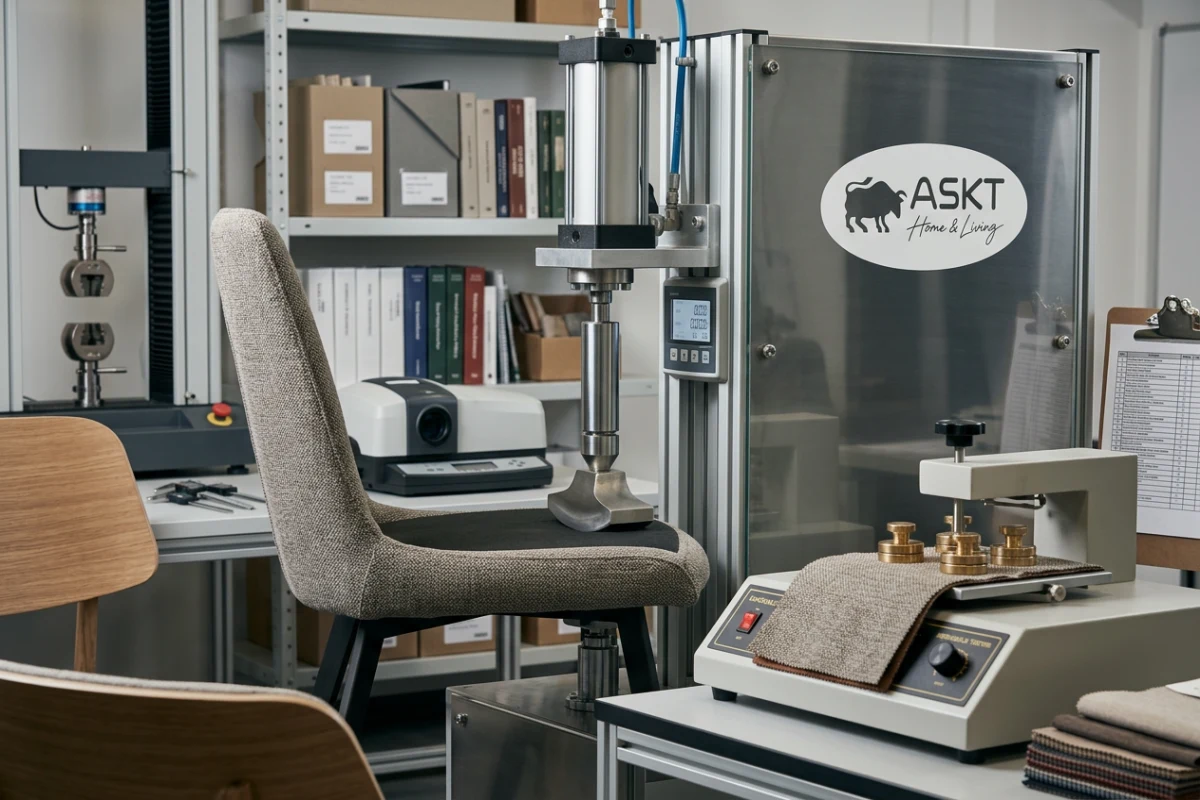
European buyers must confirm that furniture meets strict mechanical safety and durability standards. Inquire whether the factory operates an internal testing laboratory equipped with dynamic mechanical testing rigs to evaluate compliance with European domestic and contract seating standards:
- Static Load Testing: Verifying that chair seats and backrests can support heavy static downward and rearward loads without permanent frame deformation or structural joint failure.
- Dynamic Fatigue Testing: Subjecting chair seats, backrests, and swivel mechanisms to tens of thousands of repeated load cycles to simulate years of intensive daily use.
- Drop Impact Resistance: Verifying that internal frames, pocket spring units, and base plates withstand heavy shock impacts without fracturing or detaching.
How do packaging engineering and container loading optimization protect buyer margins?
Packaging design is an essential pillar of the supplier audit. Even the highest-quality dining chair will generate heavy warranty losses if it suffers transit damage during ocean freight, port handling, container transshipment, or parcel delivery across European road networks.
Evaluating Transit Packaging and Drop Testing
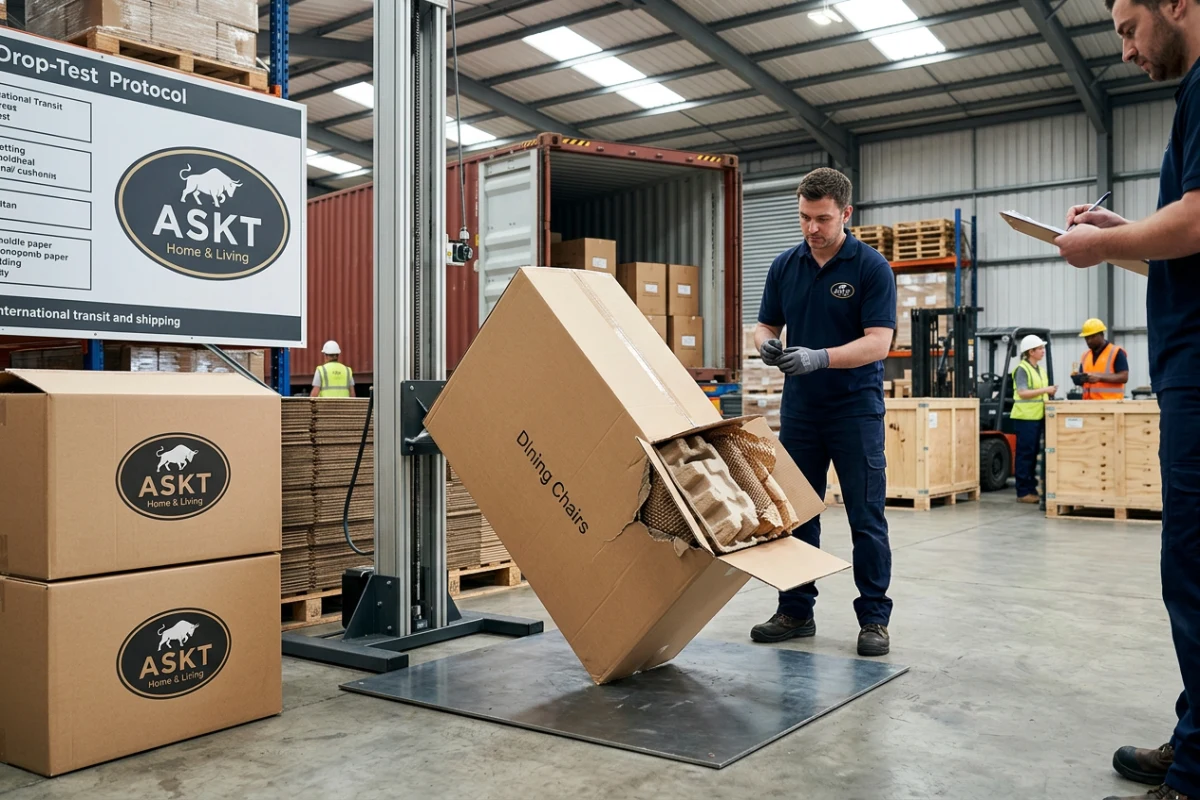
A comprehensive factory audit requires inspecting the packaging department and observing standardized packaging drop tests:
- Carton Specification: Ensure the factory utilizes high-strength, multi-layer corrugated cardboard boxes (such as 5-ply double-wall cartons) designed to resist vertical stacking compression during high-cube container transit.
- Internal Cushioning and Surface Shielding: Verify how delicate chair components are separated inside the carton. Metal legs should be individually wrapped with protective foam sleeves; seat shells require non-abrasive protective bags; and corners must be reinforced with edge protectors or sustainable honeycomb paper padding rather than fragile single-use plastic wraps.
- Hardware Pack Containment: Assembly hardware packs (screws, washers, Allen keys, leveling foot caps) must be securely sealed in heavy-gauge blister packs or dedicated hardware boxes and fastened to the inner carton wall to prevent loose metal parts from scratching upholstery surfaces.
- Packaging Drop Test Protocols: The supplier should demonstrate a standardized carton drop test sequence, dropping a fully packed carton onto its most vulnerable corner, surrounding edges, and flat faces. After testing, the carton is opened to verify zero upholstery tears, zero bent metal components, and intact hardware packages.
Knock-Down (KD) Engineering and Container Optimization
Ocean freight represents a substantial portion of the landed cost for European furniture importers. Sourcing teams must audit how the manufacturer engineers Knock-Down (KD) structures to reduce packaging volume (CBM):
- Flat-Pack Efficiency: A well-engineered KD dining chair separates the upholstered seat shell from the metal leg subframe, allowing shells to nest closely and leg assemblies to pack compactly in a single carton.
- Loading Capacity Maximization: Compared to fully assembled chairs that fill shipping containers with empty air, optimized KD packaging can more than double the number of chairs loaded into a 40ft High Cube container, dramatically lowering the freight cost per unit.
- Container Loading Plans: Evaluate whether the factory uses professional container loading software to plan efficient stacking patterns, ensuring weight is evenly distributed and cartons fit snugly without shifting in transit.
How should buyers audit environmental compliance, material sustainability, and social responsibility?
European retailers, wholesalers, and contract buyers face strict legal and corporate requirements regarding environmental protection, material safety, and ethical supply chains. A supplier audit must verify that the manufacturing partner complies with transparent environmental and social governance practices.
- Chemical and Material Safety: Ensure that raw materials comply with European chemical safety regulations. Upholstery fabrics, foams, and interior composite boards must be free of harmful chemical substances and toxic off-gassing. Buyers should check certifications such as OEKO-TEX for fabrics and verify that low-emission adhesives are used throughout the upholstery workshop.
- Sustainable and Recycled Materials: As European consumers demand sustainable furniture solutions, assess whether the factory offers eco-friendly material alternatives, including circular fabrics manufactured from recycled plastic bottles (rPET), responsibly sourced wood components, and packaging systems utilizing recycled paper and reduced plastic wrap.
- Factory Working Conditions and Ethical Labor: Audit the factory floor for basic workplace safety, fire exits, ventilation in gluing and painting areas, and proper personal protective equipment for machine operators. Reputable B2B manufacturers maintain transparent labor practices and hold third-party social compliance audit credentials, such as BSCI, demonstrating fair working hours and safe operating environments.
Practical Dining Chair Supplier Audit Checklist for European Sourcing
Use this consolidated audit table when conducting on-site factory evaluations or reviewing third-party inspection reports across overseas manufacturing partners:
| Audit Category | Evaluation Checkpoint | Verification Method | European Market Standard / Requirement |
|---|---|---|---|
| 1. Facility & Equipment | Automated fabric cutting | Direct workshop inspection | Multi-ply computerized cutting for identical fabric panel dimensions |
| Shell preparation & punching | Machine inventory check | Dedicated board punching and automated 4-legged fastener insertion machines | |
| Metal frame fabrication | Metal workshop inspection | Automated robotic welding arms for clean, consistent, high-strength weld beads | |
| Surface coating line | Finishing department check | Multi-stage pretreatment with continuous electrostatic powder coating line | |
| 2. Materials & Upholstery | Fabric durability and safety | IQC lab reports & certificates | Tested for Martindale abrasion, color fastness, stain resistance; chemical safety |
| Internal seat construction | Prototype teardown inspection | High-density resilient foam, ergonomic curved boards, integrated pocket spring units | |
| Bonding adhesives | IQC chemical review | Eco-friendly, formaldehyde-free, low-VOC glues to prevent transit odor | |
| 3. Structural QC & Testing | Static and dynamic load strength | On-site mechanical testing rig | Compliance with European mechanical durability and safety standards |
| Frame stability & alignment | Flat floor inspection jigs | Zero leg wobble, precise diagonal symmetry, exact screw hole tolerances | |
| Motion & swivel hardware | Cycle testing fixtures | Smooth 360-degree rotation, precise auto-return zero positioning, zero wobble | |
| 4. Packaging & Logistics | Transit carton durability | Material check & burst test | Heavy-duty 5-ply double-wall corrugated shipping boxes |
| Transit shock resistance | Standardized drop test sequence | Drop testing on corner, edges, and faces with zero internal product damage | |
| KD container loading efficiency | Packaging CBM calculations | Optimized nested KD packing to maximize unit count per 40ft High Cube container | |
| 5. Sustainability & Ethics | Workplace safety & social compliance | Factory tour & audit reports | Safe working conditions, proper ventilation, ethical labor standards (e.g., BSCI) |
| Sustainable material options | Material catalog review | Availability of fabrics from recycled materials and reduced-plastic packaging |
How does a modular product architecture reduce procurement risk for European buyers?
Managing minimum order quantities (MOQs) across diverse retail product lines presents a recurring operational challenge for European furniture wholesalers, retail buyers, and e-commerce brands. Committing an entire 40ft shipping container to a single dining chair design or fixed fabric color increases inventory holding risk if market demand shifts.
To overcome this commercial friction, forward-thinking B2B manufacturers develop modular seating systems. By standardizing universal mounting plates and KD connection points across a wide range of interchangeable seat shells and metal base frames (such as static four-leg frames, cantilever bases, sled bases, and auto-return swivel assemblies), buyers can combine multiple seat shapes, fabric textures, and frame finishes within a single container order.
This modular approach enables European procurement teams to test new upholstery colors and base designs in local markets with minimal inventory exposure before scaling up volume orders. When auditing a potential manufacturing partner, evaluating their modular engineering capability provides a clear indicator of how effectively they can support your long-term supply chain flexibility and commercial growth.
Frequently Asked Questions
What are the primary structural and mechanical requirements for dining chairs imported into Europe?
Dining chairs imported for European domestic and contract markets must satisfy rigorous mechanical safety, static strength, stability, and cyclic fatigue requirements. Structural testing involves verifying that frames, seat platforms, and backrests can withstand repeated dynamic load cycles and static weight loads without frame bending, joint cracking, or fastener loosening. Testing also verifies that leg bases remain perfectly balanced to prevent rocking or tipping during everyday use.
Why should European buyers audit upholstery fabrics for chemical safety and abrasion resistance?
European consumers and commercial contract clients demand durable, safe textiles. Fabrics must undergo standardized laboratory testing for Martindale abrasion resistance to prevent premature surface wear, pilling, or fabric thinning. Furthermore, chemical safety verification ensures that upholstery fabrics, foams, and bonding adhesives are free of hazardous substances, heavy metals, and formaldehyde, eliminating chemical off-gassing risks inside sealed shipping containers and ensuring full compliance with European consumer safety regulations.
What are the most common red flags during a dining chair factory audit?
Key warning signs during a factory audit include: exclusive reliance on manual hand-cutting and manual spot welding for large volume orders; absence of documented Incoming Quality Control (IQC) records for fabrics, foams, and steel; lack of on-site mechanical load testing equipment; noticeable solvent or glue odors in the upholstery workshop; damaged or uncalibrated welding jigs that cause uneven chair legs; and inadequate protective packaging that fails standard transit drop tests.
How does Knock-Down (KD) design improve container loading and reduce shipping costs?
A well-engineered KD dining chair structure allows the seat shell and the metal base frame to separate cleanly and pack flat in a nested arrangement inside a single carton. This reduces the carton cubic meters (CBM) compared to fully assembled chairs. By minimizing wasted air space inside the shipping box, European importers can significantly increase the total unit count loaded into a 40ft High Cube container, dramatically lowering maritime freight costs per unit and maximizing warehouse storage efficiency.
If you are currently preparing a factory audit or evaluating overseas manufacturing partners for upcoming dining furniture collections, Senden Sie uns Ihre Lieferanten-Checkliste – wir beantworten die technischen und kommerziellen Punkte strukturiert.