
Dining Table Chair Dimensions: A Practical Sizing Guide for European Furniture Buyers
If you have ever sat at a dining table where your knees hit the apron, your elbows were too high, or you had to squeeze past the person next to you, you already understand why dining table chair dimensions are not a small detail. For a household, it is an annoying meal. For a European furniture wholesaler, retail chain or contract buyer, a sizing mismatch is a commercial problem that shows up in returns, complaints, rework and damaged brand reputation.
Over the years, I have seen too many good product collections fail not because of fabric quality or frame design, but because someone picked a table and chair set based only on looks and price, without checking the real dimensional relationship between them. In this guide, I will break down the key sizing rules that matter when sourcing dining furniture for European markets, and explain why each dimension affects your bottom line.
Why Matching Dining Table and Chair Dimensions Matters for B2B Buyers
A dining set is a system, not two separate products. When the chair and table do not fit together ergonomically, every other feature — fabric, colour, frame style — becomes less important. The customer either sends it back, leaves a negative review, or simply never buys from you again.
For B2B buyers, the stakes are higher than they look at first glance. First, there is the direct cost of returns and replacements, which eat into margins quickly, especially when goods have been shipped across long distances. Second, there is the cost of customer service time and warehouse handling. Third, and most damaging in the long run, there is the reputational cost. Retailers live on repeat business and reviews. Wholesalers live on retailer trust. A pattern of sizing complaints can cost you accounts.
There is also a category management angle. If you sell sets as a matched package, customers reasonably expect them to work together. If the chair seat is too high, or there is not enough knee space under the table, you are not just selling an uncomfortable product — you are selling a mismarketed one. That is why professional buyers treat dimensional compatibility as a non-negotiable quality check, not a styling detail.
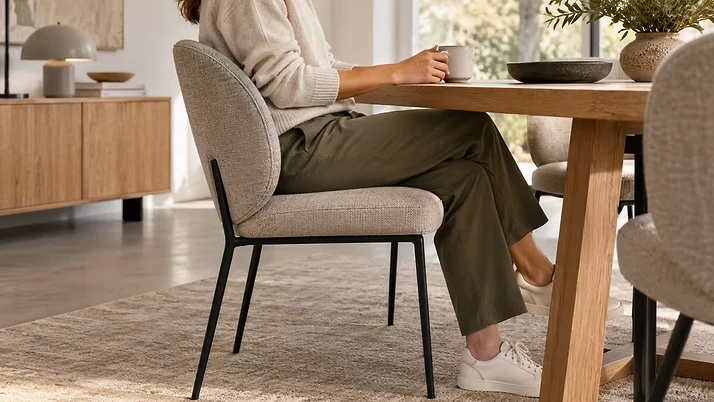
Standard Dining Table Heights and Corresponding Seat Heights
The foundation of a good dining table and chair height match is the relationship between table top height and seat top height. Most European dining tables fall within a common height range, and most dining chairs are designed to complement that range. But "common range" is not the same as "guaranteed fit", and that is where sourcing mistakes happen.
How height matching actually works
The basic principle is simple: the seat should be low enough that diners can comfortably reach the table top with their elbows and forearms, but high enough that their legs are not dangling and their posture is supported. The difference between table height and seat height is the critical number, not either measurement on its own.
For buyers evaluating a new collection, the practical lesson is this: never match a table and chair by reading two separate product spec sheets and assuming they will work. Always check the gap between the seat surface and the underside of the table, and make sure that gap includes enough space for thighs plus a comfortable movement margin. Upholstered chairs with pocket spring seating, for example, compress under body weight, so the effective seat height in use is lower than the nominal measured height. That is a good thing for comfort, but it has to be accounted for in the specification.
Why standard dining chair seat height is not a single number
You will often see references to a standard dining chair seat height, and there is a typical range that most manufacturers follow. But within that range there is real variation, and that variation matters. Wooden seat chairs tend to sit at one part of the range. Upholstered chairs with foam or pocket spring interiors sit at another. Chairs with metal frames and adjustable feet can be fine-tuned slightly, but only within a small window.
For European markets, where dining furniture is used across home, hospitality and contract settings, buyers need to be even more careful. A chair that feels just right in a domestic dining room may be too low for a café table that customers use for quick meals and laptops. A chair chosen for a high-end restaurant may work beautifully with a solid wood table, but not with a sintered stone top that sits on a thicker frame structure. Every combination has to be tested as a pair.
Legroom, Knee Clearance and Table Overlap Rules
Height is only half the story. The other half is what happens under the table, and this is where a lot of dining sets fall apart. Dining table legroom dimensions are easy to forget when you are looking at product photos and fabric swatches, but they are the first thing a customer notices when they sit down.
What legroom really means
When we talk about legroom in a dining setting, we are actually talking about three different measurements. First, there is vertical knee clearance — the space between the top of the seat and the bottom of the table apron or frame. Second, there is depth clearance — how far back under the table your knees and thighs can go without hitting a support beam or leg. Third, there is width between table legs, which determines whether two people sitting next to each other have room for their legs without knocking knees.
For buyers, the most common mistake is checking only table top height and seat height, and forgetting that the apron — the horizontal panel or rail under the table top — can reduce usable space dramatically. A table that looks perfectly sized on paper can feel cramped in real use because the apron sits unusually low. This is especially true with certain table styles, including some solid wood designs and tables with thick sintered stone tops mounted on supporting frames.
The table overlap rule
Another dimension that is rarely talked about but extremely important in practice is chair-to-table overlap. In simple terms, this is how far the chair seat can slide under the table edge when not in use. It matters because it affects how much floor space is needed around the table, how easy it is to push chairs in neatly, and how the room looks when the dining set is not being used.
For retail buyers, overlap directly affects customer satisfaction in smaller European homes and apartments, where dining space is often limited. For contract and hospitality buyers, it affects cleaning routines, aisle width and how easily staff can move between tables. It is one of those small details that separates a thoughtfully specified dining set from a casually assembled one.
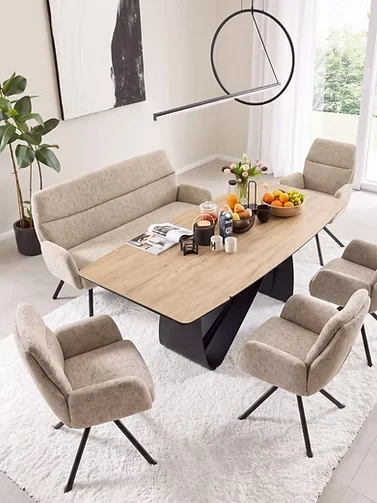
Seat Width and Dining Chair Spacing Per Table Length
If height and legroom are about individual comfort, seat width and spacing are about how the whole table works as a group. Dining chair spacing per table length is one of the most frequent sources of customer complaints, because what looks right in a product render does not always feel right in real life.
Why seat width is not the same as occupied width
A chair's stated seat width is the width of the seat cushion or seat shell. But the actual space a person takes up at the table is wider. Arms, shoulders, elbows and movement all add to the footprint. If you place chairs exactly seat-width apart along a table, diners will feel cramped. They will bump elbows. They will have trouble getting in and out. And they will blame the table, the chairs, or both.
For B2B buyers, the rule of thumb is to think in terms of occupied width per diner, not seat width per chair. The exact number depends on the chair style — armless chairs take less space, armchairs take significantly more — and on the market you are selling into. In some European markets, customers expect generous personal space at the table. In hospitality settings, density is a commercial consideration, but comfort still sets the floor for what is acceptable.
How to calculate chair spacing correctly
Calculating dining chair spacing per table length properly means starting from the table, not from the chair. First, decide how many place settings you want to market the table for. Then work backwards to see what chair width allows that number without overcrowding. Remember to leave space at the ends of the table, and remember that table legs reduce usable length if they are inset from the edge.
Rectangular tables are the most straightforward, but they still have pitfalls. Many buyers assume that if a table is a certain length, a certain number of chairs will fit, without checking where the legs are positioned. Round tables are trickier, because the available edge space curves away and seating has to follow the shape. Extension tables are the most complex of all, because the spacing changes depending on whether the table is fully extended, partially extended or closed.
Common Dining Set Dimension Combinations for European Markets
European dining habits vary by country and by setting, but there are some common combinations that perform well across markets. Understanding these standard configurations helps buyers make faster, safer choices when building a collection.
Four-seater and six-seater rectangular sets
The four-seater rectangular dining set is a staple in urban apartments and smaller homes. It is also one of the categories where sizing errors are most frequent, because manufacturers sometimes push the table as far down in size as possible to hit a price point, without leaving enough room for comfortable seating or movement. Buyers should pay special attention to chair width and overhang in this size range.
Six-seater sets are the workhorse of the European dining furniture market, common in family homes, mid-range restaurants and office canteens. At this size, dining chair spacing per table length becomes the most critical dimension, because three chairs per side leaves very little margin for error. If the chairs are even slightly too wide, the middle diner will feel squeezed.
Round and extendable sets
Round tables are popular in smaller dining rooms and in hospitality settings because they encourage conversation and use space efficiently. But dimensional matching is different with round tables. Chair spacing follows the curve, legroom depends on the base design, and the number of people you can comfortably seat changes more with chair style than it does with rectangular tables.
Extendable tables add another layer of complexity, because they have to work well in both closed and extended positions. A chair that fits perfectly when the table is fully open may feel cramped when it is closed, or vice versa. Buyers sourcing extendable sets should always test both configurations, not just the fully extended one.
How to Avoid Sizing Mistakes When Sourcing Dining Sets
Now that we have covered the key dimensions, let us look at what professional buyers actually do to prevent sizing mistakes. The best approach is not to trust spec sheets alone, but to build verification into your sourcing process.
Always test as a set, not as separate products
This is the single most important rule. A table and a chair that each meet their own individual specifications can still be a bad match when put together. The only way to know for sure is to test them as a pair, ideally with people of different heights and builds sitting in them. If you are buying sets to sell as matched packages, you should treat the combination test as part of your incoming quality process.
Check compressed height, not just nominal height
With upholstered chairs, especially those with pocket spring seating, the seat compresses when someone sits on it. That means the effective seat height in use is lower than the height you measure on an empty chair. For comfort, this is usually a good thing. But for height matching, it means you have to account for compression or you may end up with a dining table and chair height match that looks right on paper but feels too low in use.
Verify dining table legroom dimensions on real samples
Similarly, apron designs can sit lower at the centre than at the edges, and table structures behave differently once assembled. For contract and hospitality buyers, who need furniture to perform reliably over years of heavy use, checking legroom on physical samples is a basic part of due diligence. It is much cheaper to catch a problem at the sample stage than to fix it after a container has been shipped.
Document everything and communicate clearly to your customers
Finally, good dimensional specification is also good marketing. When you can tell your customers exactly how many chairs fit a table, what the seat height is, and how much knee clearance there is, you reduce returns, reduce customer service questions, and position yourself as a professional supplier. For online retailers in particular, clear dimensional diagrams and seating guides can make a measurable difference to conversion and return rates.
A Manufacturer's Perspective on Dimensional Quality Control
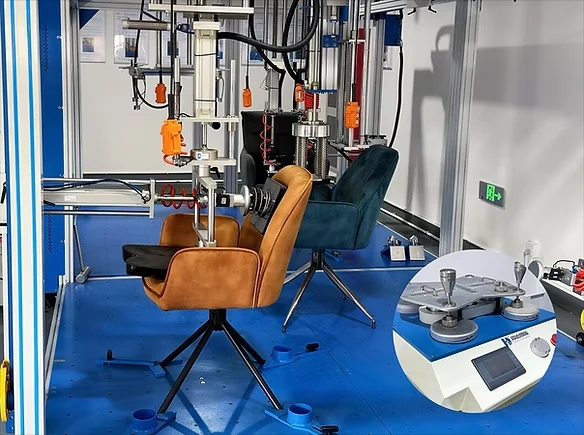
From a manufacturing standpoint, getting dining table chair dimensions right is not just about design — it is about process control. Small variations in frame welding, upholstery thickness, table top mounting or powder coating thickness can add up to noticeable differences in the final product. That is why serious manufacturers check key dimensions at multiple stages of production, not just at the end.
At ASKT, for example, we treat dimensional consistency as a core quality requirement for every dining collection we produce for European buyers. We verify chair heights, table heights, apron positions and spacing compatibility during sample development, at the start of mass production, and again during pre-shipment inspection. We also test matched sets with different user sizes to make sure the ergonomics work in real use, not just on a drawing. For buyers, this kind of systematic checking means fewer surprises at the warehouse, fewer complaints from end customers, and a more reliable product range over time.
When you are evaluating a potential supplier, one of the questions worth asking is how they control dimensional consistency across production batches. A supplier that can explain their measurement points, their tolerance ranges and their inspection process is more likely to deliver a product that matches your samples, your spec sheets and your customers' expectations. A supplier that cannot answer that question clearly may be relying on luck rather than process, and luck is a risky foundation for a long-term supply relationship.