Dining Table Edge Finishing Quality: B2B Technical Sourcing and Quality Control Guide
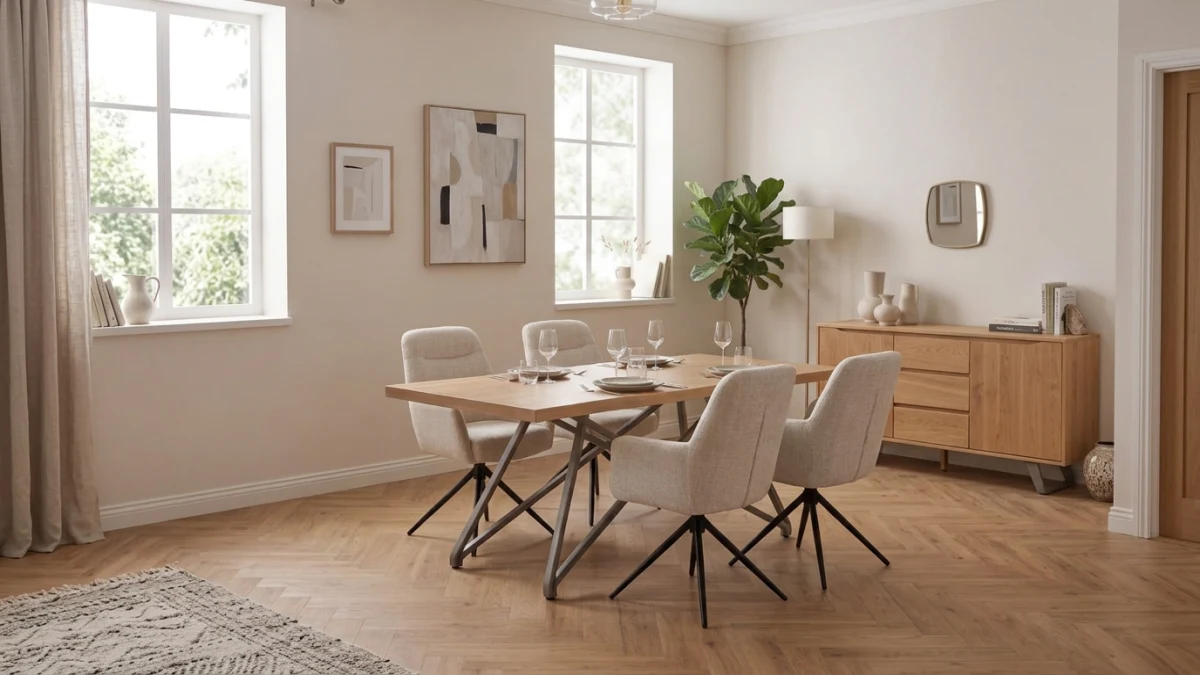
Dining table edge finishing quality is determined by precision edge profiling, durable adhesive bonding, and comprehensive moisture protection around the entire tabletop perimeter. In commercial furniture sourcing, high-quality edge execution prevents liquid penetration, stops core swelling, resists everyday impact wear, and ensures clean visual alignment. Reliable edge finishing directly reduces container transit damage, lowers retail return rates, and protects commercial margins across demanding European distribution channels.
Why Does Dining Table Edge Finishing Quality Impact Long-Term Commercial Success for European Buyers?
For European furniture wholesalers, retail chains, e-commerce brands, and contract furniture buyers across Germany, the Netherlands, the UK, Poland, Switzerland, and Ireland, the perimeter edge of a dining table is the most vulnerable structural and visual interface. While tabletop surfaces such as oak veneer or sintered stone capture immediate customer attention, the perimeter edge endures continuous physical stress throughout its lifecycle.
In daily residential and contract environments, table edges encounter recurring mechanical collisions from dining chairs, direct contact with dinnerware, frequent cleaning with damp cloths, and exposure to accidental liquid spills. If the edge finishing is executed poorly, small manufacturing defects quickly escalate into visible structural failures that damage brand reputation and increase warranty claims.
From a B2B supply chain perspective, sub-optimal edge finishing introduces multiple commercial and operational risks:
- Moisture Infiltration and Substrate Swelling: An unsealed or unevenly bonded edge allows ambient humidity and spilled liquids to penetrate engineered wood substrates, causing permanent swelling, surface bubbling, and delamination.
- Chipping and Corner Fracture: Brittle or overly sharp perimeter corners lack the impact resistance required for high-traffic dining rooms and hospitality venues, leading to chipped edges during everyday use.
- Aesthetic Degradation and Visible Glue Lines: Inconsistent trimming, rough glue lines, or telegraphing substrate imperfections degrade the perceived value of the furniture, making it difficult for retailers to maintain healthy commercial margins.
- Transit Vulnerability in Long-Distance Export: Fragile perimeter profiles are significantly more prone to crushing and friction wear during multi-leg container shipping, warehouse handling, and final-mile parcel delivery.
Prioritising robust dining table edge finishing quality during product development and supplier evaluation safeguards product durability. For commercial projects such as hotels and restaurants where dining furniture undergoes frequent turnover and rigorous daily cleaning, durable edge finishing ensures tables maintain their aesthetic appeal and structural performance over many years.
What Are the Key Tabletop Edge Banding Standards and Material Selections for Modern Dining Tables?
Tabletop edge banding standards vary depending on the underlying core substrate, the decorative surface finish, and the intended market segment. Sourcing teams must evaluate how different edging materials behave under mechanical stress and environmental exposure to select the most appropriate option for their product line.
| Tabletop Surface and Core Material | Typical Edge Finishing Solution | Primary Functional Benefit | Key Sourcing Considerations for Buyers |
|---|---|---|---|
| Oak Veneer over Engineered Board | Natural Wood Veneer Banding / Solid Wood Lipping | Authentic grain continuity, tactile natural texture, repairable surface | Requires precise moisture control and flexible backing to prevent veneer cracking along tight profile radiuses |
| Sintered Stone on Structural Substrate | Chamfered or Bevelled Sintered Edge with Matching Underlayer | Superior scratch resistance, high thermal stability, non-porous hygiene | Precision CNC edge polishing is essential to eliminate micro-chips and sharp perimeter stress points |
| High-Pressure Laminate or Melamine Board | Thermoplastic Edge Banding (ABS / Synthetic Banding) | High impact resilience, consistent colour matching, cost-effective production | Edge thickness selection determines impact absorption and the achievable radius profile for user comfort |
| Solid Hardwood Slab | Integrated Profiled Edge (Chamfer, Bevel, or Rounded) | Uniform material density, sandable finish, premium craftsmanship | Relies on controlled timber drying and protective lacquer sealing across end-grain perimeters |
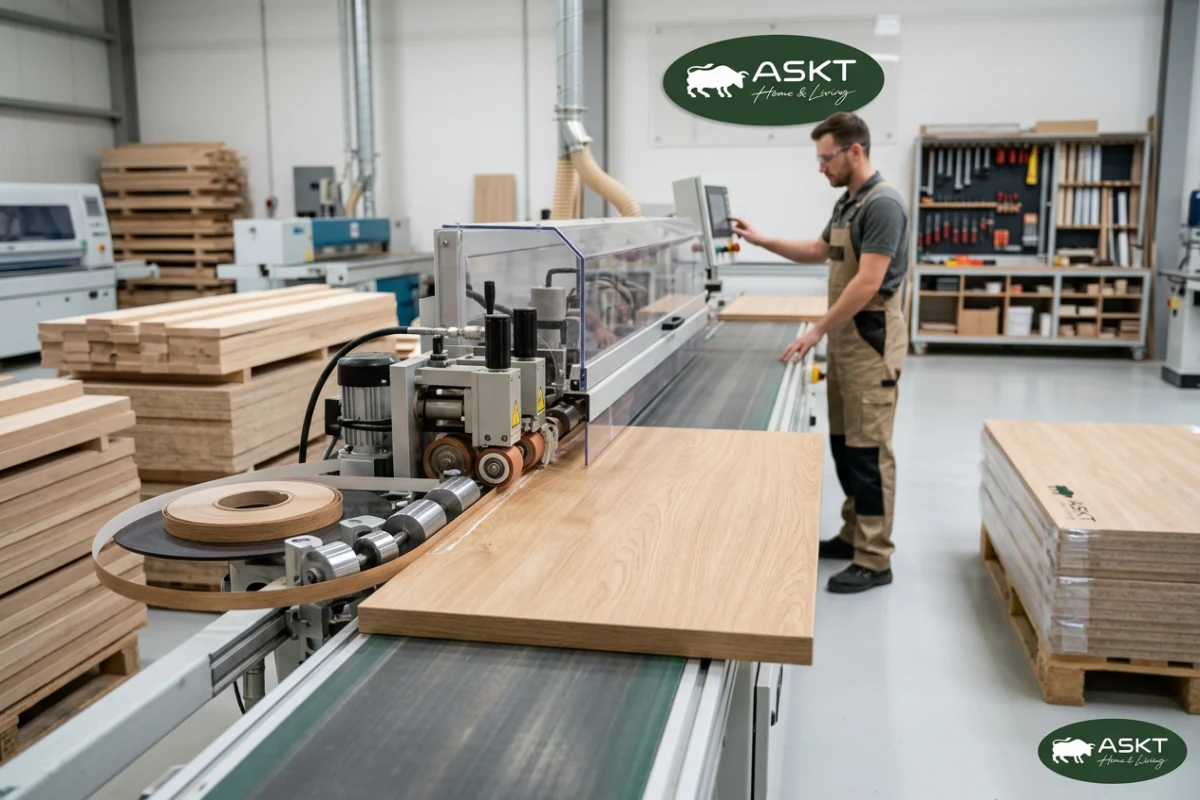
Thermoplastic Perimeter Banding
In contemporary furniture manufacturing for the European market, synthetic edge bandings such as ABS are widely specified for engineered wood tabletops. Thermoplastic edging offers high mechanical toughness, flexible processing across automated machinery, and excellent colour stability across large production volumes.
When reviewing thermoplastic edge specifications, professional buyers should evaluate two primary factors:
- Band Thickness and Impact Dispersal: Thicker bandings (such as 1.5 mm to 2.0 mm) allow automated edge banding machinery to mill a smooth, rounded radius along the top and bottom corners. This rounded profile disperses lateral impact from dining chairs and reduces corner chipping compared to thin 0.5 mm or 1.0 mm tapes.
- Cross-Sectional Colour Uniformity: High-grade thermoplastic bandings maintain solid pigmentation throughout their entire thickness. When trimmed and scraped during production, they do not develop pale stress marks along profiled corners, ensuring a clean, uniform perimeter appearance.
Natural Oak Veneer and Solid Wood Edging
For mid-to-high-end dining collections featuring oak veneer, edge finishing requires careful technical execution to maintain aesthetic harmony between the surface and the perimeter:
- Reinforced Veneer Banding: Incorporating a flexible backing layer onto natural wood veneer rolls prevents edge splintering when applying the tape along long table perimeters or gentle curve transitions.
- Solid Timber Lipping: Sourcing collections with solid wood edge lippings bonded to the engineered substrate before surface veneering provides a durable boundary. This construction allows deeper edge chamfering while protecting the softer internal core from side impacts.
How Does Dining Table Edge Bonding Moisture Resistance Prevent Delamination and Core Swelling?
A dining table's real-world longevity depends heavily on the adhesive technology used to secure perimeter edge bandings. Dining table edge bonding moisture resistance represents the critical barrier protecting internal wood fibers from ambient humidity, liquid contact, and cleaning agents.
In high-volume B2B manufacturing, edge bonding performance is governed by adhesive chemistry, glue line thickness, and machine pressure calibration:
Adhesive Technologies in Tabletop Production
Commercial furniture factories utilise various adhesive systems depending on target pricing, production capacity, and performance requirements:
- Standard Hot-Melt Adhesives: These thermoplastic glues provide fast open times and economical processing for standard residential dining tables. They form a reliable bond in climate-controlled environments but offer moderate resistance to prolonged standing water or intense localized heat.
- Reactive Moisture-Curing Adhesives: Polyurethane-based reactive adhesives chemically cross-link during curing, creating an exceptionally tight, heat-stable, and water-resistant bond. This adhesive system produces an ultra-thin glue line that significantly enhances dining table edge bonding moisture resistance, making it suitable for contract dining and extendable dining tables subject to regular liquid exposure.
- Zero-Joint Fusion Banding: Advanced hot-air or laser edge technologies activate a functional polymer layer pre-applied to the banding material. This eliminates traditional glue lines entirely, creating a seamless, non-porous fusion between the edge tape and tabletop core that provides maximum protection against moisture ingress and dirt accumulation.
Glue Line Precision and Application Control
Achieving durable moisture resistance requires strict control over adhesive spread rates during manufacturing. If too little adhesive is applied, microscopic voids remain along the edge seam, allowing spilled liquids to migrate into the core board. Conversely, excessive adhesive squeeze-out creates visible, uneven seams that attract dust and detract from the clean aesthetic expected by European consumers.
Professional manufacturing facilities calibrate glue dosage, edge pressure rollers, and trimming cutters to ensure a continuous, uniform adhesive seal across every linear metre of the tabletop.
What Edge Profiling and Structural Designs Minimize Surface Chipping and Impact Wear?
Edge finishing quality is not solely about adhesive performance; it also encompasses the geometric profile of the tabletop perimeter. The mechanical design of an edge directly influences how the dining table distributes impact forces from daily chair collisions and general handling.
Standard Profile Geometries and Their Functional Characteristics
- Square Ninety-Degree Edge: While visually minimalist and modern, a sharp ninety-degree edge concentrates mechanical stress along a fragile boundary line. It carries a higher risk of chipping during handling and can feel sharp against forearms during extended dining or working.
- Soft Radius Profile: Rounding the top and bottom corners of the edge banding creates a gentle radius that deflects incoming physical impacts. This geometry significantly improves resistance to chipping and enhances tactile comfort for the user.
- Chamfered Profile: A clean angled bevel cut along the perimeter edge removes vulnerable sharp corners while providing a refined, contemporary profile. Chamfering reduces direct surface contact when dining chairs are pushed beneath the table.
- Reverse-Bevel (Undercut) Profile: Angling the underside perimeter inward gives solid and veneered tabletops a light, floating appearance while keeping the bottom edge protected from direct lateral impact.
Extension Table Edge Matching
For extendable dining tables featuring leaf systems, edge finishing requires precise dimensional tolerance control. Extension leaves must feature perfectly matched edge profiles and identical perimeter thicknesses. If split edges differ in height or profile contour by even a fraction of a millimetre, the extended tabletop will display uneven seams and heightened vulnerability to localized impact wear.
How Do Sustainable Packaging Solutions Ensure Dining Table Transit Edge Protection During Export?
Even a tabletop with high manufacturing quality can arrive damaged if export packaging fails to protect perimeter edges during international logistics. Overseas container transport, port handling, and domestic distribution subject flat-packed furniture to continuous vibration, vertical compression, and corner drop impacts.
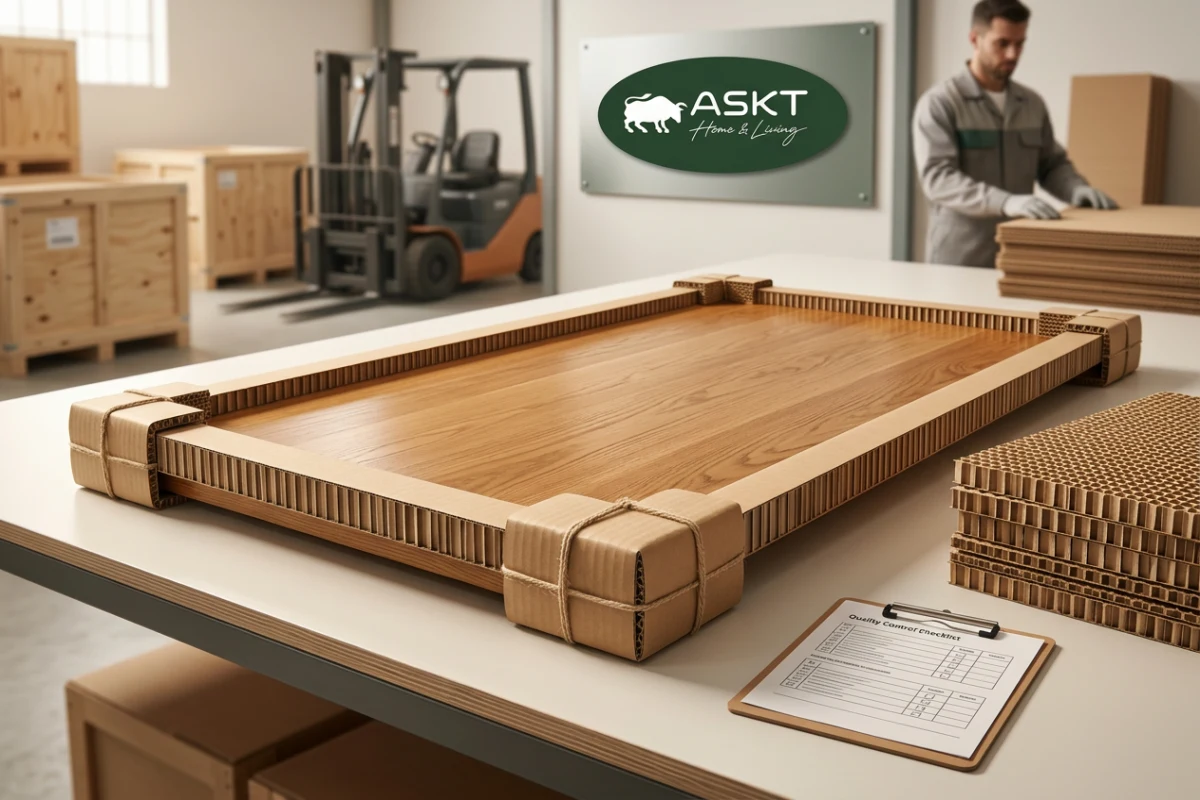
Ensuring dining table transit edge protection is a vital component of B2B supply chain reliability, directly reducing freight claims and reverse-logistics costs.
Perimeter and Corner Protection Strategies
Effective export packaging builds a protective buffer around the vulnerable tabletop perimeter without creating unnecessary bulk or unrecyclable waste:
- Full-Length Perimeter Edge Guards: Continuous U-profile channels encase the long and short edges of the tabletop, shielding the edge banding against lateral impacts and strap indentation during palletising and container loading.
- Reinforced Corner Protectors: Molded corner caps or multi-layer cardboard corner guards provide impact absorption at the four primary table corners, preventing corner crushing during handling and unloading.
- Internal Cushioning Layers: Smooth surface interleaving sheets prevent abrasive friction between flat-packed tabletops and knock-down (KD) metal frame components stored within the same carton.
Sustainable Packaging with Reduced Plastic Use
European retailers and purchasing groups face increasing regulatory and consumer pressure to minimise single-use plastic waste. Modern B2B furniture manufacturers support this transition by replacing conventional expanded polystyrene foam with recyclable cardboard engineering:
- Honeycomb Cardboard Frameworks: High-density honeycomb paper structures provide high compression resistance and shock dampening around tabletop edges while remaining fully recyclable in standard European paper waste streams.
- Fitted Corrugated Inserts: Precision-folded corrugated cardboard dividers hold knock-down components, such as metal legs and extension hardware, securely in place, preventing internal shifting during sea transit.
- Optimised Carton Sizing: Tailoring master cartons closely to the dimensions of flat-packed KD tables improves container loading efficiency, lowers shipping costs per unit, and reduces internal carton void space where movement could cause edge damage.
How Should Professional Sourcing Teams Implement B2B Dining Table Quality Control and Factory Inspection?
To ensure consistent edge quality across volume production runs, European sourcing managers, purchasing specialists, and quality inspectors must implement structured B2B dining table quality control protocols during factory audits and pre-shipment inspections.
Comprehensive Tabletop Edge Inspection Checklist
- Visual and Surface Inspection:
- Confirm glue lines are clean, continuous, and free from adhesive squeeze-out, voids, or dark residue.
- Verify that edge banding colour, texture, and sheen level match the primary tabletop surface seamlessly.
- Check for smooth, uniform profile trimming without chatter marks, steps, or rough cutter gouges.
- Inspect natural wood veneers for smooth transitions without grain tearing or splintering along bevelled edges.
- Dimensional and Alignment Verification:
- Measure perimeter thickness across multiple points to confirm consistent thickness across the entire table length.
- Verify that edge banding sits perfectly flush with the top surface without sharp overhangs or recessed steps.
- Check the alignment of extension table seams to ensure leaves fit tightly with uniform edge gaps.
- Adhesion and Mechanical Integrity:
- Verify adhesive bonding strength along straight perimeters and corner transitions to prevent edge peeling.
- Test edge stability under light mechanical deflection to ensure the banding does not separate from the core substrate.
- Inspect sintered stone tabletops for smooth, chip-free chamfered edges and secure bonding to supporting sub-layers.
- Moisture Barrier Evaluation:
- Check that all exposed core edges, including underside balancing layers and cutouts for extension hardware, are sealed against atmospheric moisture.
- Ensure surface lacquers and protective coatings extend uniformly over perimeter edge joints.
Integrating Durability and Structural Performance Testing
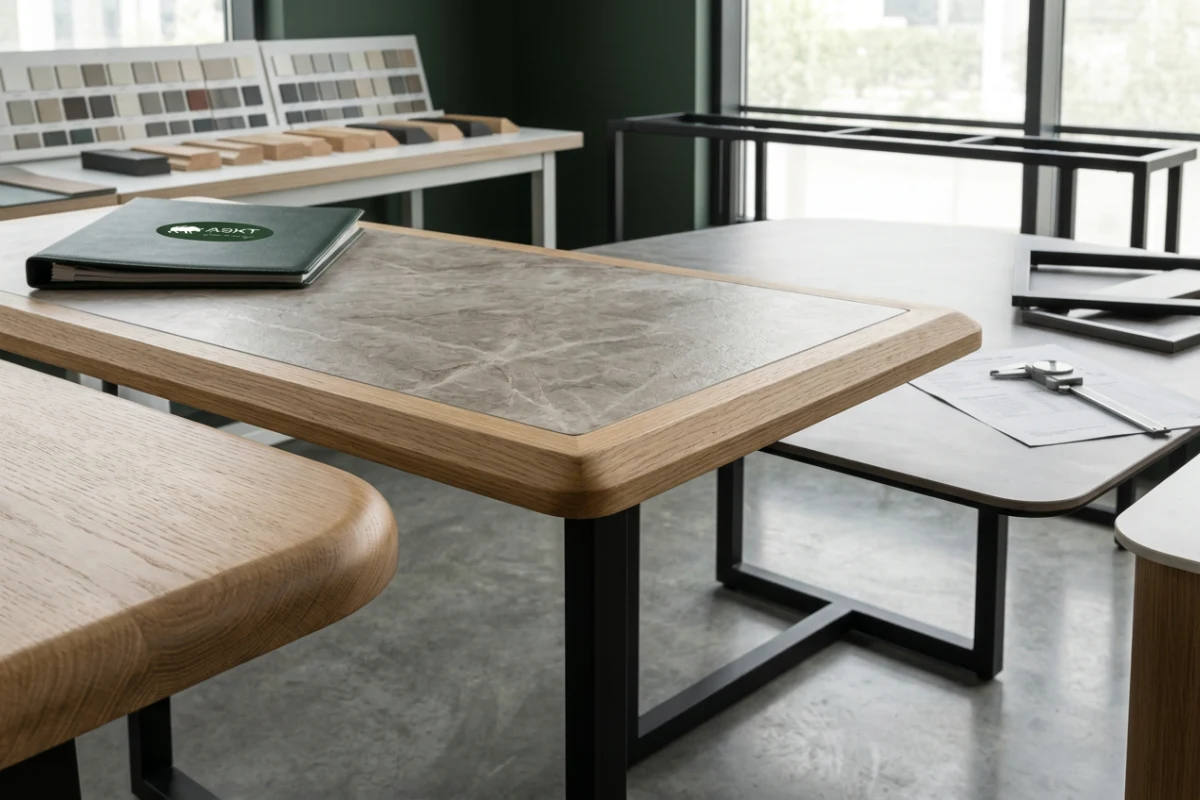
During the product development and sample approval stages, dining table designs should undergo structural performance and durability testing according to recognized EN standards for domestic and contract furniture. Evaluating edge stability under static load, impact, and repeated use ensures that tabletop assemblies, knock-down connection points, and extension mechanisms perform reliably throughout their commercial lifecycle.
How Do OEM and ODM Customization Capabilities Balance Aesthetics, Durability, and Logistics Efficiency?
Successful furniture sourcing requires balancing commercial design trends with practical manufacturing realities. Professional OEM and ODM manufacturing partners help European buyers tailor tabletop edge treatments to suit specific retail price points, regional customer preferences, and logistics requirements.
Customization Options Across Table Collections
OEM and ODM customization enables brands to develop differentiated dining collections across various materials and configurations:
- Surface and Edge Pairings: Sourcing teams can combine contemporary sintered stone or natural oak veneer tabletops with complementary edge profiles, such as clean straight cuts, elegant bevels, or rounded borders.
- Frame and Base Integration: Coordinating tabletop edge finishes with powder-coated metal frames, solid wood legs, or swivel and auto-return mechanisms creates cohesive dining ranges suitable for both residential homes and contract interiors.
- Extension System Engineering: Customising internal extension mechanisms and leaf edge finishing ensures smooth operation and visual consistency when tables are extended for larger gatherings.
Logistics and Container Optimization
Collaborating with an experienced export manufacturer allows buyers to optimize product engineering for efficient container loading. Designing dining tables with intelligent knock-down (KD) structures and protective edge packaging enables higher carton density per container, reducing international freight costs per unit and minimizing transit damage risk.
By establishing clear technical standards for edge materials, adhesive durability, profile geometry, and sustainable protective packaging, European furniture importers and retail buyers can build resilient, high-performing dining collections that deliver sustained commercial value.
For European furniture wholesalers, retail chains, and contract project buyers seeking dependable indoor furniture manufacturing and transparent quality control, discuss your edge and surface requirements with ASKT to develop commercially stable dining ranges built to European market standards.