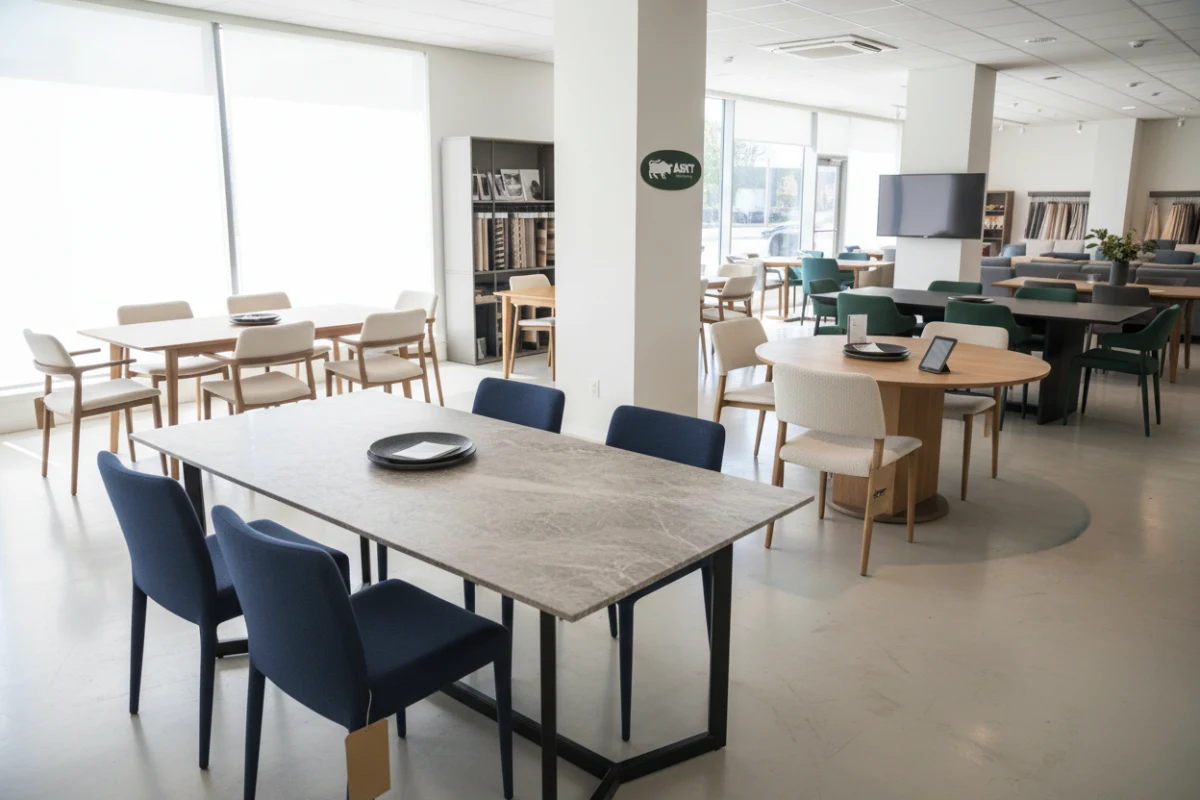
How to Evaluate a Dining Table Manufacturer in China: A Complete Sourcing Guide for European B2B Buyers
For European category managers, furniture importers, and retail chain buyers, sourcing furniture is fundamentally an exercise in risk management. In competitive retail landscapes across Germany, the UK, the Netherlands, and France, a single product defect, non-compliant finish, or instance of transit damage can quickly wipe out profit margins and harm your brand reputation.
While sourcing dining tables from China offers exceptional design versatility and scale, navigating the manufacturing landscape requires deep technical diligence. Moving past glossy catalogues to thoroughly assess a potential supplier's engineering processes, material compliance, and logistical capabilities is essential. Partnering with a specialized dining table manufacturer in China is the most reliable way to build a durable, commercially successful product line.
This guide explains the exact criteria professional B2B buyers must use when evaluating China furniture manufacturers, ensuring your next product launch is stable, compliant, and highly profitable.
Sourcing Dining Tables from China: Trading Companies vs. Direct Factories
Many European purchasing teams mistakenly source dining furniture through generalist trading companies or multi-category brokers. While these middlemen offer a wide product selection, they often lack direct control over the production line, leading to quality inconsistencies and communication delays.
When evaluating a dining table manufacturer in China, verifying that they are a direct manufacturer with dedicated production lines is critical. A specialized Chinese dining table factory invests in advanced machinery, raw material testing, and structured quality control processes. This direct oversight ensures consistent quality and allows for seamless customization to meet specific market demands.
| Evaluation Metric | Generalist Trading Company | Specialized Dining Table Manufacturer China |
|---|---|---|
| Quality Control Ownership | Relies on third-party inspectors or factory self-reporting | In-house QC team verifying every production stage |
| Customization (OEM/ODM) | Limited to pre-existing catalog variations | Deep customization of dimensions, finishes, and frames |
| Structural Engineering | Little to no input on internal structural joints | Dedicated engineering for strength and KD mechanisms |
| Packaging Design | Standard factory packaging with limited protection | Custom-engineered packaging designed for transit safety |
| Supply Chain Transparency | Hidden sub-contractors and variable material sources | Fully traceable raw materials and clear production updates |
Partnering directly with a dining table manufacturer in China gives you direct access to technical experts. This makes it easier to develop custom designs, adjust product dimensions, and ensure your shipments meet strict European market requirements.
Structural Engineering and Stability in Modern Table Manufacturing
A dining table must withstand constant daily stress, shifting loads, and environmental changes. For B2B buyers, a table's structural integrity must be objectively verified before it leaves the factory floor. Assessing structural engineering is a key step when evaluating China furniture manufacturers.
Robotic Welding and Metal Frame Consistency
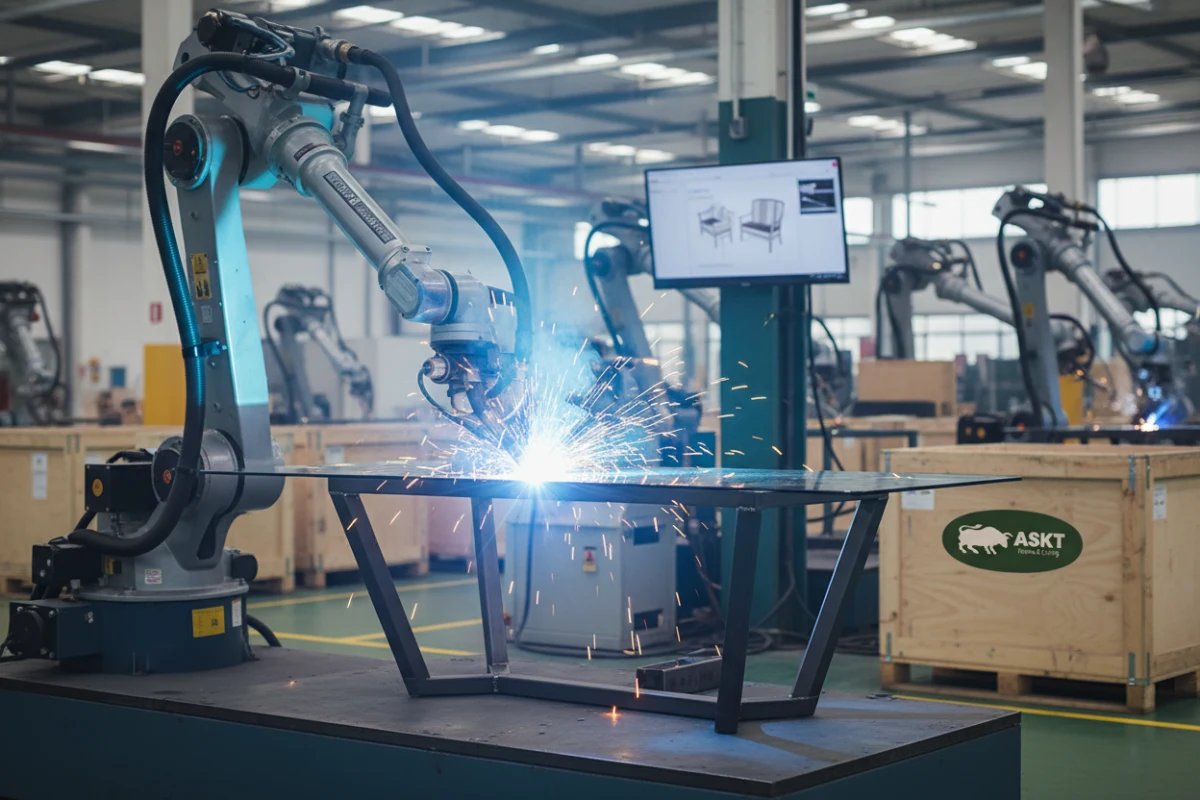
Many contemporary dining table designs feature heavy metal frames combined with sintered stone or wooden tops. When auditing a Chinese dining table factory, pay close attention to their metal fabrication and welding departments. Manual welding can introduce human error, resulting in weak joints, uneven surfaces, and potential structural failure under load.
To eliminate these risks, a professional dining table manufacturer in China will utilize automated welding robotic arms. Robotic welding ensures:
- Uniform Weld Seams: Consistent weld penetration across all structural joints for long-term durability.
- Zero Frame Deformation: Precise heat control prevents metal components from warping during assembly.
- Smooth Finishes: Flawless weld seams allow powder-coating finishes to adhere perfectly, protecting against rust, peeling, and chipping.
KD (Knock-Down) Structures: Balancing Stability and Logistics
Shipping fully assembled dining tables from Asia to Europe is financially impractical due to high container freight rates. Consequently, a table's KD (Knock-Down) structure must be highly engineered for efficiency and stability.
Poorly designed KD structures lead to table wobbling, difficult home assembly for end consumers, and increased product return rates. When sourcing dining tables from China, choose manufacturers that use high-quality hardware, such as precision-threaded metal inserts and heavy-duty steel brackets. These components must be robust enough to allow repeated assembly and disassembly without stripping the threads or weakening the joint connections. All designs should be thoroughly tested against European EN testing standards for domestic table strength, stability, and safety to guarantee retail-ready durability.
Evaluating China Furniture Manufacturers on Material Integrity and Compliance
The tabletop material is the most visible and heavily used part of any dining table. European environmental and chemical compliance standards require strict quality control on all raw materials used by a B2B dining table supplier.
Sintered Stone: The Ultimate High-Traffic Surface
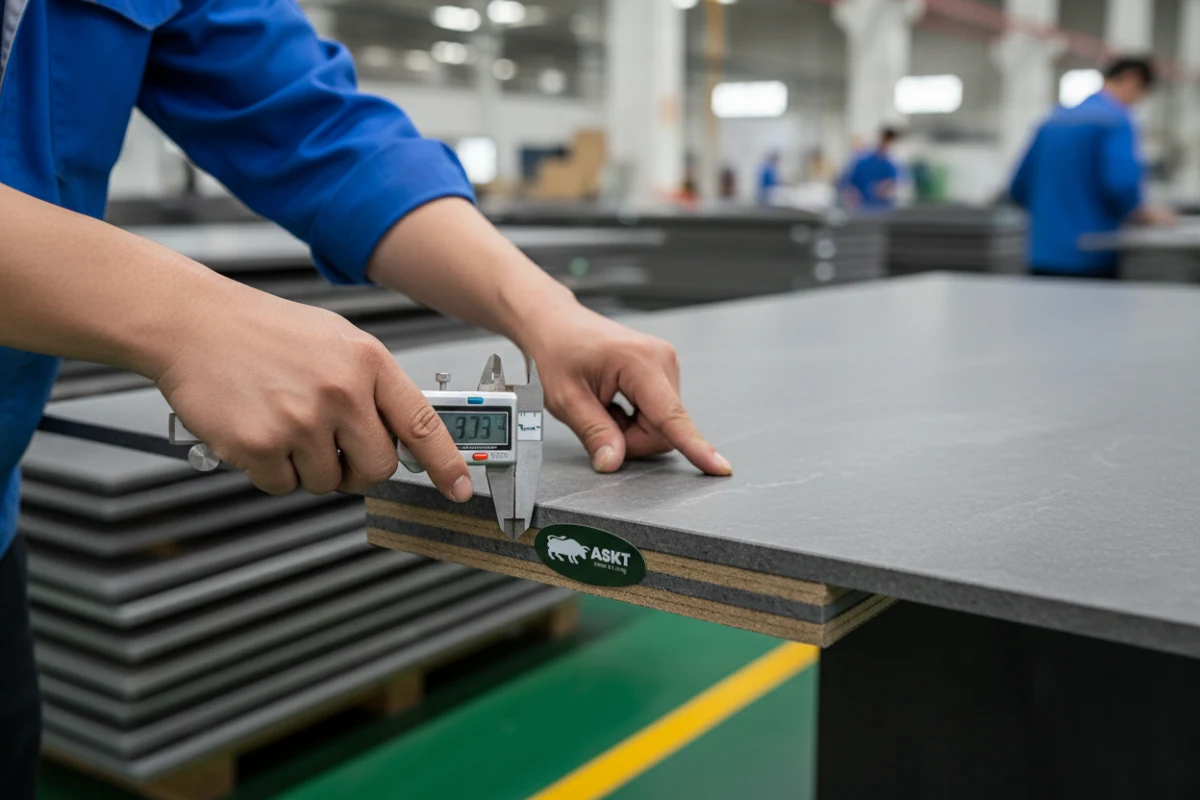
Sintered stone is highly popular in Europe due to its scratch-resistant, heatproof, and waterproof properties. However, because sintered stone is rigid, it requires proper structural support. A professional dining table manufacturer in China will always back a sintered stone top with a perfectly flat, shock-absorbing substrate—such as high-density fiberboard or a reinforced metal sub-frame.
Without this critical backing, sintered stone can crack or chip under impact. During your factory evaluation, confirm that the supplier performs rigorous impact drop testing and uses high-performance bonding adhesives that can withstand temperature fluctuations without degrading.
Oak Veneer: Controlling Moisture and Preventing Warping
For wooden and oak veneer collections, European buyers face unique challenges related to indoor climate variations. Central heating in European homes during winter can dry out wood, leading to warping, cracking, or splitting if the material is not properly dried.
To prevent these issues, a reliable Chinese dining table factory must closely monitor the moisture content of wood veneers and core boards, keeping it within an optimal range suited for European climates. Additionally, to comply with strict European chemical safety regulations, the manufacturer must use formaldehyde-free glues during the veneering process. Ask potential suppliers to share their raw material test logs and detailed moisture control procedures to verify their commitment to chemical compliance.
Packaging Optimization and Container Loading Efficiency
The manufacturing process is not complete until the product arrives undamaged at your warehouse. Transit damage is a major source of unexpected costs when sourcing dining tables from China, especially for heavy sintered stone or fragile wood veneer tops.
Sustainable High-Protection Packaging
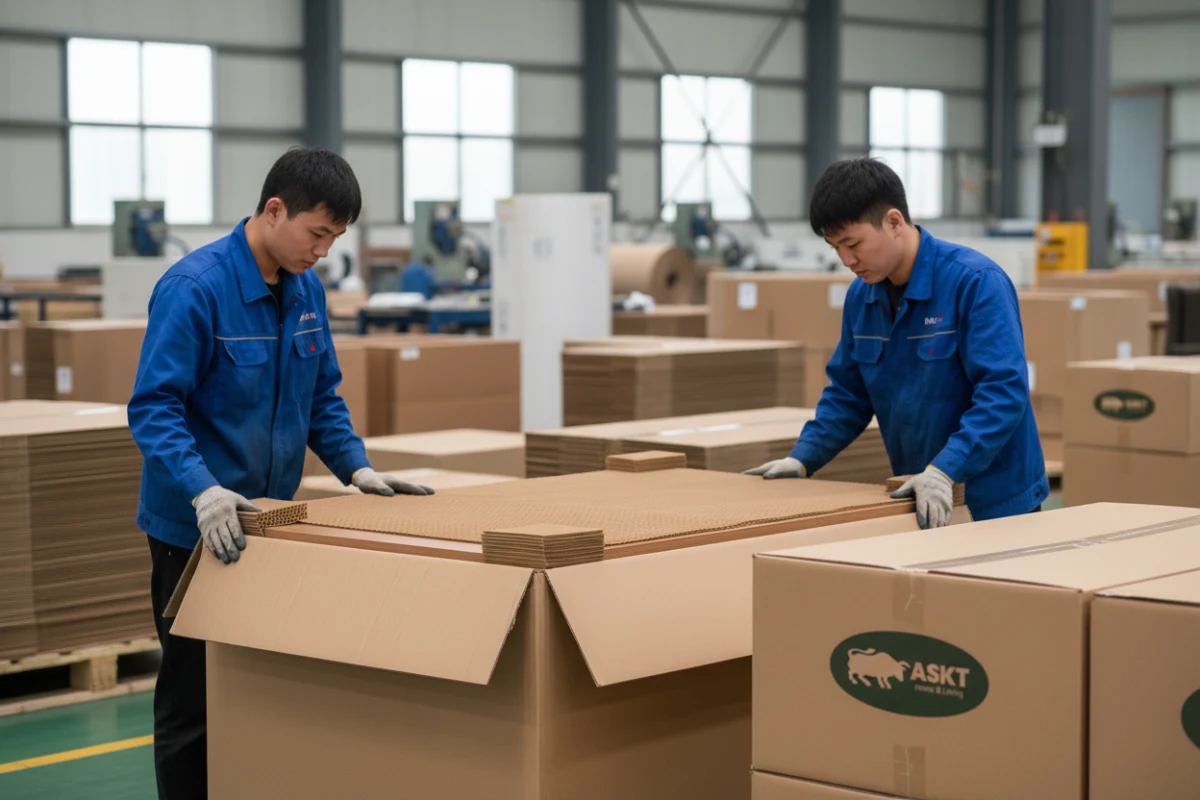
Traditional expanded polystyrene (EPS) foam is increasingly restricted under European ESG policies and often fails to provide adequate protection for heavy furniture. Leading factories have updated their packaging lines to use sustainable, high-density honeycomb paper and edge guards instead of single-use plastics.
This sustainable packaging approach provides:
- Superior Shock Absorption: Honeycomb structures absorb and disperse heavy impact forces during transport.
- Eco-Friendly Compliance: Meets the strict environmental standards set by European retail chains and consumers.
- Optimized Box Dimensions: Reduces unnecessary bulk, allowing for smaller, more uniform cartons.
Maximising Container Loading Configurations
A professional dining table manufacturer in China will design product packaging with container loading efficiency in mind. By matching carton dimensions to standard 40ft HQ shipping container measurements, the factory can eliminate wasted space. This allows you to fit more units into every container, significantly reducing your shipping cost per unit and improving your overall landed cost structure.
Coordinated Collections: The Advantage of a Complete B2B Dining Table Supplier
For wholesalers, retail chains, and e-commerce brands, buying dining tables in isolation can lead to coordination challenges. Managing multiple suppliers often results in color mismatches, mismatched metal finishes, and complex shipping logistics.
Sourcing from a B2B dining table supplier that offers coordinated collections—including dining chairs, bar stools, and benches—is a much more efficient strategy. This approach offers several key advantages:
- Perfect Material Matching: Ensures that the powder-coated metal legs of your dining tables perfectly match the frames of your dining chairs.
- Unified Fabric Collections: Allows you to offer cohesive dining sets featuring consistent fabric textures, colors, and durability ratings (such as waterproof, easy-clean, or pet-friendly properties).
- Lower Administrative Costs: Streamlines your procurement by managing one primary relationship, one quality control standard, and a single shipping schedule.
- Flexible Container Loading: Enables you to mix tables, chairs, and benches in a single container, lowering your minimum order quantity (MOQ) per item and reducing inventory risk.
By sourcing coordinated dining sets from a single dining table manufacturer in China, you can create cohesive product offerings that drive higher average order values for your business.
A Practical Sourcing Checklist for Evaluating China Furniture Manufacturers
When conducting factory audits or reviewing potential manufacturing partners, use this checklist to ensure they meet professional B2B standards:
1. Production Automation and Machinery
- Does the factory use automated cutting machines and robotic welding arms for consistent metal fabrication?
- Are they equipped with precision multi-spindle drilling machines to ensure perfect alignment of KD hardware?
- Do they have dedicated edge-banding and veneering machinery to guarantee smooth, moisture-resistant board finishes?
2. Quality Control and Product Testing
- Does the manufacturer have a dedicated, in-house quality control team separate from production management?
- Can they provide documentation showing compliance with European EN strength, durability, and safety standards?
- Do they conduct standardized drop tests, scratch tests, and moisture content checks on every production batch?
3. Sustainability and Material Sourcing
- Can the supplier trace their wood and oak veneers to sustainably managed forests?
- Do they use formaldehyde-free adhesives and low-emission finishes that comply with European chemical regulations?
- Is their packaging primarily made of recyclable, plastic-free materials like high-density honeycomb paper?
4. OEM/ODM Development and Sample Capabilities
- Does the factory have an experienced product design and engineering team to support private-label customization?
- Can they produce accurate, retail-ready samples within a reasonable timeframe before mass production?
- Are they able to customize product dimensions, fabric selections, and frame finishes to match your target market?
Conclusion: Mitigating Sourcing Risks Through Technical Transparency
Sourcing dining tables from China does not have to carry high operational risks. By moving away from generalist trading companies and partnering with an engineered, transparent direct manufacturer, European B2B buyers can secure excellent product quality, optimize shipping costs, and build a reliable, long-term supply chain.
At ASKT, we believe in complete manufacturing transparency. We combine our deep understanding of the European furniture market with advanced manufacturing processes, strict raw material selection, and rigorous product testing. Whether you are looking for contemporary metal-framed tables, elegant oak veneer finishes, or highly durable sintered stone collections, our team is ready to help you develop custom OEM/ODM solutions that drive commercial success.
If you want to review our structural testing methods, material certifications, and custom manufacturing capabilities, contact our team today to Request Dining Table Capability Report.