
Dining Table Quality Tests for Furniture Buyers: Essential Standards and Sourcing Inspection Protocols
Dining table quality tests for furniture buyers evaluate structural stability, mechanical load capacity, surface resilience, and transit packaging strength under European standards such as EN 12521. Systematic factory inspections—including vertical static load tests, perimeter edge checks, tabletop impact audits, and transit drop testing—verify that dining collections endure everyday domestic or contract use, reduce customer claims, and protect wholesale margins across European distribution networks.
Why Are Dining Table Quality Tests Essential for Furniture Importers and Wholesalers?
For commercial furniture buyers sourcing for markets in Germany, the Netherlands, the UK, Poland, Switzerland, and Ireland, structural failure in the field creates severe financial liability. A dining table serves as a daily focal point in residential dining rooms, restaurants, and hospitality spaces. When a table wobbles, deflects under weight, shows surface delamination, or sustains corner crushing during transit, the importer carries the cost of product returns, reverse logistics, customer dissatisfaction, and brand erosion.
Executing systematic dining table quality tests during pre-production, in-line manufacturing, and pre-shipment inspection protects commercial margins through five core operational advantages:
- Regulatory Compliance: Adhering to European benchmarks like EN 12521 dining table test standards confirms legal compliance and safety validation for EU and UK commercial markets.
- Structural Reliability: Validating horizontal stability and vertical static load capacity prevents structural loosening, joint failure, or base collapse under rigorous daily usage.
- Surface Durability: Inspecting scratch resistance, finish adhesion, and impact tolerance across oak veneer and sintered stone tops ensures long-term appearance retention.
- Transit Safety: Conducting calibrated dining table packaging drop tests eliminates transit damage across sea freight, container handling, and courier logistics.
- Batch Uniformity: Standardising inspection routines across production cycles ensures consistent assembly tolerances, hardware alignment, and finish quality for repeat B2B orders.
What Are the Core EN 12521 Dining Table Test Standards and Requirements?
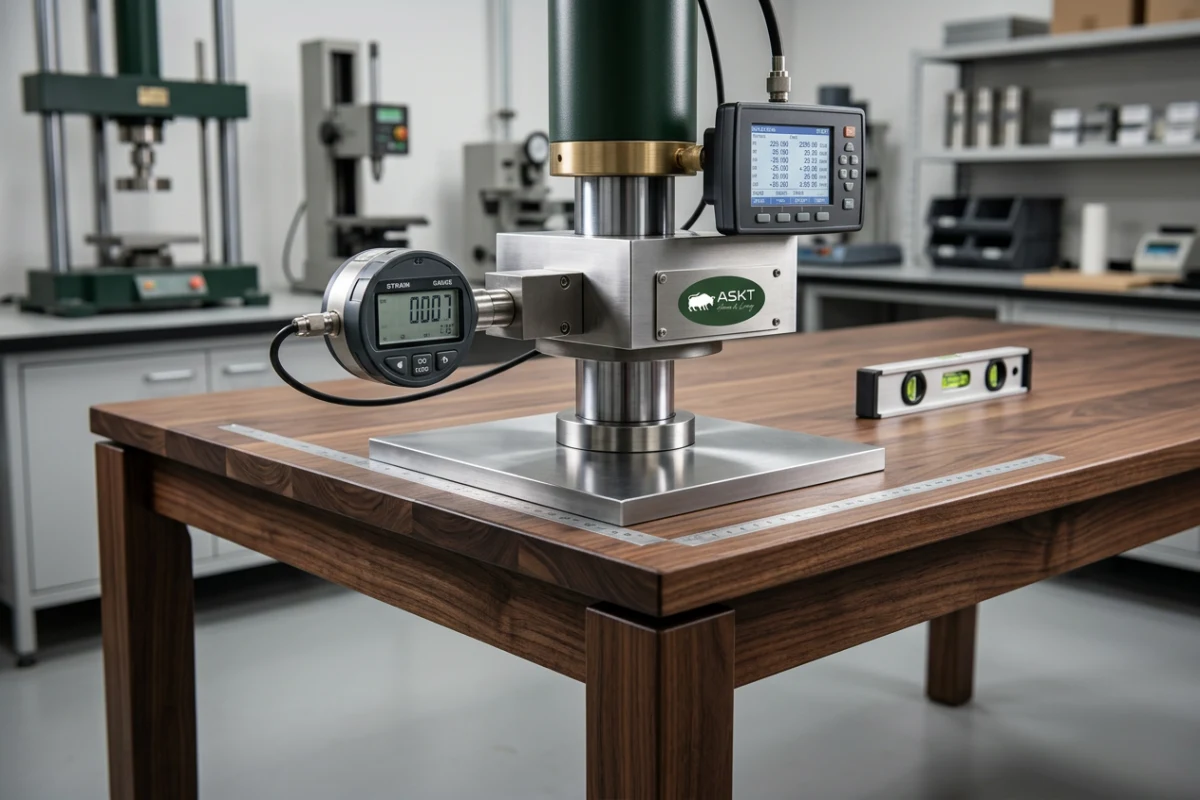
European standard EN 12521 outlines the mechanical safety, strength, and stability requirements for domestic tables intended for adult use. Importers supplying retail chains, e-commerce platforms, and purchasing groups use this standard to establish rigorous quality benchmarks with manufacturing partners.
The standard classifies physical performance evaluations into clear mechanical assessments:
| Assessment Category | Inspection Method & Focus Area | Acceptance Criteria & Pass Benchmarks |
|---|---|---|
| Vertical Static Load | Concentrated downward force applied to tabletop centre and extension leaves | No joint fractures, permanent structural deflection, or frame splitting |
| Sustained Edge Load | Vertical load applied to outermost perimeter edges and cantilevers | Table must not tip over, loosen at connecting points, or suffer beam deformation |
| Horizontal Durability | Repeated cyclical horizontal forces applied to frame aprons and legs | Fasteners remain secure without joint loosening, wobble, or weld fatigue |
| Tabletop Impact | Drop-weight impact applied to central and sensitive top zones | Surface must not crack, shatter, delaminate, or exhibit structural rupture |
| Baseline Stability | Progressive horizontal and vertical tipping force along perimeter margins | Table base maintains continuous floor contact without overturning |
Meeting EN 12521 dining table test standards gives commercial buyers verified documentation of structural reliability, ensuring smooth distribution through European retail and wholesale channels.
How Are Furniture Load Bearing and Stability Testing Procedures Conducted?
Furniture load bearing and stability testing evaluates whether a table structure can withstand continuous static pressure, dynamic user movement, and offset weight distribution over years of service.
1. Vertical Static Load Verification
In vertical static load testing, calibrated pneumatic or hydraulic testing equipment applies defined downward pressure onto the tabletop. For standard dining furniture, continuous loads are applied across central support rails and extension panels to evaluate structural rigidity. Quality inspectors examine three primary performance indicators:
- Deflection Under Load: Measuring temporary beam deflection while the maximum test force is sustained.
- Permanent Sagging: Verifying that the tabletop returns completely to true flatness once the test weight is removed.
- Fastener Integrity: Inspecting knock-down (KD) bolts, metal inserts, and frame joints to confirm that no micro-fractures, stripping, or loosening occurred.
2. Perimeter and Cantilever Edge Load Testing
Dining table users frequently lean their body weight against table ends, corners, or extended leaves. Edge load testing applies targeted vertical loads directly to table perimeters and extension leaf tips. This assessment confirms that:
- Cantilever brackets, steel underframes, and wooden aprons resist downward bending forces.
- Extension table slide tracks and locking mechanisms maintain firm alignment without slippage or mechanical failure.
- The table base footprint maintains balance, preventing tipping or foot lifting under asymmetric weight.
3. Lateral Stability and Push-Pull Fatigue Testing
Horizontal stability checks apply alternating lateral forces to tabletop perimeters while table feet are held in place with base stops. This testing replicates real-world conditions where users push away from the table or shift heavy items across the surface. Quality inspectors verify that leg brackets, weld joints, and mounting hardware resist progressive loosening or frame distortion.
What Methods Are Used for Tabletop Strength and Impact Inspection Across Different Materials?
Tabletop strength and impact inspection verifies that primary surfaces resist accidental impacts, scratch hazards, and moisture exposure without chipping, blistering, or structural damage. Because dining tables utilise diverse materials, inspection methods are tailored to specific substrate properties.
Tabletop Testing Protocol Matrix
- Sintered Stone Tabletops:
- Steel Ball Impact Test: Calibrated drop-weight impact onto centre and perimeter areas to verify fracture resistance.
- Substrate Lamination Inspection: Bond audit checking adhesion between sintered stone slabs and supporting base boards to prevent hollow voids.
- Edge Chamfer Check: Microscopic review of bevelled edges to verify the absence of CNC edge chipping or micro-fissures.
- Oak Veneer and Engineered Wood Tops:
- Cross-Hatch Adhesion Test: Precision grid scoring and tape peel test to verify secure lacquer and veneer bonding.
- Surface Hardness & Scratch Check: Standardised scratch evaluation to test clear-coat resistance against daily contact.
- Moisture and Heat Spot Check: Evaluates surface resistance to wet glassware, hot plates, and common dining spills.
- Extension System Mechanisms:
- Slide Operation Smoothness: Verification of smooth track gliding without binding or metal grinding.
- Extension Leaf Alignment: Flushness inspection across seam lines in both closed and fully extended configurations.
Sintered Stone Impact and Base Lamination Checks
Sintered stone tops deliver exceptional heat, stain, and scratch resistance, but their rigid composition requires careful impact evaluation:
- Calibrated Impact Testing: A solid steel ball is dropped from specified heights onto central areas and outer margins. The stone must show no cracking, edge shattering, or surface fractures.
- Lamination Bonding Quality: For designs combining sintered stone with tempered glass or engineered wooden sub-panels, inspectors verify complete adhesive coverage, eliminating air gaps that could reduce load distribution.
- Edge Profile Verification: Edge bevels and chamfers are inspected for smoothness to ensure safe handling and impact durability.
Oak Veneer Surface and Coating Evaluation
Natural oak veneer tables require detailed surface checks to confirm long-term grain stability and finish adhesion:
- Cross-Cut Finish Adhesion: Technicians apply a cross-hatch pattern through the protective finish, apply adhesive tape, and inspect coating retention to confirm strong bond strength.
- Liquid and Thermal Exposure: Spot testing evaluates finish resilience against warm dishes and moisture contact, ensuring coatings do not cloud, blister, or soften.
- Veneer Seam Uniformity: Visual inspection under balanced lighting confirms book-matched veneer sheets are smoothly joined without open glue lines, uneven sanding, or colour variations.
How Should Importers Inspect Metal Frames, Welded Joints, and Powder Coating?
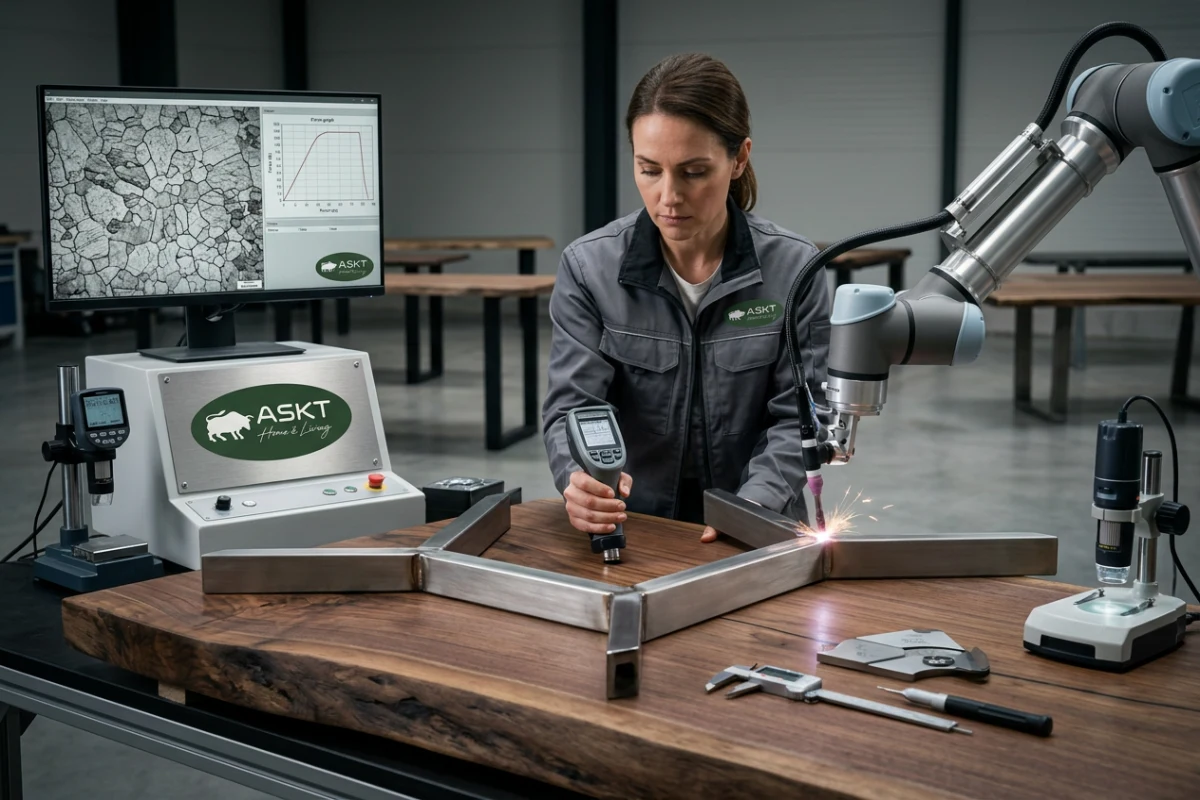
Modern contemporary dining furniture frequently combines wooden or sintered stone surfaces with metal frames, sled bases, or spider leg configurations. Frame integrity depends on precision welding and protective surface finishes.
1. Welded Joint Integrity and Robotic Welding Precision
Manual welding can introduce structural inconsistencies across mass production, including uneven penetration, porosity, or weld spatter. Advanced furniture production employs robotic welding arms to maintain uniform weld seams and reliable structural strength.
Quality inspectors verify:
- Continuous weld beads free of pinholes, burn-through, or undercut defects.
- Precise angular squareness of mounting plates to ensure flush, stress-free contact with tabletop underframes.
- Uniform alignment of pre-drilled bolt hole patterns to guarantee effortless KD assembly.
2. Powder Coating Adhesion and Corrosion Protection
Metal table bases must resist surface scratching, scuffing, and atmospheric corrosion during ocean transit and long-term domestic use. Key inspections include:
- Cross-Hatch Tape Adhesion Testing: Verifying that the baked powder coating adheres firmly to the pre-treated metal substrate without flaking.
- Coating Thickness Audits: Measuring dry film thickness with calibrated magnetic gauges across visible tubes, underside returns, and welded joints.
- Scratch and Scuff Resistance: Testing finish toughness against footwear scuffs and abrasive contact to maintain visual appearance.
Why Is Knock-Down (KD) Structure Durability and Repeated Assembly Testing Crucial?
Knock-down (KD) engineering allows dining tables to be packed flat, optimising container loading efficiency and lowering ocean freight costs per unit. However, KD connections represent critical load points that require thorough mechanical evaluation.
Pre-shipment inspections must include repeated assembly and hardware durability assessments:
- Threaded Insert Retention: In wooden or composite table underpanels, metal threaded inserts must withstand specified tightening torque without loosening or pulling free from the substrate.
- Repeated Assembly Cycles: Test teams assemble, tighten, disassemble, and reassemble table legs and framework multiple times. KD joints must retain rigid clamping force without thread stripping or structural wobble.
- Hardware Accuracy & Tool Fit: Inspecting supplied bolts, spring washers, Allen keys, and adjustable leveling feet ensures complete hardware sets and smooth retail customer assembly.
What Protocols Govern Dining Table Packaging Drop Tests and Container Loading?
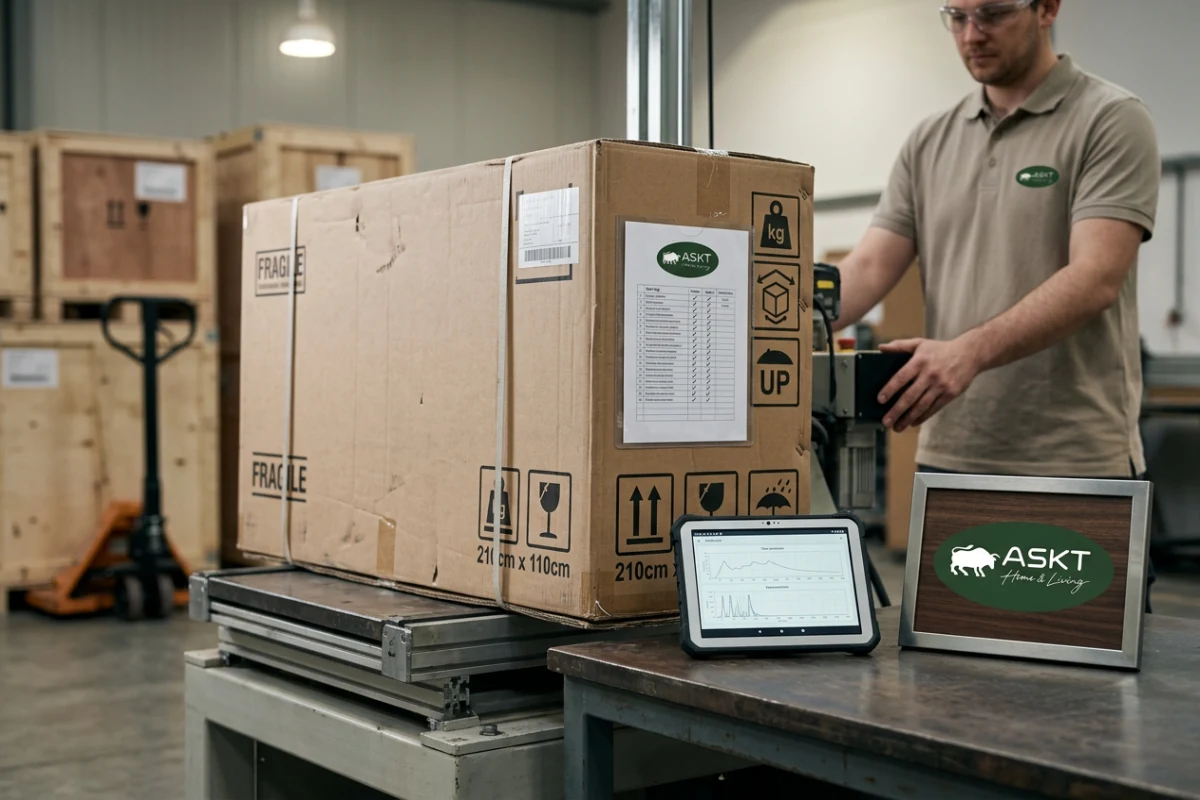
Even high-quality dining tables will experience high return rates if packaging cannot survive long-distance maritime transport, container handling, and courier delivery. A structured dining table packaging drop test protocol validates packaging security before dispatch.
Standard International Transit Drop Test Sequence
Transit packaging testing replicates the drops, shocks, and corner impacts encountered during logistics transit through a standardized ten-drop sequence:
- Drop onto the most vulnerable packaging corner
- Drop onto the shortest edge radiating from the tested corner
- Drop onto the intermediate edge radiating from the tested corner
- Drop onto the longest edge radiating from the tested corner
- Flat drop onto the smallest packaging face
- Flat drop onto the opposite small face
- Flat drop onto the longest side face
- Flat drop onto the opposite longest side face
- Flat drop onto the top face
- Flat drop onto the bottom face
Upon completing the drop sequence, inspectors open the carton to inspect all components. The packaging passes only when both the outer carton and the internal table components show zero structural breakage, corner crushing, surface scratching, or bent hardware.
Sustainable Packaging Material Alternatives
European wholesale and retail buyers increasingly require sustainable packaging solutions that minimise single-use plastic waste while maintaining transit security. Modern furniture manufacturing transitions from conventional expanded polystyrene (EPS) foam to recyclable, high-strength alternatives:
| Packaging Function | Traditional Packaging Material | High-Performance Sustainable Alternative |
|---|---|---|
| Corner Protection | Polystyrene (EPS) foam blocks | High-density corrugated paper corner guards |
| Edge Cushioning | Polyethylene (PE) foam strips | Multi-layered honeycomb paper edge boards |
| Surface Wrapping | Polyethylene plastic wrap | Scratch-resistant soft protective tissue paper |
| Outer Packaging | Standard 5-ply corrugated carton | Heavy-duty reinforced 7-ply export carton |
Container Loading Optimization and Stacking Integrity
Carton dimensions should be engineered precisely to maximise volume utilisation inside standard 40ft High Cube (HQ) shipping containers. Packaging compression tests confirm that bottom-layer cartons can support the static weight of stacked units during extended ocean transit without box collapse or internal product pressure points.
How Can European Furniture Buyers Standardize Pre-Shipment Quality Control Workflows?
To build a dependable, scalable furniture supply chain, European wholesale and retail buyers must implement a standardized Quality Control (QC) checklist across all manufacturing batches. Clear testing protocols ensure consistent quality across repeat production runs.
Here is a practical five-stage pre-shipment quality control workflow for commercial dining table sourcing:
Stage 1: Raw Material and Component Verification
- Audit moisture content of solid wood and veneer components to prevent warping in heated European interiors.
- Verify metal tube wall thickness and dimensional consistency against technical specifications.
- Confirm testing documentation for low-emission adhesives and durable surface finishes.
Stage 2: Structural Frame and In-Line Welding Audit
- Inspect robotic welding seams on metal leg structures and framework assemblies.
- Verify precise alignment of pre-drilled holes, threaded inserts, and KD mounting points.
- Test smooth mechanical operation and positive locking engagement on extension table slide systems.
Stage 3: Finished Product Assembly and Load Testing
- Assemble sample units from the finished production batch to verify part fit and assembly clarity.
- Conduct vertical static load and edge load tests to confirm structural rigidity and deflection recovery.
- Check diagonal squareness, surface levelness, and the adjustment range of floor-leveling glides.
Stage 4: Surface Quality and Coating Inspection
- Perform cross-hatch finish adhesion tests on coated metal frames and veneered surfaces.
- Inspect sintered stone edges, veneer grain matching, and lacquer coats under high-intensity inspection lighting.
- Verify scratch resistance and surface cleanliness across finished tabletops.
Stage 5: Packaging Inspection and Transit Drop Testing
- Verify carton printing, barcodes, product labelling, assembly instructions, and hardware packs.
- Conduct full ten-drop transit simulations on packaged finished units.
- Verify container loading patterns, carton stacking arrangements, and corner bracing before sealing container doors.
At ASKT, we incorporate these comprehensive quality testing protocols across our manufacturing and export operations. With over 20 years of dedicated experience supporting European furniture wholesalers, retail chains, and purchasing groups, ASKT combines an in-depth understanding of European durability standards with efficient, high-precision manufacturing. Whether your portfolio focuses on sintered stone dining tables, oak veneer collections, metal KD structures, or matching dining chairs, ASKT provides transparent quality control, certified testing workflows, and optimized container packing to protect your brand reputation and ensure commercial success.
Please feel free to ask ASKT about testing requirements for your dining table collection to ensure full European compliance, product durability, and seamless supply chain execution.
Frequently Asked Questions (FAQ)
What is the primary difference between residential and contract dining table testing?
Residential dining table testing under EN 12521 evaluates stability, strength, and durability for standard household usage. Contract and commercial furniture testing evaluates tables under significantly higher static load thresholds, continuous cyclical fatigue forces, and aggressive edge impacts to simulate the heavy, frequent usage typical of restaurants, hotels, and commercial dining venues.
How many sample dining tables should be tested during a pre-shipment inspection?
For standard B2B production orders, visual, dimensional, and packaging inspections are conducted across a statistically representative sample of the batch. For mechanical stress and destructive assessments—such as static overload tests, cross-hatch coating adhesion checks, and full carton drop tests—inspectors select one to two complete units per production run to confirm compliance without excessive sample loss.
Why is wood moisture content testing critical for European furniture markets?
Natural wood and veneer substrates expand and contract with fluctuations in ambient humidity. If furniture manufactured in Asia contains elevated moisture levels, the dry indoor heating common across European homes during winter will cause rapid wood shrinkage. This can lead to surface warping, hairline veneer cracks, and split joints. Verifying balanced moisture content prior to pressing and finishing prevents these climate-related defects.