
What Furniture Buyers Should Check When Evaluating Dining Chair Packaging
When evaluating dining chair packaging before placing bulk orders, professional buyers must inspect carton structural strength, internal component isolation, corner protection, hardware containment, and drop test resilience. Thorough packaging assessment prevents transit scratches, frame distortion, and carton crushing during sea freight and warehousing, while container loading optimization protects commercial margins by maximizing container fill rates and minimizing product return rates.
Why is evaluating dining chair packaging essential for European furniture importers and retailers?
For commercial furniture buyers, retail chains, wholesalers, and e-commerce brands across Germany, the Netherlands, the UK, Poland, Switzerland, Ireland, and broader European markets, packaging is a foundational element of product reliability. Dining chairs present specific logistics challenges because they combine structural metal frames or wooden bases with upholstered seat shells, delicate fabrics, powder coating, and precision swivel or auto-return mechanisms. During international transport, goods undergo extensive handling, multi-tier container stacking, sea vibrations, humidity variations, and regional distribution before reaching their destination.
Inadequate packaging introduces substantial commercial and operational risks:
- High Return and Replacement Costs: A scuffed powder-coated leg or bruised upholstery fabric makes an individual dining chair unsellable as first-quality stock. Replacing individual chairs or parts from bulk container shipments creates administrative friction, inventory imbalances, and margin erosion.
- Brand Reputation and Customer Dissatisfaction: Delivering damaged goods or visibly crushed outer cartons undermines commercial relationships with contract clients and retail consumers alike.
- Warehouse and Stacking Inefficiencies: Weakened or deformed cartons cannot be safely stacked in vertical warehouse racks, reducing usable storage height and increasing handling labor.
- Excess Freight Expenses: Bulky, poorly engineered packaging carries unnecessary void volume, inflating ocean freight costs per chair and lowering container loading efficiency.
Evaluating dining chair packaging during product development and sample approval ensures that structural and surface vulnerabilities are resolved before serial production begins.
How should buyers assess internal furniture packaging protection and component separation?
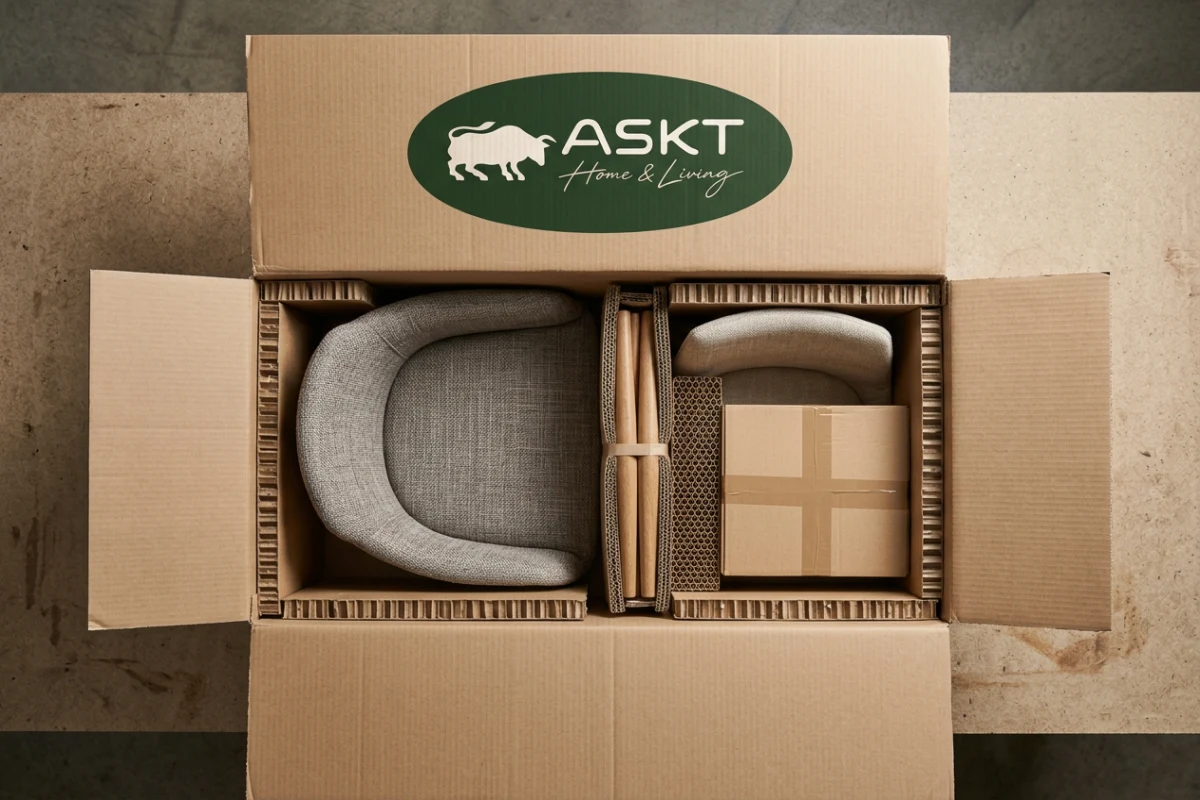
Effective furniture packaging protection depends on eliminating internal movement and preventing abrasive friction between incompatible surfaces. In knock-down (KD) dining chair configurations, seat shells, base frames, metal legs, and assembly hardware share a single outer carton. Without disciplined component isolation, hard metal edges and hardware bags will rub against upholstered fabrics, gouge finished surfaces, or distort mounting brackets during transit.
When reviewing pre-production packaging samples, professional buyers should inspect five key areas of internal protection:
1. Component Isolation and Surface Separation
Every individual component inside the box requires dedicated protection. Upholstered chair shells must be wrapped in non-abrasive, breathable protective covers to safeguard delicate fabrics, easy-clean materials, or faux leather against surface abrasion and pressure marking. Metal frames and legs must be fully separated from upholstered seat pans using corrugated dividers, protective sleeves, or high-density paper buffers. Metal-on-metal or metal-on-fabric direct contact must be completely eliminated.
2. Hardware Boxing and Fixings Security
Loose bolts, washers, leveling glides, and assembly tools pose severe puncture risks if left loose. Commercial packaging standards require all assembly hardware to be sealed in heavy-duty polybags or dedicated hardware boxes. The hardware pack must be taped securely to an inner carton wall or tied to the frame rather than resting loosely in the box where it could collide with finished surfaces.
3. Corner and Edge Buffering
Carton corners absorb the heaviest kinetic energy during handling and transport. Buyers should inspect whether the package incorporates reinforced corner guards, folded corrugated buffers, or edge protectors. These protective elements maintain a safety clearance between the outer carton wall and the chair's exterior edges, absorbing external compression.
4. Mechanism Protection for Swivel and Auto-Return Chairs
Chairs equipped with 360-degree swivel or auto-return mechanisms feature concentrated weight at the central steel pivot. Packaging structures must incorporate internal support cradles that hold the swivel hub securely in position. This prevents the heavy mechanism from shifting or punching through the outer carton base during vertical handling.
5. Movement and Void Fill Testing
Once all components are placed inside the sample carton and the flaps are closed, testing personnel should gently shake the carton. Any perceptible shifting, sliding, or rattling indicates insufficient internal void fill. The internal structure must achieve a secure friction fit that distributes handling forces evenly across the entire carton interior.
What carton structural specifications ensure durability during export logistics?
Outer carton integrity determines whether stacked products can withstand weeks of ocean freight and variable warehouse conditions. Packaging that appears rigid in an ambient factory sample room may experience significant compression loss when subjected to sustained container weight and maritime humidity.
Professional furniture buyers should evaluate carton specifications against established B2B logistics benchmarks:
| Inspection Parameter | Evaluation Focus | Sourcing Risk Mitigated |
|---|---|---|
| Cardboard Construction | 5-ply double-wall corrugated cardboard | Prevents carton bulging, side puncture, and stacking collapse under load. |
| Liner Quality & Paper Weight | High-density Kraft outer and inner liners | Enhances moisture resistance and maintains carton rigidity in humid transit environments. |
| Flute Alignment | Vertical flute orientation relative to stacking | Maximizes vertical compression strength to support multiple stacked tiers in containers. |
| Manufacturer Joint | Reinforced glued or stitched joint construction | Eliminates seam separation under heavy handling or high-density stacking. |
| Carton Flap Sealing | Secure H-taping pattern on top and bottom seams | Prevents tape peel, carton opening, and dust ingress during long-distance shipping. |
| Shipping Markings | Clear item codes, batch numbers, weight, and handling symbols | Prevents warehouse mishandling, improper orientation, and inventory sorting errors. |
Outer carton markings should clearly display handling indicators, including stacking height limits and orientation arrows, helping logistics teams maintain proper handling standards throughout the distribution chain.
How should a dining chair drop test be performed and evaluated?
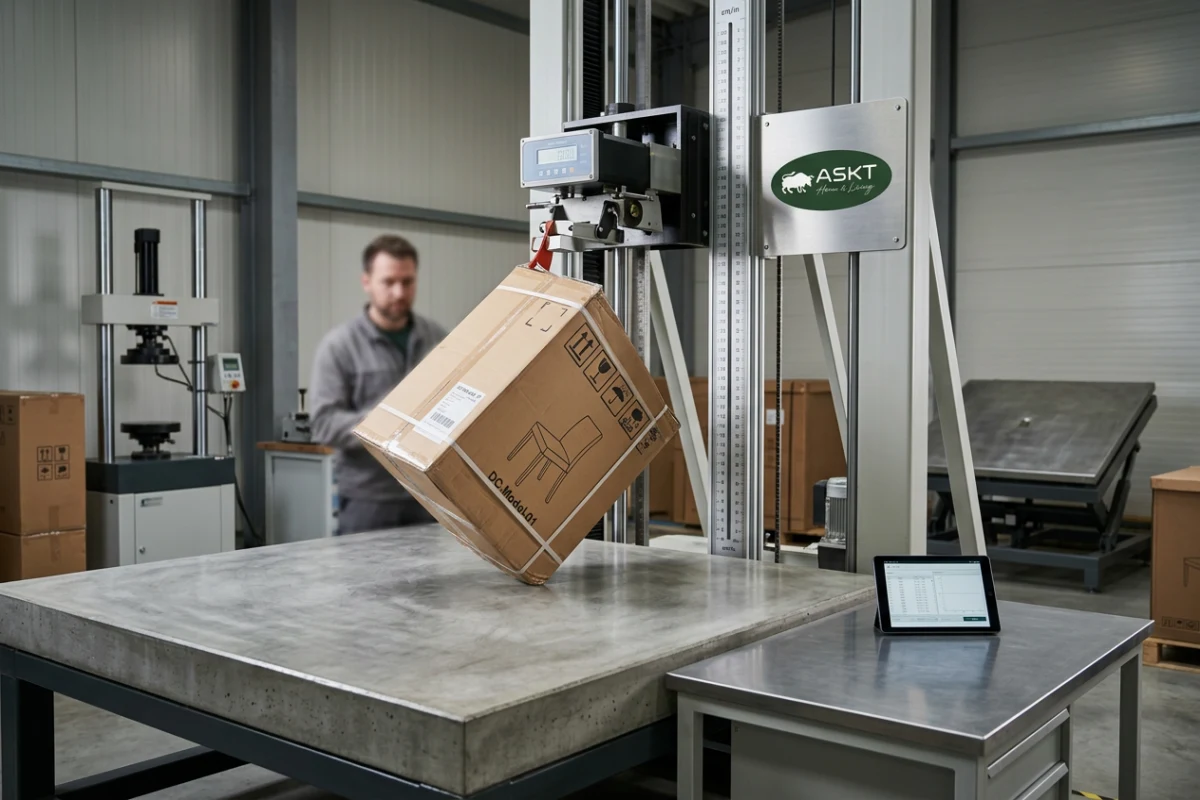
A dining chair drop test provides empirical verification that internal cushioning, component isolation, and outer carton construction perform reliably under real-world logistics stress. Conducting physical drop testing on production-representative packaging samples allows buyers and manufacturers to identify weak joints, inadequate cushioning, or loose hardware before approving mass production.
Testing procedures evaluate the packaged product against a systematic sequence of impacts onto a flat, rigid floor surface, covering vulnerable corners, edges, and flat carton panels.
Systematic Drop Testing Procedure
During sample evaluation, the fully packed dining chair carton is dropped from a defined height based on gross package weight across a standard multi-point sequence:
- Manufacturer Joint Corner Drop: The carton is dropped directly onto the corner adjacent to the manufacturer joint.
- Shortest Edge Drop: An impact targeting the shortest edge radiating from the tested corner.
- Medium Edge Drop: An impact targeting the intermediate edge radiating from the tested corner.
- Longest Edge Drop: An impact targeting the longest edge radiating from the tested corner.
- Small Flat Face Drop: An impact onto one of the small end panels.
- Opposite Small Flat Face Drop: An impact onto the opposite small end panel.
- Large Flat Face Drop: An impact onto one of the primary side panels.
- Opposite Large Flat Face Drop: An impact onto the opposite side panel.
- Bottom Face Drop: A flat drop directly onto the bottom base panel in its normal shipping orientation.
- Top Face Drop: A flat drop directly onto the top closing panel.
Post-Drop Teardown Inspection Criteria
Immediately following the drop sequence, the carton is opened for a comprehensive teardown inspection. A passing result requires compliance across three criteria:
- Structural and Surface Integrity: The chair frames, welds, legs, and fastening points must show no bending, cracking, or distortion. Powder coating and upholstery surfaces must be free of abrasions, tears, pressure indentations, or chips. Swivel and auto-return mechanisms must operate smoothly without misalignment or mechanical play.
- Hardware Containment: The hardware pack must remain fully intact and secured in its designated location, with zero loose fasteners dispersed inside the carton.
- Packaging Functionality: While the exterior carton corners may show localized deformation from impact absorption, the carton must remain closed, the seams intact, and the internal dividers functional.
How does container loading optimization improve freight efficiency without sacrificing protection?
Container loading optimization balances cargo density with product safety. For international furniture procurement, shipping costs represent a substantial component of total landed cost. Reducing package dimensions by even a small percentage allows more units to fit into a standard 40ft High Cube (40HQ) container, directly decreasing freight expenditure per unit.
However, aggressive carton downsizing must never compromise internal component isolation or structural protection. Buyers should evaluate how product engineering and packaging design interact to optimize volume:
Knock-Down (KD) vs. Assembled Configurations
Knock-down structural designs allow chair bases, legs, and seat shells to nest closely together. A well-designed KD configuration packed two or four pieces per box can significantly increase container unit counts compared to fully welded, non-KD designs. Engineering the base frames to nest precisely inside the underside contours of seat shells maximizes space utilization while protecting delicate upholstery.
Vertical Flute Orientation and Stacking Calculations
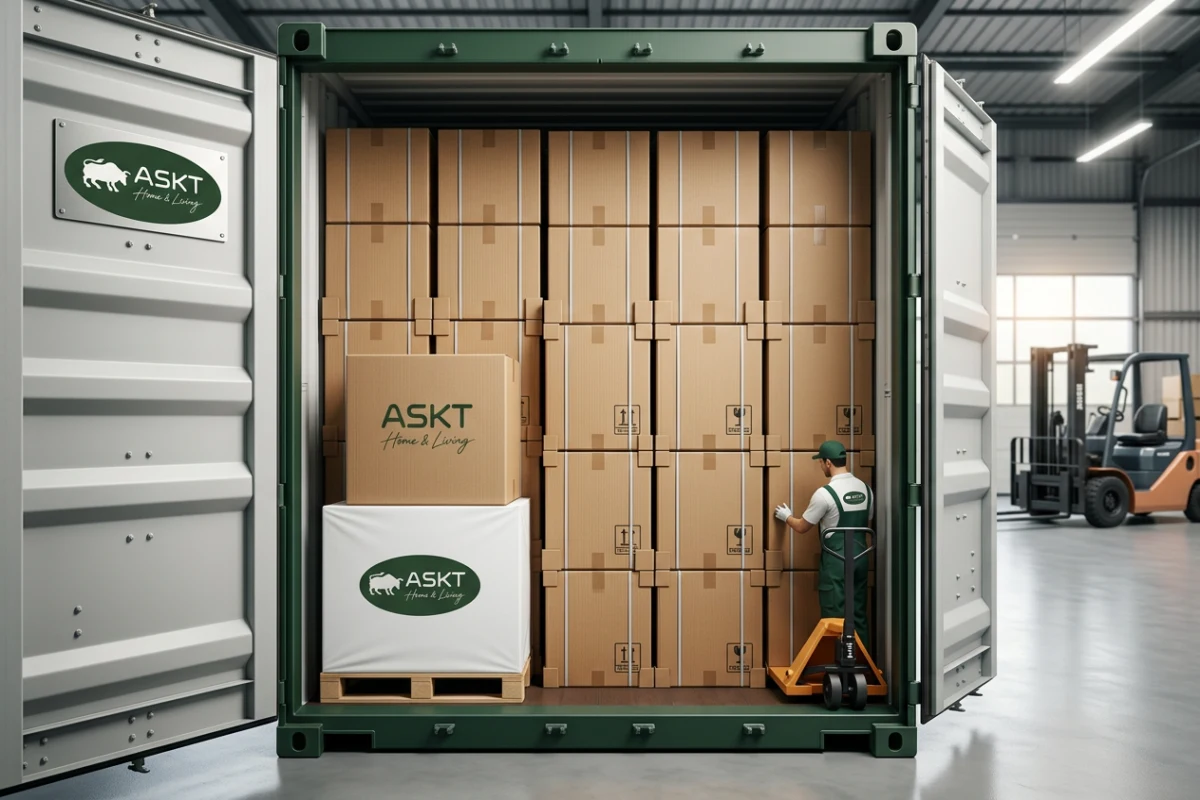
Inside a 40HQ container, cartons are stacked up to ceiling height. Lower cartons must support the static weight of multiple tiers throughout the entire voyage. Carton dimensions must be planned so that the internal corrugation flutes remain strictly vertical when loaded. Orienting cartons on their sides to squeeze additional units into the container often leads to structural buckling and product damage.
Dimensional Alignment with Container Space
Carton length, width, and height should be calculated to divide efficiently into container internal dimensions. Minimizing void gaps between carton rows prevents cargo from shifting, toppling, or colliding during maritime transit, creating a stable, self-supporting cargo block.
Modular Product and Packaging Design
Utilizing modular frames that fit across multiple chair models allows factories and buyers to standardize outer carton dimensions across different product lines. This consistency simplifies container planning, palletization patterns, and warehouse racking management.
How do sustainable packaging materials support European environmental requirements?
European furniture buyers and importers are actively working to reduce non-recyclable packaging waste to meet environmental regulations and corporate sustainability targets. Sourcing strategies in Germany, the Netherlands, the UK, and across Europe prioritize recyclable mono-materials, reduced plastic content, and optimized packaging volume.
Traditional Expanded Polystyrene (EPS/Styrofoam) inserts are increasingly replaced by recyclable, fiber-based alternatives that deliver equal structural protection during transit:
1. Honeycomb Paperboard and Molded Fiber
High-density honeycomb cardboard structures offer strong compressive resistance and impact cushioning. Pre-cut honeycomb blocks and molded paper buffers support chair corners, frames, and swivel assemblies while remaining fully recyclable in standard paper waste streams.
2. Folded Corrugated Inserts
Engineered corrugated cardboard dividers and folded triangular supports provide rigid internal separation and shock absorption. Using the same corrugated material for both the outer box and internal fittings creates a mono-material packaging solution that simplifies recycling for European commercial customers and end consumers.
3. Recycled and Breathable Protective Wraps
To safeguard upholstered fabrics and delicate surface coatings against abrasion and moisture, manufacturers use recyclable film wraps or breathable non-woven dust covers. Combining sustainable packaging with durable fabrics and eco-conscious materials creates a coherent, compliant product offering for European markets.
What should be included in a B2B furniture packaging checklist before serial production?
A comprehensive B2B furniture packaging checklist ensures that purchasing teams, product managers, and factory quality control inspectors maintain strict alignment on packaging standards. Buyers should review this structured checklist during sample approval and pre-shipment inspections:
Outer Carton Specifications
- 5-ply double-wall corrugated cardboard construction verified.
- Corrugated flutes oriented vertically in the upright shipping position.
- Glued and stitched manufacturer joints inspected for strength.
- Carton dimensions aligned with container loading layout calculations.
- Clear shipping marks, SKU numbers, gross/net weights, and handling symbols printed on short and long carton sides.
- Sturdy H-taping pattern applied securely to top and bottom carton flaps.
Internal Protection and Component Isolation
- Complete physical barrier between metal components and upholstered surfaces.
- Upholstered shells protected with non-abrasive, breathable covers.
- Chair legs, base frames, and sharp corners cushioned with corrugated buffers or honeycomb protectors.
- Swivel or auto-return mechanisms supported with dedicated internal cradles.
- Hardware fittings, screws, and tools sealed inside dedicated bags or boxes and firmly attached to the inner packaging.
- Assembly instructions and component checklists enclosed inside the carton.
- Friction fit verified with zero internal rattling or component shifting when closed.
Performance Testing and Quality Verification
- Full ten-point drop test successfully completed on a production-grade packaging sample.
- Post-drop teardown confirms zero surface scuffing, frame bending, weld cracking, or fabric bruising.
- Packaging materials comply with recyclable mono-material and reduced-plastic standards.
- Carton gross weight aligns with single-person or multi-person manual handling requirements.
How can buyers integrate packaging evaluation into factory quality control workflows?
Packaging evaluation must be embedded directly into regular sourcing and quality control workflows rather than treated as a last-minute pre-shipment check. Managing packaging standards across three clear stages ensures consistent quality:
1. Sample Development and Quotation Stage
When requesting prototype development for OEM or ODM dining chair models, require the manufacturer to submit a complete packaging specification sheet alongside the physical product sample. This documentation should detail carton dimensions, cardboard specifications, internal packing schematics, container loading estimates, and drop test verification results.
2. During-Production Inspection (DUPRO)
During bulk production runs, quality control inspectors should visit the packaging area to confirm that production lines are using the approved packaging materials. Inspectors must verify that assembly workers correctly apply edge protectors, wrap upholstered shells properly, secure hardware packs, and seal cartons with the specified H-taping standard.
3. Final Pre-Shipment Inspection (PSI) and Container Loading Supervision
During pre-shipment audits, inspectors draw random finished cartons from mass production batches according to standard sampling procedures. Audits include measuring outer dimensions, inspecting shipping marks, conducting on-site drop tests, and supervising container stuffing to ensure tight, uniform loading patterns that prevent cargo shifting.
By establishing transparent packaging criteria, systematic testing protocols, and container optimization strategies, commercial furniture buyers protect their supply chains against transit losses, preserve profit margins, and deliver flawless dining furniture to European customers.