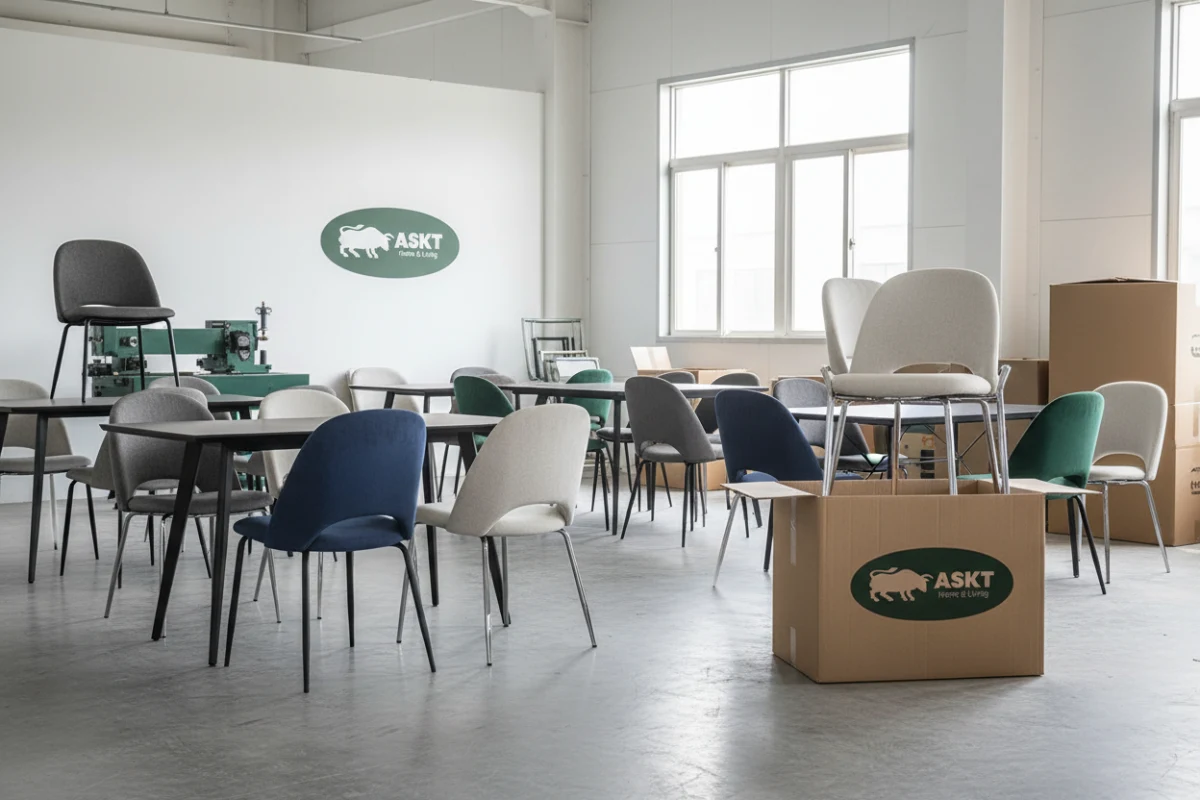
Evaluating a Professional OEM Dining Chair Manufacturer for European B2B Markets
As professionals who have spent decades collaborating with European furniture wholesalers, large-scale retail chains, and contract project buyers, we understand that sourcing a dining chair is not simply an aesthetic choice. For an importer, buying coordinator, or product manager, a dining chair represents a complex matrix of structural engineering, regulatory compliance, supply chain logistics, and long-term economic performance. When ASKT reached the milestone of exporting over 550,000 dining chairs to the highly competitive German market in 2024 alone, it was not because of visual aesthetics alone. It was the direct result of aligning precision manufacturing with the rigorous technical and operational expectations of European B2B sourcing specialists.
For purchasing departments, the path to launching a successful and profitable furniture collection relies on partnering with an OEM dining chair manufacturer that functions as a technical and engineering advisor. This comprehensive guide outlines the entire B2B engineering and production lifecycle. It demonstrates how a professional custom dining chair supplier translates creative design concepts into certified, high-performance, and commercially stable furniture lines.
Section 1: Translating Design Briefs into Technical Specifications
The relationship between a professional B2B buyer and an industrial partner begins long before raw materials reach the factory floor. When e-commerce brands or contract sourcing teams conceptualise a new contemporary dining chair line, the initial design brief is often abstract. It typically consists of hand sketches, digital renderings, or reference photos from competing product lines. The critical challenge in B2B furniture sourcing China is converting these visual inspirations into precise, repeatable, and structurally sound engineering data.
To bridge this communication gap and eliminate misunderstandings, a modern manufacturer must leverage structured digital tools. Rather than allowing critical details to be lost in translation during cross-border emails, ASKT utilises a proprietary conversational platform called Sunbin KI. This digital assistant acts as an expert communication bridge between your design team and our production engineers. By asking product managers structured, reverse-questioning prompts, Sunbin KI extracts vital technical parameters early in the development cycle. It clarifies specific frame wall thicknesses, internal structural support requirements, fabric rub-test performance targets, and exact weight capacity tolerances. This digital intake process ensures that when our industrial designers generate CAD schematics, the drawings align perfectly with both your creative vision and the practical requirements of high-volume manufacturing.
In contemporary furniture design, small deviations in leg angles or backrest curves can completely compromise structural safety. A slight miscalculation in the pitch of a rear metal leg can create a leverage hazard, leading to instability or joint fatigue. Our engineering team analyses joint stress points using finite element software. This ensures that every load-bearing element is optimized. By standardising these parameters during the CAD stage, we establish a robust foundation for mass-production tooling, eliminating expensive errors before physical materials are cut.
Section 2: The Golden Sample Phase: Verifying Structural Integrity and Ergonomics
Once digital CAD schematics are finalised and approved by the buyer, the development workflow moves into the physical prototyping phase: the creation of the Golden Sample. In furniture OEM ODM services, the Golden Sample is not merely a display piece. It is the definitive physical benchmark that represents the exact manufacturing standard, material composition, and quality threshold for subsequent mass production.
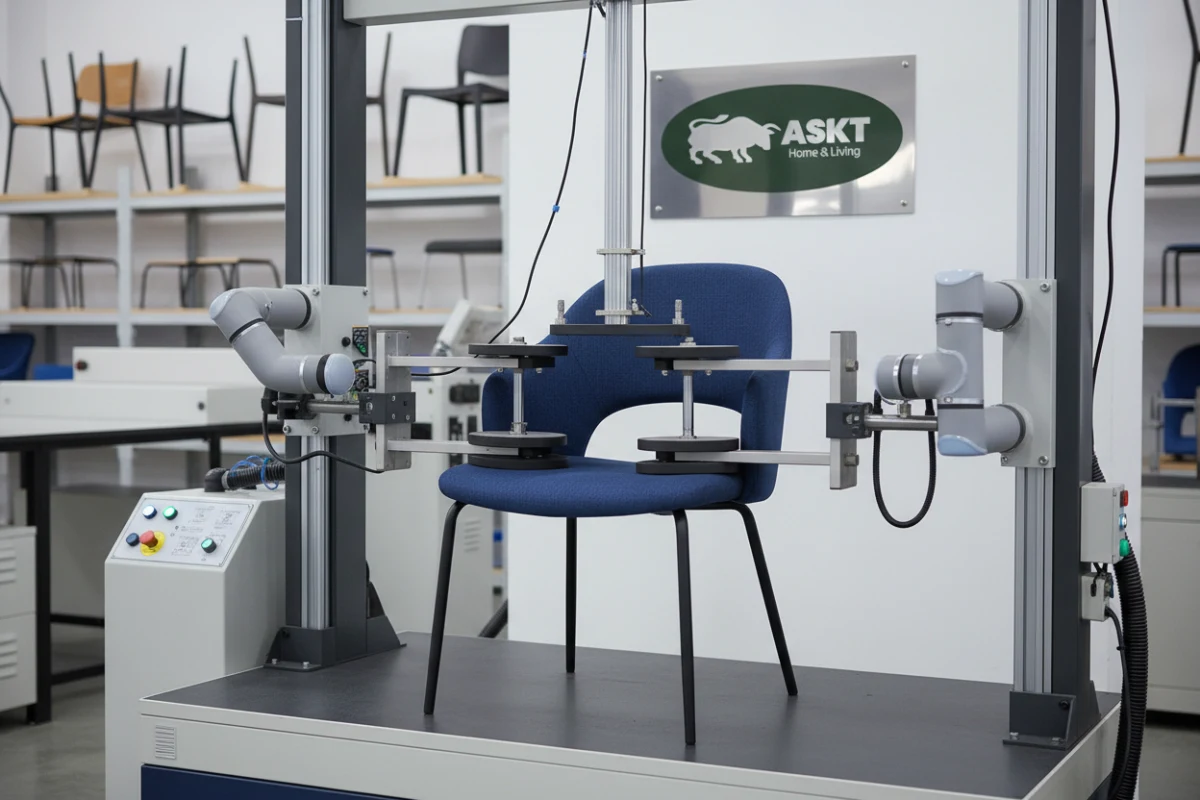
During this phase, our master craftsmen construct an initial physical prototype to test the CAD drawing against real-world physical forces. The primary objective is to verify structural integrity and ergonomics. A dining chair must offer excellent support and comfort for various body shapes. Our team evaluates the seat pan depth, the curvature of the backrest, the density of the internal polyurethane foam, and the overall balance of the frame. Even a highly detailed 3D model cannot fully predict how a specific foam density will compress over hours of continuous use or how a fabric will stretch across a complex curved backrest.
Furthermore, the Golden Sample is subjected to rigorous in-house mechanical stresses. We test joint connections, frame deflection, and fasteners to identify potential points of failure. Any adjustments required to improve durability or manufacturing efficiency are documented and integrated back into the CAD drawings. The finalised Golden Sample is then signed off by both the buyer and our quality control department. This sample remains in our controlled laboratory to serve as the reference standard against which every single batch is inspected before loading.
Section 3: Sourcing Certified Materials: Fabric Performance and Safety Compliance
For European B2B furniture buyers, material safety and performance compliance are non-negotiable requirements. When importing furniture into markets like Germany, the Netherlands, or the UK, products must meet strict environmental and chemical safety regulations. A professional custom dining chair supplier must provide complete traceability and certified compliance for all primary materials.
Upholstery fabric is one of the most critical components of a contemporary dining chair. To guarantee consumer safety and prevent regulatory import issues, all fabrics sourced for ASKT furniture are certified under the OEKO-TEX® STANDARD 100. This certification guarantees that the textiles have been tested for harmful substances, including heavy metals, volatile organic compounds (VOCs), and banned colorants. It ensures the finished seating is completely formaldehyde-free and safe for domestic and commercial environments.
In addition to chemical safety, fabric durability is essential for long-term customer satisfaction and low return rates. We offer a curated range of high-performance materials, including ASKT-Tex functional fabrics. Engineered with advanced hydrophobic nanotechnology, ASKT-Tex repels liquids, preventing water, coffee, or wine from penetrating the inner foam. Spills remain on the surface and can be wiped away with a dry cloth. These fabrics are also highly scratch-resistant, making them ideal for pet-friendly households, and they retain excellent breathability and rub-fastness over thousands of cycles.
+-----------------------+-----------------------------+--------------------------------------+
| Material Component    | European Target Standard    | Primary Sourcing Benefit             |
+-----------------------+-----------------------------+--------------------------------------+
| Upholstery Textiles   | OEKO-TEX® STANDARD 100      | Formaldehyde-free, chemical safety   |
| Nanotech Fabrics      | ASKT-Tex Hydrophobic Tech   | Water, stain, and scratch resistance |
| Structural Frames     | High-tensile carbon steel   | Fatigue resistance, high load limit  |
| Wood Components       | FSC-Certified Timber/Plywood| Responsible forestry, no warping     |
+-----------------------+-----------------------------+--------------------------------------+
Beyond textiles, the choice of structural materials is equally critical. For our metal-frame collections, we source high-tensile carbon steel and apply premium electrostatic powder-coating finishes. This process creates a thick, uniform protective barrier that resists impact, chipping, and corrosion. For upholstered collections utilising internal wooden frames, we select kiln-dried hardwood and multi-layered plywood to prevent warping, cracking, or structural shifting over time.
Section 4: Modern B2B Manufacturing: Leveraging Automation for Batch Consistency
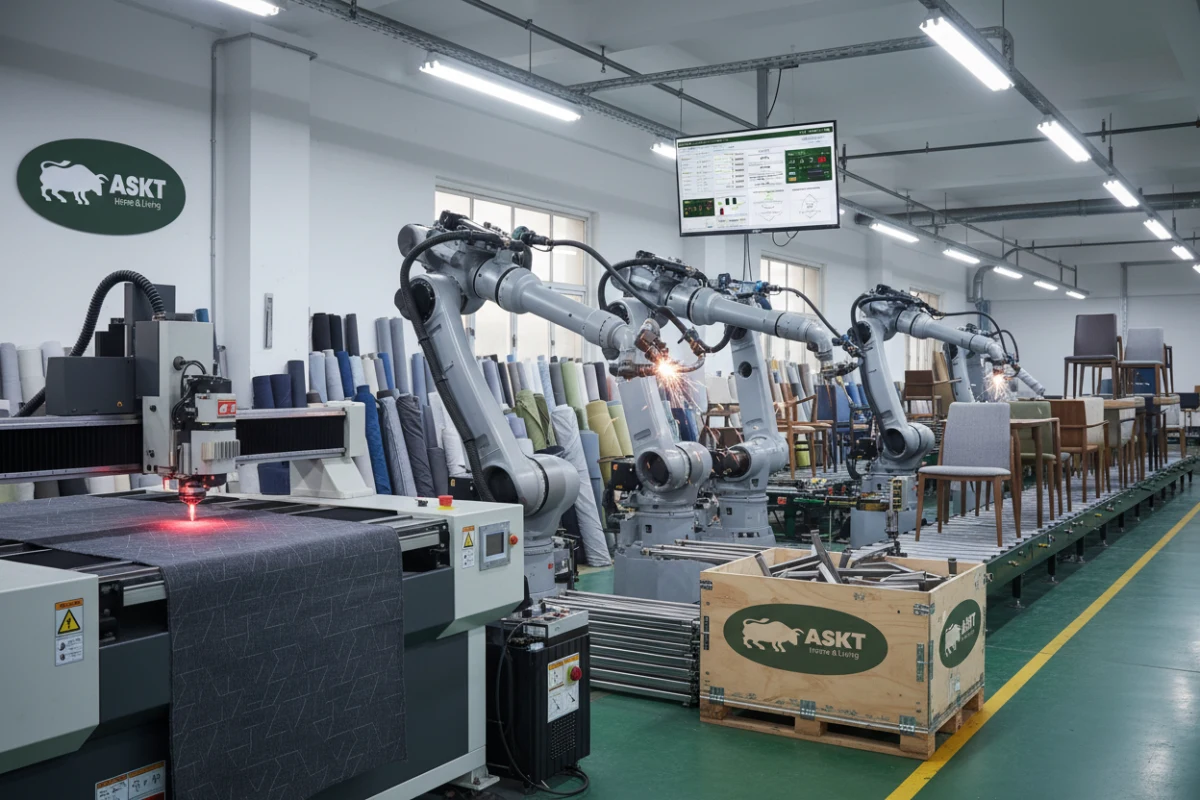
Maintaining a high level of dining chair mass production quality across thousands of units requires moving away from pure manual craftsmanship toward advanced factory automation. While human expertise remains essential for intricate upholstery details, automated machinery is critical for eliminating dimensional variation, reducing material waste, and ensuring structural consistency.
At our manufacturing facilities in China, we have integrated advanced automated machinery into every core stage of the production process:
- Automated Fabric Laser Cutters: Traditional manual fabric cutting is prone to slight alignment errors, leading to uneven seams and loose upholstery. Our CNC laser cutting systems cut multiple layers of fabric simultaneously with sub-millimetre precision. This ensures that every upholstered panel fits the chair frame perfectly, maintaining clean lines and consistent tension across all production batches.
- Automated Board-Punching and Nail-Installing Equipment: The internal structural integrity of an upholstered chair depends on the precise placement of structural fasteners, T-nuts, and dowels. Our automated board-punching and nail-installing machinery drills and inserts connection hardware at exact, programmed coordinates. This eliminates the risk of missing or misaligned fasteners, which are common causes of frame failures in manually assembled furniture.
- Robotic Welding Arms: For our metal-frame dining chairs and bar stools, structural joint strength is paramount. We utilise high-precision robotic welding arms to assemble steel frames. Unlike manual welding, which can vary based on operator fatigue, robotic welding delivers highly consistent weld penetration and uniform bead profiles. This precise thermal control prevents metal warping and guarantees that every structural joint can easily withstand years of repeated mechanical loading.
By leveraging this advanced manufacturing technology, we reduce human error, speed up production cycles, and guarantee that the 10,000th chair off the assembly line matches the physical tolerances and quality of the very first Golden Sample.
Section 5: The KINEXA Modular Solution: Simplifying Logistics and Optimising MOQs
One of the most significant challenges facing European B2B furniture buyers—particularly e-commerce brands, regional retailers, and growing wholesalers—is balancing inventory risk against minimum order quantity (MOQ) requirements. Ordering separate, full containers of multiple unique dining chair models can lead to high warehousing costs, tied-up working capital, and the risk of holding slow-moving stock.
To address this logistical challenge, ASKT developed the KINEXA modular system. The KINEXA framework is built on standardized structural interfaces, allowing buyers to mix and match interchangeable seat shells and metal leg designs. For example, a single, highly refined upholstered seat shell can be paired with a classic four-legged metal frame, a modern cantilever base, a swivel mechanism, or an auto-return office base.
             [ Seat Shell Design A ]       [ Seat Shell Design B ]
                        │                             │
                        └──────────────┬──────────────┘
                                       │ (Standardised Interface)
                                       ▼
             ┌─────────────────────────┼─────────────────────────┐
             ▼                         ▼                         ▼
     [ 4-Leg Metal Base ]     [ Cantilever Base ]      [ Swivel Return Base ]
This modularity offers several powerful advantages for B2B furniture procurement:
- Reduced MOQ Barriers: Instead of purchasing a full container of one specific model, buyers can source a single container filled with standard interchangeable seat shells and a variety of nesting metal bases. This enables you to offer your customers a wider range of product configurations without inflating your inventory footprint.
- Optimized Container Loading: Standardised seat shells are designed to stack efficiently, and KD (Knock-Down) metal bases nest tightly inside transit packaging. This modular design significantly reduces wasted space inside shipping containers. By maximizing container load density, the KINEXA system lowers per-unit transport costs from China to European ports, directly improving your gross import margins.
- Simplified Product Costing and SKU Management: Standardising structural interfaces simplifies product development and cataloguing. Introducing a new model to your collection no longer requires a completely new manufacturing program; it simply involves pairing an existing, proven base with a newly designed seat shell. This flexibility reduces engineering costs and accelerates your time-to-market.
Section 6: Quality Control and Trade-Offs: Implementing "Test First, Ship Second"
In B2B furniture manufacturing, quality control is not a final step before shipping; it is an active protocol that must be integrated into every stage of production. A reliable OEM partner does not hide manufacturing trade-offs but openly discusses them to help buyers make informed decisions. For instance, prioritizing maximum structural durability under extreme commercial use may require thicker steel tubing, which increases unit weight and material costs. Conversely, designing ultra-lightweight frames for lower-cost shipping might require internal reinforcement plates to maintain structural stability. We help buyers navigate these technical trade-offs based on their specific market positioning and target price points.
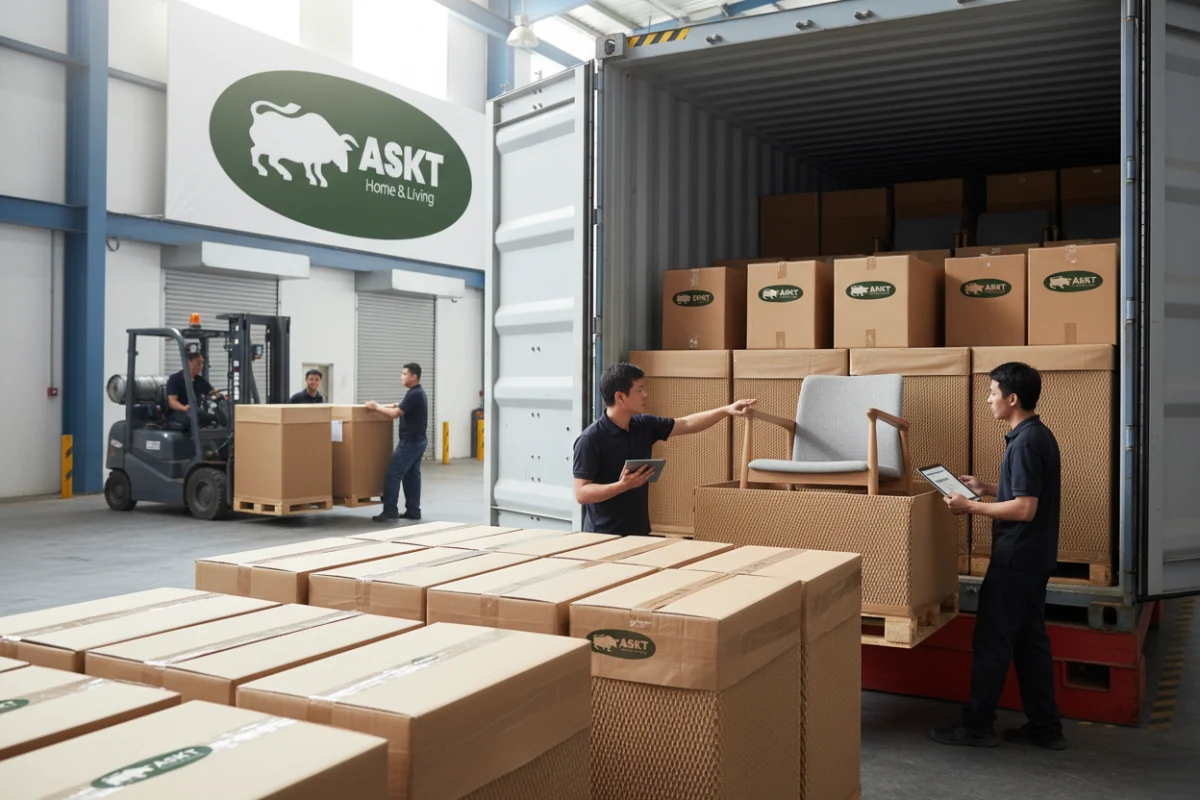
To guarantee that every shipment meets European standards, ASKT operates under a strict "Test first, ship second" quality control philosophy. This workflow ensures that no container leaves our loading docks without undergoing rigorous physical testing and structural verification:
- EN12520 Compliance Testing: All dining chairs intended for European residential markets are engineered and tested to comply with the European safety standard EN12520 (Domestic Seating). Our in-house quality control lab simulates years of continuous usage by subjecting production samples to cyclic seat and back durability tests, leg forward-impact tests, and static load tests of up to 110 kg or more. For tables, we test to the EN12521 standard to verify structural safety and stability under load.
- Transit Packaging and Damage Prevention: Product damage during international ocean transport or local parcel delivery can quickly erode B2B profit margins. To eliminate transit damage, we have replaced traditional single-use plastics and basic bubble wrap with sustainable, heavy-duty honeycomb paper protection and double-wall corrugated shipping boxes. This sustainable packaging is drop-tested to ensure that our dining chairs arrive in pristine condition, ready for direct delivery to retail stores or consumer doorsteps. This approach also aligns with the stringent ESG (Environmental, Social, and Governance) targets of modern European retailers.
- Transparent Inspections: We provide B2B buyers with comprehensive, transparent inspection reports before shipping. These reports contain detailed high-definition photos, precise dimensional measurements, fabric wear-resistance test results, and weight-loading verification records, ensuring complete transparency and peace of mind before cargo is released.
Selecting the right production partner is one of the most critical decisions for your business. By combining over 20 years of manufacturing experience, advanced automation, certified materials, and modular supply chain solutions, ASKT is dedicated to helping European B2B buyers reduce sourcing risks and build highly profitable, reliable furniture collections.
If you are currently evaluating your supply chain, planning a new contemporary dining chair collection, or looking to optimize your import logistics, our engineering team is here to assist you. Contact us today to discuss your technical drawings, fabric specifications, and custom branding requirements.