How to Successfully Manage an FCL Dining Chair Order from China
How to Successfully Manage an FCL Dining Chair Order from China
For international furniture retailers and wholesale distributors, securing high-quality inventory at a competitive price is the cornerstone of profitability. Placing an FCL dining chair order China is one of the most effective ways to leverage economies of scale, minimize unit transport costs, and maintain a consistent supply chain. However, moving high-volume shipments across ocean channels involves far more than simply selecting a product design and signing a purchase order.
To successfully execute a large-volume import, buyers must systematically manage product packaging, container volumes, quality assurance tolerances, and international logistics. This comprehensive guide outlines the critical steps to safely transition from draft specifications to a successfully landed shipment.
1. Calculating the True Total Landed Cost of Your Dining Chair Import
When importing dining chairs from China, many procurement teams fall into the trap of focusing solely on the Free On Board (FOB) price quoted by the manufacturer. While the FOB price represents the baseline manufacturing cost, it does not represent your final investment.
Evaluating the total landed cost is a prerequisite for executing any high-volume FCL dining chair order China. The true landed cost encompasses several factors:
- Ocean Freight Rates: Maritime shipping rates fluctuate seasonally and are influenced by global trade dynamics.
- Customs Duties and Tariffs: Depending on your country of import, dining chairs may be subject to specific duty rates, anti-dumping duties, or trade tariffs.
- Local Port Handling Fees: This includes terminal handling charges (THC), documentation fees, and customs clearance charges at both the origin and destination ports.
- Domestic Inland Freight: The cost of trucking the full container load (FCL) from the destination port to your primary distribution center.
By building a comprehensive landed cost model early in the purchasing cycle, you can establish realistic retail margins and avoid unexpected capital outflows when your cargo arrives.
2. Crucial Packaging and Stacking Specifications to Lock in Pre-Production
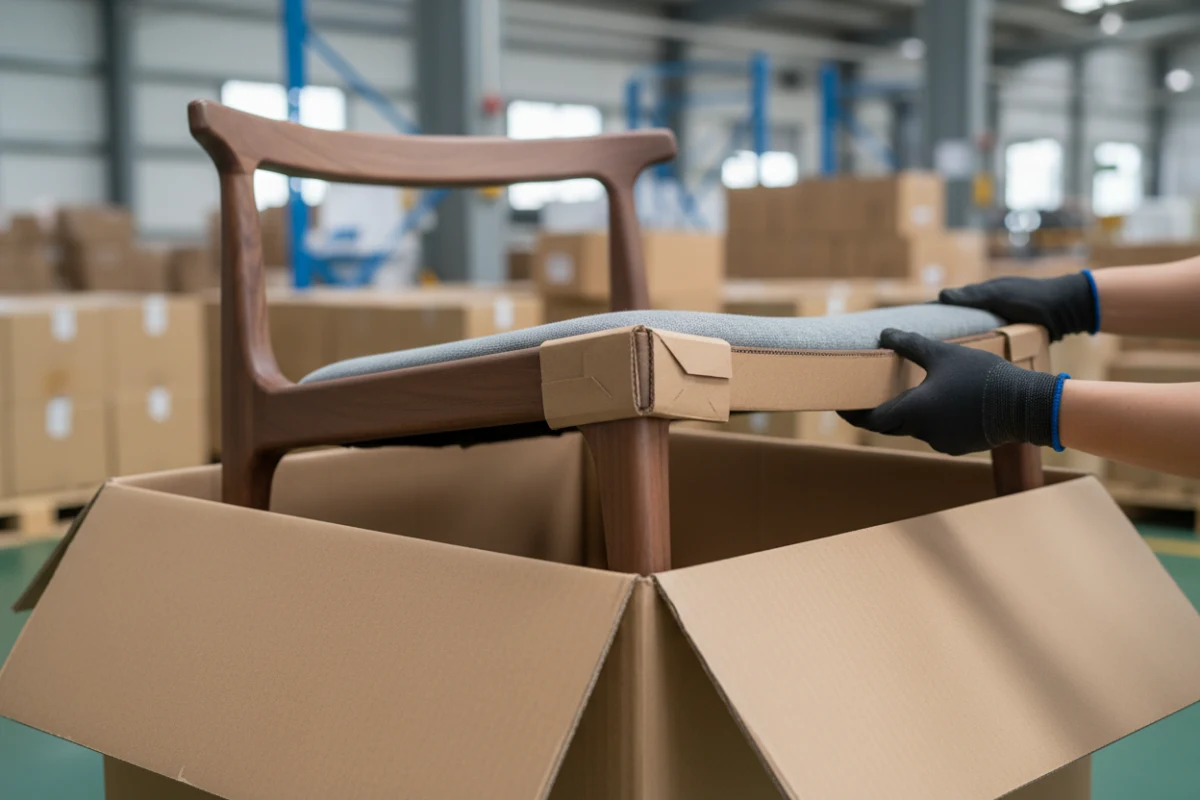 Ensuring proper inner packing and structural protection is critical for long ocean transits.
Furniture is highly susceptible to transit damage caused by container vibration, high humidity, and rough handling at ports. Establishing rigorous packaging specifications before production begins is vital for securing your bulk FCL dining chair order China during international transit.
To protect your investment, clearly define your packaging expectations in your product specification sheets:
Knocked-Down (KD) vs. Fully Assembled Packaging
Knocked-down (KD) chairs are shipped disassembled, which significantly reduces the package volume per unit and allows you to load more units into a single container. However, KD chairs require clear assembly instructions, robust hardware packs, and reliable pre-drilled holes. Fully assembled chairs, while occupying more container space, eliminate assembly hassle for end-users but require much sturdier internal carton support to prevent leg breakage.
Carton Quality and Burst Strength
Insist on double-wall corrugated cardboard cartons (at least 5-ply) with a certified Edge Crush Test (ECT) rating or bursting test value. The cartons must withstand high-stacking pressure inside the container without collapsing. Corner guards, polyethylene (PE) foam wrapping, and heavy-duty strapping should be standard protocol for every carton.
3. Regulatory Compliance and Material Standards for Global Markets
Different target markets enforce strict structural safety, chemical usage, and material sourcing regulations. For an FCL dining chair order China destined for global markets, compliance is a non-negotiable legal requirement that protects your brand from expensive customs seizures or product recalls.
An integral part of active furniture supply chain risk management is ensuring that your chosen factory meets the regulatory standards of your destination country:
- North American Standards (USA & Canada): Chairs must comply with structural performance standards such as ANSI/BIFMA X5.1. Additionally, upholstered chairs must satisfy flame retardancy standards like California Technical Bulletin 117-2013 (CAL 117) and formaldehyde emission limits governed by CARB Phase 2 and the EPA TSCA Title VI.
- European Standards (EU): Dining chairs must meet EN 12520 for mechanical safety, strength, and durability. Wood materials must comply with the European Union Timber Regulation (EUTR) or the newer EU Deforestation Regulation (EUDR) to prove legal and sustainable logging.
Ensure that all raw material certifications (such as FSC-certified wood or OEKO-TEX certified fabrics) are verified and documented prior to container loading.
4. Setting Quality Control and Defect Tolerance Thresholds
 Rigorous quality control inspections prevent defective inventory from loading onto containers.
When importing in container volumes, a minor systematic defect can quickly ruin an entire shipment, leading to massive financial losses. Partnering with a reputable wholesale dining chairs manufacturer for an FCL dining chair order China requires a formal Quality Agreement that outlines an acceptable quality limit (AQL).
Before the factory begins mass production, define your quality standards and defect categories clearly:
- Critical Defects: Any issue that affects user safety or violates legal compliance (e.g., structural failure of a chair frame, presence of mold, or hazardous chemical levels). The acceptable tolerance for critical defects must be 0%.
- Major Defects: Deficiencies that reduce the product's usability or salability (e.g., severe wood warping, mismatched screw holes, deeply torn fabric, or major paint peeling). A typical AQL for major defects is set at 1.5% or 2.5%.
- Minor Defects: Slight cosmetic imperfections that do not affect structural integrity or primary aesthetics (e.g., tiny sewing frays on the underside, minor variations in paint gloss, or tiny scratches on hardware). These are typically tolerated up to an AQL of 4.0%.
Always schedule a pre-shipment inspection (PSI) by an independent third-party agency. This inspection should be conducted when the order is at least 80% packed, ensuring that the chairs meet your defined AQL before they are loaded into the container.
5. Maximize Container Volume: 20GP vs. 40HQ Loading Strategies for Chairs
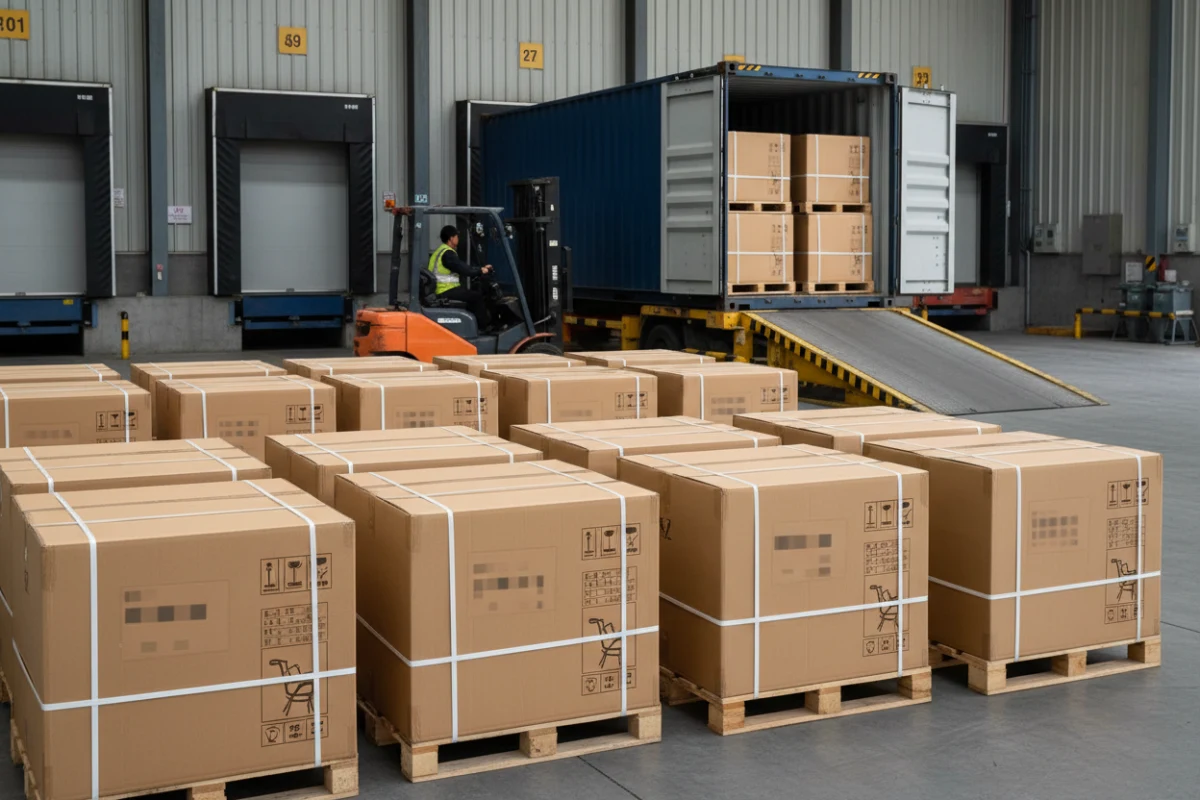
 Effective nesting and container load optimization significantly reduce per-unit shipping costs.
Ocean freight costs are calculated per container rather than per item. Therefore, maximizing the volumetric efficiency of your shipping container is direct profit in your pocket. Implementing smart furniture container load optimization strategies can significantly lower your per-unit shipping costs.
When planning your FCL dining chair order China, deciding between a 20GP and 40HQ container depends on your total volume and the physical characteristics of the chairs:
| Container Type | Internal Volume (Approx.) | Maximum Weight Capacity | Ideal For |
|---|---|---|---|
| 20GP (General Purpose) | ~33 cubic meters (CBM) | ~21,000 to 28,000 kg | Heavy materials or smaller, trial-run shipments. |
| 40HQ (High Cube) | ~76 cubic meters (CBM) | ~26,000 to 29,000 kg | Volumetric, lightweight items like chairs, offering the lowest cost per CBM. |
Because dining chairs are relatively lightweight but bulky, they are typically limited by container volume (cube-out) long before they reach the maximum weight limit (weight-out). Therefore, a 40HQ container is almost always the most cost-effective choice for bulk dining chair shipments, as it offers more than double the volume of a 20GP container for only a marginal increase in freight rate.
By utilizing smart space-saving measures—such as nesting chairs, mixing fully assembled designs with KD models, or using empty chair cavities to pack smaller accessory boxes—your FCL dining chair order China will yield the highest possible shipping efficiency.
Conclusion: Streamlining Your FCL Dining Chair Supply Chain
Successfully managing a bulk furniture import from China requires combining meticulous quality standards with precise logistical planning. By understanding the true landed costs, locking in protective packaging designs, ensuring strict regulatory compliance, and maximizing container space, you can transform complex global sourcing into a highly profitable, repeatable business model.
If you are ready to secure the best rates and optimize your logistics, Request FCL Quote Preparation to streamline your next FCL dining chair order China.