How should flat-pack dining chairs be packed for e-commerce delivery in Europe?
Flat-pack dining chairs for European e-commerce delivery should be packed to match carrier dimension and weight limits, use targeted protection that reduces damage during last-mile handling, and be optimised for both container loading and simple customer assembly, while balancing cost control and sustainability expectations across markets such as Germany, the Netherlands and the UK.
Why flat-pack packaging matters for European e-commerce furniture buyers
For online furniture retailers, packaging is not a secondary detail—it is a core part of the product experience and the cost base. A poorly packed flat-pack dining chair can arrive with scuffed upholstery, bent metal frames, cracked wooden parts or missing hardware, which triggers returns, customer complaints and negative reviews. In European e-commerce, where return logistics are expensive and brand reputation travels quickly, those costs eat into margin faster than almost any other operational issue.
Packaging also touches almost every part of the supply chain. It influences container utilisation on the way from the factory, warehousing efficiency in Europe, carrier selection for last-mile delivery, and even how customers perceive quality when they open the box. For wholesalers and e-commerce brands buying from China, getting the packaging specification right at the manufacturing stage is far more effective than trying to fix damage later with rework or local repacking.
From a buyer perspective, the best packaging is invisible in the best sense: it survives the journey, does not cost too much, is easy to handle, and aligns with the brand's sustainability story. That is why e-commerce furniture packaging best practices always start with the full logistics path in mind, not just the product itself.
What are the key dimension and weight constraints for European delivery channels?
When we talk about flat pack dining chair packaging dimensions Europe-wide, the first rule is that there is no single universal limit. Each carrier network has its own maximum length, width, height and weight thresholds, and exceeding them usually triggers surcharges, manual handling fees or forced upgrades to more expensive services. For online retailers selling across multiple European countries, that variability makes standardisation critical.
In practice, most European parcel and last-mile networks work most efficiently with cartons that stay within common medium-parcel ranges. Beyond the raw dimensions, there are also practical constraints related to how packages move through sortation hubs, onto vans and up to front doors. Long, narrow or awkwardly shaped cartons are more likely to be damaged, misrouted or refused by drivers, even if they technically fit the published limits.
The most dimension-sensitive points in the delivery journey are:
- Automated sortation systems, which can reject packages outside approved size bands
- Van loading and doorstep delivery, where weight and manoeuvrability matter
- Multi-floor buildings and apartment entrances common in cities across Germany, the Netherlands and the UK
- Return handling, where oversized packaging increases reverse logistics cost
For flat-pack dining chairs, the practical implication is that the carton should be designed around the carrier grid, not just around stacking components as tightly as possible. A few extra millimetres of box length might seem harmless at the factory, but multiplied by thousands of units and multiple carriers, it can push an entire SKU into a more expensive tariff.
Weight is equally important. Heavier cartons are more likely to be dropped from greater height during manual handling, and they also increase the chance of customer dissatisfaction on delivery day. For e-commerce brands, keeping single-carton weight within a comfortable two-person carry range is a good baseline, especially if assembly is intended for the end customer without professional help.
What core protection do flat-pack dining chairs need for last-mile delivery?
Last-mile delivery protection for flat-pack chairs is the difference between a five-star review and a return request. The challenge with dining chairs is that they combine several different component types in one box: upholstered seat or back panels, metal or wooden frames, legs, hardware bags and sometimes assembly tools. Each of these parts can damage the others if they are not separated and immobilised properly.
The highest-risk areas are almost always the same:
- Corners of seat shells and backrests, which take the brunt of impact if the box is dropped
- Metal frame ends and joint points, which can puncture cardboard and scratch upholstery
- Upholstered surfaces, which are easily scuffed, torn or stained by cardboard dust or adhesive
- Hardware bags, which can shift during transit and dent or chip finished components
- Leg sections, which can snap if pressure is applied at the wrong angle
E-commerce furniture packaging best practices address these risks with layered protection rather than one generic solution. That usually means a combination of edge protectors on rigid parts, separating layers between upholstered and hard components, internal bracing to stop movement inside the carton, and reinforced corners on the outer box itself.
One common mistake I see retailers make is using too much of the wrong protection. Wrapping everything in thick bubble wrap sounds safe, but if parts can still slide around inside the box, they will still hit each other during transit. Good protection is about immobilisation first, and shock absorption second. A tightly fitted inner structure that holds each component in its own compartment performs better than loose filler material, and it often uses less packaging overall.
Drop testing is the most reliable way to validate protection. A packaging design that passes controlled drop tests from realistic heights and on different edges is far more likely to survive real last-mile handling than one approved only by visual inspection. For European e-commerce volumes, that upfront testing cost is quickly recovered through lower damage rates and fewer replacement shipments.
How does packaging design affect logistics cost and customer experience?
Flat-pack packaging cost optimisation for online retailers is rarely about choosing the cheapest carton. It is about understanding how every packaging decision ripples through the rest of the business. A slightly more expensive box that reduces damage by a meaningful percentage, fits more units per container and lowers carrier surcharges will almost always deliver better total cost than the lowest-price alternative.
On the inbound side, packaging dimensions directly affect container loading. If the carton footprint is designed to fit standard pallets and 20-foot or 40-foot container internal dimensions without wasted gaps, the per-unit transport cost drops immediately. For dining chairs, which are relatively light but bulky, cube utilisation is often more important than weight utilisation. Small improvements in box shape can add up to significant freight savings over a season.
On the outbound side, the same dimension decisions influence carrier cost. Most European last-mile carriers price by weight and dimensions, often using volumetric formulas. A carton that falls just under a size threshold can move the entire SKU into a lower price band. That is why flat pack dining chair packaging dimensions Europe strategies are usually developed jointly with logistics teams, not just with packaging suppliers.
Customer experience is another cost factor that is easy to underestimate. The unboxing moment is the first physical contact a customer has with the brand. If the packaging is difficult to open, full of plastic, confusing to sort through or missing clear assembly instructions, the customer's perception of the whole product drops. On the other hand, well-organised components, labelled bags and reasonable packaging effort create confidence that the product is well made, even before assembly starts.
Returns are the most expensive consequence of poor packaging. In European e-commerce, return shipping, inspection, repacking, restocking and refurbishment can easily exceed the original profit margin on a dining chair. In the worst cases, returned chairs cannot be resold at all and become write-offs. Investing in better packaging upfront is therefore usually a risk-reduction decision as much as a cost decision.
What sustainable packaging options work for European e-commerce markets?
Sustainability is no longer a nice-to-have in European furniture packaging. Consumers, retailers and regulators all expect less plastic, more recyclable material and clearer environmental messaging. For online furniture brands, packaging is one of the most visible ways to demonstrate ESG commitment, because it is the part of the product every customer touches first.
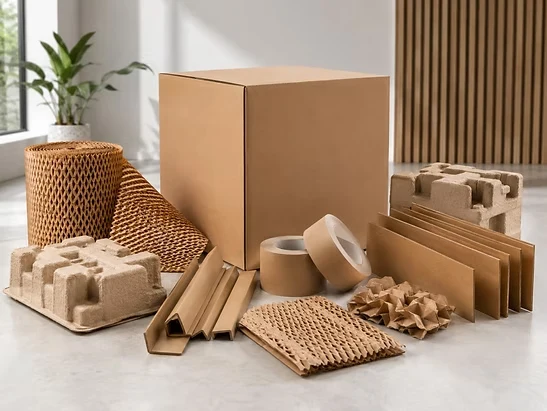
Paper-based solutions are the most common replacement for plastic foam and bubble wrap. Honeycomb paper, corrugated inserts and moulded pulp components can be engineered to provide very similar shock and scratch protection to their plastic equivalents, as long as they are designed for the specific shape of the chair parts. Generic paper fillers do not perform as well, but custom-fit paper protection often does.
The trade-off with sustainable packaging is usually cost and design time. Plastic foam is lightweight, easy to source in standard shapes and familiar to packers. Paper-based protection often requires custom tooling, more precise assembly at the packing station and slightly more training for factory teams. However, as demand rises across Europe, the cost gap continues to narrow, and many buyers now see sustainable packaging as a commercial advantage rather than an extra expense.
Another important point is that sustainable packaging does not only mean less plastic. It also means right-sized cartons that avoid wasted space, recyclable outer boxes without mixed-material coatings, and clear on-pack recycling instructions in the languages of the target markets. For brands selling in Germany, the Netherlands, the UK and other European countries, those details matter for both customer perception and compliance with packaging waste regulations.
What should buyers check when reviewing flat-pack packaging with a manufacturer?
Reviewing packaging with a furniture manufacturer is one of the most underrated steps in product development. Many buyers focus heavily on fabric, frame and finish, and then treat packaging as a last-minute detail. That is usually a mistake, because packaging performance depends on how the product itself is designed for disassembly and packing.
Here is a practical checklist to use when evaluating a manufacturer's flat-pack dining chair packaging proposal:
- Does the carton size fit the standard parcel tiers of your main European carriers?
- Have drop tests been performed and documented for the proposed packaging?
- Are high-risk components such as metal frame ends and seat corners individually protected?
- Are upholstered surfaces separated from hard parts to prevent scuffing and tearing?
- Is hardware bagged, labelled and secured so it cannot shift and damage components?
- Does the packaging use the minimum necessary material while still meeting protection targets?
- Are assembly instructions clear, multilingual where needed and positioned where customers find them immediately?
- Can the carton footprint be stacked efficiently on pallets and in standard shipping containers?
- Are packaging materials aligned with your sustainability targets and local recycling rules?
- Does the manufacturer offer packaging customisation for different markets or sales channels?
The most productive packaging reviews happen early, when the KD structure and component shapes can still be adjusted. Small changes to how legs detach, how backrests split or how frames nest together can make a big difference to packaging volume, protection and cost. Waiting until production tooling is finalised limits most of those options.
It is also worth asking the manufacturer about their packaging quality control process. Consistent packing is as important as the design itself. If some cartons are packed tightly and others loosely, damage rates will vary unpredictably. A reliable manufacturer will have clear packing work instructions, regular in-line checks and defined escalation procedures if packaging defects are found during inspection.
How does ASKT approach flat-pack dining chair packaging for European e-commerce?
At ASKT, we treat packaging as an integrated part of product development, not an afterthought. With over 20 years of manufacturing experience and a focus on the European market, including Germany, the Netherlands, the UK, Poland, Switzerland and Ireland, we design flat-pack dining chair packaging with the full journey in mind—from container loading at the factory to last-mile delivery to the customer's home.
Our approach starts with understanding each buyer's specific logistics set-up. A brand selling mainly through parcel carriers in Germany has different dimension and protection needs than a wholesaler delivering on pallets to retail warehouses. We work through those requirements early so packaging design, KD structure and component layout are all aligned.
We also support customisation in packaging, just as we do with fabrics, colours and frame finishes. That can include branded cartons, multilingual instruction manuals, private-label packaging, adjusted component arrangement for specific assembly flows, and sustainable material options such as honeycomb paper protection and reduced plastic use. For buyers building their own e-commerce brand, those packaging details are a direct extension of the customer experience.
Quality control is built into our packaging process, from incoming material checks for carton strength and protective material performance to in-process packing audits and final pre-shipment inspection. We know that consistent packaging quality directly affects our buyers' return rates, carrier costs and customer satisfaction, so we track it with the same discipline as frame welding, powder coating or upholstery quality.
If you are an e-commerce furniture brand, wholesaler, importer or retail chain evaluating flat-pack dining chair supply for the European market, it is worth reviewing packaging specifications with your manufacturing partner before finalising any product range. Small decisions made at that stage can have a disproportionate effect on logistics cost, damage rates and customer perception over the lifetime of a product.
To discuss your specific delivery requirements and explore how a tailored packaging solution could support your e-commerce operations, send us your shipping specifications for a custom packaging review.