
FSC vs EUDR for Furniture: The Complete Compliance and Due Diligence Guide for European Importers
FSC certification confirms responsible forest management and chain-of-custody tracking, but it does not satisfy the European Union Deforestation Regulation (EUDR) on its own. While FSC is a voluntary industry standard, EUDR is a mandatory legal regulation requiring precise harvest plot geolocation coordinates, documented proof of zero deforestation after 31 December 2020, and verified legality under the harvest country's laws. European furniture importers must submit a formal Due Diligence Statement (DDS) before placing wooden dining furniture on the European market.
What Is the Core Difference Between FSC Certification and EUDR Compliance for Furniture?
For many years, commercial furniture buyers sourcing wooden dining tables, dining benches, and upholstered dining chairs with internal wooden boards relied on Forest Stewardship Council (FSC) certification to prove environmental responsibility. However, the introduction of the EUDR creates a fundamental shift from voluntary sustainability verification to mandatory legal compliance. Understanding the operational and legal boundaries in FSC vs EUDR furniture procurement is essential for wholesalers, retailers, and contract buyers across Germany, the Netherlands, the UK, Poland, Switzerland, Ireland, and other European markets.
FSC operates as an independent, non-governmental certification body. Its certification frameworks—such as FSC 100%, FSC Mix, and FSC Recycled—track timber through an accredited Chain of Custody (CoC). This system monitors wood raw materials as they pass from certified forests through sawmills, intermediate processors, and manufacturing plants. FSC standards evaluate forest management practices, ecosystem preservation, biodiversity, indigenous community rights, and forestry work conditions.
In contrast, the EUDR is a binding European Union regulation enforced directly by customs authorities and national competent authorities in each EU member state. It establishes strict legal obligations for operators and traders placing specific timber-derived commodities and finished goods—including solid wood dining tables, oak veneer surfaces, and upholstered chairs containing wooden composite boards—onto the European single market. Achieving European timber compliance dining furniture standards requires compliance across three statutory pillars: no deforestation on the harvest plot after the 31 December 2020 cut-off date, strict compliance with all relevant legislation in the country of production, and verifiable geographic traceability.
| Compliance Dimension | FSC Certification | EUDR (EU Deforestation Regulation) |
|---|---|---|
| Legal Status | Voluntary market certification | Mandatory European statutory regulation |
| Enforcement Body | Independent certification bodies and auditors | EU Member State Competent Authorities and Customs |
| Scope of Obligation | Commercial chain-of-custody verification | Mandatory legal liability for European operators |
| Deforestation Cut-off Date | Based on voluntary standard review cycles | Fixed statutory threshold: 31 December 2020 |
| Geolocation Data | Forest management unit boundary | Exact GPS coordinates (point or polygon perimeters) |
| Customs Requirement | Market preference and commercial proof | Mandatory Due Diligence Statement (DDS) reference |
| Non-Compliance Risk | Loss or suspension of certification status | Fines up to 4% of EU turnover, shipment confiscation, trading bans |
While FSC certification establishes a credible foundation for ethical forestry, European customs authorities will not grant automatic market access simply because an import shipment carries an FSC Chain of Custody claim.

Why Does FSC Certification Alone Fail to Meet EUDR Due Diligence Obligations?
Many European purchasing managers assume that obtaining a valid FSC certificate from an overseas dining furniture manufacturer automatically guarantees customs clearance under new EU timber rules. In practice, relying solely on FSC certification furniture import paperwork creates compliance gaps that expose importers to severe commercial and regulatory penalties.
The regulatory mechanisms of FSC and EUDR diverge across several specific legal and technical parameters:
- Granular Geographic Coordinates: FSC Chain of Custody verifies that certified wood materials flow through approved facilities using mass-balance or batch-accounting methods. In contrast, EUDR demands exact geographic coordinates (latitude and longitude coordinates, including polygon boundary maps for forest plots exceeding four hectares) pinpointing the exact plots of land where the timber was harvested.
- Rigid Deforestation Cut-Off Date: EUDR explicitly prohibits the import of timber harvested from land subjected to deforestation or forest degradation after 31 December 2020. FSC forest management standards permit timber harvesting within approved long-term conversion plans under specific historical circumstances, meaning some FSC-certified wood might not meet EUDR temporal criteria.
- Broad Scope of Local Legality: FSC Principle 1 requires legal compliance, but EUDR specifies compulsory adherence to a wide range of national statutory frameworks in the country of harvest. This includes land tenure rights, environmental regulations, forestry management rules, third-party and indigenous rights, labour rights, occupational safety, tax laws, and export regulations. Importers must hold concrete legal documentation for every link in the supply chain.
- Direct Importer Liability: Under FSC systems, the primary sanction for non-compliance is the suspension of a certificate. Under EUDR, European operators face direct civil and administrative penalties, including maximum fines of at least 4% of total annual EU turnover, confiscation of goods, forfeiture of commercial revenues, and temporary exclusion from public procurement tenders.
Third-party certifications remain valuable components of an importer's overall risk assessment toolkit. However, EU guidance confirms that certification schemes cannot replace the individual operator's legal responsibility to gather, verify, and submit due diligence data.
What Are the Mandatory Due Diligence Requirements for European Timber Dining Furniture?
To achieve complete EUDR due diligence furniture compliance, European furniture wholesalers, retail chains, and contract buyers must operate an internal Due Diligence System (DDS). This system requires a structured, three-step compliance workflow before any wooden dining tables, benches, or upholstered chairs are placed on the EU market.
Step 1: Information Gathering --> Step 2: Risk Assessment --> Step 3: Risk Mitigation (Botanical Species, GPS Coordinates, Legality Proofs) --> (Deforestation Risk, Supply Chain Complexity, Mixing Risks) --> (Batch Segregation, Independent Auditing, Direct Verification)
Step 1: Information Collection and Data Gathering
Importers must collect verifiable technical and supply chain records for every production batch of dining furniture. The required information includes:
- Product Description and Tariff Classification: Full trade descriptions, commercial article names, and accurate Harmonised System (HS) codes (such as Chapter 94 for finished furniture and Chapter 44 for semi-finished wood elements).
- Scientific Botanical Identification: The full scientific genus and species names for every wood-based component (for example, Quercus alba for oak veneer surfaces and solid wood dining table frames, as well as specific hardwood species used for internal seat boards).
- Country and Regional Origin: The precise country of harvest, down to local administrative regions and specific forest management units.
- Geolocation Coordinates: Precise GPS coordinate points or digital polygon boundary maps representing every individual harvest plot.
- Production and Harvest Date Ranges: Timeframes confirming when the timber was cut and processed.
- Supplier and Processor Details: Full commercial identities, business addresses, and registration numbers for sawmills, veneer slicers, board manufacturers, and the final assembly factory.
- Evidence of Legal Harvesting: Official cutting permits, land tenure documentation, domestic transport records, tax receipts, labour standard compliance records, and export licences.
Step 2: Comprehensive Risk Assessment
With all documentation collected, the European buyer must evaluate supply chain risks against the European Commission's criteria. Key evaluation factors include:
- Country Risk Benchmarking: Assessing whether the sourcing region is classified as low, standard, or high risk under EU monitoring.
- Regional Deforestation Rates: Evaluating historical land-use changes and deforestation patterns in the harvest area since 31 December 2020.
- Supply Chain Complexity: Assessing the number of intermediaries, log markets, drying facilities, and veneer processors involved between the forest plot and the dining furniture factory.
- Risk of Material Mixing: Determining whether unverified or non-compliant timber could mix with verified stock during milling, board preparation, or chair assembly.
- Indigenous and Community Rights: Confirming the absence of land disputes, customary tenure conflicts, or unresolved local claims in the harvesting district.
Step 3: Targeted Risk Mitigation
If the risk assessment identifies any non-negligible risk of deforestation or legal non-compliance, the importer must apply mitigation measures before releasing shipments for export. These measures include:
- Requesting supplementary documentation, chain-of-custody audit reports, and certified verification records from upstream mills.
- Commissioning independent third-party audits and direct factory inspections to evaluate material tracking.
- Partnering with manufacturers that maintain physical batch segregation, documented inventory control, and separate storage zones for compliant wood.
Once the risk is confirmed to be negligible, the importer submits the official Due Diligence Statement (DDS) through the EU Information System to generate the required reference number for customs clearance.

How Does Supply Chain Traceability Connect Raw Timber to Dining Furniture Manufacturing?
Managing furniture supply chain traceability EUDR requirements is particularly complex for finished indoor furniture. Unlike bulk raw timber, a modern dining chair, dining table, or lounge chair incorporates multiple materials into a single product: solid wood legs, oak veneer surfaces, internal structural wooden boards, metal sub-frames, swivel mechanisms, pocket springs, foam cushioning, and upholstery fabrics.
To ensure complete traceability, a professional B2B dining furniture manufacturer integrates compliance checkpoints throughout every stage of the manufacturing process:
1. Raw Material Intake and Document Verification
Compliant manufacturing begins at raw material reception. When solid timber planks, oak veneer leaves, and engineered wood boards arrive at the factory, quality control teams verify incoming delivery dockets against harvesting permits, sawmill declarations, and GPS coordinate sheets. Materials receive unique internal batch codes that link physical stock to specific harvest dossiers.
2. Physical Segregation and Component Processing
During component shaping, cutting, and processing, raw materials must remain fully segregated:
- Board Punching and Shaping: Precision punching and cutting machinery processes internal wooden seat boards to strict dimensional tolerances while preserving batch identification.
- Fastener Installation: Automated nailing equipment installs structural fasteners into wooden seat bases without compromising board integrity.
- Batch Isolation: Dedicated material racks keep verified timber batches isolated from conventional commercial inventory, preventing accidental material mixing.
3. Integration with Metal Frames and Functional Mechanisms
Contemporary dining chairs frequently combine wooden seat cores with robust metal chassis, powder-coated steel legs, and auto-return swivel systems. Robotic welding arms assemble metal frames to guarantee structural consistency and weld integrity, followed by electrostatic powder coating for corrosion resistance.
During assembly, the internal wooden board (carrying its unique EUDR batch code) is mechanically fastened to the powder-coated metal frame. Component tracking tags record the pairing of the specific wood batch with the structural metal assembly.
4. Upholstery, Padding, and Chemical Safety Compliance
In the upholstery workshop, performance fabrics—including waterproof, easy-clean, stain-resistant, pet-friendly textiles, and eco-friendly covers made from recycled polyester—are cut and fitted over high-density foam or pocket spring seat cushions. Environmentally responsible adhesives secure upholstery layers without releasing harmful volatile organic compounds (VOCs).
Responsible dining furniture manufacturers maintain comprehensive compliance standards across all materials, ensuring fabrics, foams, and glues meet European chemical safety and environmental benchmarks alongside timber compliance.
5. Flat-Pack Packaging, Batch Labelling, and Logistics Optimisation
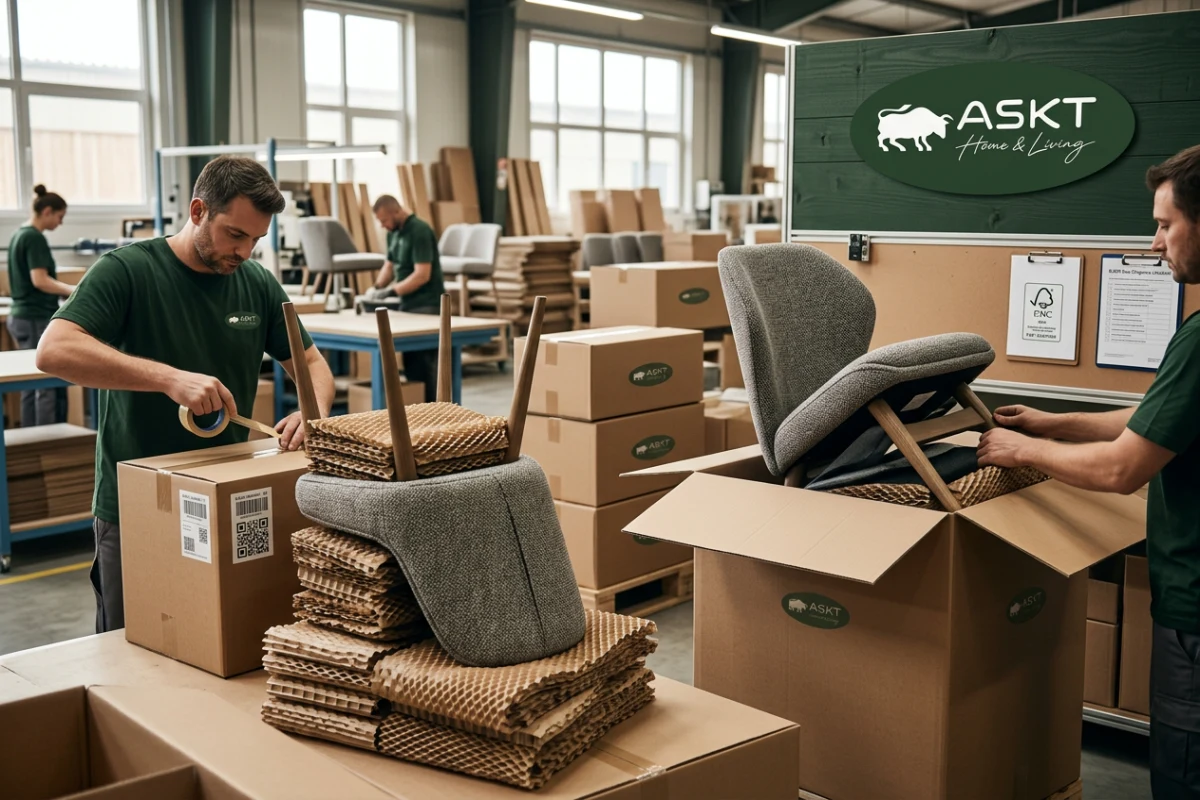
Finished dining chairs and extension dining tables are packed into knock-down (KD) configurations to maximise container space utilisation and reduce shipping costs. Protective packaging incorporates sustainable paper honeycomb padding and edge guards to minimise single-use plastic consumption.
Every export carton is printed with a machine-readable batch barcode that links the packaged furniture piece directly to its production batch, bill of materials (BOM), wood component origin records, and the corresponding EUDR Due Diligence Statement.
[Harvest Plot (GPS Coordinates & Cutting Permits)] ↓ [Sawmill & Board Processor (Legality Records)] ↓ [Factory Intake & Batch Barcode Registration] ↓ [Component Shaping, Punching & Frame Assembly] ↓ [Upholstery Bonding & Structural Testing] ↓ [KD Packaging with Honeycomb Paper Protection] ↓ [Customs Due Diligence Statement (DDS) Clearance]
| Production Stage | Compliance Control Point | Traceability Verification Action |
|---|---|---|
| Timber Intake | Raw Material Log & Geolocation Record | Match physical delivery to harvest coordinates and cutting permits |
| Board Preparation | Precision Punching & Fastener Nailing | Apply batch tracking codes to shaped wooden board components |
| Frame Integration | Robotic Metal Welding & Powder Coating | Fasten metal chassis while recording wood batch codes in the production log |
| Upholstery Assembly | Fabric Application & Adhesive Bonding | Use certified fabrics and VOC-free adhesives with recorded batch lots |
| Packaging & Packout | KD Carton Packing & Barcode Labelling | Print batch tracking numbers on export cartons for DDS customs mapping |
What Practical Steps Should European Buyers Take to Verify Furniture Suppliers Before Import?
European wholesalers, retail buyers, product managers, and contract furniture specifiers must establish robust supplier evaluation protocols before issuing purchase orders. To mitigate regulatory and supply chain risks, commercial buyers should implement a structured pre-procurement verification checklist.
Practical Pre-Procurement Sourcing Checklist
- Confirm Botanical Data and HS Classifications: Require the factory to provide exact Latin botanical names (Genus and species) alongside correct customs tariff classifications for all timber elements in the collection.
- Inspect Sample Geolocation Records: Request sample GPS coordinates (point coordinates or polygon boundary data) for timber allocations before authorizing mass production.
- Verify Batch Segregation Capabilities: Audit the factory's material management workflows to ensure strict physical and digital separation between verified timber batches and general stock.
- Review Packaging and Container Optimization: Ensure the manufacturer provides space-efficient KD product designs, durable honeycomb protective packaging, and optimised container loading plans to control shipping costs.
- Check Structural Durability and EN Testing: Confirm that dining chairs and tables meet European standards (such as EN 12520 for domestic dining furniture or EN 16139 for contract seating) regarding load capacity, joint stability, and fatigue resistance.
- Evaluate Fabric and Component Specifications: Verify that upholstery fabrics feature necessary performance attributes, such as abrasion resistance, colour fastness, stain resistance, and chemical safety compliance.
Working with an experienced manufacturing partner simplifies European compliance and supply chain management. For instance, ASKT combines over 20 years of B2B dining furniture manufacturing experience with transparent quality control, strict timber traceability, modular dining chair engineering, and sustainable packaging solutions. This buyer-oriented approach enables European furniture businesses to minimise sourcing risk, streamline customs clearance, and deliver durable, compliant furniture to commercial and retail clients.
Frequently Asked Questions About FSC and EUDR Furniture Compliance
Does an FSC Chain of Custody certificate guarantee green-lane customs clearance under EUDR?
No. FSC certification provides recognized third-party verification of responsible forestry practices and supply chain custody, making it a valuable tool during risk assessments. However, under EUDR legislation, European customs authorities require the submitting importer to hold exact harvest plot geolocation coordinates, proof of deforestation-free land use after 31 December 2020, and evidence of local legal compliance. An FSC certificate alone does not replace the mandatory Due Diligence Statement (DDS).
Are upholstered dining chairs with internal wooden boards subject to EUDR regulations?
Yes. Any furniture piece containing wood components—including internal seat bases, curved backboard panels, solid wood legs, or decorative oak veneers classified under customs chapters such as Chapter 94 or Chapter 44—falls under EUDR scope. Importers must provide timber species identification and geolocation coordinates for all wooden elements within the upholstered chair.
What are the legal penalties for importing non-compliant wooden dining furniture into the EU?
Penalties enforced by EU Member State Competent Authorities are proportional to environmental damage and commercial value. Sanctions may include maximum fines of at least 4% of the operator's total annual EU turnover, confiscation of the imported furniture shipments and associated timber revenues, temporary exclusion from public procurement procedures, and temporary bans from placing timber products on the EU market.
How should European importers prepare their furniture manufacturers for EUDR due diligence?
European buyers should establish clear procurement protocols before issuing purchase orders. Importers must require their manufacturing partners to document raw material origins back to sawmills, collect precise GPS harvest coordinates, provide evidence of harvesting legality, enforce strict batch segregation on production lines, and provide comprehensive bills of materials for every dining chair and table collection.
If you are evaluating dining chair or dining table suppliers for the European market, ASKT supports furniture wholesalers, retail chains, and commercial importers with transparent manufacturing, robust compliance documentation, certified materials, and stable export management. Learn more about our manufacturing capabilities and compliant collections by exploring our B2B dining furniture sourcing solutions.