Furniture Manufacturing Automation vs Craftsmanship: Achieving Consistency and Quality in Seating Production
True dining chair manufacturing quality is achieved neither through complete automation nor through unassisted manual labour alone. Superior commercial furniture requires a calibrated hybrid model: automated machinery delivers structural repeatability in metal frames, board drilling, and fabric cutting, while skilled craftspeople execute complex upholstery tensioning, visual seam alignment, tactile defect detection, and meticulous final assembly quality control for long-term furniture production consistency.
Does High Factory Automation Always Guarantee Superior Dining Chair Manufacturing Quality?
In modern commercial furniture sourcing, purchasing managers and retail buyers frequently assume that a higher degree of factory automation directly correlates with superior product quality. When evaluating dining chair manufacturing quality, this assumption often oversimplifies the physics of furniture production. Automated machinery is exceptional at executing rigid, mathematically repetitive tasks within fixed tolerances. High-speed fabric cutting plotters and computerised woodworking machinery can repeat identical cuts thousands of times without fatigue. However, commercial dining chairs and upholstered lounge seating are not composed entirely of rigid, uniform materials. They integrate flexible textiles, resilient foam padding, pocket spring units, and complex contours that respond dynamically to ambient humidity, grain direction, and operational tension.
Automated systems lack sensory adaptability. A robotic arm cannot feel the elasticity variation between two distinct rolls of fabric, nor can standard automated tensioning equipment compensate for the directional stretch of textured bouclé, woven velvet, or faux leather. When a factory relies exclusively on rigid automation without skilled human intervention, specific quality risks emerge:
- Fabric Pattern and Grain Misalignment: Automated tensioners apply identical pull force regardless of slight variations in yarn weave, causing visible grain warping across curved chair backrests.
- Seam Puckering on Curved Geometries: Fixed robotic sewing heads cannot adjust thread tension dynamically when encountering localized foam density variations or complex double-curved ergonomic shells.
- Undetected Subsurface Irregularities: Optical sensors and machine cameras frequently fail to detect subtle tactile anomalies beneath upholstery layers, such as micro-ridges on substrate edges or uneven foam transitions that human fingertips detect instantly.
- Rigid, Unforgiving Aesthetic Finishing: Fully automated edge-folding and stapling can result in harsh corner pleating, hollow spots along seat perimeters, or sterile aesthetic profiles that fail to meet the tactile expectations of European consumers.
Achieving uncompromising dining chair manufacturing quality requires identifying precisely where automated machinery delivers structural reliability and where experienced manual craftsmanship is irreplaceable. Automated machinery establishes the dimensional chassis, while master craftspeople provide the tactile sensitivity, visual balancing, and adaptive tensioning required to produce premium indoor furniture collections.
Where Does Automation Excel in Modern Furniture Production Consistency?
To manufacture furniture collections that endure intensive commercial use and comply with European durability expectations, automated machinery is indispensable in the foundational engineering stages. High-volume export manufacturing requires automated consistency to eliminate human fatigue and dimensional drift across repeat production runs.
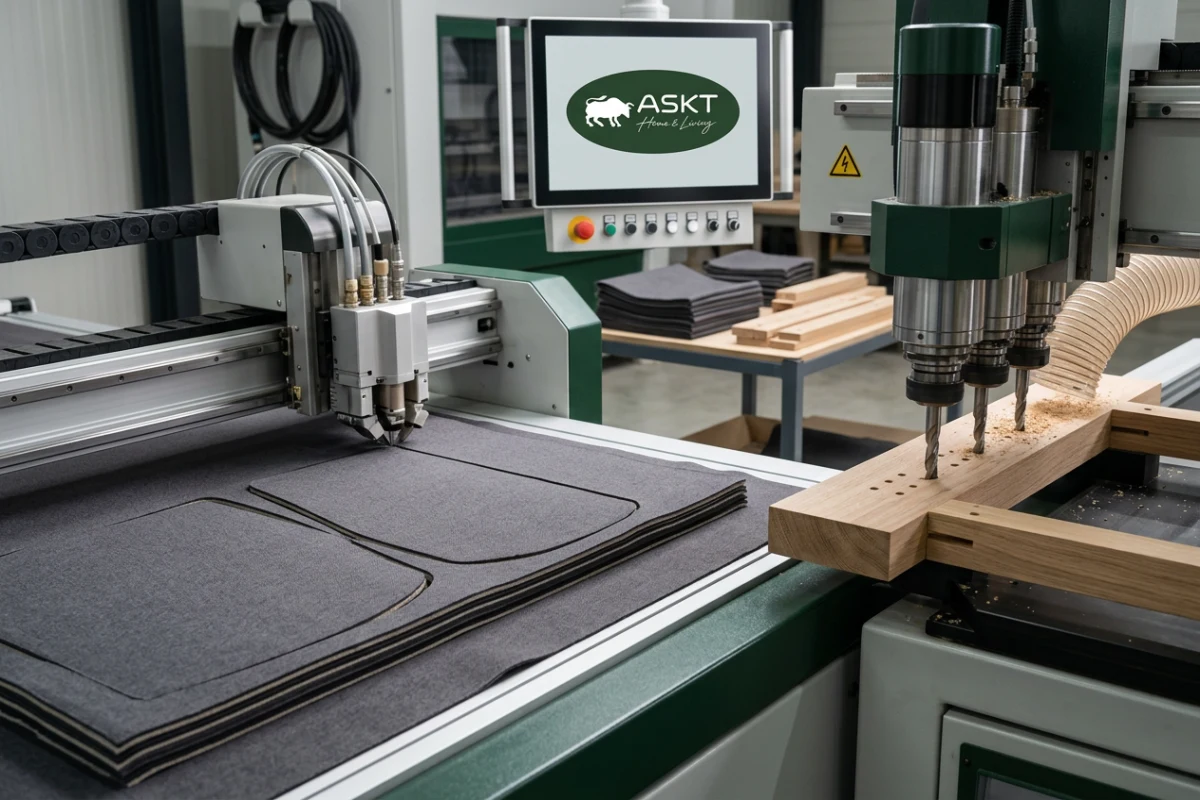
Automated production equipment delivers critical commercial advantages across several key manufacturing stages:
- Precision Fabric and Pattern Cutting: Digital fabric cutting plotters utilize computerised layout software to slice multi-ply textiles with millimetre precision. This eliminates pattern drift, minimizes material waste, and guarantees that every pattern piece aligns perfectly with the master technical drawings during reorders.
- Automated Wood Substrate Drilling and Punching: Ergonomic seat shells and internal backrest boards require exact fastener placement. Computer-controlled drilling and punching machinery positions fixing points with absolute accuracy. This ensures that metal sub-frames, swivel plates, and auto-return mechanisms align effortlessly during final assembly or knockdown (KD) flat-pack construction.
- Automated Internal Hardware and Nut Insertion: Fastening threaded inserts, T-nuts, and structural connectors into internal wood substrates using automated nailing and insertion equipment ensures uniform insertion depth and consistent holding torque. This structural uniformity prevents loose internal hardware that leads to wobbly chair legs after extended use in residential or hospitality dining settings.
- Robotic Frame Welding and Tube Bending: Metal sub-frames, cantilever bases, and tapered steel legs welded by robotic arms receive consistent weld penetration and smooth, uniform weld seams. This structural integrity guarantees dependable load-bearing performance and eliminates weld spatter that can compromise subsequent powder coating adhesion and corrosion resistance.
- Surface Preparation and Powder Coating Lines: Automated electrostatic powder coating systems and multi-stage pre-treatment tunnels apply protective coatings with uniform micron thickness across metal chair frames. This automated consistency ensures resilient scratch resistance, consistent gloss levels, and long-term protection against environmental wear.
By automating these heavy-duty structural operations, manufacturers establish an identical, structurally sound platform for every unit, creating the baseline for furniture production consistency before the piece reaches the upholstery department.
Why Is Manual Craftsmanship Essential for Upholstered Seating Quality Control?
While steel sub-frames and substrate boards thrive under computerised precision, upholstered seating quality control depends entirely on human sensory perception and artisanal skill. Upholstered furniture interacts directly with human posture, tactile touch, and visual inspection under ambient light, making manual dexterity irreplaceable across several critical assembly areas.
1. Tactile Tension Balancing on Ergonomic Contours
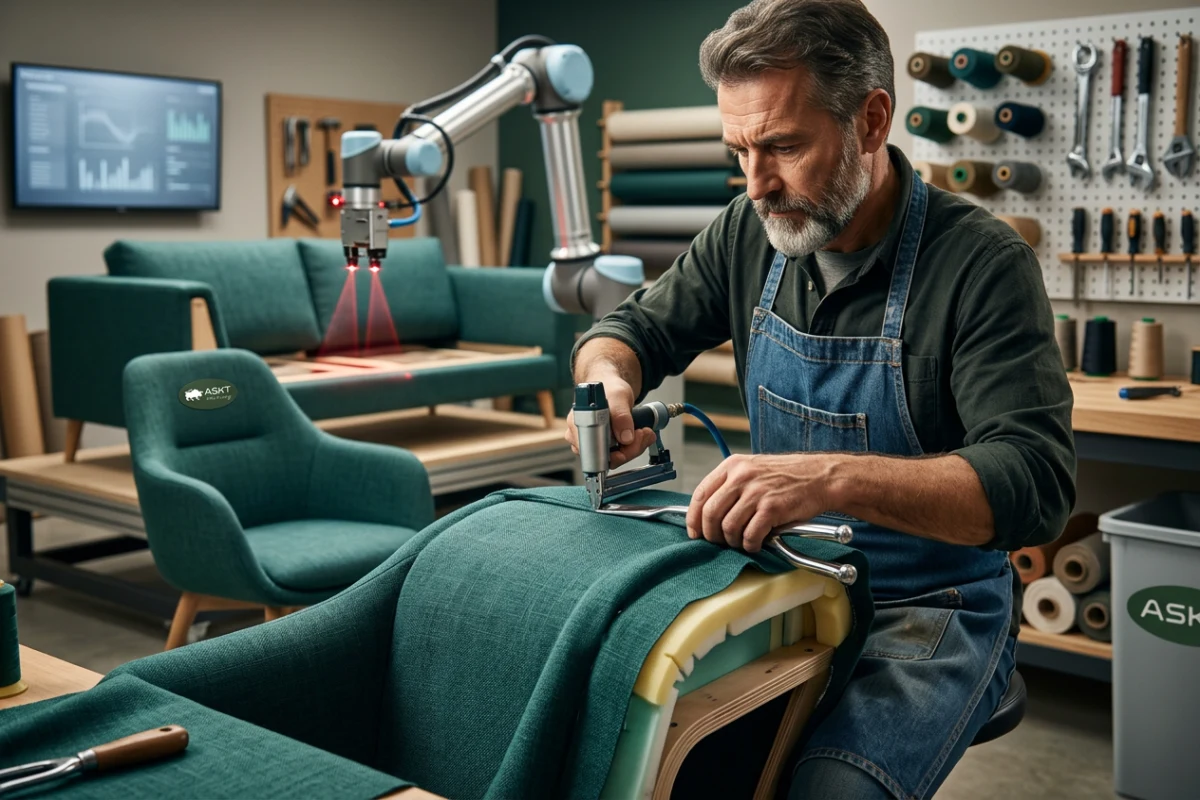
Every roll of upholstery fabric—ranging from textured flat weaves to waterproof, easy-clean, and pet-friendly technical textiles—possesses distinct elongation and tensile characteristics. When wrapping fabric over ergonomic curved backrests, bucket seats, or high-resilience foam layers integrated with pocket spring seating, an experienced upholsterer dynamically adjusts pull strength. The craftsman senses how the internal foam compresses, pulling the textile with balanced manual tension to eliminate surface ripples, bubbles, and asymmetric corner pleats while maintaining firm, comfortable support.
2. Visual Seam Alignment and Decorative Detailing
Robotic sewing equipment cannot continuously compensate for the subtle visual wander of complex decorative stitching. When joining contrast piping, executing intricate vertical quilting, or aligning seams along the perimeter of dining chairs and bar stools, human sewing operators actively guide the material through the sewing foot. Craftspeople align seams against physical reference points, ensuring that decorative fluting, diamond tufting, and perimeter seams remain straight and visually symmetrical across an entire dining set.
3. Subsurface Tactile Inspection and Foam Integrity Audits
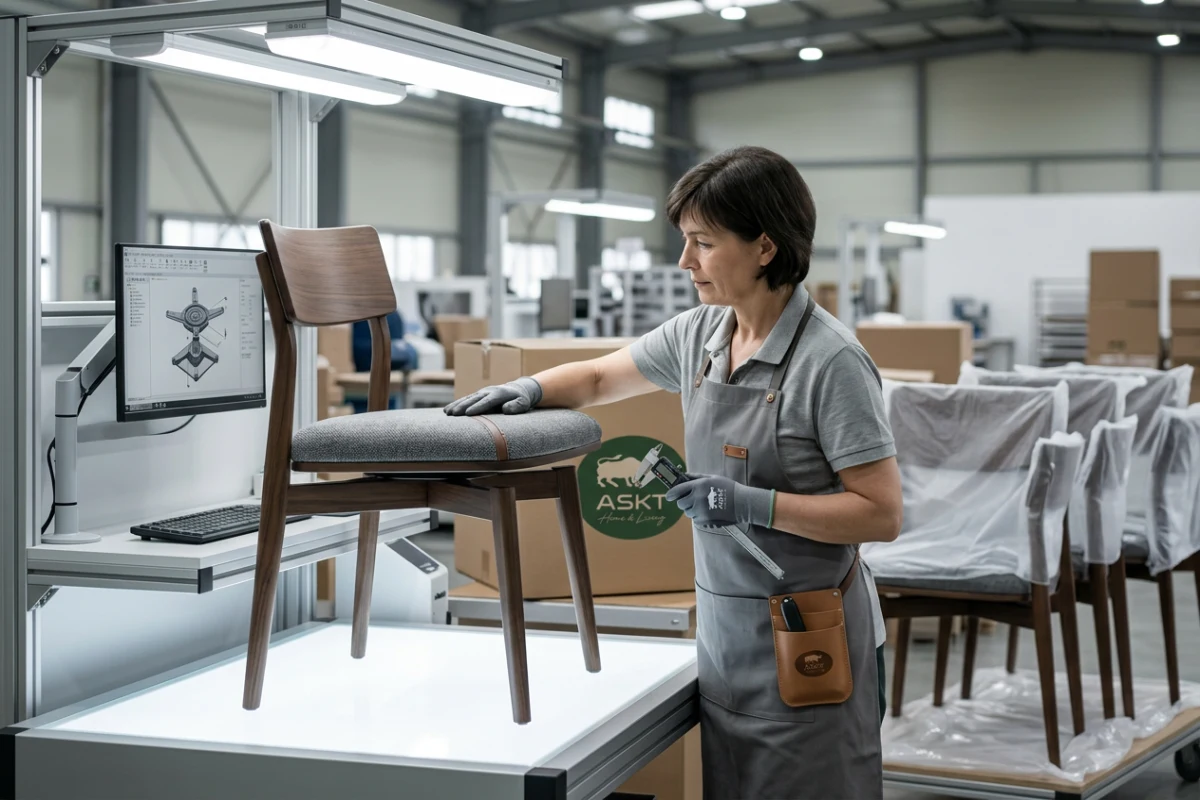
Automated inspection cameras primarily evaluate external two-dimensional geometry, missing internal structural defects. Experienced quality inspectors conduct tactile surface sweeps using direct hand contact across the entire chair envelope. Craftspeople evaluate foam rebound speed, check for voids or localized hardening in bonded foam layers, verify smooth transitions over wood and metal frame edges, and confirm that pocket spring cores are positioned correctly without internal friction or noise.
4. Precision Knockdown (KD) Fitting and Swivel Testing
For dining chairs featuring 360-degree swivel mechanisms or auto-return functions, manual testing is vital. A skilled technician manually engages the mechanism, checking for smooth rotational resistance, absence of mechanical play, precise zero-point return alignment, and silent operation. This sensory audit prevents defective hardware from reaching overseas distribution channels.
How Do Automated Machinery and Manual Craftsmanship Compare Across Production Stages?
Understanding how manufacturing responsibilities are divided between machinery and human skill enables commercial purchasing directors to evaluate whether a prospective factory has optimized its workflows for both cost efficiency and structural excellence.
| Production Stage | Primary Method | Production Equipment / Tools | Primary Quality Objective | Commercial Value for European Buyers |
|---|---|---|---|---|
| Pattern Digitisation & Cutting | Automated Machinery | Digital multi-ply fabric cutting plotters | Exact pattern dimensions and minimal material waste | 100% pattern consistency between initial samples and mass production reorders |
| Substrate Preparation & Drilling | Automated Machinery | Automated drilling and CNC board punching machines | Exact hole pitch and positional repeatability | Flawless knockdown (KD) consumer assembly and zero hardware misalignment |
| Metal Frame Fabrication | Automated Machinery | Robotic welding arms, CNC tube benders | Deep, uniform weld penetration and precise tube angles | Superior structural durability, high load capacity, and smooth powder coating finish |
| Internal Hardware Insertion | Automated Machinery | Automatic T-nut insertion and nailing machines | Uniform torque and consistent fastener embedding depth | Elimination of loose internal fasteners and structural leg wobbling over time |
| Pocket Spring & Foam Assembly | Hybrid (Manual + Jigs) | Pneumatic bonding jigs, precision spray booths | Accurate foam positioning and secure spring core bonding | Long-term seating resilience, ergonomic posture support, and zero foam slippage |
| Fabric Sewing & Hemming | Manual Craftsmanship | Industrial walking-foot sewing machines, alignment gauges | Straight seam trajectories and balanced thread tension | Refined decorative piping, aligned quilting patterns, and durable seam strength |
| Upholstery Wrapping & Stapling | Manual Craftsmanship | Pneumatic staple guns, manual tension levers | Dynamic fabric tensioning and smooth corner pleating | Ripple-free fabric surfaces, clean edge transitions, and ergonomic contour conformity |
| Mechanism & Swivel Assembly | Hybrid (Manual + Tools) | Calibrated torque wrenches, alignment fixtures | Precise component alignment and smooth rotation | Reliable auto-return functionality, zero mechanical play, and silent operation |
| Final Quality Inspection (QC) | Manual Sensory Review | Dimensional gauges, tactile surface audit, light booths | Comprehensive visual, tactile, and structural verification | Substantial reduction in post-sale return rates and protected retail brand reputation |
How Do Leading Factories Integrate Both Approaches to Achieve Furniture Production Consistency?
Achieving consistent dining chair manufacturing quality across large container shipments requires a synchronized production workflow where automation supports human artisans rather than replacing them indiscriminately. Leading manufacturers utilize a structured four-pillar approach to harmonize engineering precision with manual craftsmanship:
1. Standardized Substrates and Modular Platform Engineering
Consistency begins with dimensional standardization. By engineering standardized seat shell platforms and universal baseplate mounting systems, factories can produce internal wooden shells and metal sub-assemblies using automated punching and robotic welding. This structural standardization eliminates dimensional variances between production batches. When upholsterers receive geometrically identical wooden and metal substrates, their manual effort is focused purely on fabric tensioning and surface detailing, rather than making ad-hoc adjustments for irregular frames.
2. Comprehensive Ergonomic and Dimensional Standardization
High manufacturing consistency is rooted in empirical ergonomic principles tailored to European living spaces and hospitality venues. Leading manufacturers establish precise technical standards for seat height, backrest pitch, lumbar support curvature, and dining table clearance across dining chairs, bar stools, and dining benches. These dimensional parameters are programmed directly into automated tube benders and robotic welding fixtures, ensuring that every batch exhibits identical seat posture, stable centre of gravity, and proper clearance under standard dining tables.
3. Material Pre-Testing and Performance Conditioning
Manual craftsmanship can only achieve reliable results when raw materials meet rigorous physical specifications. High-standard factories evaluate incoming upholstery fabrics for abrasion resistance, colour fastness against light and rubbing, tensile strength, and seam slippage before rolls are approved for cutting. When skilled upholsterers work with certified, pre-tested textiles—including waterproof, easy-clean, and pet-friendly fabrics—the physical behaviour of the material remains predictable under manual tensioning, preventing batch-to-batch visual discrepancies.
4. Structured Quality Control Checkpoints and Worker Training
Artisanal consistency is maintained through systematic in-line quality control. Leading manufacturers implement multi-stage inspection gates: incoming raw material verification, semi-finished structural frame inspection, post-upholstery visual and tactile audits, and pre-packaging functional reviews. Continuous vocational training ensures that sewing technicians and upholsterers maintain standardized stapling patterns, uniform seam allowances, and rigorous sensory defect detection protocols across every production line.
What Practical Workflow Should Buyers Use When Evaluating Furniture Suppliers?
When evaluating furniture suppliers for European retail chains, purchasing groups, e-commerce platforms, or contract hospitality projects, sourcing specialists must look beyond marketing claims and evaluate actual factory floor capabilities. Sourcing teams can utilize the following structured checklist during on-site factory audits or technical video evaluations to assess the supplier's balance between automation and craftsmanship:
- Automated Machinery Deployment in Foundational Stages:
- Are fabric and leather patterns cut using computerised digital plotters or manual handheld shears?
- Are metal chair frames and table base structures welded via automated robotic arms or manual arc welding with inconsistent weld beads?
- Does the factory employ automated drilling and punching machinery to position fastener holes on wooden seat shells, ensuring reliable knockdown (KD) assembly?
- Are internal T-nuts and structural threaded hardware inserted using automated equipment with controlled depth and torque?
- Artisanal Expertise on the Upholstery and Sewing Lines:
- Do sewing operators utilize specialized alignment jigs, gauges, and walking-foot machines to maintain straight decorative stitching and piping?
- How do upholsterers manage fabric tension around tight curves and deep bucket shells to avoid surface wrinkling or fabric stretching?
- Is foam and pocket spring bonding executed with precise adhesive distribution inside clean, well-ventilated bonding stations?
- Are complex decorative techniques, such as diamond tufting or vertical channel stitching, guided by experienced craftspeople with clear master reference samples?
- Standardization, Modularity, and Quality Control Systems:
- Does the manufacturer utilize modular frame platforms that allow interchangeable legs, swivel mechanisms, and seat shells across collections?
- Are there dedicated, well-lit quality inspection stations equipped with dimensional calipers, surface checking tables, and standardized inspection checklists?
- How are functional hardware components—such as auto-return swivel plates, table extension runners, and gas lifts—tested for smooth, silent operation?
- Does the factory maintain comprehensive traceability records from raw material batch testing through to finished carton labeling?
- Sustainable Packaging and Container Logistics Engineering:
- Are dining chairs engineered with space-efficient knockdown (KD) structures to maximize container loading capacity in 40ft High Cube containers?
- Does the packaging replace excessive plastic foams with sustainable protective materials, such as heavy-duty corrugated board and honeycomb paper corner protectors?
- Are packaged cartons subjected to rigorous transit testing, including drop testing and vibration simulations, to ensure damage-free transit to European distribution hubs?
What Are the Commercial Advantages of Balanced Furniture Manufacturing for European Importers?
For European furniture wholesalers, large retail chains, and contract buyers, selecting a manufacturing partner that effectively balances furniture manufacturing automation vs craftsmanship provides tangible commercial advantages that protect profit margins and strengthen brand reputation:
- Minimized Customer Return Rates and Warranty Claims: Automated structural precision ensures that bolt holes, metal brackets, and leg assemblies align effortlessly during retail or end-consumer assembly, eliminating cross-threading and loose hardware issues. Concurrently, skilled manual upholstery prevents fabric puckering, premature seam splitting, and internal foam deformation, drastically reducing after-sales service costs.
- Optimized Container Loading and Lower Landed Freight Costs: Standardized modular components and precision-drilled KD structures allow dining chairs and bar stools to be packed into ultra-compact carton dimensions. By maximizing container space utilization in ocean freight shipments, buyers lower their per-unit logistics expenses while utilizing sustainable packaging that aligns with European environmental preferences.
- Reliable Batch-to-Batch Aesthetic and Functional Consistency: Combining automated cutting and robotic welding with skilled upholstery guarantees that repeat production orders match initial golden approval samples in fabric alignment, seating firmness, metal finish, and dimensional tolerance, safeguarding retail catalog accuracy.
- Flexible OEM and ODM Customization Capabilities: While fully automated mega-factories often resist small batch adjustments, a balanced manufacturing facility can rapidly adapt upholstery materials, frame finishes, custom stitching patterns, and dimensions. This flexibility enables B2B buyers to develop exclusive private-label collections tailored to their specific regional market preferences.
Frequently Asked Questions
Why cannot robotic automation completely replace manual upholstery in dining chair production?
Robotic automation cannot fully replace manual upholstery because upholstery fabrics, synthetic leathers, and cushioning foams are pliable materials with inherent variations in elasticity, grain, and density. A skilled human upholsterer continuously feels the material tension, dynamically adjusting manual pull force around curves and visually aligning seam lines to eliminate ripples, puckering, and surface voids—a level of sensory problem-solving that current industrial robotics cannot achieve.
What are the primary quality risks of 100% manual furniture production in high-volume export?
Purely manual production across high-volume export runs introduces human fatigue and dimensional inconsistency. Common defects include variable drill hole spacing on wooden shells leading to misaligned KD assembly, inconsistent welding penetration on metal frames causing structural failure under load, uneven fabric cut allowances, and fluctuating fastener torque. Automated drilling, digital cutting, and robotic welding are vital to guarantee absolute structural repeatability across thousands of units.
How does balanced manufacturing improve container loading efficiency and shipping costs?
By combining automated drilling and CNC punching for precision knockdown (KD) frameworks with standardized modular seat shells and leg assemblies, chairs can be flat-packed into highly compact, stackable cartons. This structural precision maximizes container space utilization inside 40ft High Cube containers, allowing European importers to load significantly more units per shipment, while robust packaging designs using honeycomb paper protect finishes without excessive plastic waste.
How should European buyers audit upholstery quality control during factory evaluations?
European buyers should audit upholstery quality control by inspecting seam straightness on curved contours, checking the symmetry of corner pleating, evaluating fabric tension across seat envelopes, and testing foam rebound resilience. Furthermore, buyers should verify that the factory uses high-performance, pre-tested textiles with verified colour fastness and abrasion resistance, non-toxic bonding adhesives, and structured multi-point inspection protocols before final packaging.
If you are evaluating dining chair, dining table, or contract furniture suppliers for the European market, ASKT provides over 20 years of B2B manufacturing expertise, flexible OEM and ODM customization, and transparent quality control. Celebrate 19 September Tag des Handwerks: explore craftsmanship and automation with ASKT to discover how balanced engineering precision and artisanal skill create dependable commercial value for your furniture business.