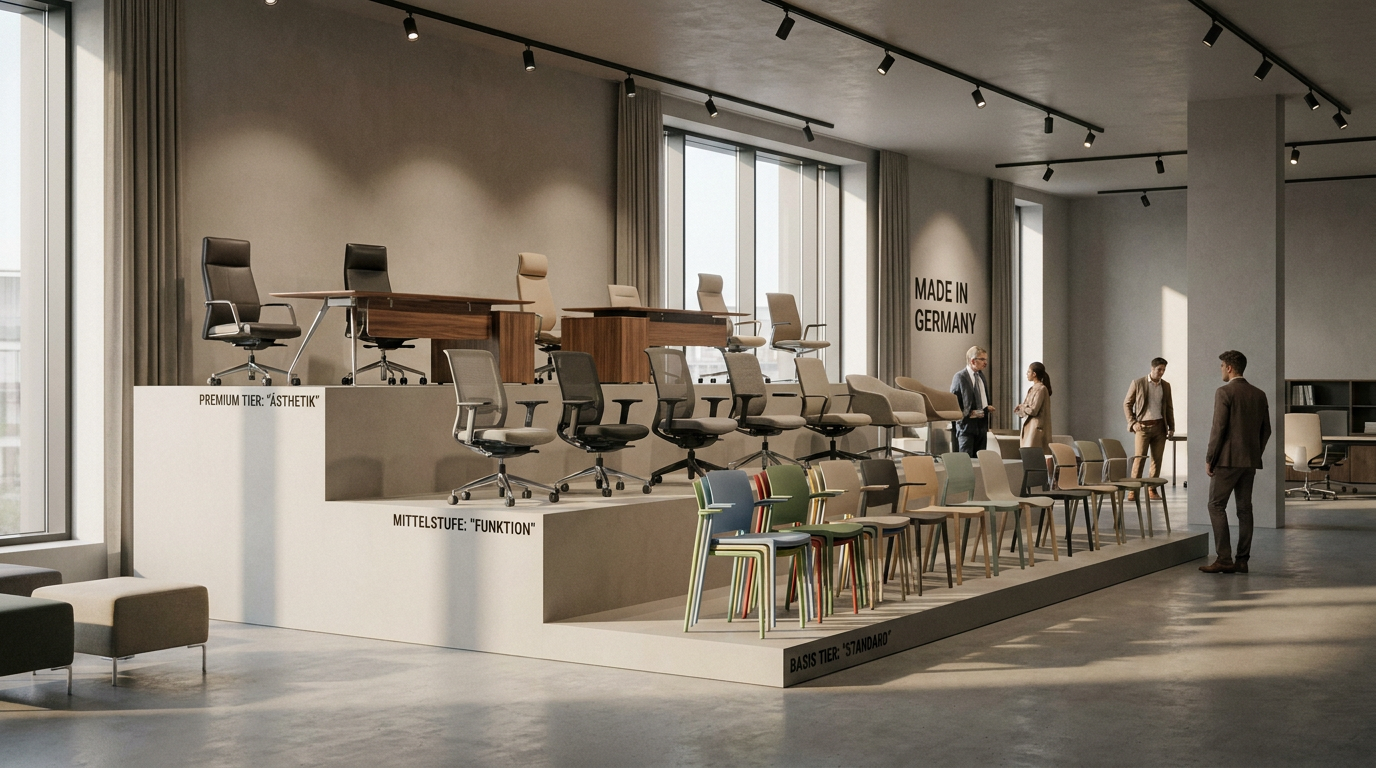
The Pricing Tier Framework: Mistakes and Risks in German Furniture Assortment Planning
The Pricing Tier Framework: Mistakes and Risks in German Furniture Assortment Planning
For Einkaufsleiter in German furniture retail
The German furniture retail environment is currently defined by intense stationary trade pressure and aggressive pricing competition. As consumer spending remains cautious, the challenge for every Einkaufsleiter (Procurement Manager) is to maintain a healthy Marge (margin) while ensuring high Abverkauf (sell-through). The most effective lever to achieve this balance is the strategic implementation of Preislagen (price tiers).
At ASKT Furniture, with over 15 years of manufacturing experience and ISO 9001 certification, we have observed that retailers who master price tiering can increase their Average Order Value (AOV) by up to 25% without expanding their physical floor space. This article provides a decision framework for optimizing your commercial seating Sortiment (assortment).
The Problem: Inefficient Sortiment Structure and Margin Erosion
Many German retailers suffer from 'middle-market drift'—a situation where the assortment is too broad but lacks depth in specific price segments. This leads to high Lagerdruck (inventory pressure) and forces sales teams into constant discounting to move stagnant stock. When every product competes on price alone, your Marge inevitably erodes.
Furthermore, without clear price anchoring, customers struggle to perceive value. In the B2B sector, such as restaurant or hotel procurement, buyers need a logical progression from budget-friendly options to premium, durable solutions. Failing to provide this structure results in lost conversion opportunities.
Common Mistakes in Price Tiering
- Over-diversification of SKUs: Carrying too many similar products at the same price point creates decision paralysis and increases logistics costs.
- Ignoring the 'Ankerpreise' (Anchor Price): Without a high-end 'Best' tier to serve as a psychological anchor, the 'Better' tier appears expensive rather than high-value.
- Neglecting Lieferzuverlässigkeit (Delivery Reliability): A price tier is only effective if the stock is available. Choosing suppliers with long or unstable lead times disrupts the entire tiering strategy.
- Poor Quality-Price Alignment: If a 'Better' tier product has a high Reklamation (complaint) rate, it destroys the profitability of the entire segment.
The Decision Framework: The 3-Tier Price Ladder
To optimize your commercial furniture Sortiment, we recommend the 'Good-Better-Best' (GBB) model. This framework categorizes products based on material quality, durability, and customization options.
Tier 1: The 'Good' (Entry Level)
- Focus: Price-sensitive B2B buyers and high-volume projects.
- Characteristics: Standardized designs, limited finishes, and high durability for the price.
- ASKT Advantage: Our flexible MOQ of 200 units allows retailers to test entry-level designs without excessive capital tie-up.
Tier 2: The 'Better' (The Volume Driver)
- Focus: The core of your Abverkauf. This is where most commercial projects land.
- Characteristics: Enhanced ergonomics, premium fabrics, and ISO 9001 certified manufacturing standards.
- Goal: To provide the best value-to-durability ratio.
Tier 3: The 'Best' (The Margin Protector)
- Focus: Premium hospitality and executive office spaces.
- Characteristics: Full customization, exotic woods or specialized metals, and superior craftsmanship.
- Goal: To set the 'Anchor Price' and capture high-margin bespoke orders.
Comparison Matrix for Price Tier Evaluation
| Metric | Good (Entry) | Better (Value) | Best (Premium) |
|---|---|---|---|
| Target Marge | 15-20% | 25-35% | 40%+ |
| Abverkauf Speed | Very High | High | Moderate |
| Customization | None | Limited (Colors) | Full Customization |
| Lead Time | 45 Days | 45 Days | 50-60 Days |
| Material Focus | Metal/Standard Fabric | Solid Wood/Performance Fabric | Premium Leather/Hardwood |
Actionable Recommendations for SKU Efficiency
To increase your AOV, your sales staff should be trained to 'up-sell' from the 'Good' tier to the 'Better' tier by highlighting long-term ROI. For instance, explaining that a chair from ASKT Furniture’s 'Better' tier features reinforced joints and high-density foam significantly reduces long-term Reklamation costs for the end client.
Strategic Checklist for Einkaufsleiter:
- Does the 'Best' tier product justify a 30% price premium over the 'Better' tier?
- Is the supplier's Lieferzuverlässigkeit (delivery reliability) verified by ISO 9001 standards?
- Can the supplier support a 45-day lead time to maintain lean inventory levels?
- Are the 'Good' tier products durable enough to avoid damaging the retailer's reputation?
- Does the 'Better' tier offer enough customization (e.g., custom upholstery) to win B2B contracts?
FAQ: Addressing Risks in Procurement
How does a 45-day lead time impact SKU efficiency? A stable 45-day lead time, like the one provided by ASKT Furniture, allows retailers to maintain lower safety stocks. This reduces Lagerdruck and improves cash flow, allowing for more frequent refreshes of the Sortiment.
What is the impact of Reklamation on price tiers? High complaint rates in the 'Better' tier are catastrophic. They erase the higher Marge earned from the sale. Ensuring your supplier has a 15-year track record and rigorous quality control is essential for protecting your bottom line.
Conclusion
Mastering price tiers is not just about setting numbers; it is about engineering a Sortiment that guides the customer toward value while protecting the retailer's Marge. By implementing a structured GBB framework and partnering with reliable manufacturers like ASKT Furniture, German retailers can navigate current market pressures with confidence.
Do you want me to send you a practical evaluation checklist or decision framework for your next procurement cycle?