
How Hotel Furniture Buyers Plan Packaging and Drop Tests to Prevent Transit Damage
Hotel furniture buyers can systematically reduce transit damage by establishing tailored packaging specifications based on product weight and construction, reinforcing vulnerable structural contact zones, and enforcing standardized pre-shipment drop tests before container dispatch. Aligning packaging design with product durability, container loading efficiency, and transparent quality control verification protects project schedules, minimizes replacement costs, and ensures flawless on-site hotel installation.
In hospitality and contract furniture procurement, logistics risk represents a direct operational threat to handover deadlines, fit-out timelines, and project margins. Because contract dining chairs, lounge seating, dining tables, and desks undergo multi-stage handling across ocean freight, port transfers, regional warehousing, and final hotel site delivery, buyers must take a proactive approach to transit protection.
Why is transit damage so costly in hotel furniture procurement projects?
Transit damage in hotel furniture projects generates financial and operational complications that extend far beyond the direct material value of the affected items. Hotel fit-outs operate on tight turnover schedules where entire floors or dining spaces are installed in synchronized phases. When goods arrive with scuffed upholstery, chipped table corners, or bent metal frames, the entire installation workflow faces severe disruption.
Professional contract buyers recognize several compounding risks associated with transit damage:
- Disrupted Project Delivery Schedules: Manufacturing replacement furniture, coordinating quality control inspections, and managing ocean shipping lead times can take weeks or months. A single batch of damaged dining chairs can delay guest room or restaurant commissioning.
- Excessive Replacement and Logistics Expenses: Dispatching small-batch replacements or arranging urgent air freight to meet opening deadlines increases logistics expenditures and eliminates project profit margins.
- On-Site Installation Friction: Fitting crews on site lose valuable time unboxing, sorting, documenting, and isolating damaged goods rather than completing room installations efficiently.
- Interior Design Inconsistencies: Sourcing quick local repairs or impromptu temporary replacements often results in mismatched fabric colours, inconsistent powder coating finishes, or divergent wood stains that compromise brand standards.
- Commercial Disputes and Administrative Overhead: Managing damage claims across freight forwarders, insurers, and manufacturing partners diverts internal resources and strains supply chain relationships.
Implementing structured contract furniture transit damage prevention during the product development and procurement stages mitigates these risks before orders leave the manufacturing facility.
How should buyers define packaging specifications for KD and assembled furniture?
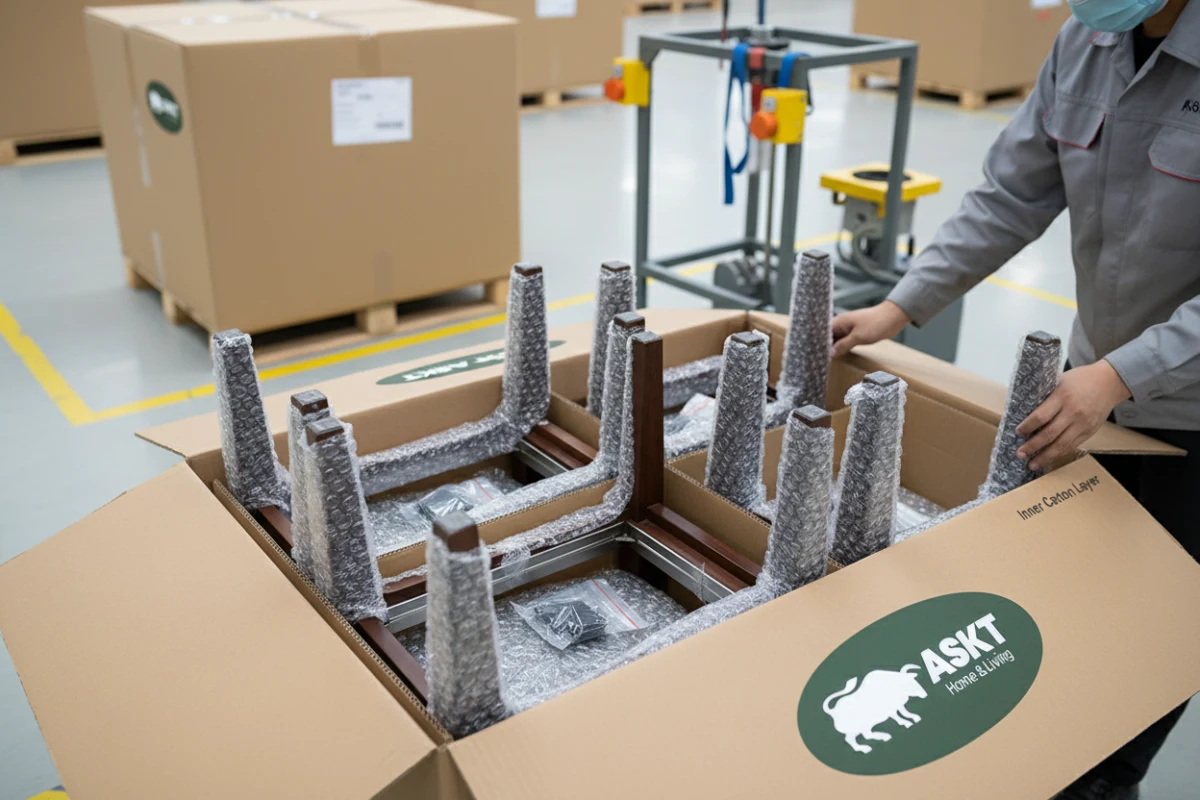
Packaging specifications must be engineered around product weight, dimensions, materials, and assembly structure. Contract dining collections encompass diverse materials and mechanisms—including upholstered chairs with pocket spring seating, powder-coated metal frames, swivel mechanisms with auto-return functions, extension dining tables, sintered stone surfaces, and natural oak veneer tops. Applying a generic carton design across different product categories creates either transit vulnerability or inefficient container utilization.
To ensure reliable hotel furniture shipping protection, buyers should evaluate packaging designs against specific structural characteristics:
| Furniture Category & Construction | Primary Transit Risks | Packaging Structure Requirements | Internal Cushioning & Component Protection |
|---|---|---|---|
| KD Dining Chairs (Metal Frame & Swivel) | Component friction, mechanism puncture, hardware loss | Multi-layer corrugated outer carton tailored to component geometry | Individual surface wrapping on powder coating, secured hardware packs, partitioned separation boards |
| Fully Upholstered Chairs (Pocket Springs) | Fabric scuffing, pressure marks, corner crush, moisture absorption | High-strength corrugated master carton with reinforced top and bottom edges | Non-woven breathable protective sleeves, protective wrap, desiccant placement for humidity control |
| Extension Dining Tables (Oak Veneer Tops) | Edge chipping, surface scratching, rail misalignment, corner impact | High-density flat-pack master carton with perimeter edge reinforcement | High-density corner caps, edge buffer channels, isolated leg compartments, zero interior void clearance |
| Sintered Stone Dining & Coffee Tables | Impact cracking, flexural stress, edge chipping from drops | Rigid reinforced carton or structured crating engineered for heavy flat loads | Continuous perimeter edge dampening, high-density impact buffers, full surface isolation |
| Lounge Chairs & Dining Benches | Frame warping, fabric abrasion, leg abrasion during stacking | Sturdy structural carton with internal vertical load support inserts | Form-fitting foam edge guards, soft fabric wraps, isolated leg protection caps |
For knock-down furniture, KD furniture packaging standards require that every component remains completely isolated from adjacent metal or wood surfaces. Screws, bolts, and swivel mechanisms must be secured in designated packaging compartments so that hardware cannot shift, puncture carton walls, or scratch finished surfaces during transport.
What are the critical protection zones in contract dining furniture?
Effective packaging engineering targets vulnerable stress points rather than simply adding random packing material. When evaluating supplier packaging proposals, hotel furniture buyers should inspect four critical protection zones.
1. Structural Corners and Exposed Edges
Outer carton corners and edges absorb the primary kinetic energy during handling, stacking, and container transit. For dining tables with oak veneer or sintered stone surfaces, corner impacts can cause chipping, delamination, or structural cracking. High-density corner protectors, continuous edge guards, and reinforced carton perimeters must be specified to absorb multi-directional impact.
2. Powder-Coated Metal Frames and Swivel Mechanisms
Metal chair frames, metal table bases, and auto-return swivel mechanisms represent concentrated mass points. If allowed to shift inside the carton, hard metal edges can abrade powder-coated finishes or tear through external packaging. Dedicated internal corrugated partitions or molded inserts must hold metal components in a fixed position, maintaining complete separation from upholstered or finished elements.
3. Upholstered Seating and Fabric Surfaces
Contract chairs upholstered in commercial fabrics, waterproof materials, or easy-clean textiles require protection against friction, pressure indentation, and moisture exposure during long ocean transit. Non-abrasive internal covers shield the fabric from corrugated cardboard rubbing, while properly positioned desiccant bags protect upholstery and internal pocket spring structures from ambient moisture and humidity fluctuations in shipping containers.
4. Hardware and Assembly Fasteners
Loose hardware represents a frequent cause of transit damage and on-site assembly delays. Fastener packs must be clearly labeled, securely anchored to the interior packaging structure, and isolated from finished surfaces. This ensures that fitting teams at the hotel site can access hardware immediately without searching through loose packing fill.
How should buyers plan and execute a furniture packaging drop test protocol?
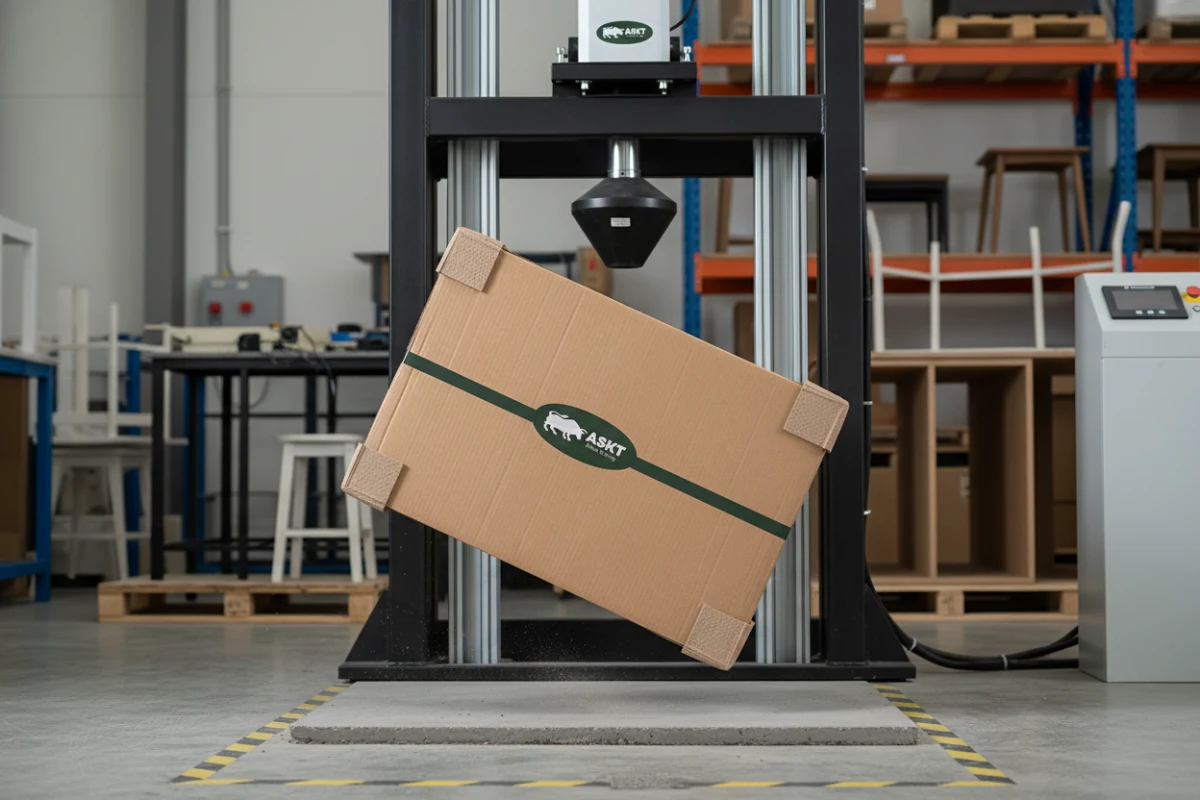
To verify that a packaging design will withstand international shipping, hotel furniture buyers should require a standardized furniture packaging drop test protocol during sample development and pre-shipment quality inspection. A structured drop test simulates the physical drops, impacts, and tipping incidents that cartons encounter during port handling, container loading, and site unloading.
A systematic drop test follows a 10-drop sequence conducted on a flat, non-yielding surface such as smooth concrete:
- Drop 1 (Vulnerable Corner): Drop the carton onto its most vulnerable corner, typically the manufacturer's joint corner.
- Drop 2 (Shortest Edge): Drop the carton onto the shortest edge radiating from the tested corner.
- Drop 3 (Medium Edge): Drop the carton onto the next longest edge radiating from the tested corner.
- Drop 4 (Longest Edge): Drop the carton onto the longest edge radiating from the tested corner.
- Drop 5 (Small Flat Face): Drop the carton flat onto its smallest surface face.
- Drop 6 (Opposite Small Face): Drop the carton flat onto the opposite smallest surface face.
- Drop 7 (Medium Flat Face): Drop the carton flat onto one of the medium-sized surface faces.
- Drop 8 (Opposite Medium Face): Drop the carton flat onto the opposite medium-sized surface face.
- Drop 9 (Largest Flat Face): Drop the carton flat onto the largest surface face (typically top or bottom).
- Drop 10 (Opposite Largest Face): Drop the carton flat onto the opposite largest surface face.
Drop Height Determination by Package Weight
Drop heights must be calibrated according to gross package weight. Because heavier cartons exert higher kinetic energy upon impact, drop heights are adjusted proportionally:
- Packages under 10 kg: Drop height of 76 cm
- Packages between 10 kg and 19 kg: Drop height of 61 cm
- Packages between 20 kg and 29 kg: Drop height of 45 cm
- Packages between 30 kg and 45 kg: Drop height of 30 cm
Executing this hotel furniture packaging drop test on fully packed production samples verifies whether the internal cushioning dampens kinetic shock and keeps internal components securely in place.
How should buyers establish acceptance criteria and corrective action loops?
A drop test protocol is only effective when supported by objective pass/fail criteria and an established corrective engineering loop. After completing the 10-drop sequence, quality control inspectors and buyers must conduct an immediate unboxing inspection to evaluate both the external carton and internal furniture components.
Clear Drop Test Acceptance Criteria
- Pass: The outer carton may display normal surface scuffs or moderate corner compression, but the internal structural inserts remain functional, and the furniture item exhibits zero structural damage, zero functional defects, and zero cosmetic scratches, dents, or fabric tears.
- Conditional Minor Deviation: The outer carton sustains corner crushing or an internal partition fractures, but the furniture itself remains completely undamaged. The supplier must adjust internal cushioning density or reinforce partition walls before mass packaging commences.
- Definite Fail: The outer carton tears open, hardware breaks loose, internal components contact each other, or the furniture exhibits bent metal legs, cracked sintered stone, scratched powder coating, scuffed veneer, or torn fabric. Mass packaging must be halted immediately until corrective designs are retested.
Corrective Action Workflow:
1. Identify Failure Point (e.g., corner impact, frame migration, surface abrasion)
2. Perform Root-Cause Analysis (e.g., inadequate corner density, loose interior void)
3. Re-engineer Packaging Inserts (e.g., increase buffer thickness, isolate metal components)
4. Re-pack Golden Sample Furniture
5. Re-run 10-Drop Verification Sequence
6. Document Full Photographic Test Report and Approve Mass Production Packaging
Maintaining clear visual documentation—including photographs of the packed carton before testing, impact points after each drop, the unpacking process, and close-ups of all finished surfaces—ensures full transparency across the supply chain.
How can buyers balance packaging durability with container loading optimization and ESG goals?
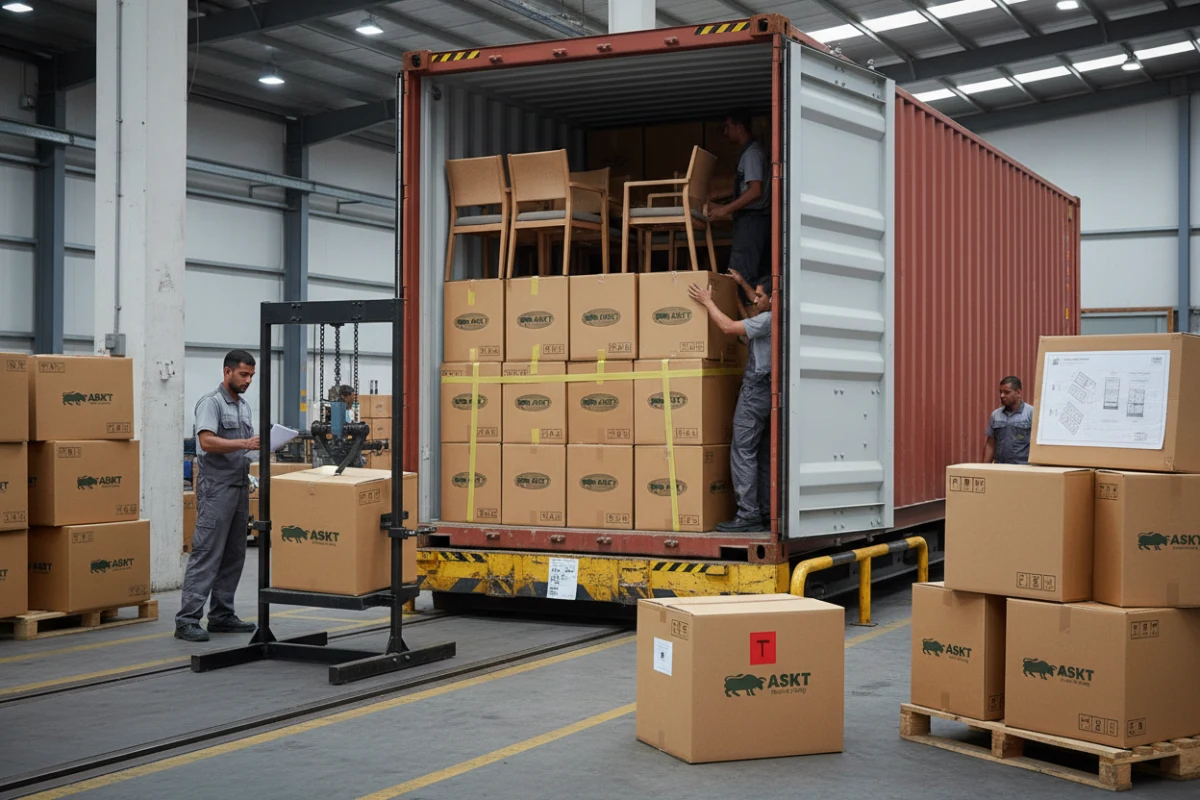
While robust packaging is vital for transit safety, excessive over-packaging creates commercial and environmental trade-offs. Bulky cartons increase packaging cubic meters (CBM), which lowers container loading efficiency, increases ocean freight costs per unit, and increases packaging waste on hotel installation sites. Furthermore, European buyers in markets such as Germany, the Netherlands, the UK, Switzerland, and Poland face increasing regulatory and corporate pressure to reduce single-use plastics and implement sustainable packaging practices.
Professional buyers can resolve these trade-offs by applying three core supply chain principles:
1. Standardizing KD Geometry and Modular Dimensions
Knock-down structures allow dining chairs, bar chairs, and tables to be packed into compact, standardized carton shapes. Disassembling chair legs or swivel bases from upholstered seat shells significantly reduces carton volume compared to fully assembled units. By aligning carton dimensions with standard European pallet sizes and 40HQ container interior dimensions, buyers maximize container loading density while maintaining structural rigidity.
2. Transitioning to Sustainable Paper-Based Cushioning
To meet corporate ESG targets and European packaging disposal standards, buyers should collaborate with manufacturers to replace expanded polystyrene (EPS) with recyclable corrugated inserts, honeycomb paperboard, and molded paper pulp. High-density honeycomb paper provides superior compressive strength and edge dampening while remaining fully recyclable in European waste streams.
3. Precision Internal Fitting to Eliminate Void Space
Carton volume should match product dimensions precisely. Empty void space inside a carton allows heavy metal frames or table tops to gain momentum during handling, increasing the likelihood of carton rupture. Precision-cut corrugated inserts immobilize components securely, providing high transit protection without inflating carton outer dimensions.
Frequently Asked Questions About Contract Furniture Packaging Verification
How many sample cartons should undergo drop testing before mass production?
Buyers should require at least one to two fully packed production samples per furniture model to undergo drop testing during the initial sample sign-off stage. For high-volume hotel fit-out orders, quality inspectors should perform randomized drop tests on 1% to 2% of packed cartons during the final pre-shipment quality control inspection to ensure that assembly and packing consistency match approved standards.
What documentation should buyers demand from suppliers after drop testing?
A comprehensive drop test report must include clear photographic and video evidence. Key documentation includes high-resolution images of the package prior to testing, photos of the impact contact points after each individual drop, step-by-step images of the unboxing process, and detailed close-ups of all corners, powder-coated metal frames, wood veneer surfaces, sintered stone edges, and upholstery seams.
How does knock-down (KD) chair packaging improve freight economics for hotel projects?
KD chair packaging separates chair frames, swivel mechanisms, and seat shells into nested or compact flat configurations, significantly reducing the package cubic meters (CBM) per piece. This enables buyers to load substantially more units into a standard 40HQ container compared to fully assembled chairs, directly reducing shipping costs per seat and lowering overall project logistics budgets.
What are the main differences between packaging for retail and packaging for hotel contract furniture?
Retail furniture packaging often prioritizes individual consumer unboxing and colorful retail branding, whereas hotel contract furniture packaging focuses heavily on multi-unit bulk stacking durability, container space optimization, rapid on-site unpacking for installation crews, and standardized carton labeling to ensure quick room-by-room distribution across large hospitality project sites.
If you are sourcing dining chairs, dining tables, or custom contract furniture for European hospitality and commercial projects, partnering with an experienced manufacturer ensures reliable quality control, optimized packaging, and stable export execution. Discover how ASKT supports contract buyers with engineering expertise, transparent inspection workflows, and sustainable packaging solutions at https://www.asktfurniture.com/.