
What Should a Hotel Furniture Procurement Risk Register Include? A B2B Sourcing Guide
A comprehensive hotel furniture procurement risk register must systematically record risk identification codes, project phases, specific risk descriptions, root causes, probability ratings, impact severity scores, early warning triggers, preventive mitigation protocols, fallback contingency actions, and designated risk owners. It tracks critical vulnerabilities across design specifications, sample approvals, raw materials, manufacturing consistency, durability testing, container loading, and site delivery handovers.
What Are the Core Structural Elements of a Furniture Supply Chain Risk Register Template?
A structured furniture supply chain risk register template functions as an active decision-making framework throughout a hospitality project lifecycle. For hotel buyers, purchasing groups, and contract furniture importers, procurement involves interconnected commercial, mechanical, and logistical factors. Structuring the register with standardized parameters ensures project teams identify emerging vulnerabilities before they translate into production bottlenecks, budget variances, or project delays.
A complete procurement risk register template relies on ten essential data columns:
- Risk Identifier and Project Phase: A unique reference code mapped to the specific stage of procurement, including Pre-Production Specification, Material Sourcing, Mass Production, Quality Verification, Packaging and Container Logistics, or Site Handover.
- Risk Category: Classification of the operational area involved, such as Dimensional Tolerance, Structural Integrity, Material Performance, Supply Lead Time, Packaging Resilience, or Logistics Synchronization.
- Event Description: An unambiguous statement defining the specific failure event (such as dining chair frame misalignment, upholstery abrasion wear, or sintered stone tabletop transit fractures).
- Root Cause Analysis: The underlying mechanical, chemical, manufacturing, or communication factor that triggers the failure mode.
- Probability Assessment (P): A quantitative rating from 1 (rare or low probability) to 5 (frequent or high probability) estimating how likely the event is to occur.
- Impact Severity Rating (I): A rating from 1 (minor cosmetic issue rectifiable on site) to 5 (critical structural failure, safety hazard, or major opening delay).
- Risk Score: The calculated product of Probability multiplied by Impact ($P imes I$), establishing priority tiers for corrective action.
- Early Warning Indicators: Observable leading indicators that signal an emerging issue, such as delayed pre-production sample approvals, uneven powder coating thickness, or unverified fabric test reports.
- Preventive Action Plan: Proactive engineering controls, supplier evaluation protocols, and manufacturing safeguards applied before volume production starts.
- Contingency Plan and Assigned Owner: Pre-agreed emergency workflows executed if a risk event occurs, paired with a specific accountable role such as the Purchasing Manager, Lead Quality Inspector, or Sourcing Specialist.
| Register Column | Operational Function | Practical Application in Hospitality Procurement |
|---|---|---|
| Risk ID | Unique tracking reference | RSK-SEAT-018 |
| Project Phase | Pinpoints timeline stage | Material Sourcing and Fabric Preparation |
| Risk Description | Concrete statement of failure | Upholstered dining chairs exhibit fabric colour variation across batches |
| Root Cause | Identifies technical failure point | Dye lot variation and unmonitored fabric roll inspection at the mill |
| Probability (1–5) | Likelihood of occurrence | 3 (Moderate likelihood in split-batch fabric orders) |
| Impact (1–5) | Operational severity | 4 (Visible shade mismatch across hotel restaurant dining sets) |
| Risk Score | Prioritization matrix ($P imes I$) | 12 (High priority requiring mandatory control) |
| Early Warning Trigger | Observable leading indicator | Fabric supplier batch swatch deviates under standard light source inspection |
| Preventive Action | Upstream manufacturing control | Mandate master colour fastness checks and single-dye-lot allocation per project batch |
| Contingency Plan | Remediation workflow | Deploy reserved safety fabric yardage or re-dye under accelerated delivery agreement |
| Assigned Owner | Accountable role | Project Procurement Specialist and Quality Control Lead |

How Should Pre-Production Specification and Sample Approval Risks Be Tracked?
Within commercial hospitality projects, specification discrepancies represent a significant source of rework, unexpected expenses, and installation friction. When translating architectural interior designs into mass-manufactured dining chairs, dining tables, or barstools, minor gaps in technical drawings or sample reviews can cascade into widespread batch errors. Contract furniture sourcing risk management must address these variables during initial engineering and prototyping.
Pre-production risks in the register should focus on three critical technical checkpoints:
- Ergonomic and Clearance Mismatches: Seating dimensions that fail to harmonize with dining table underframes create immediate usability issues. If dining chair seat heights, backrest angles, or armrest heights are incorrectly proportioned relative to dining table aprons, guest seating posture suffers and chairs cannot slide neatly under table surfaces. The risk register must document strict dimensional parameters, specifying seat height, backrest recline, clearance depths, and armrest profiles.
- Drawing Discrepancies in OEM and ODM Customization: Discrepancies between 2D conceptual interior elevations and production-ready manufacturing drawings lead to structural misunderstandings. Preventive measures require detailed 3D technical drawings, precise cross-sectional schematics, and clear dimension tolerances for metal tubing thickness, wood frame joinery, and foam padding densities.
- Sample Sign-Off Deviations (Golden Samples): Mass production initiated without approved reference standards creates significant quality variation. The risk register must record the creation, formal sign-off, and retention of duplicate "golden samples"—one set maintained at the buyer's quality office and the other secured on the factory floor—against which all subsequent batch runs are measured for colour, finish gloss, stitching lines, and foam resilience.
Establishing clear pre-production protocols ensures that custom dimensions, upholstery fabrics, powder coating colours, and wood veneers conform exactly to the commercial interior brief before production tooling and batch cutting begin.
What Hospitality Furniture Quality Control Risks Must Be Logged During Manufacturing?
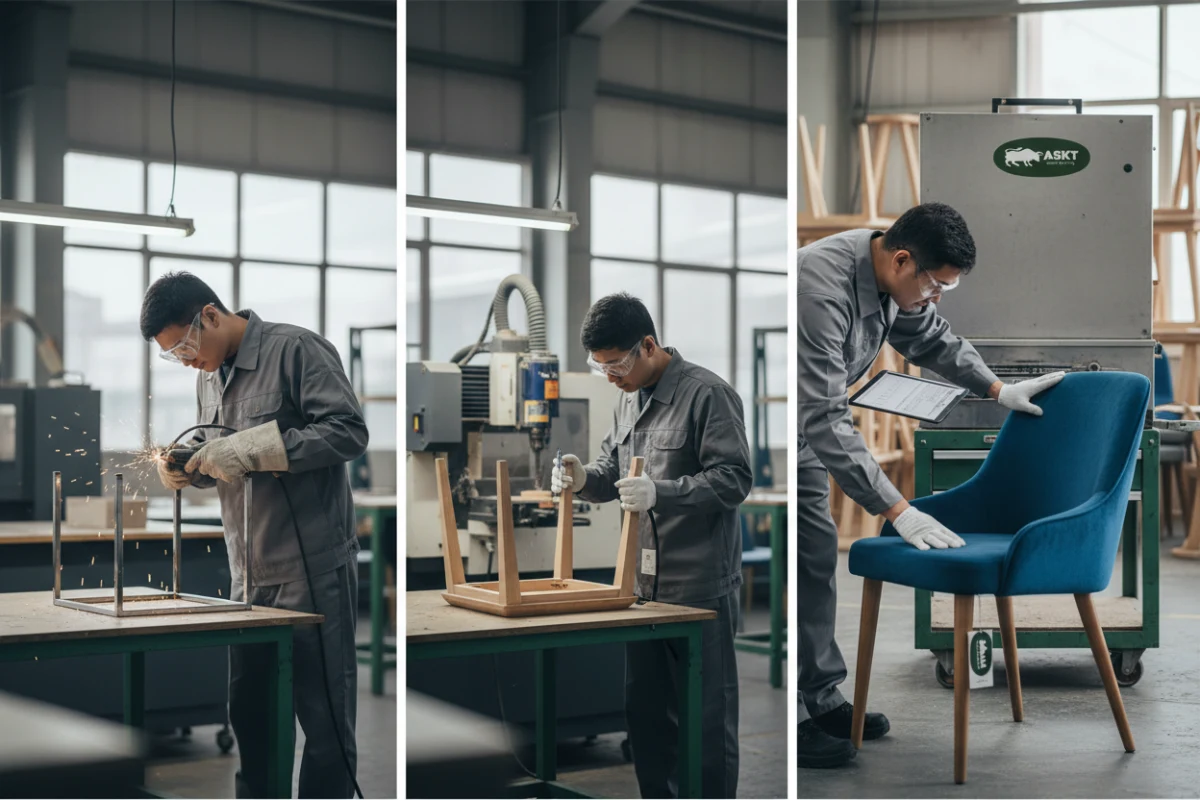
During active production, hospitality furniture quality control risks center on manufacturing consistency, structural stability, and craftsmanship. Commercial hotel dining spaces, breakfast areas, and guest lounges subject furniture to intensive, high-frequency daily use. Any structural weakness or material inconsistency during mass production directly undermines longevity and customer satisfaction.
The procurement risk register must track specific manufacturing failure points:
- Metal Frame and Base Integrity: Weak weld seams, uneven tube bending, or inadequate metal wall thickness create severe durability risks under heavy dynamic loads. In contract dining chairs and barstools, the register must mandate continuous welding checks, smooth joint grinding, and uniform powder coating application to prevent early surface corrosion or finish peeling.
- Wood Joinery and Veneer Bonding: Natural wood components, oak veneer dining tables, and dining benches are susceptible to warping, joint loosening, and surface cracking if moisture content and pressing parameters are not tightly controlled. Sourcing teams must document acceptable moisture ranges for solid wood and veneer substrates, alongside robust bonding inspections for table surfaces.
- Sintered Stone Tabletop Processing: Sintered stone surfaces offer exceptional heat, scratch, and stain resistance in hospitality dining environments. However, improper substrate support, uneven adhesive spreading, or improper edge chamfering can introduce stress points prone to edge chipping. The register should require rigid structural backing boards and precision edge finishing.
- Upholstery and Internal Foam Construction: Irregular stitching, misaligned seams, and uneven foam density degrade both appearance and long-term comfort. For commercial dining chairs and lounge chairs, incorporating pocket spring seating cores combined with high-resilience foam provides long-lasting structural support and prevents foam sag over years of commercial use. The risk register must define foam density minimums and stitching tension benchmarks.
- Swivel and Auto-Return Mechanism Failures: Hotel bar chairs and conference dining chairs featuring swivel or auto-return mechanisms require strict quality verification. The register must include cyclic rotation checks, smooth bearing performance audits, and alignment verification to ensure auto-return bases reset accurately to their original position without binding or noise.
How Does Contract Furniture Sourcing Risk Management Address Testing, Durability, and Compliance?
Structural failures in commercial dining environments expose hotel operators to operational disruption, brand damage, and commercial liability. Therefore, a comprehensive risk register must integrate verified performance testing benchmarks and regional European compliance protocols into the procurement workflow.
The register must track the following mechanical, chemical, and durability risks:
1. Structural Durability and European Standard (EN) Testing
Commercial hospitality furniture must withstand rigorous mechanical stress. The risk register should establish clear requirements for European standard (EN) testing relevant to dining furniture:
- Seating Strength and Durability: Verifying that dining chairs, barstools, and lounge seating pass relevant EN durability standards, including static downward seat loading, backrest fatigue cycles, leg forward and lateral thrust tests, and seat impact drops.
- Table Stability and Load Capacity: Ensuring dining tables, coffee tables, and extension tables meet EN stability requirements, preventing tipping when vertical loads are applied to table edges or extended leaves.
- Extension and Swivel Mechanisms: Testing moving parts under repetitive cycles to guarantee that table extension rails glide smoothly and swivel mechanisms maintain smooth operation under sustained commercial usage.
2. Fabric Performance and Textile Integrity
High-traffic hotel dining and public spaces require fabrics engineered for durability and low maintenance. The risk register must detail textile performance metrics:
- Abrasion Resistance: High-cycle Martindale rub testing to verify that fabrics resist friction, surface thinning, and yarn pilling under continuous guest turnover.
- Colour Fastness to Light and Rubbing: Verifying that upholstery fabrics resist fading from ambient sunlight and prevent dye transfer onto clothing during wet or dry commercial rubbing.
- Waterproof, Easy-Clean, and Pet-Friendly Properties: Commercial dining environments encounter regular spills and liquid exposure. Specifying waterproof, stain-resistant, and easy-clean fabrics ensures rapid maintenance for hotel housekeeping teams while extending the operational lifespan of the furniture.
3. Material Safety and Environmental Considerations
Procurement documentation must account for material safety and responsible manufacturing. Foam components, upholstery textiles, adhesives, and surface finishes must comply with European chemical safety parameters. Sourcing teams should record verification of low-emission finishes, durable and recyclable metal components, and sustainable sourcing practices that align with evolving European market expectations.
What Packaging, Container Loading, and Transit Risks Must Be Mitigated for Hotel FF&E?
Logistics and freight risks extend far beyond ocean transit schedules. Physical transit damage, inefficient container packing, and disorganized delivery sequencing directly threaten hotel handover deadlines and install budgets.
To safeguard project timelines, the risk register must address four logistical failure modes:
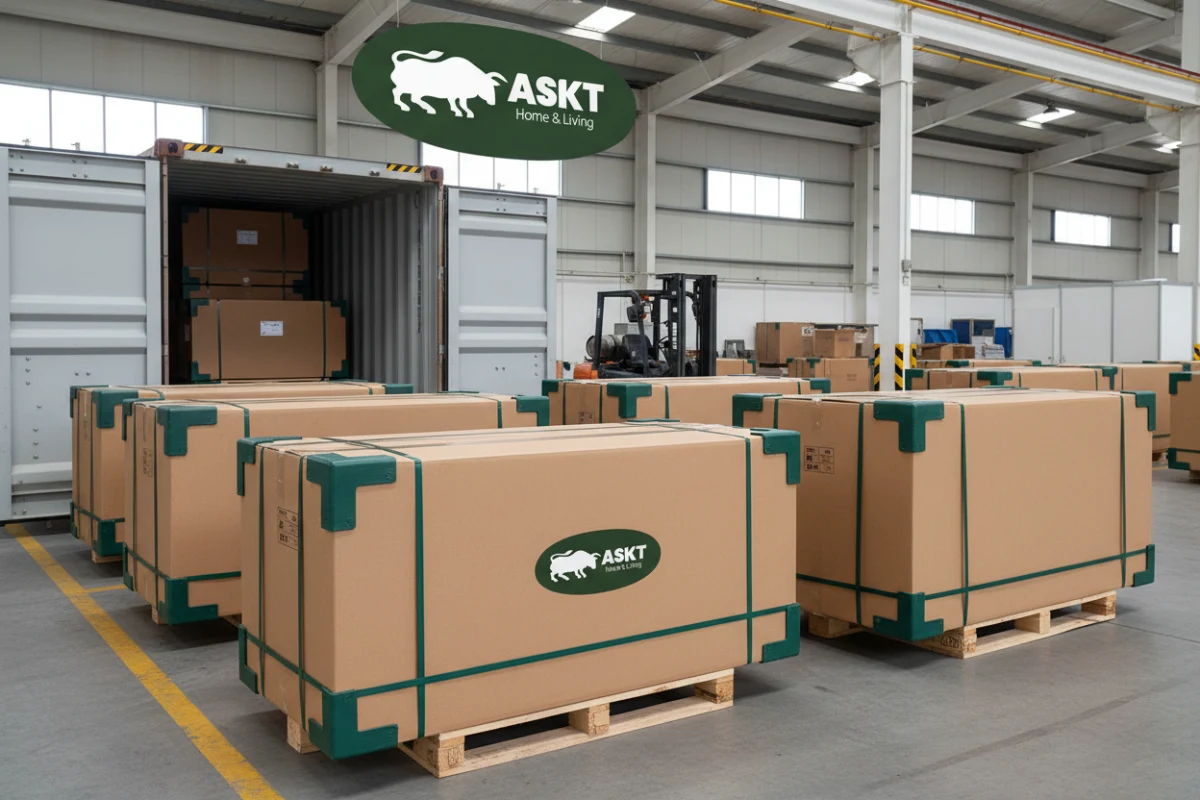
- Transit Impact and Packaging Failure: Inadequate protective packaging leads to crushed box corners, scratched powder coating, chipped tabletop edges, and bent chair legs during sea freight and multimodal transit. The risk register should mandate drop-tested packaging designs, reinforced edge and corner protection, and sustainable packaging materials with reduced plastic use, ensuring both structural protection and environmental responsibility.
- Container Loading Inefficiencies: Bulk shipping of fully assembled furniture inflates freight costs per unit and increases container requirements. Implementing engineered Knock-Down (KD) structures allows dining chairs, bar chairs, and tables to pack flat or nest efficiently. This packaging optimization maximizes container loading capacity, minimizes shipping volume, and significantly lowers landed logistics costs.
- Moisture and Environmental Exposure During Transit: Temperature fluctuations in ocean containers cause condensation and trapped humidity, potentially damaging oak veneer surfaces, metal hardware, or upholstery fabrics. Mitigation actions recorded in the register include strict desiccant placement, protective internal wrapping, and sealed master cartons.
- Desynchronized Delivery Sequences: Delivering dining furniture to a hotel site before floor finishes, paintwork, or lighting installations are finished leads to on-site congestion, dust contamination, or accidental damage in holding areas. The risk register must coordinate factory production runs and container dispatch dates with the project contractor's phased handover schedule.
How Can Buyers Integrate a Hotel FF&E Procurement Checklist with the Risk Register?
A hotel FF&E procurement checklist details the chronological tasks required at each milestone, while the risk register analyzes the potential failure modes of those tasks and specifies preventive controls. Using both tools simultaneously ensures that project milestones are not merely marked as complete, but verified against rigorous technical criteria.
Below is an integrated matrix demonstrating how FF&E checklist items align with risk register controls:
| Phase | Hotel FF&E Procurement Checklist Milestone | Identified Sourcing and Quality Risk | Technical and Operational Control Measure |
|---|---|---|---|
| 1. Specification | Confirm seat, armrest, and table apron clearances | Dimensional clash causing unusable seating arrangements | Verify 2D/3D CAD drawings and check cross-clearance dimensions |
| 2. Sampling | Approve physical fabric swatches and frame finishes | Colour variation or incorrect tactile finish in batch production | Sign and retain duplicate golden samples for factory and buyer |
| 3. Testing | Verify structural test certificates for seating and tables | Joint fatigue, weld cracking, or mechanism failure under load | Require EN testing validation and cyclic mechanism load checks |
| 4. Materials | Verify fabric performance and surface finish specs | Poor abrasion, dye transfer, or liquid staining in dining areas | Verify Martindale abrasion, colour fastness, and waterproof fabric properties |
| 5. Production QC | Inspect in-line frame welding, wood joinery, and sewing | Structural inconsistency, wobbling bases, or stitching flaws | Implement multi-stage quality control from frame assembly to final upholstery |
| 6. Packaging | Validate carton strength and drop-test performance | Surface scratching, crushed corners, and transit impact damage | Deploy drop-tested packaging with edge protection and reduced plastic use |
| 7. Logistics | Finalize KD packing dimensions and container loading plan | Suboptimal container utilization inflating landed shipping costs | Optimize KD structure packaging to maximize container volume efficiency |
| 8. Installation | Verify assembly hardware, glides, and site handover | Missing fasteners or mismatched leg glides slowing on-site fitting | Include complete hardware kits, assembly instructions, and spare part buffers |
How Do Modular Designs and Clear OEM/ODM Protocols Reduce Commercial Sourcing Risks?
Commercial hotel procurement often encounters project friction when design changes occur late in the procurement cycle, or when custom tooling creates excessive lead times. Applying modular design principles alongside structured OEM and ODM workflows directly reduces supply chain risk.
- Modular Structural Architecture: Designing dining chairs and barstools with interchangeable base frames and standardized seat shells allows hospitality buyers to customize finishes, leg configurations, and upholstery without incurring custom tooling delays. Modular components allow flexible container consolidation, streamline replacement part maintenance for hotel operators, and reduce inventory holding risks.
- Comprehensive OEM and ODM Customization Controls: Clear technical specifications for fabrics, metal finishes, table dimensions, and branding requirements prevent communication gaps between European project teams and manufacturing plants. Detailed specification sheets eliminate ambiguity around materials, surface gloss levels, and internal padding construction.
- Proactive Sample Development: Manufacturing fully functional pre-production prototypes for physical review, dimensional verification, and ergonomic assessment ensures that any structural adjustments are resolved before mass raw material cutting commences.
By systematically documenting every technical, operational, and logistical parameter within a structured risk register, hotel purchasing managers, furniture wholesalers, and contract buyers transform complex international procurement into a controlled, transparent, and predictable manufacturing process.
For European furniture wholesalers, contract buyers, and project importers seeking reliable dining furniture manufacturing from China, ASKT provides over 20 years of manufacturing experience, transparent quality control, and dependable export execution. Discuss your hospitality and contract furniture sourcing requirements at https://www.asktfurniture.com/.