
Hotel Furniture Sustainability Documentation: EPD, Material Compliance & Packaging Guide
Hotel furniture buyers must request verified Environmental Product Declarations (EPD), material compliance evidence for fabrics, foams, finishes, and wood components, documented proof of sustainable packaging showing plastic reduction and container optimization, and comprehensive ESG supplier audit records. Obtaining these four documentation categories ensures European hospitality procurement teams verify full lifecycle carbon impact, ensure guest safety and durability, eliminate supply chain risks, and satisfy institutional sustainability requirements.
Why is hotel furniture sustainability documentation essential in modern contract procurement?
Commercial hospitality procurement requires rigorous compliance verification to manage long-term operational risk, ensure regulatory alignment, and maintain brand reputation. In modern contract projects, requesting comprehensive hotel furniture sustainability documentation is no longer a discretionary marketing preference; it is a core procurement discipline. Hotel operators, institutional investors, interior designers, and FF&E (Furniture, Fixtures, and Equipment) contractors require auditable evidence confirming that indoor dining chairs, bar stools, lounge seating, dining tables, and coffee tables meet stringent environmental, structural, and chemical safety standards.
Without verified manufacturer documentation, hospitality purchasing teams face significant commercial and operational liabilities:
- Regulatory non-compliance and customs border risks: European customs and market surveillance authorities enforce strict rules regarding material traceability, chemical safety, and environmental impact. Lack of proper documentation can result in import delays, costly customs detentions, or rejected project consignments.
- Premature wear, failure, and replacement costs: Furniture deployed in high-traffic hotel restaurants, breakfast rooms, lobbies, and guest suites undergoes severe daily use. Unverified core materials, low-grade foam padding, or substandard frame coatings lead to rapid degradation, requiring premature replacement and inflating lifecycle costs.
- Disruption of project handovers and building ratings: Commercial hotel developments aiming for green building recognition require verified documentation from supply chain partners. Missing component data sheets or vague environmental claims can stall handover schedules and compromise project ratings.
- Brand reputation and corporate ESG exposure: Global hotel brands are accountable to corporate ESG benchmarks. Sourcing contract furniture from unverified manufacturers without traceable social and environmental records exposes hospitality groups to supply chain scrutiny and greenwashing accusations.
Establishing a mandatory documentation protocol during the supplier evaluation and request-for-quotation (RFQ) stage allows buyers to separate capable, transparent manufacturers from high-risk intermediaries.

What is furniture EPD hospitality procurement and how do buyers evaluate lifecycle impact?
In modern commercial procurement, furniture EPD hospitality procurement represents the standard for measuring and comparing the environmental footprint of contract furniture. An Environmental Product Declaration (EPD) is an independently verified, standardized document that communicates transparent data regarding the environmental impact of a product throughout its lifecycle, based on a formal Life Cycle Assessment (LCA).
For contract dining furniture, dining tables, and upholstered seating, an EPD measures environmental parameters from raw material acquisition and factory processing through distribution, active commercial use, and eventual disposal or recycling.
When evaluating supplier EPDs for hotel FF&E tenders, professional procurement teams should assess four core data points:
- Global Warming Potential (GWP) and Embodied Carbon: Quantifies total greenhouse gas emissions generated per functional unit (e.g., per dining chair, lounge chair, or dining table). This enables hospitality developers to calculate total embodied carbon across large guestroom or banquet fit-outs.
- Raw Material Composition and Resource Use: Identifies the balance between virgin materials and secondary recycled resources, such as steel frames fabricated with recycled scrap metal or upholstery fabrics woven from recycled fibers.
- Manufacturing Energy Consumption: Measures the primary energy demand across cutting, bending, robotic welding, powder coating, and automated upholstery assembly lines.
- End-of-Life Disassembly and Circularity: Details whether the furniture utilizes Knock-Down (KD) structural architecture, allowing easy mechanical separation of metal legs, wood shells, foam cushioning, and fabric covers for modular repair or recycling.
| EPD Verification Parameter | Key Documented Data | Practical Value for Hotel Procurement |
|---|---|---|
| Embodied Carbon (GWP) | Total CO₂ equivalent per finished furniture unit | Provides exact carbon data for hotel ESG reporting and interior carbon budgets. |
| Recycled Content Metric | Percentage share of recycled metal, wood, or textile | Verifies circular manufacturing claims and supports waste-reduction targets. |
| LCA Assessment Scope | Cradle-to-Gate vs. Cradle-to-Grave boundary | Clarifies whether outbound ocean shipping, hotel usage, and disposal are accounted for. |
| KD Disassembly Profile | Mechanical fastening layout and component breakdown | Facilitates on-site part replacement, refurbishment, and clean end-of-life material separation. |
Which specific hotel FF&E material compliance evidence must suppliers submit?
Hotel furniture must combine aesthetic appeal with extreme commercial durability and strict chemical safety. To protect guest health and ensure long-term durability in high-turnover hospitality environments, purchasing managers must require comprehensive hotel FF&E material compliance evidence across every individual material layer and component.
1. Fabric and Upholstery Compliance Documentation
Upholstery fabrics in hotel dining areas, conference facilities, and guestrooms must satisfy strict hygiene, performance, and safety criteria. Buyers should request:
- Chemical Safety and Harmful Substance Evidence: Documentation certifying that upholstery fabrics are free from harmful aromatic amines, heavy metals, and hazardous finishing chemicals, ensuring they are safe for continuous skin contact and comply with European safety norms.
- Commercial Wear and Abrasion Performance: Third-party laboratory test reports detailing Martindale abrasion resistance cycles, pilling resistance, and tensile strength to ensure the fabric withstands continuous commercial use.
- Colour Fastness Records: Certified test data confirming colour fastness to artificial light, dry crocking, and wet rubbing to prevent unsightly fading or colour transfer onto guest clothing.
- Specialized Functional Performance Proof: Technical data sheets validating waterproof coatings, easy-clean stain resistance, and scratch-resistant pet-friendly fabric performance for boutique and extended-stay hotel properties.
2. Internal Cushioning, Foam, and Pocket Spring Systems
Internal seat construction determines long-term seating comfort and guest ergonomic support:
- High-Resilience Cushioning Evidence: Technical data sheets confirming the use of high-density, high-resilience foam or integrated pocket spring seating systems that resist sagging and maintain structural form over hundreds of thousands of seating cycles.
- Adhesive and Off-Gassing Documentation: Formal declarations confirming that bonding adhesives used to secure foam to internal shells are solvent-free or water-based, preventing toxic volatile organic compound (VOC) emissions inside enclosed guestrooms.
3. Wood, Veneer, and Internal Structural Shells
Structural timber, curved plywood shells, and veneer surfaces require strict verification:
- Wood Traceability and Legality Proof: Clear documentation tracking timber species, country of harvest, and supply chain origin to verify legal harvesting and eliminate deforestation risks.
- Formaldehyde Emission Reports: Laboratory test certificates confirming that internal wooden seat boards and oak veneer table tops meet stringent formaldehyde emission limits, ensuring clean indoor air quality.
- Machining and Fastening Stability: Quality records showing precision batch punching and automated structural assembly, ensuring internal screw-holding strength under heavy dynamic loads.
4. Metal Frames, Swivel Mechanisms, and Solid Surfaces
- Powder Coating Safety and Corrosion Protection: Technical documentation confirming that metal frames, sled bases, and spider legs are finished with non-toxic, lead-free powder coating that resists scratching, impact, and corrosion from frequent commercial cleaning.
- Mechanical Durability and Auto-Return Systems: Test reports for 360-degree swivel mechanisms and auto-return mechanisms used in hotel bar chairs and dining chairs, proving long-term functional reliability without mechanical failure or squeaking.
- Sintered Stone Surface Compliance: Technical documentation for sintered stone dining tables and coffee tables, verifying heat resistance, scratch resistance, non-porosity, and stain resistance for hygienic food-contact environments.
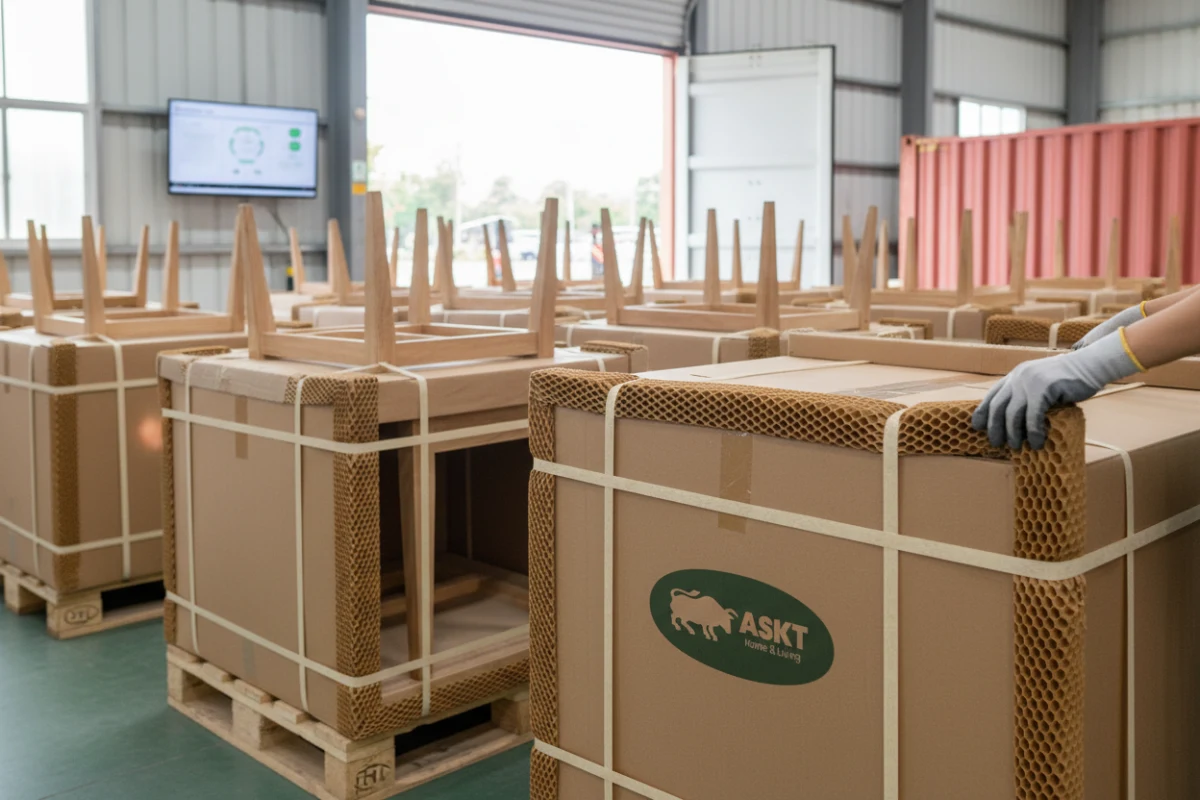
What sustainable furniture packaging documentation validates plastic reduction and cargo protection?
Packaging waste represents a substantial logistical and environmental challenge during large-scale hotel installations. Unpacking hundreds of dining chairs and tables wrapped in expanded polystyrene (EPS) foam and non-recyclable plastic films creates immense waste disposal costs and site congestion. To mitigate this, hospitality buyers must demand transparent sustainable furniture packaging documentation from suppliers prior to production sign-off.
High-performing contract furniture manufacturers engineer packaging that eliminates single-use plastics while maintaining structural integrity across long-distance ocean shipping, port transshipment, and local delivery.
Critical Packaging Evidence to Request:
- Packaging Material Specification (BOM): A detailed material breakdown showing the proportion of recyclable kraft corrugated cardboard, paper corner protectors, and biodegradable wrapping compared to plastic materials. Professional manufacturers deploy high-strength honeycomb paper protection for table edges, seat shells, and leg assemblies instead of non-recyclable plastic foam blocks.
- Plastic Elimination Metrics: Clear documentation showing the replacement of plastic bubble wrap, PVC edge guards, and plastic strapping with corrugated paper sleeves, honeycomb buffer pads, and reinforced paper tape.
- ISTA Drop Test and Impact Reports: Documented packaging drop tests and transit simulation reports proving that Knock-Down (KD) furniture packages, sintered stone table tops, and delicate oak veneers withstand rough handling, corner impacts, and container vibrations without surface or structural damage.
- Container Loading Optimization Plans: 3D container loading diagrams showing how KD structural engineering maximizes space utilization inside 40ft High Cube containers. Nesting chair shells and modular base components increases packing density, directly reducing transport carbon emissions and ocean freight cost per unit.
[Sustainable Packaging Verification Workflow]
1. Material Review       -> Specify Recyclable Honeycomb Paper & Multi-Wall Corrugated Board
2. Structural KD Design  -> Engineer Modular Bases & Nested Shells for Compact Packing
3. Lab Drop Testing      -> Verify Transit Protection & Corner Impact Resistance
4. Container Optimization-> Maximize Cubic Meter Density to Minimize Freight Carbon
5. Documentation Sign-off-> Validate Packaging BOM & Plastic Reduction Metrics
How should procurement teams conduct a hotel furniture ESG supplier audit?
Paper documentation must be validated through factory-level operational transparency. A structured hotel furniture ESG supplier audit evaluates the manufacturer's real-world production processes, workplace safety, social responsibility, and quality management systems.
1. Social Responsibility, Labor Ethics, and Workplace Safety
European contract buyers must ensure that manufacturing partners uphold ethical labor standards across their operations. Audits should verify:
- Social Compliance Verification: Valid third-party social audit reports (such as BSCI audit documentation) demonstrating fair compensation, lawful working hours, non-discrimination, safe working conditions, and complete prohibition of child or forced labor.
- Worker Personal Protective Equipment (PPE): On-site verification that factory staff are provided with and utilize appropriate safety equipment, including protective overalls, cut-resistant safety gloves for metal and fabric cutting operations, and protective ventilation masks in gluing and finishing areas.
- Operator Training and Quality Protocols: Documented standard operating procedures (SOPs) and structured training logs showing that machine operators receive comprehensive instruction before handling production equipment.
2. Automated Manufacturing and Energy-Efficient Operations
Modern manufacturing machinery enhances product consistency, minimizes material scrap, and lowers energy consumption across the production cycle:
- Automated Fabric Cutting Systems: Computer-controlled CNC cutting machines that optimize upholstery pattern layout, drastically reducing textile waste compared to manual cutting.
- Automated Wooden Board Punching & Assembly: High-precision automated punching and automated multi-point nailing machines that ensure structural accuracy and eliminate human error in seat shell fabrication.
- Robotic Arm Welding: Automated welding robotics for steel frames, delivering uniform weld seams, exceptional structural durability, and optimized energy efficiency compared to manual welding techniques.

What procurement checklist ensures complete hotel furniture sustainability compliance?
To ensure thorough evaluation during the tender and quotation stages, hospitality procurement teams should implement a structured sustainability checklist. This matrix ensures every material, structural, packaging, and operational claim is backed by auditable evidence.
| Verification Dimension | Required Documentation | Applicable Scope & Focus | Verification Frequency |
|---|---|---|---|
| Lifecycle Impact | Environmental Product Declaration (EPD) | Cradle-to-Gate or Cradle-to-Grave carbon footprint (GWP) | Per product collection (3-5 years) |
| Textiles & Upholstery | Chemical Safety & Durability Test Reports | Harmful substance compliance, Martindale wear, colour fastness | Per fabric collection / Annually |
| Recycled Content | Recycled Material Origin Certificates | Recycled PET yarn, circular textile verification | Per material production batch |
| Structural Safety | Commercial Strength & Stability Reports | European contract standards (EN 12520 / EN 12521) | Per structural model design |
| Indoor Air Quality | Formaldehyde & VOC Emission Declarations | Zero-solvent glues, low-emission internal boards | Per raw material batch |
| Surface Protection | Powder Coating & Sintered Stone Data Sheets | Non-toxic finishes, scratch & stain resistance | Per finish specification |
| Sustainable Packaging | Packaging Material BOM & Drop Test Reports | Honeycomb paper cushioning, container volume optimization | Per shipment specification |
| Factory Governance | BSCI Social Audit & Worker Safety Protocols | Ethical labor, worker PPE, automated production lines | Annual independent audit |
Frequently Asked Questions
How does an EPD differ from a standard material test report in hotel procurement?
An Environmental Product Declaration (EPD) provides a third-party-verified, comprehensive assessment of the complete lifecycle environmental impact of a finished piece of furniture, including raw material extraction, energy consumption, transport, and disposal. In contrast, a standard material test report evaluates only a single physical or chemical characteristic of an individual component, such as Martindale fabric abrasion resistance, colour fastness to light, or glue formaldehyde content. Both are vital: the EPD measures environmental footprint, while material test reports prove safety and commercial durability.
Why is Knock-Down (KD) structural design considered a sustainability feature for hotel furniture?
Knock-Down (KD) structural design enhances sustainability in two ways. First, it significantly reduces the packaged volume of dining chairs, lounge seating, and tables, allowing more units to fit inside a single shipping container and drastically lowering the transport carbon emissions per chair. Second, KD construction allows individual components—such as metal base legs, swivel mechanisms, or upholstered seat cushions—to be disassembled and replaced on-site if damaged, extending product service life and enabling clean material separation at the end of the furniture's lifecycle.
How does honeycomb paper packaging perform compared to traditional plastic foam during ocean transit?
High-density honeycomb paper cushioning provides exceptional compressive strength and impact absorption, matching or exceeding the protective performance of expanded polystyrene (EPS) plastic foam. When engineered into custom corner guards and edge buffers alongside heavy-duty corrugated cartons, honeycomb paper protects metal chair frames, oak veneer edges, and sintered stone tops against transit vibrations, drop impacts, and container handling shocks while remaining 100% recyclable upon arrival at the hotel site.
For European furniture wholesalers, contract buyers, and hospitality procurement teams seeking dependable dining chairs, dining tables, and lounge furniture backed by transparent manufacturing and verified documentation, ASKT offers proven OEM and ODM manufacturing solutions. Contact https://www.asktfurniture.com/ to discuss your project's technical specifications, packaging requirements, and sustainability compliance files.