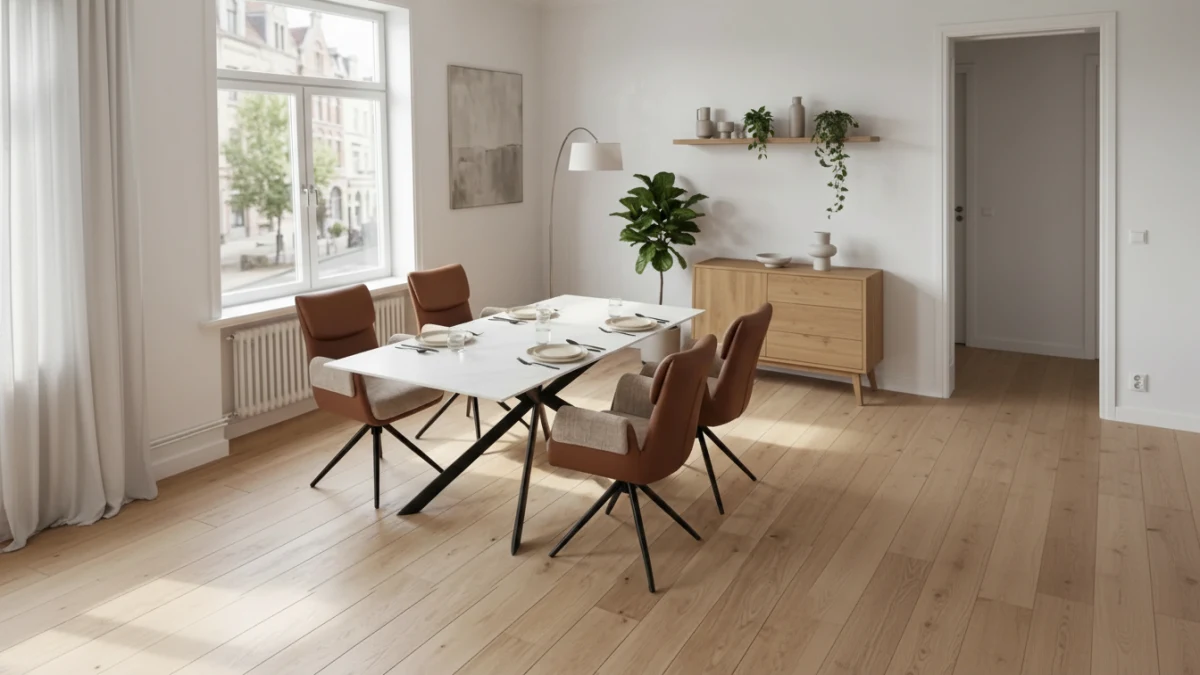
How Ceramic Dining Table Design Affects Cost, Packaging, and Container Loading
Ceramic dining table design—specifically tabletop thickness, underframe modularity, and knock-down (KD) leg engineering—directly dictates your total landed costs by defining packaging volume, transit breakage risks, and container space utilization. Wholesalers and importers targeting the European market can significantly reduce supply chain expenses by opting for optimized designs, such as ceramic-to-glass lamination and completely flat-packed support frames, which maximize density and minimize damage.
How Does Tabletop Thickness Impact Ceramic Dining Table Design Costs and Logistics?
As someone who has worked with European furniture buyers for many years, I have learned that the thickness of a sintered stone or ceramic tabletop is not merely an aesthetic choice; it is one of the most critical drivers of your shipping and material costs. When sourcing contemporary dining tables, B2B buyers must navigate the practical trade-offs between solid ceramic surfaces and laminated composite surfaces.
Solid 12mm sintered stone is highly prized for its luxurious feel, structural rigidity, and natural edge aesthetics. However, it is exceptionally heavy—averaging roughly 30 kg per square metre. This high deadweight increases material costs at the factory level and substantially drives up your domestic handling and mainland European logistics expenses. Furthermore, heavy tops require heavily reinforced timber or steel underframes to prevent sagging over long spans, compounding both the product weight and factory-level production costs.
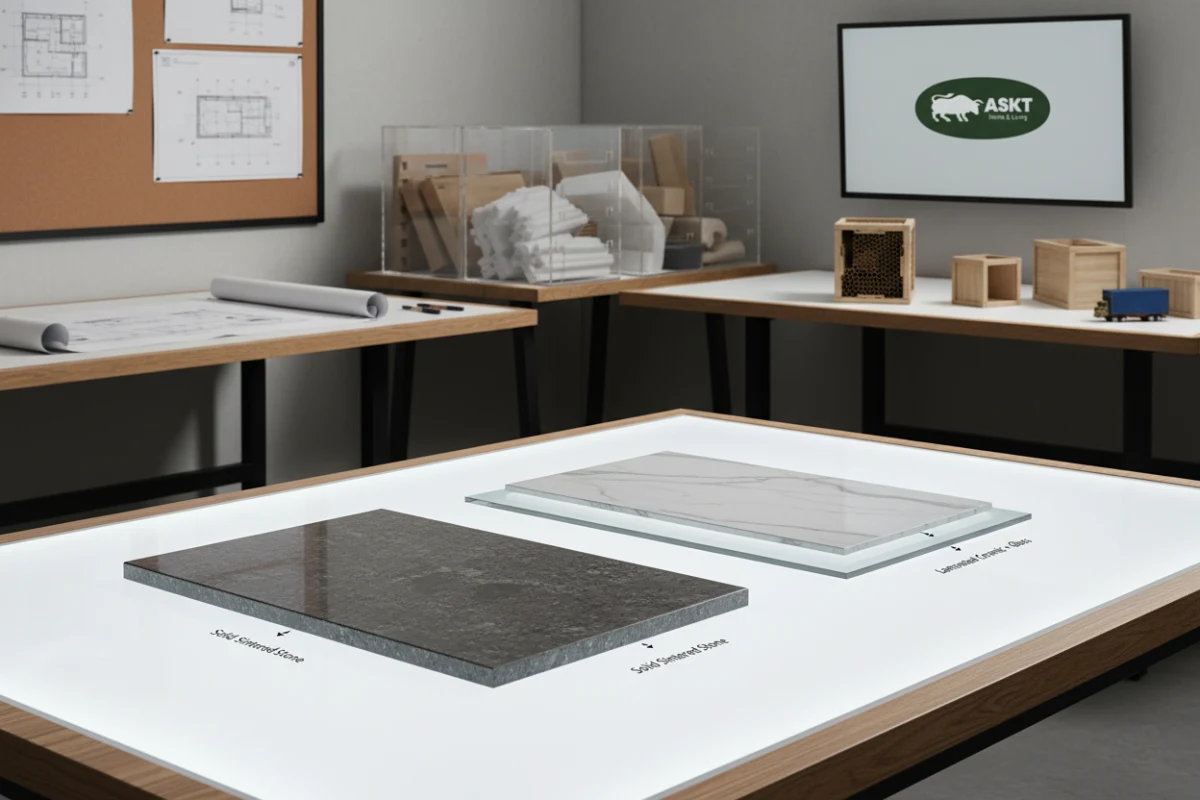
To balance these challenges, high-performing B2B brands utilize laminated designs. For instance, laminating a 3mm or 5.5mm sheet of sintered stone to an 8mm or 10mm tempered glass backing or a high-density MDF sheet yields an elegant tabletop that looks substantial but weighs up to 40% less. By using composite materials, you can easily control the ceramic dining table design costs and logistics of your inventory. Reduced weight directly translates to lower handling labor costs at your distribution centers in Germany or the Netherlands, safer last-mile delivery, and fewer structural requirements for the table frame itself.
Furthermore, the composite structure absorbs micro-vibrations better than solid, brittle stone, making it less prone to catastrophic failures under sudden impact. From a commercial standpoint, this means less customer returns and a lower insurance profile for your freight operations.
| Tabletop Construction Type | Sintered Stone Thickness | Support Backing Material | Average Weight per m² | Risk of Transit Deflection | Direct Logistic Cost Impact |
|---|---|---|---|---|---|
| Solid Sintered Stone | 12 mm | None (Self-Supporting) | ~30 kg | Low | High (Requires heavy-duty pallets & high-fee sea freight) |
| Sintered Stone + Glass | 3 mm to 5 mm | 8 mm - 10 mm Tempered Glass | ~18 kg to 22 kg | Medium-Low | Moderate (Highly optimized weight-to-volume ratio) |
| Sintered Stone + MDF | 3 mm | 9 mm - 12 mm High-Density MDF | ~15 kg to 18 kg | Medium (Requires dry warehouse storage) | Low (Lightest configuration, excellent for e-commerce parcel delivery) |
Why is Knock-Down Table Packaging Optimization Essential for Legs and Underframes?
Many product designers focus exclusively on how a table looks in a high-end European showroom. However, in B2B supply chains, the way the table's legs and underframe disassemble is just as important. A beautiful table frame with pre-welded, monolithic legs creates an unsustainable transport bottleneck because it forces you to "ship air."
At our manufacturing facilities, we heavily advocate for knock-down table packaging optimization. A welded, non-detachable metal frame for a 180cm dining table might require a box with a volume of over 0.8 cubic metres (CBM). By redesigning that exact same table to feature a fully modular, knock-down underframe—where the crossbeams, structural sub-frames, and legs are bolted together on-site by the retailer or end consumer—we can shrink the shipping box down to just 0.15 CBM.
This dramatic drop in volumetric cargo space directly increases your warehousing capability and reduces shipping overheads significantly. For a purchasing manager calculating the volumetric efficiency of their warehouse footprint, flat-packing offers substantial commercial advantages:
- Minimized Warehousing Fees: Flat-packed boxes stack perfectly on standard European pallets (800mm x 1200mm), reducing storage space in costly German or Dutch fulfillment centers.
- Efficient Parcel Shipping: Flat-pack designs allow many standard-sized dining tables to qualify for regional LTL (Less-Than-Truckload) or even standard courier parcel networks, bypassing the high fees of specialized two-man home delivery teams.
- Simplified On-Site Assembly: By engineering precise metal-to-metal connection points with pre-installed threaded inserts, we ensure that stability is not sacrificed for flat-pack convenience. The final customer receives a table that is rock-solid and incredibly straightforward to assemble, which lowers return rates due to assembly frustration.
How Can We Design Ceramic Table Shipping Damage Protection Into the Packaging?
Sintered stone and ceramic tables are incredibly durable once installed, but they are highly vulnerable to impact damage during transit. The most common point of failure is not a catastrophic shattering of the tabletop; rather, it is edge-chipping and micro-cracking caused by lateral shocks when boxes are dragged, dropped, or stacked incorrectly during sea transit.
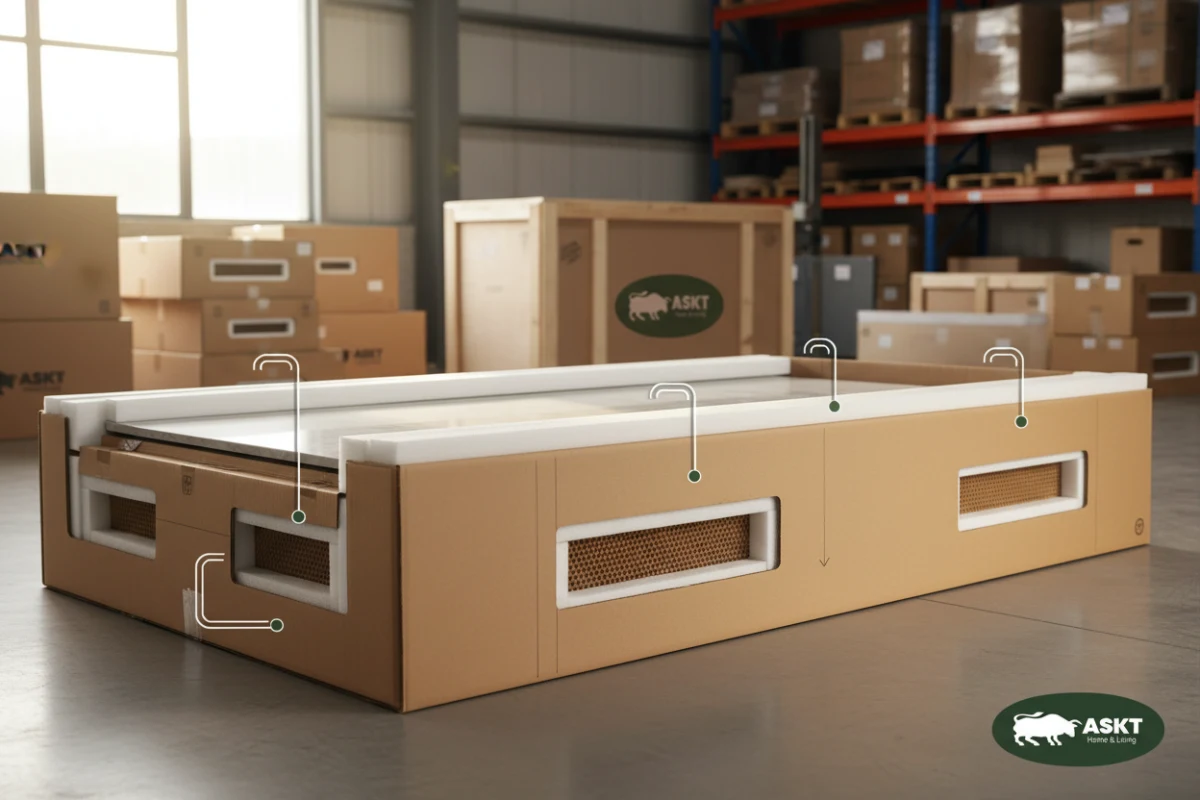
To address this, we build ceramic table shipping damage protection directly into the product packaging. Traditional polystyrene packing is no longer sufficient for heavy, high-value furniture exports to DACH countries. Instead, we utilize high-density polyethylene (EPE) foam edge protectors with a minimum thickness of 50mm, combined with structural, multi-layer honeycomb cardboard inserts. These materials are engineered to deform under impact, absorbing the kinetic energy before it reaches the fragile edge of the stone.
Our packaging designs undergo rigorous physical testing prior to approval for bulk production. Every new collection is subjected to standard drop-testing protocols—including corner drops, edge drops, and flat drops—to simulate worst-case logistics scenarios in international ports. Additionally, the box design must account for the natural flexibility of the tabletop. We place rigid timber or high-density MDF structural support panels within the carton to prevent the ceramic top from bending and cracking when other heavy items are stacked horizontally on top of it in the warehouse.
What Structural Decisions Maximize Sintered Stone Table Container Loading and Freight Efficiency?
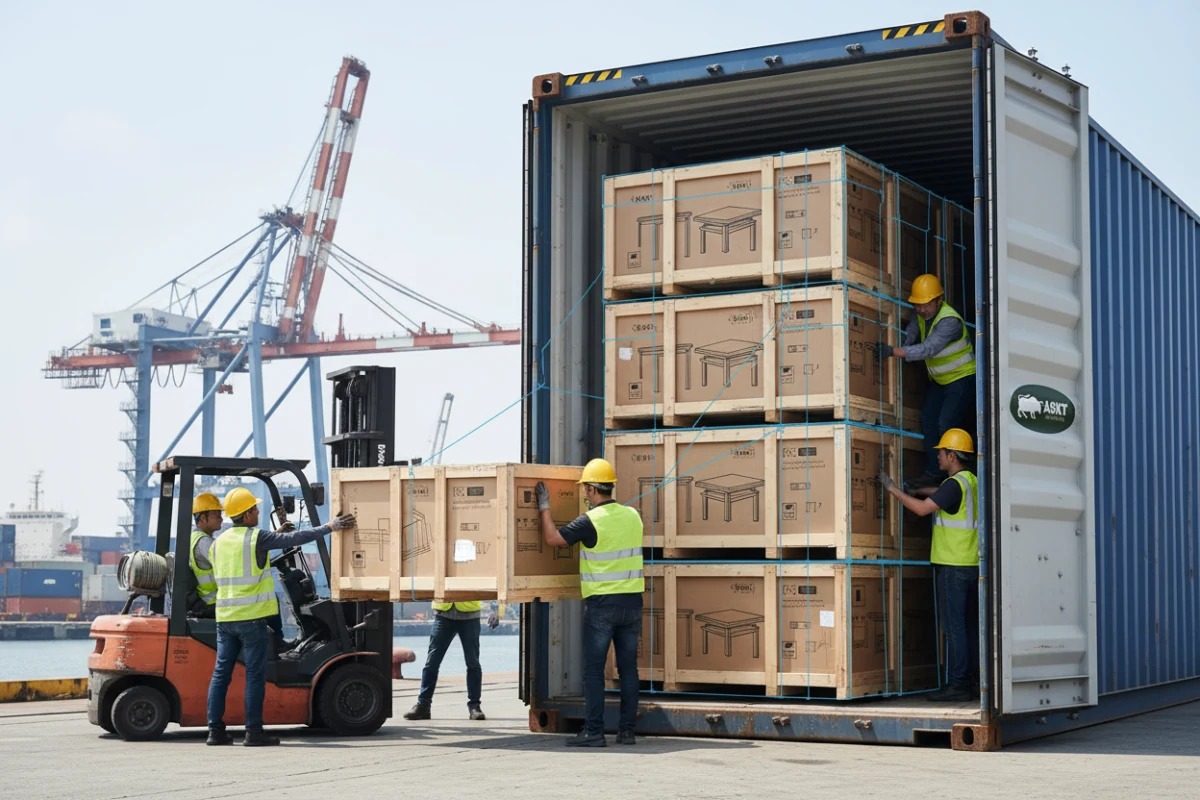
When importing container-loads of contemporary indoor furniture from Asia to Europe, sea freight is often your largest variable expense. Improving your container density by even 10% can save thousands of Euros per shipment. Therefore, maximizing sintered stone table container loading must be prioritized during the early CAD development phase of the table.
To achieve maximum container density, we design the packaging of our dining tables to allow for nested loading. Disassembled steel table legs, extension mechanisms, and structural sub-frames are nested within the hollow spaces created by the table's protective under-top frames. By arranging these metal components strategically, we eliminate void spaces inside the outer shipping cartons, dramatically increasing their compression resistance.
Furthermore, stackability dictates your final shipping density. A well-designed flat-pack carton can easily withstand the weight of up to ten stacked units without compromising the ceramic table below. If a table’s legs cannot be detached, stacking becomes impossible, and you are forced to ship a single layer of tables, leaving the upper half of your shipping container entirely empty. By designing the tables for high-density packing, we help our clients achieve exceptional B2B dining table logistics cost control.
Container Loading Comparison: 40ft HQ Container (Approx. 76 CBM)
- Pre-welded Frame Design (Non-KD): Roughly 90 to 110 tables per container. High risk of box crushing due to uneven weight distribution and excessive void spaces.
- Optimized KD Flat-Pack Design: Between 280 and 340 tables per container. Cartons are loaded evenly, maximizing volumetric capacity and securing the load against shift damage during ocean storms.
How Do Custom OEM/ODM Table Designs Balance Aesthetic Appeal with B2B Dining Table Logistics Cost Control?
European markets—particularly Germany, the Netherlands, and Scandinavia—demand contemporary, clean-lined, and minimalist furniture. However, translating these elegant, high-end designs into commercially viable, mass-produced products requires careful structural engineering and deep factory-level expertise.
When collaborating on OEM and ODM developments, we actively help buyers optimize their designs to balance high-end aesthetics with practical logistics realities. For example, a client may request a beautiful, organic curved metal pedestal base. While highly attractive, a solid curved base is incredibly difficult to flat-pack. To solve this, we engineer the base as a series of interlocking steel plates or segments that can be shipped completely flat and assembled seamlessly on-site using heavy-duty hidden bolts. This approach preserves the premium, sculptural look that high-end retailers desire while dramatically lowering freight costs.
Additionally, standardizing metal frames and under-table extension mechanisms allows wholesalers to buy in larger, more cost-effective production runs. Using our modular KINEXA system, a buyer can pair a single, standardized, highly optimized steel underframe with multiple different ceramic top shapes (such as oval, rectangular, or boat-shaped) and distinct leg styles. This flexibility dramatically lowers your inventory risk and allows you to test new contemporary trends in the European market with minimal capital investment.
What is the Total Cost of Ownership (TCO) Sourcing Checklist for Ceramic Dining Tables?
Before finalizing a purchase order for a new ceramic dining table line, product managers should perform a comprehensive review of the design’s logistical footprint. Use this five-step checklist to ensure your collection is engineered for maximum profitability:
- Analyze Tabletop Construction: Has the thickness been optimized? If using a 12mm top, can it be switched to a 3mm ceramic on 10mm glass composite to reduce container weight by 30%?
- Audit the KD Structural Engineering: Are all legs and support crossbeams completely detachable? Are the connection points steel-to-steel to prevent threading wear during assembly?
- Specify Packaging Protection Standards: Does the packaging utilize high-density EPE foam and heavy-duty honeycomb paper panels? Has the carton design passed drop-testing to protect fragile edges during local transit?
- Calculate Volumetric and Loading Density: How many units fit into a 40ft HQ container? Is the box compression strength high enough to allow 8-to-10-tier stacking in your regional warehouse?
- Review Sub-Frame Modularity: Can the underframe design support multiple tabletop sizes or styles to streamline your component inventory and reduce manufacturing complexity?
If you are evaluating dining chair or dining table suppliers for the European market, ASKT can support you with product development, customization, quality testing, and stable export experience. Explore our complete manufacturing solutions and view our newest contemporary collections by visiting https://www.asktfurniture.com/.