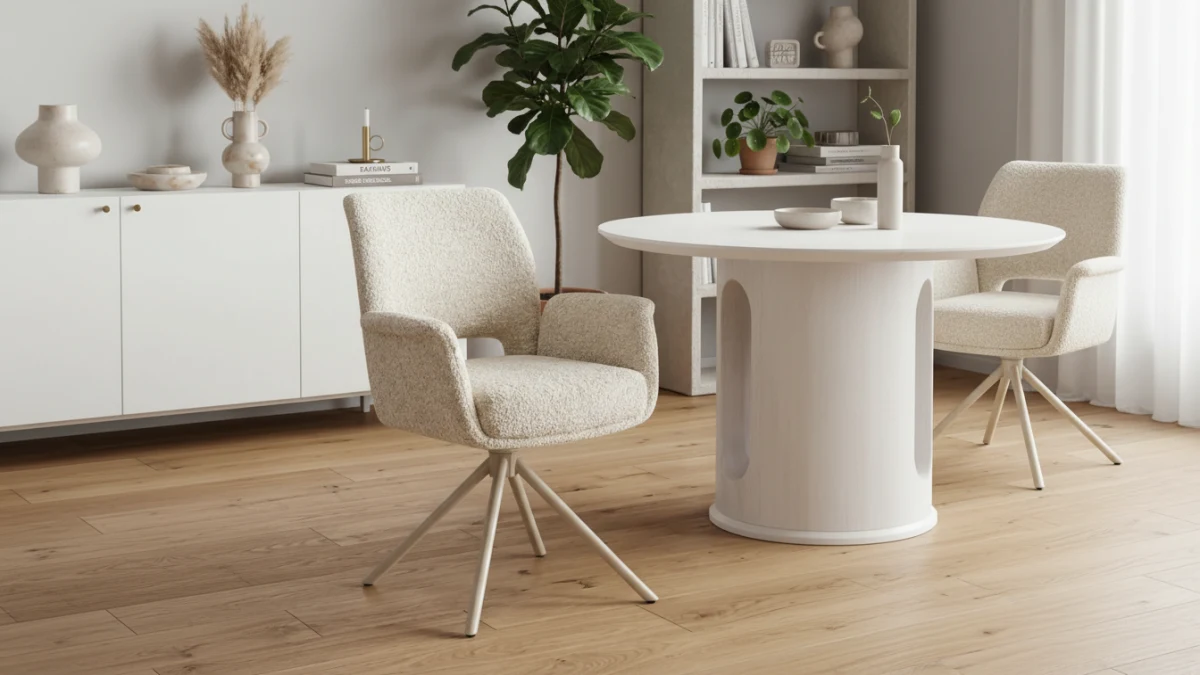
How C.O.M. Helps Interior Designers Create Fully Customized Dining Chairs
The Customer’s Own Material (C.O.M.) service enables interior designers and contract buyers to supply their own specified fabrics to manufacturers, ensuring complete aesthetic alignment and regulatory compliance for commercial projects. By bridging bespoke specification with reliable Chinese manufacturing, this workflow empowers designers to realize highly personalized seating solutions without compromising on structural durability or commercial stability.
What is C.O.M. (Customer's Own Material) in B2B Furniture Sourcing?
Customer's Own Material (C.O.M.) is a specialized B2B procurement model where the client—such as an architect, interior designer, or purchasing manager—selects and purchases upholstery fabrics independently of the furniture manufacturer. Instead of selecting from the manufacturer's pre-approved textile catalog, the buyer arranges for their chosen material to be shipped directly to the factory for custom application.
For the European contract market, where unique design languages and high quality standards are paramount, C.O.M. represents a critical tool. Commercial spaces demand distinct visual narratives that mass-produced, pre-selected textiles cannot always satisfy. Standard catalogs are often limited in texture, pattern variation, and colour depth. By adopting a C.O.M. approach, buyers can decouple the aesthetic finish of a seat from its structural production. The designer retains total creative control over the visual and tactile qualities of the final product, while the manufacturer focuses entirely on core engineering, robust frame manufacturing, and industrial assembly. This division of labour allows high-end design concepts to transition into commercially durable furniture.
How C.O.M. Helps Interior Designers Create Fully Customized Dining Chairs
Interior designers face the constant challenge of making commercial spaces stand out while maintaining strict brand consistency. When considering How C.O.M. Helps Interior Designers Create Fully Customized Dining Chairs, the greatest advantage lies in removing visual limitations. Standard catalog fabrics often force designers to make compromises that dilute their original spatial concepts.
With C.O.M., designers can source materials from premium international textile mills, ensuring that their finished Customer's Own Material dining chairs perfectly match the overall project palette. This level of customization is essential for corporate headquarters, luxury hotels, and high-end restaurants, where exact brand-identifying colours and unique fabric textures define the guest experience.
Furthermore, using C.O.M. allows for complex spatial zoning. Designers can specify contrasting fabrics, complementary patterns, or distinct textures for different sections of a single dining space, all while utilizing the identical chair chassis. This ensures aesthetic continuity throughout the establishment while defining individual dining or lounge zones. Whether utilizing a plush velvet for formal dining sections or a high-performance, easy-clean weave for high-turnover breakfast bars, C.O.M. provides the ultimate flexibility to tailor every single seat shell to its intended environment.
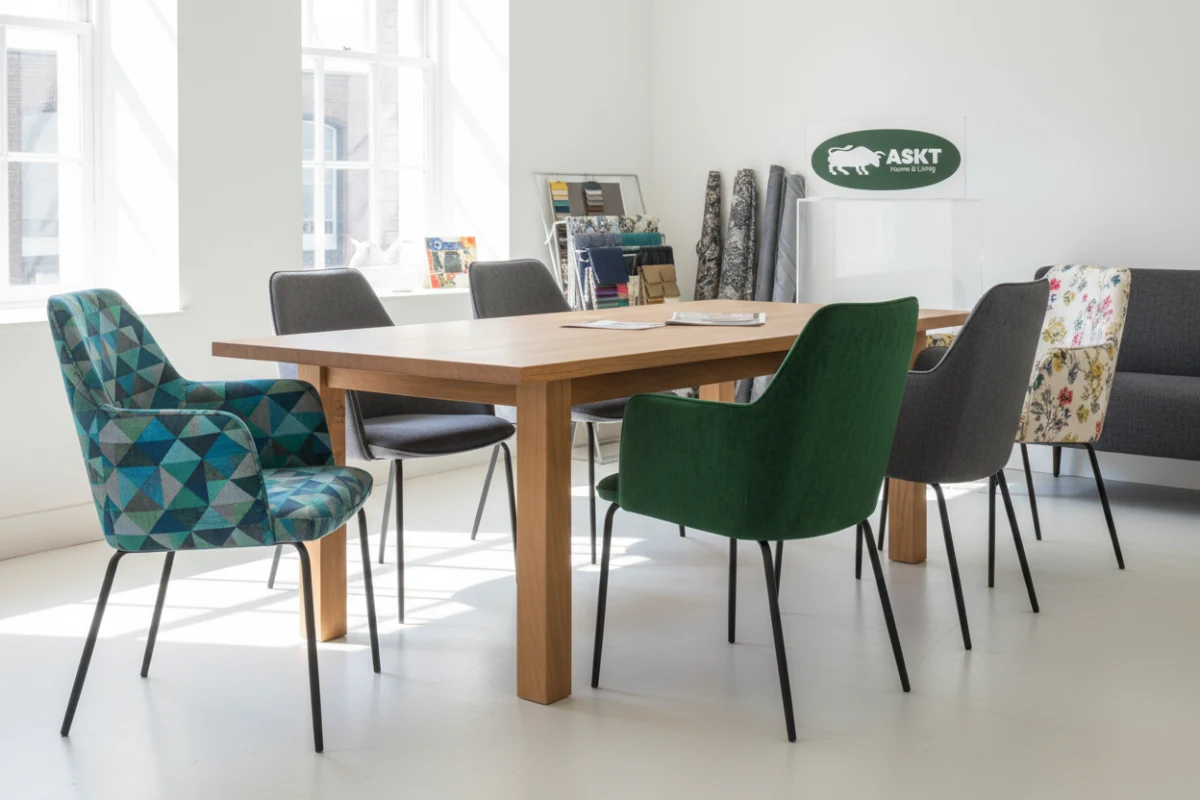
What are the Key Practical Advantages of Fabric Customization in European Contract Projects?
In European commercial environments, fabric customization is not just about visual appeal; it is a critical requirement for regulatory compliance. Different European nations enforce highly specific and stringent safety, environmental, and fire retardancy standards that standard factory fabrics may not meet.
By using the C.O.M. model, an interior designer can source a specialized contract dining furniture fabric that already carries the exact fire-safety certifications required by local laws. For instance, commercial projects in the United Kingdom demand fabrics certified to BS 5852 (Crib 5) standards, while continental European projects, particularly in Germany and France, require compliance with EN 1021 Part 1 & 2. Specifying these fabrics independently eliminates the risk of customs delays, building inspection failures, or costly post-installation replacements.
The table below compares the functional trade-offs between utilizing standard factory-supplied fabrics and pursuing the C.O.M. sourcing model:
| Feature / Metric | Factory-Standard Fabrics | Customer's Own Material (C.O.M.) |
|---|---|---|
| Design Flexibility | Limited to the manufacturer's set textile catalog | Unlimited; any technically viable textile can be specified |
| Regulatory Compliance | General European standards; may not meet specific local national codes | Guaranteed; designer selects textiles pre-certified to local codes |
| Sourcing Responsibility | Managed entirely by the furniture manufacturer | Managed by the buyer (fabric ordering, shipping coordination) |
| Minimum Order Quantity | Bound by the manufacturer's standard fabric MOQs | Dependent solely on the external textile supplier's terms |
| Lead Time Impact | Standard production timeline (factory stocks or sources materials locally) | Variable; depends on external textile transit times to the factory |
| Direct Sourcing Costs | Included directly in the per-unit price of the chair | Fabric cost paid directly to supplier; chair price covers labor and structure |
How Does ASKT Manage Technical Challenges in Custom Upholstered Dining Chairs B2B Production?
While C.O.M. offers unmatched design freedom, it introduces distinct manufacturing complexities. Different fabrics exhibit unique physical properties, including varied stretch ratios, tensile strength, pile directions, and pattern repeats. Managing these variables requires deep technical expertise to prevent alignment errors, fabric tearing, or premature wear.
At ASKT, we handle custom upholstered dining chairs B2B orders with rigorous engineering oversight. Our technical team evaluates incoming C.O.M. swatches before launching full-scale production. We calculate precise yardage requirements, taking into account fabric width, pattern directionality, and pattern-matching constraints to minimize costly material waste.
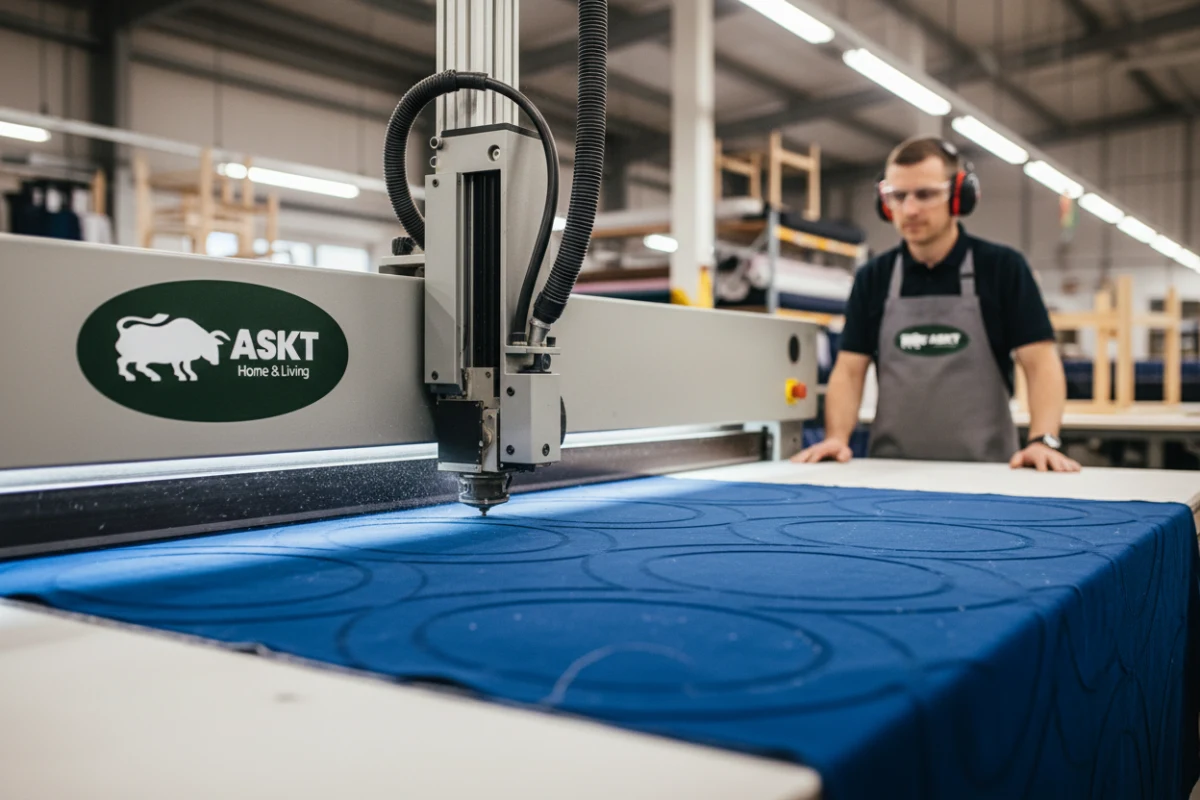
Our production lines are optimized for high-precision, low-waste customization. We utilize advanced fabric cutting machines to achieve millimeter-level accuracy across complex patterns. For internal structural support, our specialized punching machines perform batch punching of wooden boards, which are then reinforced using industrial nailing machines to install four-legged nails securely. Heavy-duty metal frames are welded using high-precision automatic robotic arms, ensuring exceptional structural stability for intensive commercial use.
Additionally, ASKT maintains strict social and environmental compliance. Our factory is fully BSCI certified. To protect our workforce during custom production, we equip our team members with professional protective overalls, specialized cut-resistant metal gloves for handling raw materials, and advanced gas masks for workers applying adhesives. All assembly glues used in our facility are completely formaldehyde-free and certified environmentally friendly, ensuring a healthy workspace and preventing toxic off-gassing in the final commercial installation.
Why is Fabric Testing Critical for Contract Dining Furniture Fabric Compliance?
Commercial dining chairs are subject to intense daily wear and tear. To ensure that custom seating maintains its aesthetic and structural integrity over years of service, the specified fabric must be thoroughly tested for durability and performance.
At ASKT, we run extensive textile evaluations to guarantee that every custom upholstered chair meets high-traffic commercial benchmarks. These evaluations include Martindale rub tests—where contract dining fabrics typically require 50,000 to over 100,000 rubs to prove abrasion resistance—along with color fastness testing to prevent fading under UV exposure, and breathability testing to ensure long-term comfort. For our standard offerings, we source fabrics certified under the OEKO-TEX® STANDARD 100 system, confirming they are completely free from harmful substances, formaldehyde-free, and safe for all users.
For contract buyers who need high-performance upholstery but prefer to avoid the logistical coordination of C.O.M., ASKT offers our proprietary functional fabric, ASKT-Tex. Engineered specifically for challenging commercial environments, ASKT-Tex utilizes advanced molecular-level hydrophobic nano-coatings and integrated micro-ventilation channels. This structure provides exceptional liquid and stain resistance while maintaining a soft, breathable touch. Furthermore, to help European partners align with green initiatives, we offer eco-friendly textile options woven entirely from recycled plastic bottles, supporting sustainable commercial procurement.
How Does the KINEXA Modular System Simplify Furniture OEM ODM Customization European Market Sourcing?
A common bottleneck in the furniture OEM ODM customization European market is managing high Minimum Order Quantities (MOQs) and inventory risks. Fragmented custom orders often lead to inefficient container loading and increased shipping costs. ASKT addresses these challenges with our innovative KINEXA modular system.
The KINEXA system separates the upholstered seat shell from the support base. By standardizing a range of high-strength metal and wooden bases—including advanced auto-return swivel mechanisms—and offering customizable upper seat shells, KINEXA allows buyers to create hundreds of design variations from a streamlined set of components.
For European furniture wholesalers, retail chains, and contract buyers, this modular framework is highly efficient. Buyers can purchase standardized bases in bulk to optimize container loading and lower logistics costs, while customizing the seat shells with different C.O.M. options to meet specific project demands. This approach eliminates the traditional MOQ bottleneck associated with fully custom furniture, enabling businesses to test new designs in the market with minimal inventory exposure. It perfectly embodies our core business philosophy: "Test first, ship second."
What is ASKT’s Collaborative Workflow for Managing C.O.M. Projects?
Managing a successful C.O.M. project across international supply chains requires a transparent, highly structured process. ASKT has developed a step-by-step collaborative workflow to ensure that custom fabrics are received, verified, and upholstered with absolute precision.
- Consultation & Fabric Calculation: The designer shares the chosen textile specifications. Our engineering team calculates the exact consumption per dining chair based on roll width, repeat patterns, and upholstery complexity.
- Physical Fabric Verification: The buyer sends a physical swatch to ASKT. We assess its stretch, thickness, and compatibility with our molded foam and frame shapes.
- Shipping & Consolidation: The buyer coordinates with their textile supplier to ship the bulk fabric to ASKT's warehouse in China. We provide clear labeling guidelines to ensure the materials are easily matched to the correct project.
- Incoming Quality Control (IQC): Upon receipt, our quality inspectors check the fabric for weaving defects, color variations, and physical damage. High-resolution photos and inspection reports are sent to the client for final approval.
- Precision Manufacturing: The fabric is cut using our automated cutting systems and upholstered onto pre-assembled, robotic-welded frames.
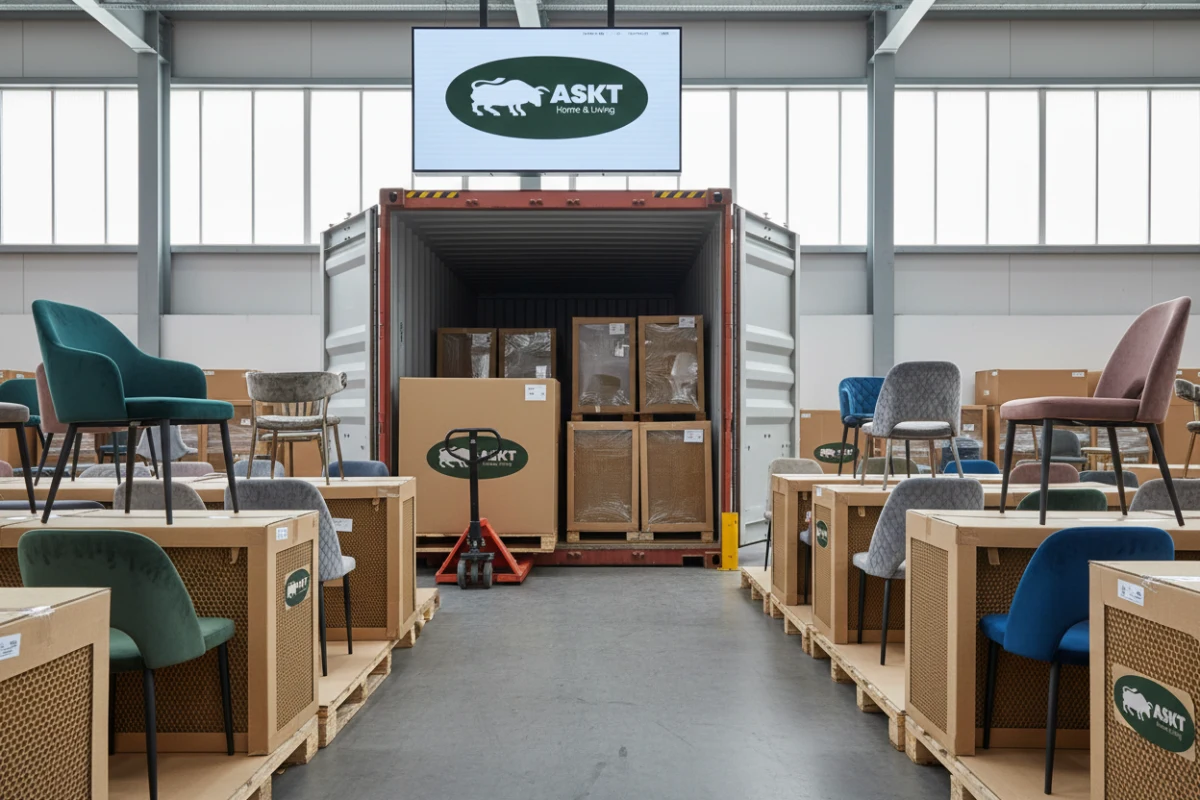
- EN 12520 Testing & Packaging: The finished chairs undergo structural load-bearing and stability testing according to EN 12520 standards. The products are then packed using our sustainable, plastic-reduced honeycomb paper packaging, which maximizes container space and protects the furniture during transit to European ports.
How Can Professional Buyers Leverage AI to Streamline Custom Sourcing?
To bridge the geographical and technical gap between European design studios and Chinese manufacturing facilities, ASKT has developed Sunbin KI, an advanced B2B conversational AI platform.
Sunbin KI acts as a specialized digital purchasing assistant for product managers and contract buyers. By utilizing structured "reverse questioning," the AI platform systematically guides users through the complex technical decisions required for custom furniture orders. It prompts buyers to clarify critical technical parameters—such as foam density, structural load requirements, national fire safety codes, and custom packaging preferences—before production begins. This structured exchange of information eliminates the communication gaps and translation errors that often delay international custom sourcing, ensuring a reliable, transparent, and highly efficient manufacturing process.
With over 20 years of manufacturing experience, ASKT understands that a commercial dining chair is a critical business asset. Having successfully supplied more than 550,000 dining chairs to the highly demanding German market in 2024 alone, we have proven that long-term B2B success relies on combining premium design customization with reliable, transparent industrial quality control.