How European Buyers Can Find Reliable Dining Chair Manufacturers with Quality Control
European buyers can find reliable dining chair manufacturers with quality control by evaluating supplier engineering expertise, conducting comprehensive factory audits, establishing strict sample approval protocols, and enforcing multi-stage quality control across raw materials, metal frames, upholstery, and packaging. Partnering with experienced B2B manufacturers that provide transparent production inspection workflows ensures consistent structural durability, reduces return rates, and protects commercial margins.
Why does multi-stage quality control define reliability in dining chair manufacturing?
For European furniture wholesalers, retail chains, purchasing groups, and contract furniture buyers, sourcing dining chairs from overseas is fundamentally an exercise in risk management and commercial reliability. Unlike purely decorative items, dining chairs endure continuous dynamic loading, repetitive mechanical stress, and varying environmental conditions across residential homes, restaurants, and commercial venues. Minor manufacturing variations in metal frame welding, foam density, upholstery tension, or bolt alignment can quickly lead to widespread product failures, costly consumer returns, and severe brand damage.
Finding reliable dining chair manufacturers with quality control requires looking beyond attractive showroom prototypes and digital catalogues. In volume furniture manufacturing, the initial sample often looks flawless; the true operational challenge lies in ensuring that the five-thousandth chair loaded into a shipping container matches the very first approved unit in structural integrity, dimensional tolerance, and surface finish. A systematic quality management framework provides the procedural guarantee that every production batch complies with the commercial expectations and safety requirements of the European market.
Furthermore, cross-border furniture logistics amplify the cost of manufacturing defects. Defective dining chairs discovered after arriving at a European distribution centre incur substantial non-recoverable costs, including sea freight, import clearance, warehouse handling, sorting, rework, or disposal. Implementing transparent quality control directly at the manufacturing facility eliminates defective components before goods are packed and loaded, safeguarding profit margins and ensuring uninterrupted supply continuity for European distribution networks.
What criteria should buyers evaluate during a dining chair supplier quality audit?
A structured dining chair supplier quality audit serves as the initial filter when assessing whether an overseas manufacturer possesses the genuine capability to deliver consistent, commercial-grade furniture collections. European sourcing specialists and product managers should look past superficial sales presentations and conduct thorough on-site or third-party factory assessments that examine production capabilities, internal quality systems, and operational transparency.
1. Production Machinery and Manufacturing Capabilities
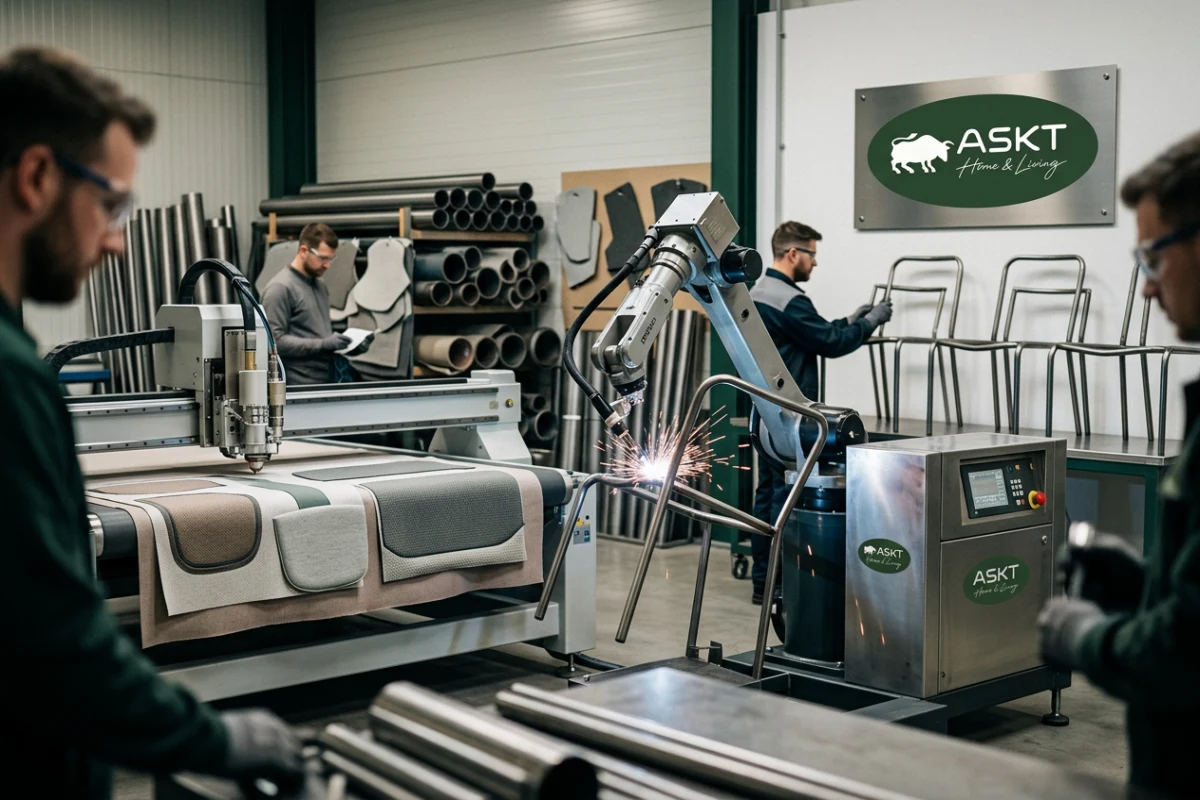
High-volume product consistency depends heavily on standardized machinery and repeatable production methods rather than unstandardized manual assembly. During a factory audit, buyers should verify the presence and proper operation of specialized equipment:
- Fabric Cutting and Pattern Preparation: Automated cutting systems ensure uniform upholstery pattern dimensions, balanced fabric tension, and minimal material waste across large production runs.
- Precision Wood and Board Processing: Accurate drilling and punching machinery for internal wooden shells and structural boards ensures that screw inserts, T-nuts, and mounting holes align accurately with metal frames.
- Metal Fabrication and Joinery: High-precision metal tube cutting, bending, and welding equipment ensure uniform weld seams, structural rigidity, and clean joints across steel frames and KD brackets.
- Powder Coating Facilities: Professional surface preparation, electrostatic powder application, and controlled curing ovens guarantee uniform coating thickness, excellent adhesion, and scratch resistance.
2. Quality Management Systems and Workforce Standards
A dependable manufacturer must operate an organized, transparent quality management system with dedicated quality control personnel stationed at every critical production step. Key operational indicators include:
- Standard Operating Procedures (SOPs): Documented assembly and inspection instructions displayed at each workstation to guide line operators.
- Material Segregation: Clear separation between incoming raw materials, components awaiting inspection, approved parts, and rejected stock to prevent non-compliant materials from entering production.
- Worker Safety and Environment: Clean, organized workshop layouts with appropriate safety measures for operators handling cutting machinery, welding units, and finishing processes.
- Management Transparency: Sourcing partners that encourage buyer oversight, share detailed inspection logs, and communicate production schedules openly.
| Audit Category | Evaluation Focus | Commercial Value for European Buyers |
|---|---|---|
| Manufacturing Equipment | Automated cutting, CNC board processing, precision welding | High batch-to-batch consistency and dimensional accuracy |
| In-House Quality Team | Dedicated IQC, IPQC, and FQC inspection personnel | Early defect identification and reduced defect rates |
| Material Management | Systematic storage and quarantine of non-conforming goods | Prevention of substandard materials in finished products |
| Operational Transparency | Documented workflows, open communication, production logs | Predictable production timelines and lower sourcing risk |
How does a structured sample development and approval process protect bulk production?
The sample development and approval process establishes the technical benchmark between the European purchasing team and the manufacturing engineering department. Without a formally approved reference sample and documented technical drawings, subjective interpretations of quality can cause severe misunderstandings during mass production.
An effective sample approval workflow involves several sequential stages:
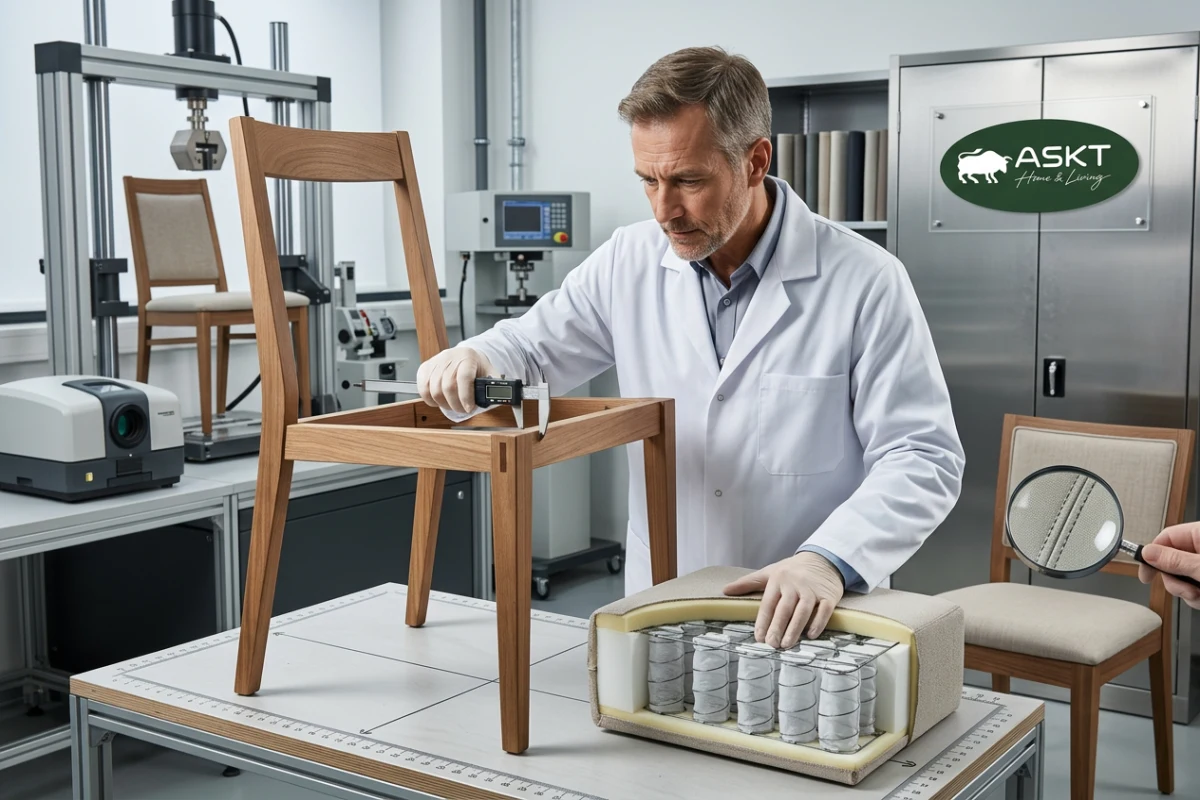
- Ergonomic and Dimensional Validation: Verifying seat height, backrest angle, armrest clearance, and overall dimensions against European dining table standards. Ergonomic assessment ensures comfortable posture and natural lumbar support for end consumers.
- Structural and Frame Rigidity Sign-off: Examining metal frame wall thickness, reinforcement gussets, bracket durability, and the stability of Knock-Down (KD) assembly points to ensure wobble-free performance.
- Mechanism Verification: For dining chairs featuring swivel or auto-return mechanisms, testing rotation smoothness, silent operation, accurate self-centring alignment, and clearance to prevent fabric rubbing against the base.
- Upholstery and Seating Core Inspection: Checking the integration of high-density foam padding and pocket spring seating cores. Pocket spring units provide resilient, long-lasting comfort without premature sagging.
- Sealed Master Reference Samples: Once the prototype meets all functional and visual criteria, identical reference samples are signed and sealed. One unit remains in the factory quality laboratory to guide mass production, while duplicate reference units are kept by the buyer's quality team for incoming delivery verification.
Establishing clear technical benchmarks during the sample phase ensures that potential design flaws, structural weaknesses, or assembly challenges are identified and resolved before raw materials are procured for bulk manufacturing.
What key inspection checkpoints belong in a B2B furniture quality control checklist?
A comprehensive furniture quality control checklist must cover the entire production lifecycle, divided into four distinct phases: Incoming Quality Control (IQC), In-Process Quality Control (IPQC), Final Quality Control (FQC), and Outgoing Quality Control (OQC).
1. Incoming Quality Control (IQC)
- Upholstery Fabrics and Leathers: Verifying roll colour consistency across dye lots, weave uniformity, surface cleanliness, waterproof coatings, easy-clean performance, and pet-friendly abrasion qualities.
- Metal Tubing and Steel Plates: Checking wall thickness, dimensional tolerances, surface smoothness, and cleanliness before finishing.
- Internal Wooden Shells and Boards: Inspecting moisture content, board density, and fastener retention strength.
- Hardware and Mechanism Components: Testing bolt tensile strength, thread precision, powder-coated surface durability, and swivel mechanism smoothness.
2. In-Process Quality Control (IPQC)
- Frame Welding and Alignment: Inspecting weld penetration, joint strength, and frame squareness to prevent uneven legs.
- Surface Coating Adhesion: Checking powder coating thickness, uniform colour coverage, and resistance to flaking or chipping.
- Foam and Spring Core Assembly: Ensuring even adhesive application, proper pocket spring positioning, and smooth foam wrapping around internal frames.
- Sewing and Stitching Quality: Monitoring stitch density, seam straightness, thread tension, and alignment along structural curves.
3. Final Quality Control (FQC)
- Stability and Levelness Check: Placing 100% of assembled chairs on a precision flat inspection surface to ensure all four legs make balanced contact without rocking.
- Visual and Tactile Inspection: Checking upholstery for wrinkles, uneven piping, fabric stains, loose threads, or surface blemishes under high-intensity inspection lighting.
- Functional Testing: Verifying that swivel mechanisms rotate smoothly, auto-return functions centre accurately, and KD assembly bolts fit smoothly into internal threaded inserts.
4. Outgoing Quality Control (OQC)
- Packaging Completeness: Ensuring correct hardware blister packs, assembly tools, floor-protecting glides, and clear multi-language assembly instruction sheets are included.
- Protective Cushioning: Verifying that corner protectors, edge guards, and internal protective wrapping prevent direct contact between metal parts and upholstered shells.
- Packaging Durability: Verifying that outer cartons possess adequate crush resistance to withstand warehouse stacking, pallet transit, and e-commerce handling.
How do EN testing standards and material specifications reduce European sourcing risk?
European buyers sourcing indoor dining furniture must ensure compliance with established B2B dining chair manufacturing standards. Adhering to verified testing standards protects commercial importers from liability, product recalls, and warranty disputes.
1. Structural Durability and EN Testing Protocols
Dining chairs destined for European wholesale, retail, and commercial distribution must undergo standardized mechanical testing to verify their safety, strength, and structural durability:
- Static Load and Fatigue Testing: Applying repetitive mechanical downward and backward forces to the seat and backrest to simulate years of intensive daily use.
- Impact and Drop Testing: Evaluating frame resilience and joint integrity when subjected to dynamic impacts on seat surfaces, back edges, and legs.
- Contract and Hospitality Performance: Commercial projects, such as restaurants and hotels, require reinforced frame construction and heavy-duty joints to withstand continuous, high-traffic use.
2. Material Specifications and Performance Characteristics
In addition to structural strength, material selection plays a critical role in product longevity and consumer satisfaction:
- Fabric Abrasion Resistance: Evaluating fabric durability through standardized abrasion testing ensures the upholstery maintains its texture and appearance under heavy friction.
- Colour Fastness: Testing fabric resistance to colour fading from light exposure and preventing dye transfer onto clothing during wet or dry rubbing.
- Functional Coverings: Utilizing easy-clean, waterproof, and pet-friendly fabrics helps European retailers offer practical solutions that resist spills and daily wear.
- Sintered Stone and Oak Veneer Matching: When sourcing matching dining tables, evaluating surface hardness, heat resistance, and scratch resistance ensures long-lasting aesthetic appeal.
Why are packaging optimisation and container loading crucial for European furniture sourcing inspection?
A thorough European furniture sourcing inspection must extend beyond the product itself to evaluate protective packaging and container loading arrangements. International sea freight exposes furniture cartons to dynamic vibration, container shifting, humidity changes, and multiple handling stages before reaching retail distribution centres.
1. Knock-Down (KD) Design and Protective Packaging
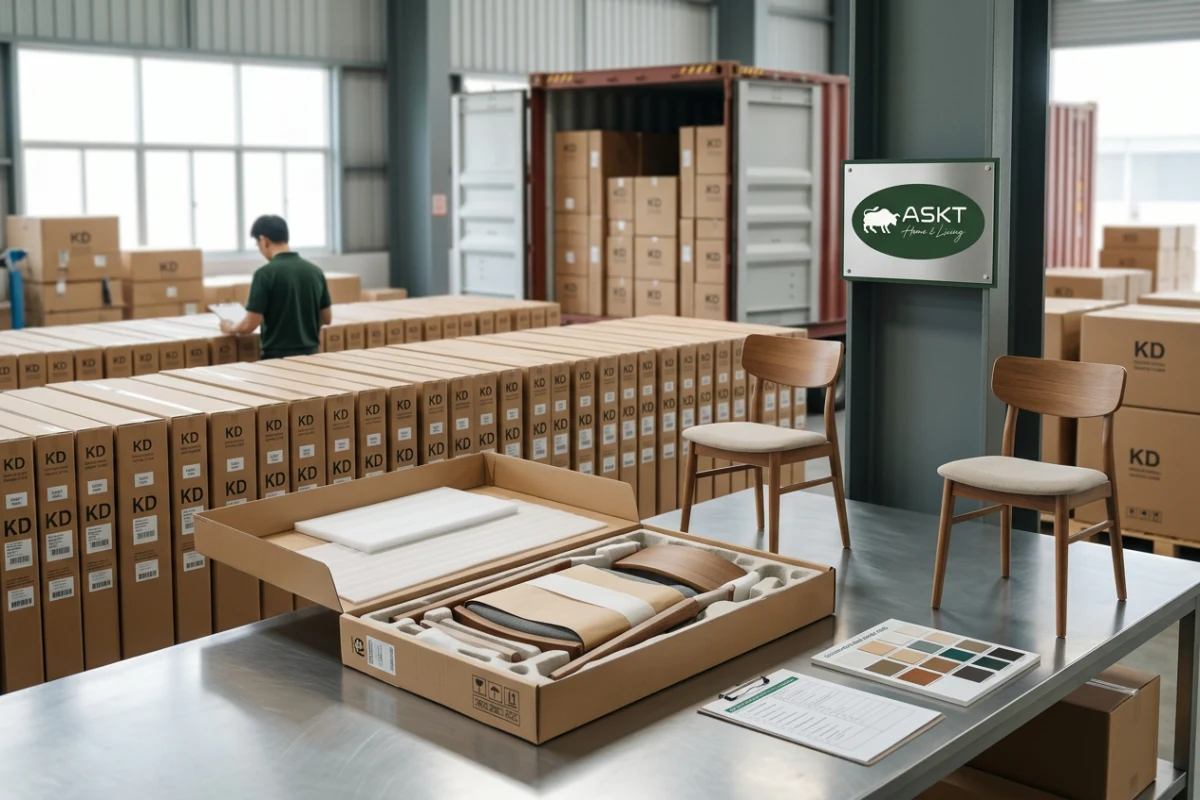
Knock-Down (KD) engineering allows dining chairs to be disassembled into compact components—such as separating the upholstered seat shell from the metal base. This flat-pack approach delivers substantial benefits:
- Minimised Freight Volume: Flat-pack packaging significantly reduces carton volume, allowing European buyers to load more units per shipping container and lower per-unit transport costs.
- Protective Cushioning: Engineered carton layouts utilize fitted internal partitions, corner edge protectors, and sustainable packaging materials with reduced plastic use, ensuring components remain securely isolated during transport.
- Damage Prevention: Eliminating movement inside the carton prevents metal bases from scratching fabric surfaces or crushing foam cushioning during rough transit conditions.
2. Container Loading Optimization
Proper container loading practices safeguard product integrity and maximize logistics efficiency:
- Stacking Stability: Arranging cartons in uniform, interlocking layers prevents carton crushing and stack collapse during maritime transport.
- Weight Distribution: Balancing total cargo weight evenly across the container floor maintains vehicle stability during road haulage in Europe.
- Moisture Protection: Utilizing container desiccant packs prevents condensation buildup and protects upholstery fabrics and metal finishes from moisture damage during ocean voyages.
| Packaging Factor | Traditional Fully Assembled | Optimized KD Flat-Pack |
|---|---|---|
| Carton Volume | Large, high volume of empty space | Compact, maximized density |
| Container Load Count | Lower unit capacity per container | Significantly higher unit capacity per container |
| Transit Protection | Vulnerable to frame bending and crushing | Secure internal cushioning and edge protection |
| Logistics Cost per Unit | Higher shipping cost per chair | Optimized freight cost per chair |
How does ASKT support European B2B buyers with transparent manufacturing and quality assurance?
ASKT is a specialized B2B dining furniture manufacturer and supply chain partner based in China with over 20 years of manufacturing experience. ASKT focuses exclusively on the design, production, and export of contemporary indoor furniture for the European market—including Germany, the Netherlands, the UK, Poland, Switzerland, Ireland, and other European countries.
Understanding that furniture wholesalers, retail chains, purchasing groups, e-commerce brands, and contract buyers prioritize product consistency, supply reliability, and logistics efficiency, ASKT integrates transparent quality control across every stage of manufacturing. The company's diverse product portfolio covers dining chairs, dining tables, bar chairs, lounge chairs, dining benches, coffee tables, office desks, and contract furniture, utilizing metal frames, upholstered pocket spring seating, swivel and auto-return mechanisms, extension tables, sintered stone, and oak veneer collections.
ASKT provides comprehensive OEM and ODM customization services, including tailoring fabrics, colours, finishes, dimensions, branding, and sustainable packaging with reduced plastic use. Through disciplined multi-stage quality control, EN structural testing expertise, and container load optimization, ASKT helps professional European sourcing teams minimize procurement risks and build resilient, commercially successful product lines.
If you are evaluating dining chair or dining table suppliers for your upcoming European collections, ASKT provides buyer-oriented sourcing support, technical consultation, and dependable manufacturing. Fordern Sie unsere QC-Checkliste, Musterfreigabe und Prüfanforderungen für Ihr Projekt an.