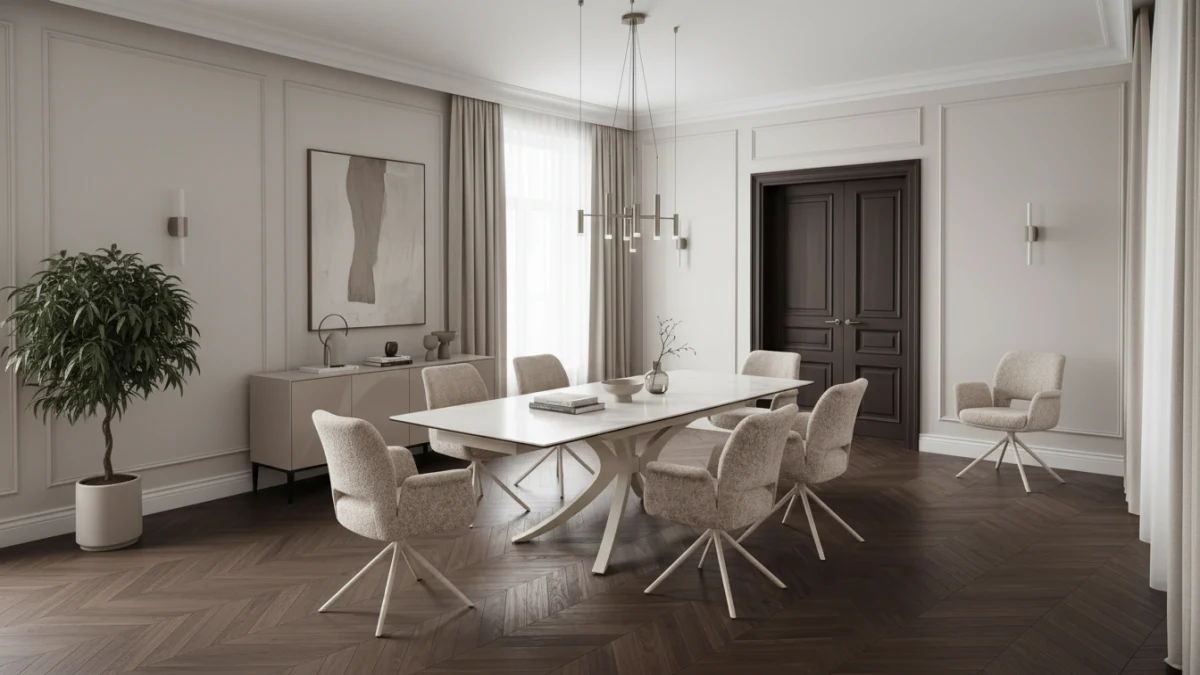
How Furniture Retailers Can Balance Design, Durability, and Price in Ceramic Dining Tables
Furniture retailers can balance design, durability, and price in ceramic dining tables by selecting high-density sintered stone mounted on structurally sound backing boards, choosing metal frames engineered with flat-pack Knock-Down (KD) structures, and partnering with transparent manufacturers that optimize container loading. This combination ensures high visual appeal for European markets, minimizes last-mile transit damage, and significantly reduces logistics costs.
Why is Balancing Aesthetics, Durability, and Price a Critical Challenge When Selecting Ceramic Dining Tables for Furniture Retailers?
The contemporary European furniture market is heavily driven by minimalist, elegant, and modern designs. Homeowners and contract clients demand sleek dining spaces featuring slim profiles, sophisticated textures, and clean aesthetics. However, when selecting ceramic dining tables for furniture retailers, purchasing managers face a complex challenge. The visual design must align with current European trends, particularly in design-conscious markets like Germany, the Netherlands, and the UK. Simultaneously, the product must possess high structural durability to survive daily domestic use, including heat exposure, sharp objects, and physical impact, without cracking or chipping. Finally, the price point must remain competitive enough to maintain healthy retail gross margins.
Many suppliers attempt to solve this equation by cutting corners, leading to critical failures. Low-cost ceramic tables often omit essential structural support, leading to sudden cracks during customer delivery or normal usage. Conversely, importing fully assembled luxury tables often results in prohibitive shipping costs that price out the middle-market segment. This retail dilemma forces B2B sourcing teams to seek smart engineering solutions. Sourcing teams must understand how the properties of sintered stone, the load-bearing design of metal frames, and the spatial optimization of packaging interact to dictate the final landed cost. The goal is to move away from a simple lowest-price procurement model and transition into an engineered sourcing strategy. By focusing on smart material selection and flat-pack logistics, furniture retail chains can deliver beautiful, resilient dining tables that fit consumer price expectations while protecting the retailer from expensive customer complaints, negative reviews, and product return liabilities.
How Does Sintered Stone Quality Vary, and How Can Buyers Select the Right Table-Top Construction?
When managing a sintered stone dining table wholesale program, B2B buyers must navigate a wide range of material qualities. Sintered stone is distinct from traditional glazed ceramic. Traditional ceramics are typically made from clay fired at moderate temperatures, resulting in a more brittle product that is prone to chipping. Sintered stone, however, is formulated from a precise blend of natural minerals, compressed under extreme industrial pressure, and fired at exceptionally high temperatures. This advanced manufacturing process induces complete vitrification, creating an incredibly dense, non-porous material with excellent scratch, heat, and stain resistance.
To balance price and durability, buyers must specify the correct slab thickness and substrate lamination:
- Ultra-Thin Slabs: These are lightweight and cost-effective but structurally vulnerable on their own. For furniture applications, these thin slabs must always be laminated to a secondary support sheet, such as a tempered glass pane or a high-density backing board. This hybrid construction keeps the table lightweight, reducing shipping costs, while the backing board absorbs physical impacts.
- Standard-Thickness Slabs: Widely recognized as an optimal specification for B2B furniture sourcing. These slabs offer excellent inherent flexural strength. When laminated to a durable wood-based backing board, they produce a table top with a premium, solid feel, quiet acoustics, and superb impact resistance.
- Thick Solid Slabs: These do not require an underlying support board. While luxurious, they are extremely heavy, which significantly increases both production costs and container shipping volume, ultimately compressing retail margins.
By opting for high-performance sintered stone laminated to a chamfered backing board, retailers can achieve the ideal balance: a surface that is highly scratch-resistant, heat-resistant, and easy to clean, all at a manageable manufacturing cost.
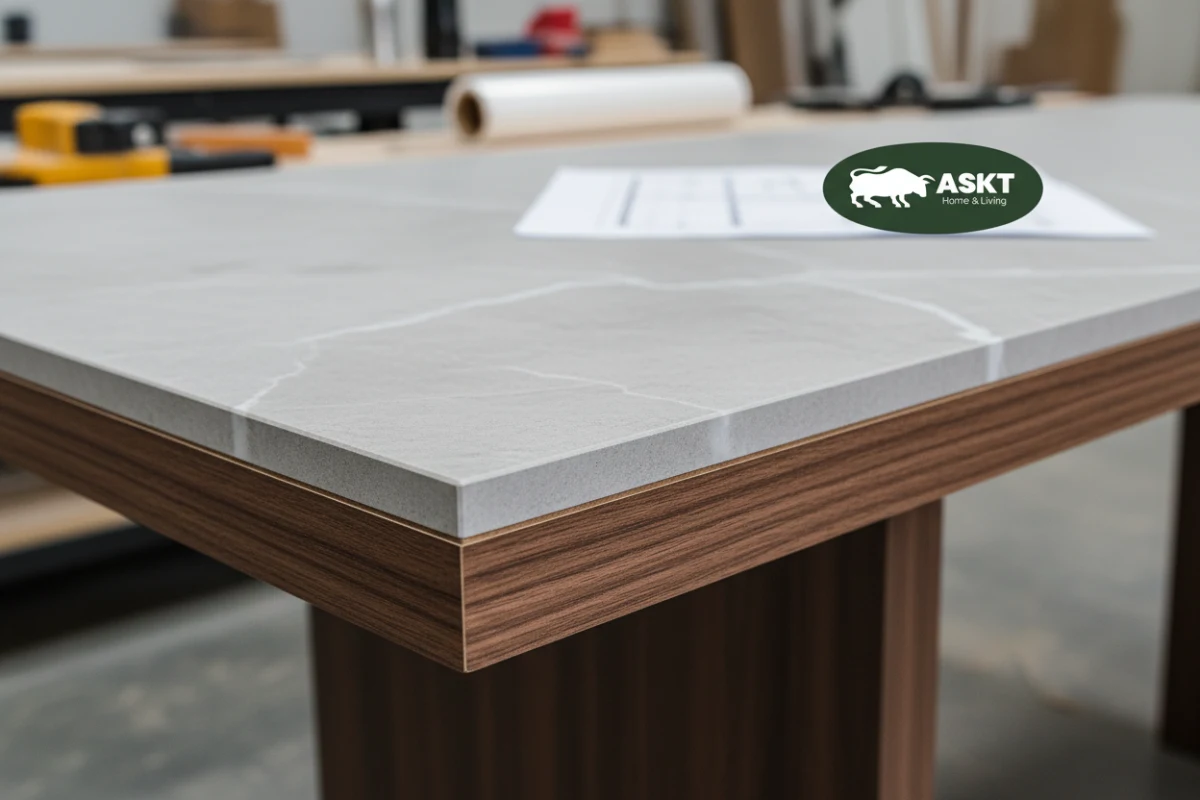
What Structural Engineering Features Prevent Wobbling and Damage in Durable Ceramic Table Manufacturing?
A high-quality ceramic top is only as stable as the understructure supporting it. Because sintered stone tops are heavy, they exert continuous structural stress on the table's frame and legs. In durable ceramic table manufacturing, structural stability is achieved through rigorous metalwork engineering, stable frame selection, and precise joinery.
To prevent sagging and warping over time, frames must be built from high-tensile metal, such as carbon steel or structural aluminium.
- Consistent Welding: Manual welding can sometimes leave microscopic voids or uneven seams, which can fail under the dynamic loads of daily family use. To eliminate this quality risk, advanced manufacturers utilize automated robotic welding processes. These systems apply consistent, high-penetration welds that guarantee uniform strength across large production batches, ensuring absolute consistency for retail chains.
- Surface Treatment: The metal understructure must be protected from humidity and wear. A high-quality electrostatic powder coating creates a dense, impact-resistant finish that resists scratching far better than traditional liquid spray paints.
- Top-to-Frame Integration: Direct metal-to-ceramic screw connections are impossible due to the hardness of the stone. Therefore, the ceramic slab must be chemically bonded to the support backing board using industrial elastic adhesives that absorb thermal expansion differences. The metal frame is then bolted directly into heavy-duty threaded metal inserts embedded deep within the backing substrate. This multi-point mechanical connection prevents the heavy stone top from shifting or separating when the table is lifted by delivery teams or consumers. Furthermore, integrating adjustable leveling glides on the table feet prevents wobbling on uneven household floors, representing a crucial quality detail that reduces consumer complaints.
How Does Container Loading Optimization and KD Structure Design Affect the Total Sourcing Cost?
A critical error in sourcing ceramic tables B2B is evaluating suppliers solely on the FOB (Free on Board) unit price. For international buyers, particularly those importing into European hubs, ocean freight is a substantial variable. Landed cost—the total cost of a product once it arrives at the retailer's warehouse—must be the primary metric for sourcing directors.
To minimize landed costs, the furniture must be engineered for shipping efficiency. This is achieved by utilizing Knock-Down (KD) structures.
- KD Structure vs. Welded Frames: A fully welded, one-piece table frame forces the factory to ship large amounts of empty air, driving up the cubic meter (CBM) volume per unit. By re-engineering the base into a modular KD structure—where legs, support rails, and mounting brackets bolt together during final assembly—the frame can be packed completely flat.
- Container Optimization: A flat-packed KD table dramatically reduces packaging volume compared to fully assembled units. This directly slashes the ocean freight cost per unit, allowing retailers to pass savings onto consumers or capture higher margins.
Sourcing managers should compare the logistical efficiency of different base designs before committing to a wholesale purchase:
| Frame & Leg Design | Flat-Pack (KD) Efficiency | Packaging Volume (CBM) | Structural Load Capacity | Ideal Retail Placement |
|---|---|---|---|---|
| 4-Leg Corner Frame | Exceptional (Legs bolt directly into corners) | Very Low | High (Direct vertical load path) | E-commerce & High-Volume Promotion |
| Trestle / A-Frame Base | High (Dismantles into flat rails and legs) | Low-to-Medium | Very High (Rigid center support) | Mid-Market Contemporary Stores |
| Central Column Pedestal | Moderate (Requires separate column packaging) | Medium-to-High | High (But prone to leverage tilt) | High-End Design Collections |
By strategically selecting designs that optimize the cubic volume of a shipping container, buyers can significantly lower their freight-related expenses, neutralizing the cost impact of specifying a higher-grade, more durable sintered stone top.
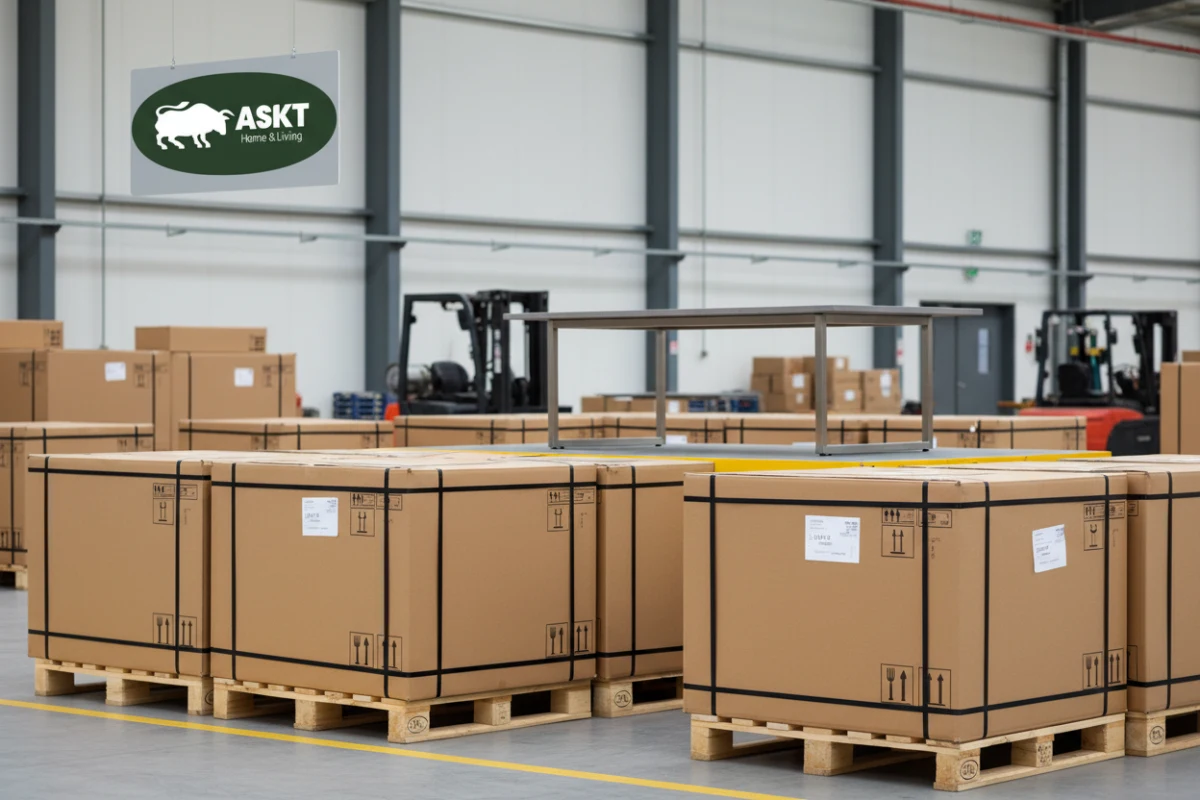
What Packaging Protection and Testing Protocols Are Required to Minimize Transit Damage and Customer Returns?
For modern multi-channel and e-commerce retailers, transit damage is a primary driver of margin erosion. Ceramic table tops, while incredibly tough once installed, are highly vulnerable to impact on their edges and corners during handling, warehousing, and last-mile delivery. Standard domestic shipping cartons are simply insufficient for high-density, fragile stone surfaces.
To ensure safe delivery and maintain low customer return rates, B2B buyers must partner with manufacturers that employ strict protective packaging protocols and carry out rigorous testing.
- High-Density Foam Capping: The entire perimeter and all corners of the sintered stone top must be encased in custom-molded, high-density foam edge protectors. This foam acts as a shock absorber, cushioning the table from side-impact forces if the carton is dropped or tipped over.
- Multi-Layer Corrugated Outer Cartons: The shipping box must be constructed from heavy-duty, multi-layer corrugated paper with high bursting strength to resist punctures.
- Protective Substrate Sheets: A critical step in professional packaging is placing rigid, lightweight structural layers—such as honeycomb paperboard or thin fiberboard sheets—on both the top and bottom faces of the table slab. These sheets distribute external crushing forces evenly across the surface area, preventing localized point-impact cracking.
- Product Testing and Drop-Testing: Buyers should verify if the packaging design has passed standardized transit drop testing. These tests simulate the harsh conditions of parcel delivery networks and maritime shipping, including free-fall drops, vibration tests, and compression loads.
Investing in robust, drop-tested packaging adds a minor premium to the initial packaging cost, but it dramatically reduces return rates. This reduction in returns directly translates to substantial savings in reverse logistics, replacement stock, and customer service labor.
How Can Retail Product Managers Customize Ceramic Collections to Protect Margins and Avoid Price Competition?
In a crowded market, selling identical, mass-produced furniture inevitably leads to price competition and shrinking margins. To counter this, retailers and wholesalers must build a degree of uniqueness into their collections. This is where leveraging a manufacturer's OEM and ODM capabilities becomes highly valuable.
By opting for furniture retail sourcing China partnerships that support customization, retail product managers can configure bespoke table collections tailored to specific market niches.
- Exclusive Sintered Stone Patterns: Instead of sourcing standard marble duplicates, buyers can select unique ceramic patterns—such as dark volcanic slate, metallic textures, or matte concrete finishes. These contemporary industrial finishes appeal strongly to modern urban consumers in Europe.
- Bespoke Edge Profiles: The aesthetic value of a table top is heavily influenced by its edge profiling. Buyers can request custom edge details, such as a reverse-bevel edge, chamfered corners, or rounded profiles. These subtle design elements instantly elevate the perceived luxury of the product, allowing for a higher retail markup.
- Modular Product Systems: Wholesalers can utilize modular engineering to keep inventory holding costs low. By sourcing a standard, high-strength metal base frame that can be paired interchangeably with either a sintered stone top or an oak veneer top, the retailer can offer two distinct design styles while maintaining only a single frame SKU in their warehouse.
Collaborating on customized collections ensures that your product lines cannot be easily cross-referenced on online comparison engines. This design exclusivity isolates your business from price wars, allowing your brand to command premium retail prices and maintain stable, healthy margins.
What is the Recommended Quality Control Checklist for Sourcing Ceramic Dining Tables?
For procurement teams and quality assurance managers preparing to evaluate suppliers, this technical checklist serves as an essential framework to verify product standards before placing bulk purchase orders:
- Surface Material Quality: Confirm the slab is genuine sintered stone with high scratch resistance and low porosity. Check for raw material purity and uniform pattern distribution.
- Lamination & Substrate Check: Ensure the ceramic top is chemically bonded to a high-quality backing board. Inspect the edges for a clean, seamless adhesive joint without air gaps.
- Structural Frame Standards: Verify the metal frame utilizes high-tensile tubing of sufficient thickness. Request proof of automated or robotic welding consistency for all major structural joints.
- Finish and Paint Integrity: Inspect the powder-coated legs for thickness and uniformity. Confirm the finish is scratch-resistant and free of raw spots, pinholes, or runs.
- Logistical CBM Optimization: Review the knock-down (KD) assembly design. Verify that the table legs and frame pack flat, minimizing the packaging volume per unit to optimize container loading.
- Threaded Metal Inserts: Check that the legs bolt directly into threaded metal inserts embedded inside the support substrate, ensuring solid mechanical connections that can survive multiple re-assemblies.
- Drop-Test Certification: Request copies of packaging transit drop-test reports to guarantee transit safety.
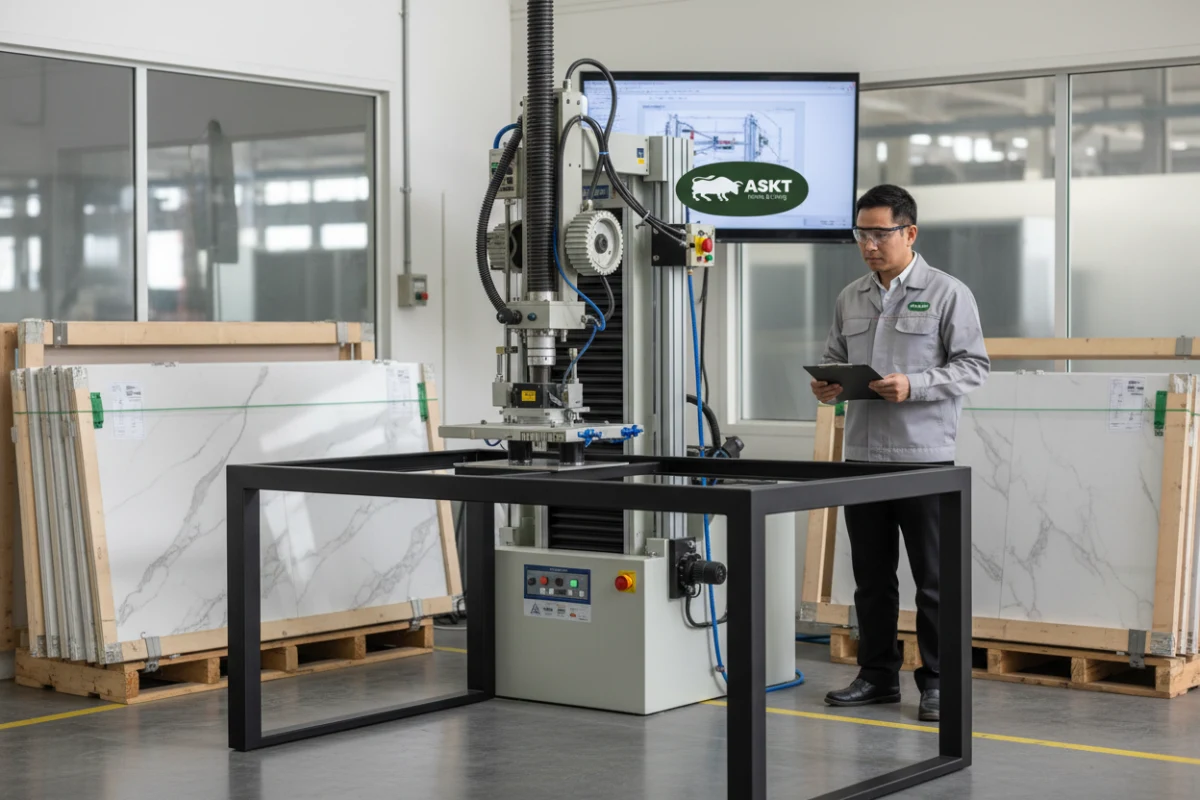
If you are currently evaluating dining furniture manufacturers for the European market and want to develop a highly profitable, structurally sound, and logistically optimized collection, explore how our team can assist your sourcing journey at https://www.asktfurniture.com/.