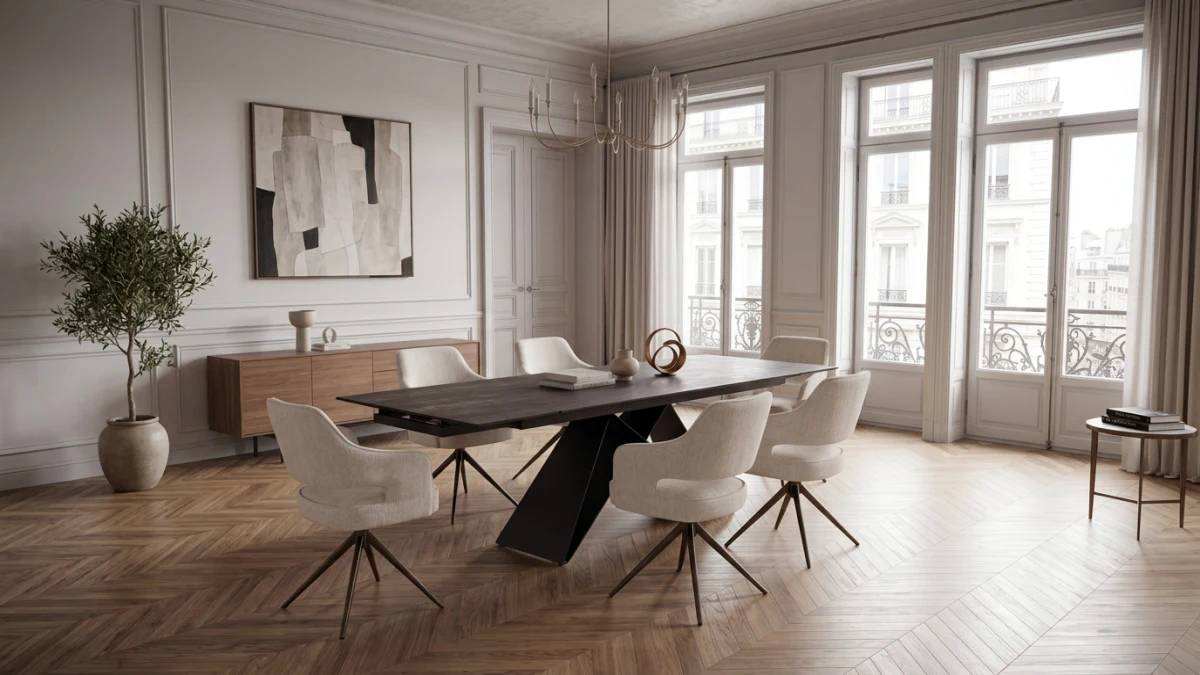
How Sintered Stone Dining Tables Are Made: Complete B2B Manufacturing and Sourcing Guide
Sintered stone dining tables are manufactured by compacting natural mineral powders under extreme mechanical pressure and firing them in industrial kilns above 1200°C. The resulting vitrified slabs undergo precision CNC edge cutting, structural substrate lamination, and integration with engineered metal or wood knock-down (KD) frames. The complete sintered stone dining table manufacturing process blends advanced mineral engineering with precision structural furniture manufacturing to create scratch, heat, stain, and impact-resistant dining furniture for modern commercial markets.
What Is Sintered Stone and Why Do Commercial Furniture Buyers Choose It?
Sintered stone is an advanced engineered surface material produced entirely from natural mineral components, such as quartz, feldspar, kaolin clay, and natural inorganic pigments. Unlike engineered quartz or composite resin surfaces, sintered stone contains no synthetic polymer binders or resins. Instead, it relies strictly on thermal fusion and ultra-high-pressure mechanical compaction, an industrial method that simulates natural metamorphic rock formation within a tightly controlled factory environment.
For European furniture wholesalers, retail chains, importers, and contract buyers across Germany, the UK, the Netherlands, Switzerland, and Poland, sintered stone represents a high-performance alternative to traditional table surfaces like natural marble, tempered glass, ceramic tile, and solid wood veneer. Natural stone is inherently porous, prone to etching from acidic liquids such as wine or lemon juice, and vulnerable to thermal shock. Sintered stone eliminates these structural vulnerabilities while offering authentic visual appeal with digital veining and diverse tactile surface textures.
In modern sintered stone furniture manufacturing, the material provides significant commercial and performance benefits:
- Near-Zero Porosity: An impermeable structure with water absorption rates below 0.05% prevents liquids, oils, sauces, and cleaning chemicals from penetrating the surface.
- Thermal and Fire Resistance: Sintered stone withstands direct contact with hot cookware without scorching, warping, discolouring, or emitting hazardous fumes.
- Scratch and Abrasion Immunity: High surface mineral hardness resists direct knife cuts, surface abrasion, and daily dining wear.
- Hygienic and Food-Safe Surface: The dense, non-porous surface prevents bacterial growth, mould retention, and chemical leaching, making it safe for food contact.
- UV and Colour Stability: Inert mineral pigments resist UV radiation and fading, ensuring long-term aesthetic consistency for residential and hospitality applications.
- Structural Rigidity: The material maintains dimensional stability without bowing or swelling when exposed to indoor temperature and humidity variations.
| Performance Property | Sintered Stone | Natural Marble | Tempered Glass | Solid Wood / Veneer |
|---|---|---|---|---|
| Surface Porosity | Impermeable (< 0.05%) | Porous (absorbs moisture) | Non-porous | Porous (requires sealant) |
| Heat Resistance | Exceptional (> 1000°C) | Sensitive (thermal shock risk) | Moderate (up to 200°C) | Low (scorches easily) |
| Scratch Resistance | High mineral hardness | Low (scratches easily) | Medium | Low to medium |
| Acid and Stain Resistance | Completely chemical inert | Prone to severe acid etching | High | Sensitive to liquid staining |
| Maintenance Needs | Minimal (wipe clean) | Regular sealing and polishing | Frequent cleaning (fingerprints) | Regular oiling and polishing |
What Raw Materials and Compaction Processes Are Used in Sintered Stone Table Top Production?
The sintered stone table top production cycle begins with exact raw material batching and processing. Raw natural minerals are selected to achieve specific mechanical and visual characteristics:
- Kaolin and High-Purity Clays: Provide essential plasticity, structural cohesion, and dimensional consistency during initial slab pressing.
- Quartz and Silica: Impart structural hardness, load-bearing rigidity, and extreme scratch resistance to the finished vitrified slab.
- Feldspar Minerals: Act as natural fluxes, lowering melting temperatures and promoting solid-state vitrification during the high-temperature firing stage.
- Inorganic Mineral Oxides: Deliver natural colour tones and through-body veining pigmentation that replicate marble and granite aesthetics.
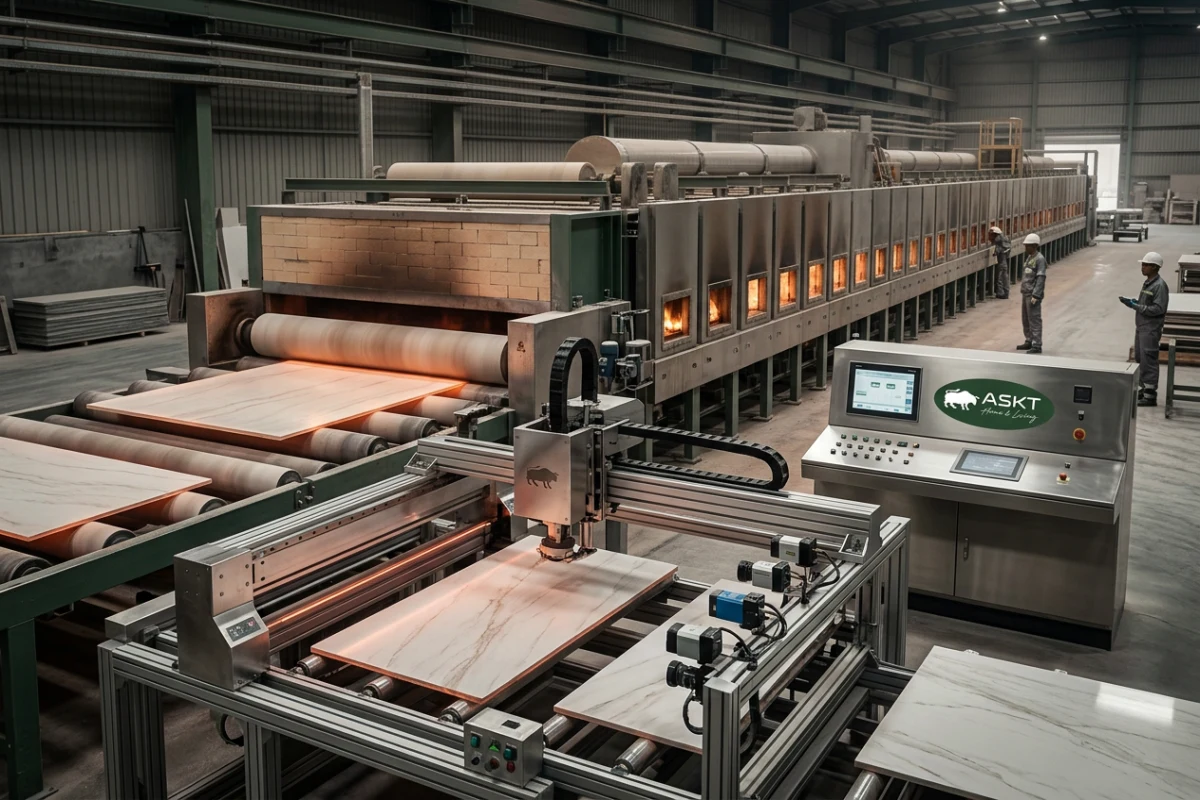
These raw components are wet-milled in industrial ball mills with water to create a fine, homogeneous slurry. The wet slurry passes into large industrial spray dryers that atomise the liquid and extract moisture, generating uniform micro-granules with precise moisture control. Maintaining consistent grain size distribution is vital; uneven particle sizes create internal density variations that can lead to micro-fractures during subsequent CNC machining, edge profiling, or transport.
Once prepared, the mineral granules are distributed onto continuous pressing lines. Heavy-duty hydraulic and continuous belt presses apply massive compaction forces over large-format slab beds. This intense compaction forces out trapped air, tightly interlocking the mineral particles and producing high-density green slabs in master formats such as 2700 x 1200 mm, 3000 x 1400 mm, or 3200 x 1600 mm.
During or directly after compaction, high-definition digital inkjet systems apply realistic marble veining, natural stone striations, or architectural patterns. Advanced production facilities coordinate surface veining with full-body mineral pigmentation, ensuring that cut perimeters and chamfered edges maintain consistent colour and texture throughout the slab core.
How Does High-Temperature Sintering and Surface Finishing Transform the Slab?
After compaction and drying, the dense unfired slab enters a continuous industrial roller kiln spanning hundreds of metres. Over an automated firing cycle, the slab moves through progressively heated zones, reaching peak sintering temperatures above 1200°C.
At these temperatures, mineral particles undergo solid-state sintering and complete vitrification. The quartz, feldspar, and clay components fuse at atomic contact points, creating an impervious crystalline matrix without synthetic polymer adhesives. This thermal transformation eliminates internal porosity, resulting in exceptional structural density, compressive strength, and chemical resistance.
Controlled cooling is equally critical. The vitrified slab moves through precise cooling gradients to relieve internal thermal stresses. If cooling occurs unevenly, residual stress remains trapped in the core, causing the slab to warp, bow, or crack when cut by waterjets or CNC saws during table manufacturing. Calibrated cooling guarantees strict flatness tolerances across long table dimensions.
Upon emerging from the kiln, the sintered stone slab undergoes mechanical surface finishing according to commercial design specifications:
- Polished Finish: Multi-stage diamond abrasive heads grind and buff the surface to achieve a glossy, reflective sheen that enhances colour depth and veining clarity.
- Matt / Honed Finish: Fine abrasive pads create a smooth, glare-free tactile surface widely popular in modern European dining and commercial interiors.
- Textured / Structured Finish: Mechanical embossing rollers or controlled surface treatments produce a subtle relief mimicking split slate, leathered granite, or natural stone.
How Are Sintered Stone Slabs Cut and Profiled for Dining Table Tops?
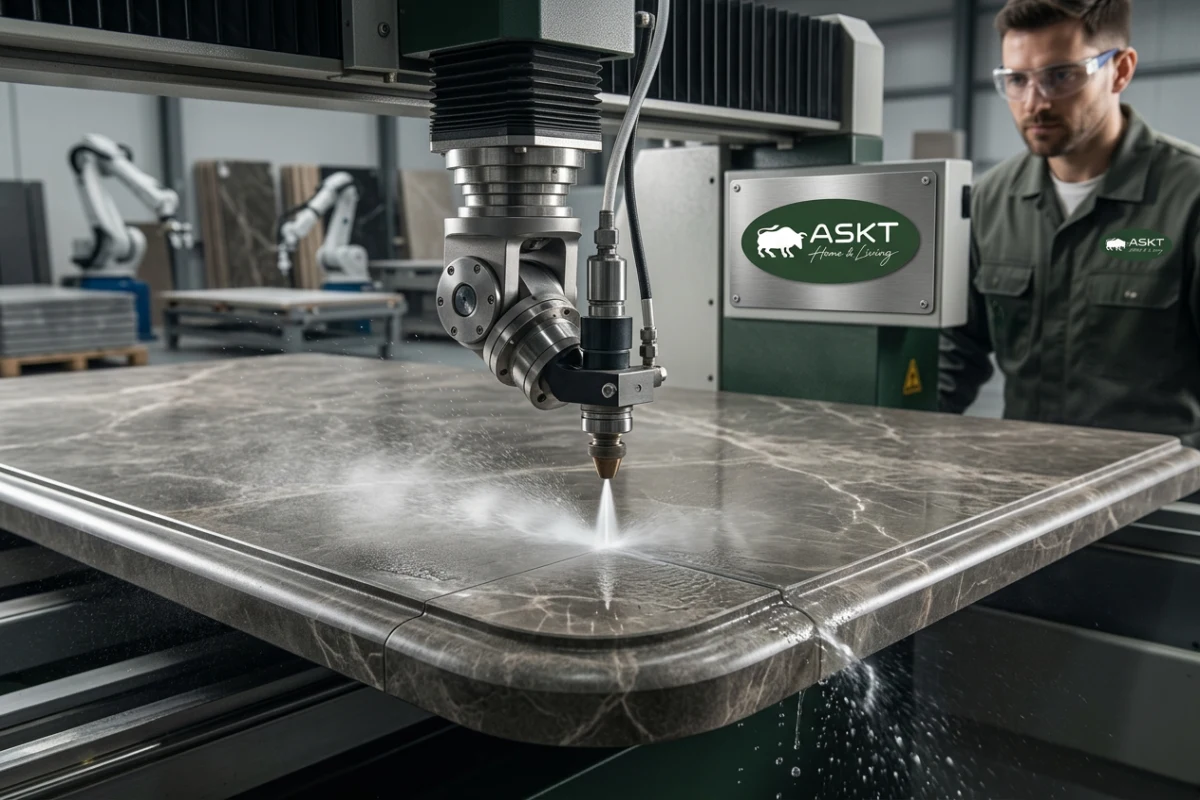
Transforming large master sintered stone slabs into custom dining table tops requires specialised computer-controlled machining equipment. Sintered stone is extremely hard and rigid, which means conventional dry saw blades or manual stonecutting tools can induce edge chipping or thermal stress fractures.
Manufacturers use multi-axis CNC bridge saws and abrasive waterjet cutting systems. High-pressure waterjet cutters, operating with garnet abrasive mixtures and continuous water cooling, slice through standard furniture slab thicknesses of 6 mm, 9 mm, or 12 mm with high precision. Waterjets cut complex curved silhouettes, oval table tops, rounded boat shapes, and rectangular perimeters without creating thermal micro-stresses along the cut line.
Following primary shaping, automated CNC edge profiling tools polish and chamfer the table perimeter. Edge design is essential for aesthetic refinement, ergonomic dining comfort, and physical impact resilience:
- Straight Polished Edge with Micro-Bevel: A crisp, contemporary edge featuring a 1 mm to 2 mm chamfer on upper and lower corners to prevent accidental chipping.
- Eased (Pencil) Edge: A subtle rounded radius (2 mm to 3 mm) that softens contact points for arms and hands during dining.
- Full Bullnose or Half Bullnose Edge: A fully rounded profile that disperses direct physical impact forces across a larger surface area.
- Chamfered Shark-Nose Edge: A 45-degree reverse undercut on the bottom rim that creates an ultra-slim, floating visual profile.
- Mitred Apron Edge: Slabs cut at 45-degree angles and bonded seamlessly with structural adhesive, creating the visual impression of a thick, monolithic stone slab without excessive weight.
Corner radius treatment is an essential quality factor in sintered stone dining table manufacturing. Sharp, 90-degree external corners concentrate physical stress and increase the risk of chipping during shipping or domestic use. Professional manufacturers apply a calibrated 5 mm to 15 mm radius corner to dissipate impact energy and ensure product longevity.
Why Is Substrate Lamination Essential in Sintered Stone Furniture Manufacturing?
Although solid sintered stone exhibits remarkable compressive strength and surface hardness, thin monolithic slabs (such as 6 mm or 9 mm) can be vulnerable to point-impact cracking if struck forcefully by heavy, hard objects when unsupported. To prevent brittle fractures and enhance acoustic and structural performance, professional sintered stone dining table manufacturing incorporates engineered composite substrate lamination.
Substrate lamination involves bonding a structural backer directly beneath the sintered stone top. This backer serves three primary manufacturing functions:
- Shock and Impact Absorption: It disperses localised kinetic energy across the entire table chassis rather than letting it concentrate on the stone surface.
- Acoustic Dampening: It eliminates the sharp, hollow clatter associated with placing plates, glassware, and cutlery onto bare stone or glass.
- Hardware Anchoring: Sintered stone cannot be drilled directly for screws without introducing severe stress cracks. A structural sub-layer provides safe anchoring points for frame brackets and hardware inserts.
Common Substrate Backing Methods in Table Production
- Tempered Glass Composite Bonding: A 6 mm sintered stone layer is bonded to a 6 mm or 8 mm sheet of toughened glass using high-strength structural bonding films or liquid resins in automated presses. This creates a balanced 12 mm to 14 mm composite slab with superior impact resistance.
- Engineered Wood / Plywood Underlay: A precision CNC-cut plywood, MDF, or solid wood core is bonded beneath the stone using high-performance polyurethane adhesives. The wood underlay is typically recessed from the stone perimeter to maintain a sleek, floating edge profile while providing robust anchor points for metal chassis bolts.
- Aluminium Honeycomb Plate Lamination: For large dining tables (over 220 cm in length) or extendable dining tables where total tabletop weight must remain manageable, lightweight aluminium honeycomb plates are laminated to the stone. This provides high torsional rigidity with minimal weight penalty.
- Safety Fiberglass Mesh Backing: An industrial woven fibreglass mesh adhered with epoxy resin to the underside of 12 mm solid sintered slabs. If catastrophic accidental force ever breaks the slab, the mesh keeps stone fragments bonded together, preventing personal injury.
Automated multi-roller continuous press systems ensure uniform adhesive spread and eliminate air voids between the sintered stone and the substrate. Using high-grade, solvent-free adhesives guarantees structural bond integrity across varying European indoor temperatures and humidity levels.
How Are Metal Frame Structures and KD Hardware Engineered for Sintered Stone Tables?
A premium sintered stone dining table requires a rigid, dimensionally stable supporting chassis. Unlike natural hardwood, which flexes slightly under load without failure, sintered stone is rigid. Any flex, sag, or twisting in the metal table frame transfers direct tensile stress into the stone top, potentially causing structural failure.
Frame Fabrication and Robotic Welding
Table frames are typically constructed from heavy-gauge carbon steel tubes, steel plates, or extruded aluminium profiles. Metal tubes undergo precision CNC laser cutting and tube bending to ensure exact joint fitment. Robotic welding arms execute structural welds along apron rails, crossbeams, and leg mounting plates. Automated welding guarantees consistent weld penetration, clean joints, and dimensional squareness across mass production batches.
Anti-Corrosion Electrostatic Powder Coating
Before surface coating, welded steel components undergo automated multi-stage pre-treatment, including degreasing, acid pickling, and phosphating to eliminate surface oils and oxidation. The metal chassis is then coated with electrostatic thermoset powder coat and cured in ovens at 180°C to 200°C. This produces a durable, scratch-resistant matt or textured finish that resists corrosion, chipping, and household cleaners.
Knock-Down (KD) Hardware Engineering for Export Logistics
To optimize shipping container space and ensure straightforward end-user assembly, dining table frames are engineered with flat-pack Knock-Down (KD) structural joints. Precision M8 steel bolts and pre-threaded steel insert collars secure the legs to heavy steel chassis mounting plates. Critical engineering details include:
- Thermal Expansion Buffer Zones: Sintered stone and steel expand and contract at different rates under temperature fluctuations. Mounting brackets feature slotted bolt holes and elastomeric silicone buffer washers that allow micro-movement without transferring shear force into the stone.
- Adjustable Levelling Glides: Heavy-duty nylon or rubber levelling feet compensate for uneven flooring surfaces up to 15 mm, preventing chassis rocking and uneven load distribution.
- Structural Longitudinal Stretchers: Double steel reinforcement beams span the underside of tables longer than 180 cm to prevent centre deflection and frame sagging.
| Structural Component | Material & Specification | Function and Engineering Benefit |
|---|---|---|
| Table Legs & Uprights | 1.5 mm – 2.0 mm wall thickness carbon steel | Delivers load-bearing capacity exceeding 150 kg; prevents leg wobble |
| Chassis Mounting Plate | 4.0 mm – 6.0 mm solid steel plate | Distributes weight evenly across substrate bonding points |
| Surface Finish | Electrostatic thermoset powder coating | Protects against corrosion, abrasion, and paint flaking |
| Fastening Hardware | M8 high-tensile steel bolts with spring washers | Secures rigid KD assembly; resists vibration-induced loosening |
| Isolation Layer | Silicone / EPDM isolation pads | Decouples stone from metal frame; absorbs mechanical vibration |
What Quality Control and Testing Protocols Ensure Sintered Stone Table Durability?
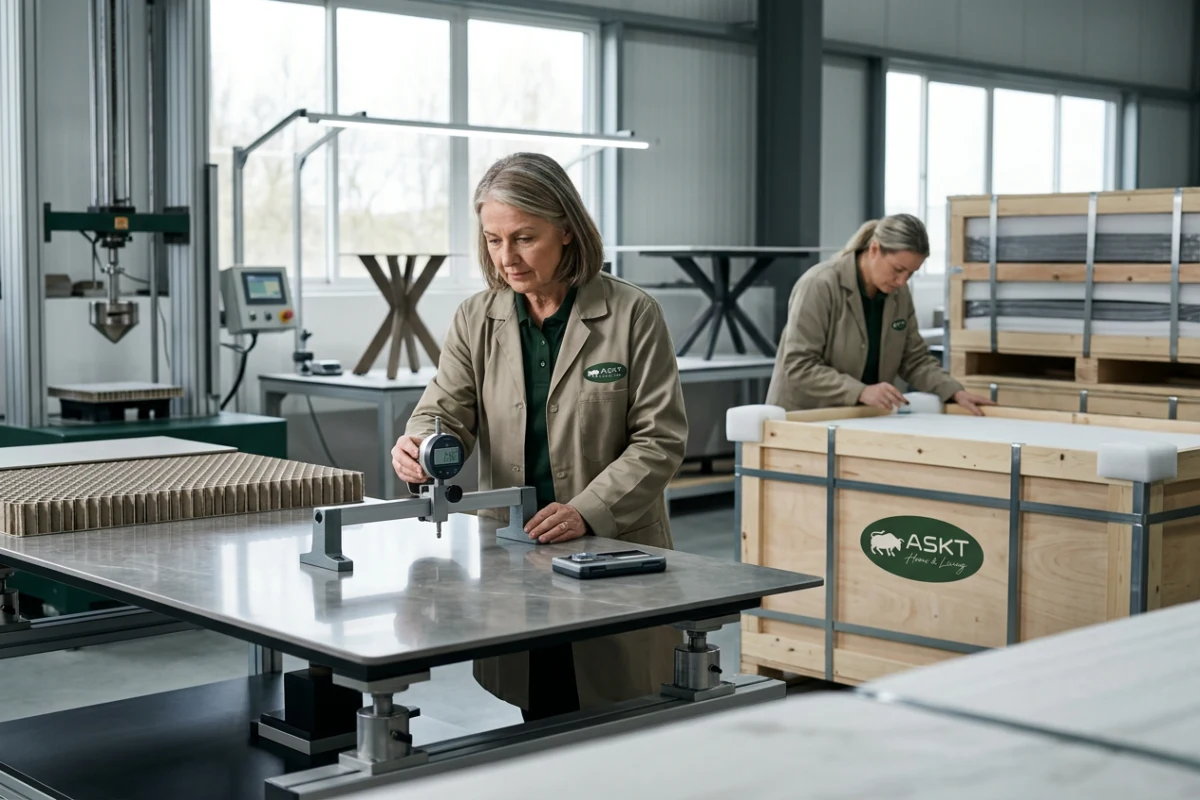
Comprehensive sintered stone table quality control is critical for maintaining consistency and minimising return rates for B2B importers, furniture retailers, and e-commerce brands. Inspection protocols are implemented at multiple manufacturing checkpoints, spanning raw slab inspection, CNC processing, structural frame assembly, and packaging verification.
Dimensional and Visual Quality Audits
- Surface Flatness and Camber Check: Table tops are measured across longitudinal and diagonal spans using digital dial indicators. Allowable deflection across a 2000 mm top is strictly controlled to ensure a level dining surface.
- Veining and Surface Uniformity: Slabs are inspected under standardised D65 daylight lamps to verify colour consistency, pattern continuity, and freedom from printing defects or glaze blemishes.
- Edge Integrity and Micro-Chip Audit: High-magnification optical checks along cut perimeters and chamfers verify that no micro-fissures or edge chips exceed acceptable cosmetic limits.
Mechanical and Structural Testing
Export dining tables undergo rigorous mechanical testing to ensure compliance with European standards for domestic and contract furniture strength, stability, and durability:
- Vertical Static Load Testing: Concentrated vertical loads of 1000 N to 2000 N are applied to the tabletop centre and overhang perimeters to verify frame stiffness, weld integrity, and substrate bond strength.
- Horizontal Fatigue Durability Testing: Cyclic horizontal forces simulate thousands of cycles of shifting, leaning, and daily dining use to ensure chassis connections remain rigid over time.
- Impact Resistance Testing: Calibrated steel impactors are dropped onto laminated tops to confirm that the composite substrate absorbs impact energy without cracking or delaminating.
- Stain and Chemical Resistance Audits: Table surfaces are exposed to common staining agents (coffee, red wine, oil, citrus juice) for 24 hours to ensure effortless cleaning with zero chemical etching.
How Does Packaging Engineering Protect Sintered Stone Tables During Transit?
Transport damage is one of the highest commercial risks for furniture importers, retail chains, and online brands. Sintered stone is a rigid material that requires specialized packaging engineering to withstand corner impacts, vibration, and multi-modal handling during sea freight, warehouse transfer, and final-mile courier delivery.
Multi-Layer Protective Packaging Structure
- Protective Surface Film: Static-cling protective polyethylene film shields polished and matt finishes against surface scratches, abrasive dust, and moisture during handling.
- Heavy-Duty Corner Guards: Moulded high-density expanded polypropylene (EPP) or polyethylene corner protectors cushion all table corners against diagonal drop impacts.
- High-Density Edge U-Channels: Foam profile channels encase the entire stone perimeter, protecting chamfered and bevelled edges from side shocks.
- Rigid Honeycomb Paperboard Encasement: 15 mm to 25 mm rigid honeycomb cardboard boards cover the top and bottom faces, dispersing external crushing forces while supporting eco-friendly packaging initiatives by reducing single-use plastic.
- 5-Ply and 7-Ply Master Cartons: High-bursting-strength corrugated outer master cartons resist compression, puncturing, and high-humidity sea transit environments.
- Palletization and Crate Reinforcement: Table tops are packed flat and secured on reinforced wooden runners or within timber crates to ensure safe forklift handling and prevent carton sagging in shipping containers.
| Packaging Element | Material Specification | Protective Function |
|---|---|---|
| Surface Cover | Static-cling protective PE film | Prevents fine dust abrasion and surface scuffing |
| Corner Protectors | Moulded high-density EPP / HDPE | Absorbs direct 45-degree corner impact shocks |
| Perimeter Buffer | 20 mm high-density foam U-channels | Protects chamfered stone edges against side impacts |
| Face Boards | 15 mm – 20 mm honeycomb paperboard | Disperses heavy crushing forces and resists punctures |
| Outer Box | 5-ply / 7-ply Kraft corrugated carton | High burst strength; withstands container stacking pressure |
| Base Support | Wooden runner / pallet skid | Facilitates safe forklift handling and prevents transit sag |
How Should B2B Furniture Buyers Evaluate Sintered Stone Dining Table Manufacturers?
Sourcing sintered stone dining tables for European retail chains, e-commerce stores, or commercial hospitality projects requires evaluating factory technical capabilities, machinery standards, and quality management systems rather than relying purely on aesthetic showroom samples.
Sourcing and Supplier Evaluation Checklist
- In-House CNC and Waterjet Cutting Infrastructure
- Does the manufacturer possess automated multi-axis CNC bridge saws and waterjets in-house, or do they outsource stone cutting to external processing yards?
- Are automated edge profiling tools utilized to guarantee smooth, chip-free chamfered edges across volume production runs?
- Substrate Bonding and Lamination Technology
- What specific backing method (tempered glass, wood core, or honeycomb panel) does the factory use, and what adhesive chemistry is applied?
- Does the facility utilize continuous roller presses to ensure void-free lamination and eliminate delamination risks?
- Metal Frame Engineering and Welding Standards
- Are table bases fabricated with robotic welding arms and high-tolerance laser-cut tubes to ensure KD fitment and structural squareness?
- Does the metal finishing include comprehensive multi-stage pre-treatment and electrostatic powder coating to prevent paint flaking?
- Quality Testing and Compliance Procedures
- Does the factory perform in-house vertical load testing, surface flatness verification, and packaging drop testing prior to shipment?
- Can the supplier provide transparent quality inspection documentation and container loading optimization reports?
- Customization and OEM/ODM Flexibility
- Does the supplier offer comprehensive OEM/ODM customization across slab patterns, matt/gloss/textured finishes, frame dimensions, and extension table mechanisms?
- Does the packaging design achieve high container filling rates while keeping transit damage rates consistently below industry benchmarks?
As an experienced B2B furniture manufacturer and supply chain partner with over 20 years of experience serving European wholesalers, retailers, and purchasing groups, ASKT provides end-to-end dining furniture solutions combining advanced sintered stone fabrication, robotic metal engineering, and verified export quality management.
If you are looking to expand your dining furniture collection with engineered sintered stone designs, explore our dining table manufacturing capabilities and discover our OEM/ODM customization options, robust KD packaging, and reliable supply chain support.