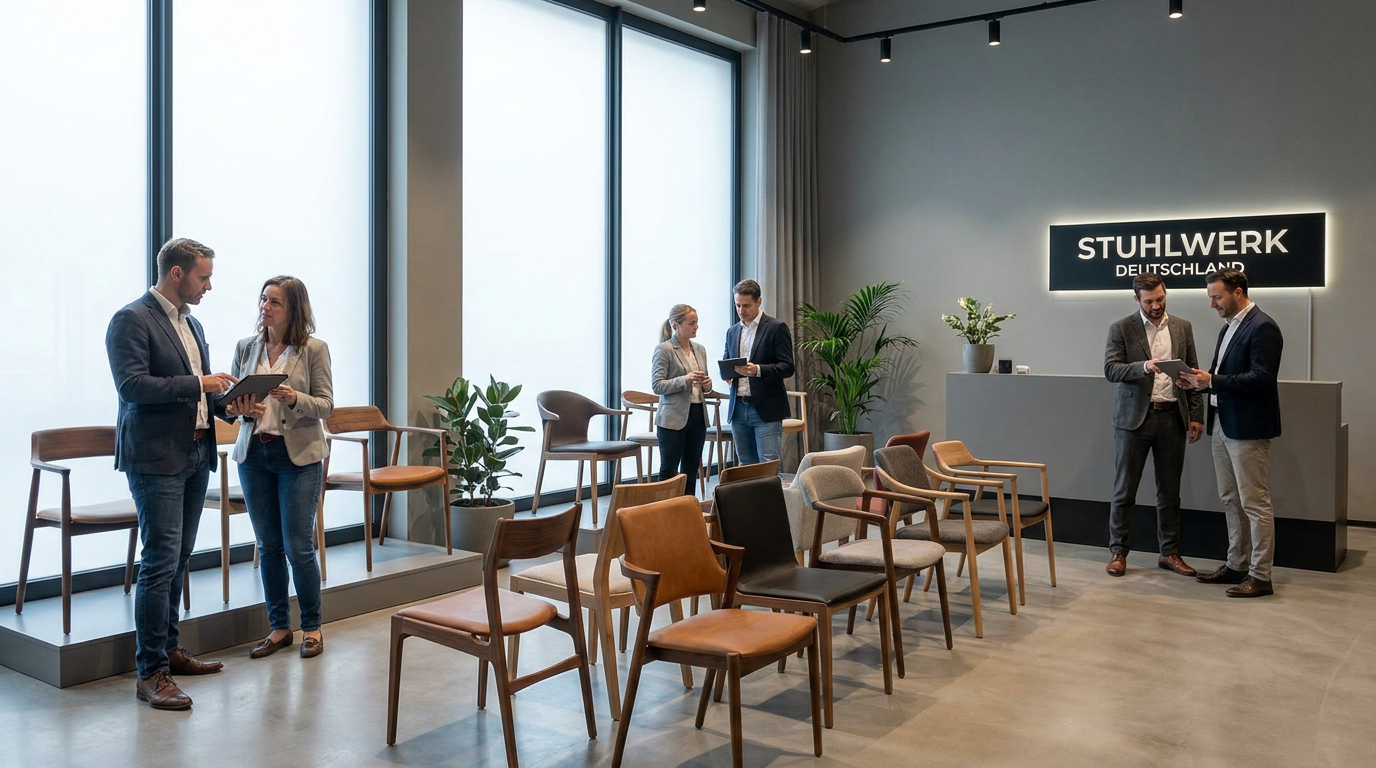
How to Build a Better Dining Chair Assortment for German Furniture Stores: A Framework for Einkaufsleiter
For Einkaufsleiter in German furniture retail.
The German stationary furniture trade is currently navigating a period of intense structural transformation. Stationary retailers are under immense pressure from high inventory costs (Lagerdruck) and thinning margins (Marge), exacerbated by aggressive pricing from pure-play online competitors. To survive, the traditional approach of maintaining a broad, unoptimized Sortiment must be replaced by a high-efficiency strategy focused on Abverkauf (sell-through) and risk management.
In the dining chair category, the challenge is twofold: maintaining a competitive Preislage (price point) while ensuring that the quality meets the strict expectations of German consumers to avoid a high Reklamationsquote (complaint rate). ASKT Furniture, with over 15 years of manufacturing expertise and ISO 9001 certification, understands that for a German procurement manager, a chair is not just a piece of furniture—it is a unit of cash flow and floor productivity.
The 'Assortment Trap': Why More SKUs are Killing Your Marge
Many German furniture stores fall into the 'Assortment Trap'—stocking too many variations in the hope of capturing every customer preference. This leads to 'Penner-Artikel' (slow-moving items) that occupy valuable warehouse space and tie up capital. When 'Lagerdruck' increases, retailers are forced into aggressive discounting, which erodes the overall Marge of the category.
To build a better assortment, Einkaufsleiter must shift their focus from 'variety' to 'velocity.' A lean, high-performing Sortiment consists of SKUs that balance design trends with proven durability. For instance, the demand for 'Hybrid Seating'—chairs that serve both dining and home-office functions—is a high-growth segment that offers better margins than standard kitchen chairs.
5 Critical Mistakes in Dining Chair Procurement for 2026
- Over-committing to High MOQs: Many retailers still work with rigid suppliers requiring full container loads per SKU. This increases inventory risk and limits the ability to test new 'Exklusivmodelle'.
- Ignoring the True Cost of Reklamation: A cheap chair becomes expensive when the Reklamationsquote exceeds 3%. The administrative and logistics costs of handling returns in Germany can wipe out the initial profit margin.
- Lack of LkSG Compliance: With the German Supply Chain Due Diligence Act (LkSG) in full effect, failing to vet suppliers for social and environmental standards is a significant legal and reputational risk.
- Neglecting Lieferzuverlässigkeit: Inconsistent lead times disrupt promotional cycles and lead to lost sales. A 45-day stable delivery window is the industry gold standard for maintaining a healthy Abverkauf.
- Static Sortiment Planning: Failing to rotate 'Penner-Artikel' out of the showroom at least twice a year leads to 'Flächenproduktivität' (area productivity) decline.
The Judgment Framework: Evaluating SKU Efficiency and Risk
When deciding which models to include in your next Sortimentswechsel, use this three-pillar framework:
1. Financial Performance (Marge & Abverkauf)
Evaluate each SKU based on its contribution margin per square meter of showroom space. If a chair has a high aesthetic appeal but low Abverkauf, it is a liability, not an asset.
2. Operational Risk (Reklamation & Quality)
Prioritize manufacturers like ASKT Furniture that provide ISO 9001 certified processes and EN 12520 testing reports. Quality assurance at the source is the only way to keep the Reklamationsquote below the critical 2% threshold.
3. Supply Chain Flexibility
In a volatile market, the ability to order in smaller batches (e.g., 200 units) allows for a more agile response to consumer trends without increasing Lagerdruck.
Comparison: Rigid Volume Suppliers vs. Flexible Partners
| Feature | Rigid High-Volume Supplier | Flexible Partner (e.g., ASKT Furniture) |
|---|---|---|
| Minimum Order Quantity (MOQ) | 500+ units per SKU | 200 units per SKU |
| Lead Time (Lieferzeit) | 60-90 days (unstable) | 45 days (guaranteed) |
| Customization (Exklusivmodelle) | Limited / High cost | Fully supported |
| Quality Certification | Often self-declared | ISO 9001 / Third-party tested |
| Risk of 'Penner-Artikel' | High | Low (due to smaller test batches) |
Actionable Recommendations for the Next Sortimentswechsel
To optimize your dining chair category for the upcoming season, we recommend the following steps:
- Audit your current inventory: Identify the bottom 20% of SKUs by sales volume and liquidate them to free up cash flow.
- Diversify with Exklusivsortimente: Work with manufacturers to create exclusive designs that cannot be easily price-compared online. This protects your Marge.
- Tighten Quality Specifications: Ensure all new contracts specify maximum allowable Reklamationsquoten and require pre-shipment inspections.
- Leverage 45-Day Lead Times: Partner with suppliers who can offer a consistent 45-day production cycle to reduce the need for massive safety stocks.
Checklist: 10-Point Supplier Delivery Reliability Audit
- Does the supplier hold a valid ISO 9001 certification?
- Can the supplier guarantee a 45-day lead time in writing?
- Is the MOQ flexible enough to allow for 200-unit test orders?
- Does the supplier provide detailed material specifications (wood moisture content, fabric Martindale)?
- Is there a clear process for handling Reklamation and spare parts?
- Are the products compliant with EU Ecodesign and LkSG requirements?
- Can the supplier provide 'Exklusivmodelle' for our store brand?
- Does the supplier have a track record of 15+ years in the industry?
- Are third-party inspection reports (e.g., SGS, TÜV) available upon request?
- Is the communication professional and responsive to German business hours?
FAQ: Addressing Common Procurement Challenges
How can I reduce the Reklamationsquote for imported dining chairs? The most effective way is to ensure the manufacturer uses standardized quality control processes. At ASKT Furniture, our ISO 9001 certification ensures that every batch undergoes rigorous testing before leaving the factory, significantly reducing the risk of post-sale issues.
What are the risks of high MOQs for stationary retailers? High MOQs lead to 'Lagerdruck', which ties up your cash flow and increases the risk of being stuck with 'Penner-Artikel' if a trend shifts. Flexible MOQs of 200 units allow for better SKU rotation.
How does the LkSG impact our sourcing from China? German retailers are legally responsible for their supply chain. You must partner with manufacturers who are transparent about their labor practices and environmental impact. ASKT Furniture provides the necessary documentation to support your LkSG compliance efforts.
Conclusion
Building a better dining chair assortment is a balancing act between design, price, and operational efficiency. By focusing on high-velocity SKUs, minimizing Reklamation through quality partnerships, and maintaining a flexible supply chain, Einkaufsleiter can protect their Marge even in a challenging market. ASKT Furniture is committed to supporting German retailers with high-quality, ISO-certified commercial seating solutions and reliable 45-day delivery.
Do you want me to send you a practical evaluation checklist or decision framework?