How to Test an Auto-Return Dining Chair Mechanism Before Mass Production: A B2B Sourcing Guide
To test an auto-return dining chair mechanism before mass production, evaluate rotational angle range, return centering precision, operational noise, structural play, and multi-cycle durability on pre-production samples. Verifying mechanical tolerances under dynamic loads ensures the chair resets cleanly to the neutral baseline without wobble, grinding noises, or spring fatigue during high-frequency dining use.
Why is pre-production mechanism testing critical for B2B dining chair sourcing?
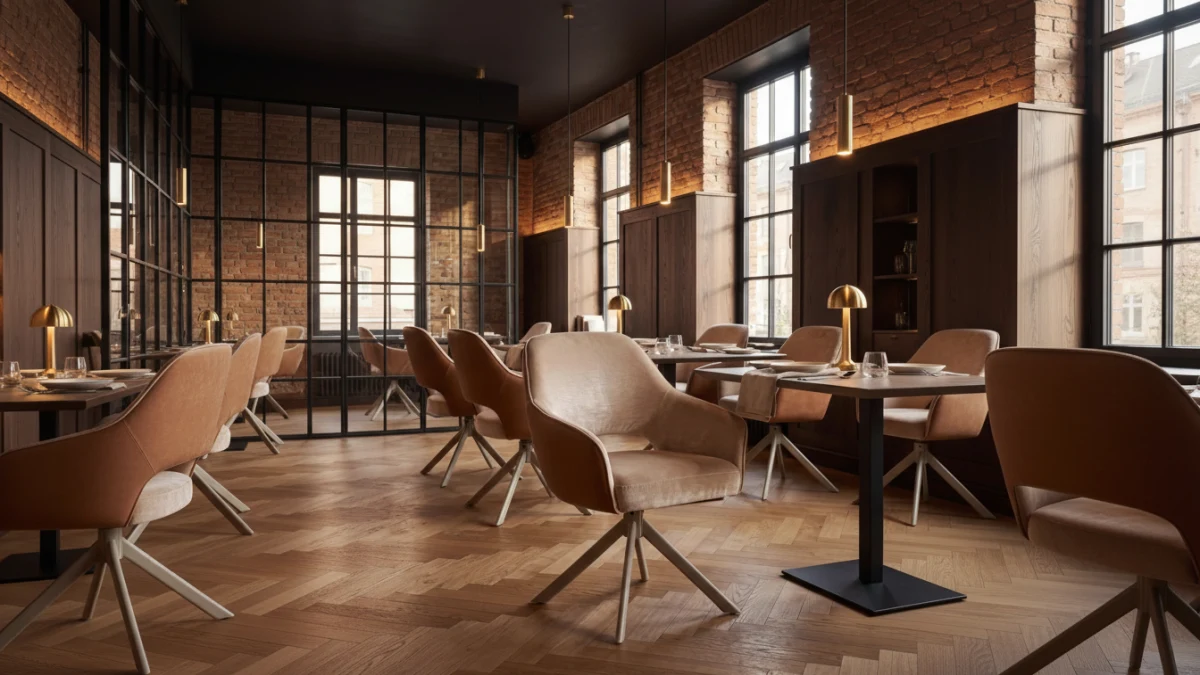
In modern commercial and residential dining environments, auto-return swivel chairs offer significant functional value by maintaining clean dining room lines, improving seating ergonomics, and facilitating smooth entry and exit around dining tables. However, integrating moving mechanical parts into an upholstered dining chair creates substantial operational and structural risks if the swivel core is not thoroughly evaluated prior to bulk tooling and mass manufacturing.
For European furniture wholesalers, retail chains, and contract importers across markets such as Germany, the Netherlands, the UK, Poland, and Switzerland, mechanism failure represents one of the highest drivers of post-sale customer returns, warranty expenses, and brand dissatisfaction. When an auto-return swivel fails, the defect is immediately apparent to the consumer: the chair sticks off-centre, produces metallic grinding or squeaking sounds, or exhibits excessive vertical and horizontal play when occupied.
Conducting a structured auto return swivel dining chair test on pre-production prototypes protects B2B buyers across several core operational dimensions:
- Defect Prevention at Scale: Identifying improper spring tension, insufficient bearing lubrication, or misaligned base plates on early pre-production samples prevents entire shipping containers of defective dining chairs from entering European logistics and distribution networks.
- Brand Reputation and Retail Trust: Dining chairs undergo continuous rotational cycles every day. A smooth, silent, and accurate return action provides an immediate tactile impression of premium engineering and manufacturing quality.
- Minimising Warranty and Freight Losses: The logistics and administrative costs of handling consumer product returns across European borders far exceed the investment required for rigorous pre-production furniture sample testing and factory-floor validation.
- Validating Structural Frame Compatibility: Testing ensures that the swivel plate, knock-down (KD) metal frame connection, threaded inserts, and upholstered seat shell work together harmoniously without putting excessive stress on frame welds or structural fasteners.
What key functional parameters define an auto-return swivel mechanism?
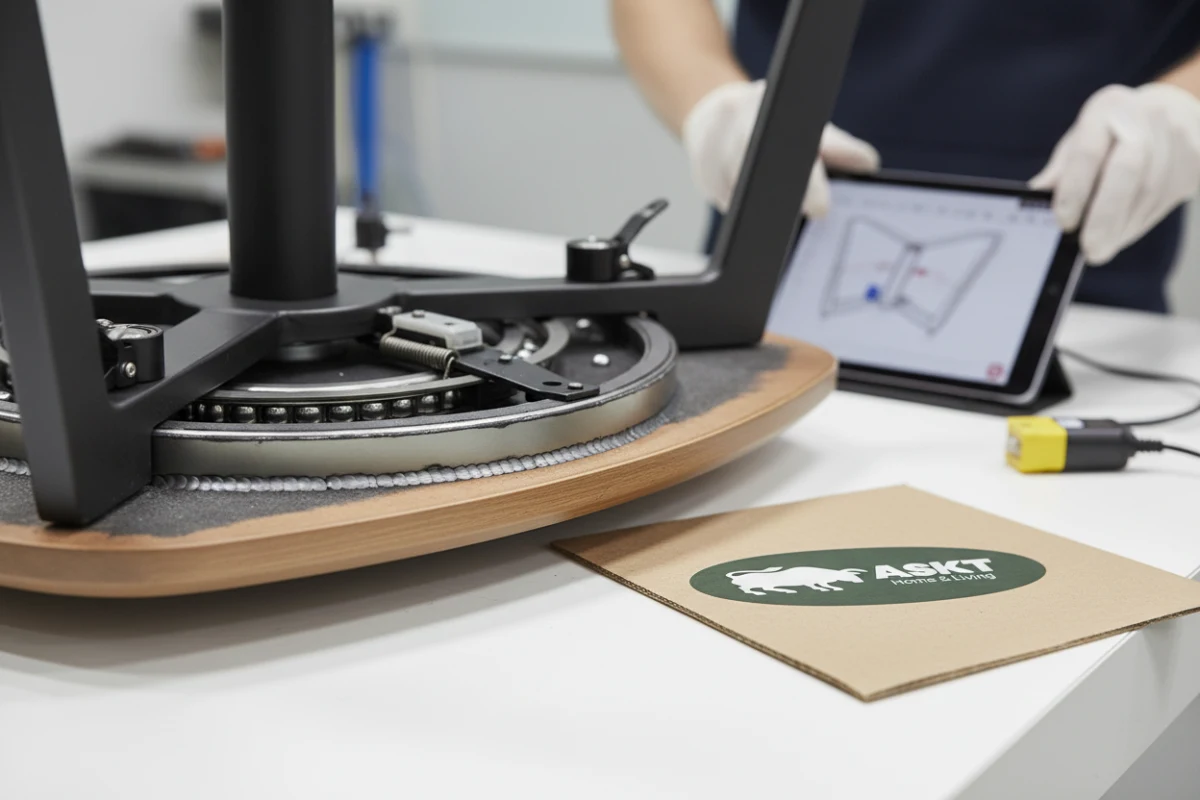
Before initiating physical sample evaluations, procurement teams, product managers, and quality engineers must define clear functional criteria and tolerance thresholds. An auto-return mechanism typically incorporates a central steel pivot shaft, radial ball bearing raceways or low-friction polymer bushings, and an internal torsion spring or cam-return core enclosed in heavy-gauge steel housing.
Understanding these critical technical parameters simplifies swivel chair return mechanism inspection and establishes definitive baseline pass/fail criteria for incoming components and prototype assemblies:
| Technical Parameter | Optimal Specification | Common Sourcing Defect |
|---|---|---|
| Rotational Range | 90° left / 90° right (180° total) or 360° continuous with return | Under-rotation, mechanical binding, or abrupt hard-stopping at extreme angles |
| Centering Tolerance | ≤ ±2° deviation from neutral center baseline | Angular drift where the seat rests 5° to 15° away from the table axis |
| Return Speed and Damping | 1.0 to 2.5 seconds to full rest position | Violent spring snapping or sluggish return that stalls midway through travel |
| Acoustic Profile | Silent, smooth operation (< 45 dB) | Metallic clicking, bearing friction, spring creaking, or housing grinding |
| Axial and Radial Play | ≤ 1.5 mm lateral movement at seat perimeter | Perceptible wobble, tilting looseness, or rocking joint instability |
| Cycle Durability | Retains torque and centering across multi-thousand cycles | Spring fracture, fastener loosening, bearing race deformation, or structural shearing |
What is the step-by-step testing procedure for pre-production prototypes?
Executing a systematic, repeatable testing protocol ensures that every pre-production sample meets the mechanical, structural, and aesthetic standards expected by demanding European B2B buyers.
Here is the recommended five-stage inspection process for pre-production prototype validation:
Stage 1: Unloaded Visual and Dimensional Verification
Begin by inspecting the standalone swivel mechanism prior to frame assembly, as well as the assembled chair prototype:
- Mounting Hole Pitch and Alignment: Verify that the bolt hole pattern matches the steel subframe mounting plates exactly, ensuring bolts thread straight without forced mechanical bending or cross-threading.
- Welding and Coating Integrity: Check that mounting brackets and central cylinder weld seams are continuous, clean, free from weld spatter, and protected with a durable powder coating or anti-corrosion finish.
- Lubrication Containment: Ensure that internal high-viscosity grease remains securely sealed inside the bearing race and does not weep or leak onto the chair frame, upholstery fabrics, or floor packaging.
Stage 2: Manual Rotation and Return Damping Assessment
Mount the swivel mechanism securely to the frame and upholstered seat shell to assess dynamic movement:
- Rotate the seat smoothly by hand to 45°, 90°, and maximum travel limits in both clockwise and counter-clockwise directions.
- Release the chair from each angle and observe the return arc. The mechanism must return to the 0° center smoothly without sudden deceleration jerks, mechanical catching, or oscillation past the neutral baseline.
- Repeat this test 10 to 15 times consecutively in rapid succession to ensure consistent velocity and return consistency across both directions.
Stage 3: Loaded Static and Dynamic Centering Inspection
A mechanism that functions smoothly while unloaded can behave very differently under the dynamic weight of a seated user:
- Apply a standardized static vertical load on the center of the seat cushion to simulate realistic human body weight.
- Rotate the seat 90° to the side and release it under load. Measure whether the return mechanism completes the full return arc without binding or stalling.
- Measure the final resting position against the chair front edge. The deviation from the exact 0° center baseline must remain strictly within the specified ±2° tolerance window.
Stage 4: Structural Play and Wobble Testing
Structural rigidity and tight tolerances are essential for user comfort and safety in commercial and domestic settings:
- While a load is applied to the seat, grasp the outer perimeter of the upholstered shell.
- Apply alternating upward, downward, and lateral forces along the front, rear, and sides of the seat frame.
- Measure the clearance between the rotating upper plate and the fixed lower mounting plate. Excess play indicates oversized bearing raceways, loose central rivets, or inadequate plate thickness.
Stage 5: Multi-Cycle Durability and Endurance Testing
To guarantee dining chair swivel mechanism durability, pre-production components must undergo mechanical endurance testing:
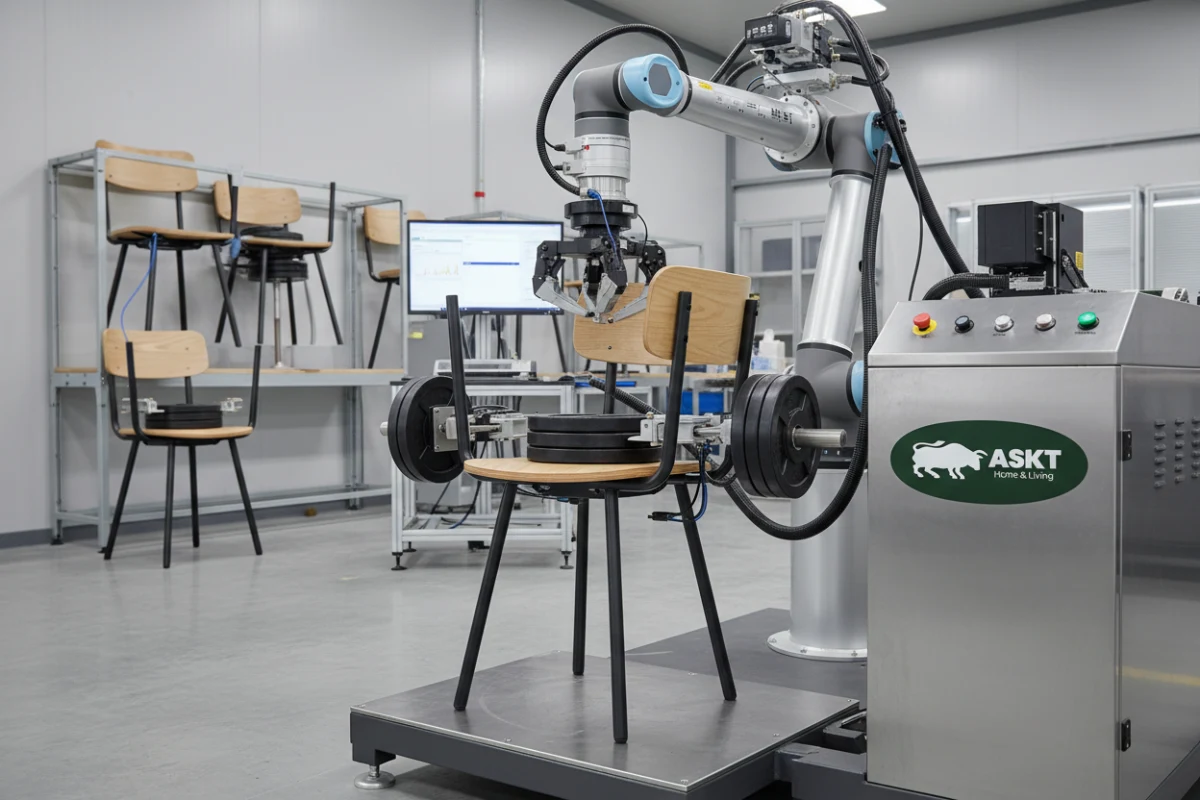
- Mount the complete dining chair assembly onto an automated cyclic test rig.
- Apply standard vertical downward test force to the seat cushion.
- Actuate continuous rotational cycles (rotating from 0° to 90°, releasing to neutral, and repeating in alternating directions) across thousands of continuous operational cycles.
- Inspect the unit periodically for signs of metal debris, spring torque degradation, acoustic changes, or loosened assembly bolts.
How do you assess return alignment precision, structural play, and noise levels?
European consumers expect visual uniformity when dining chairs are arranged neatly around an oak veneer, sintered stone, or solid wood dining table. If an auto-return chair rests at an irregular angle, the entire dining set appears misaligned and unappealing on a retail floor or in a hospitality dining room.
1. Evaluating Alignment Precision
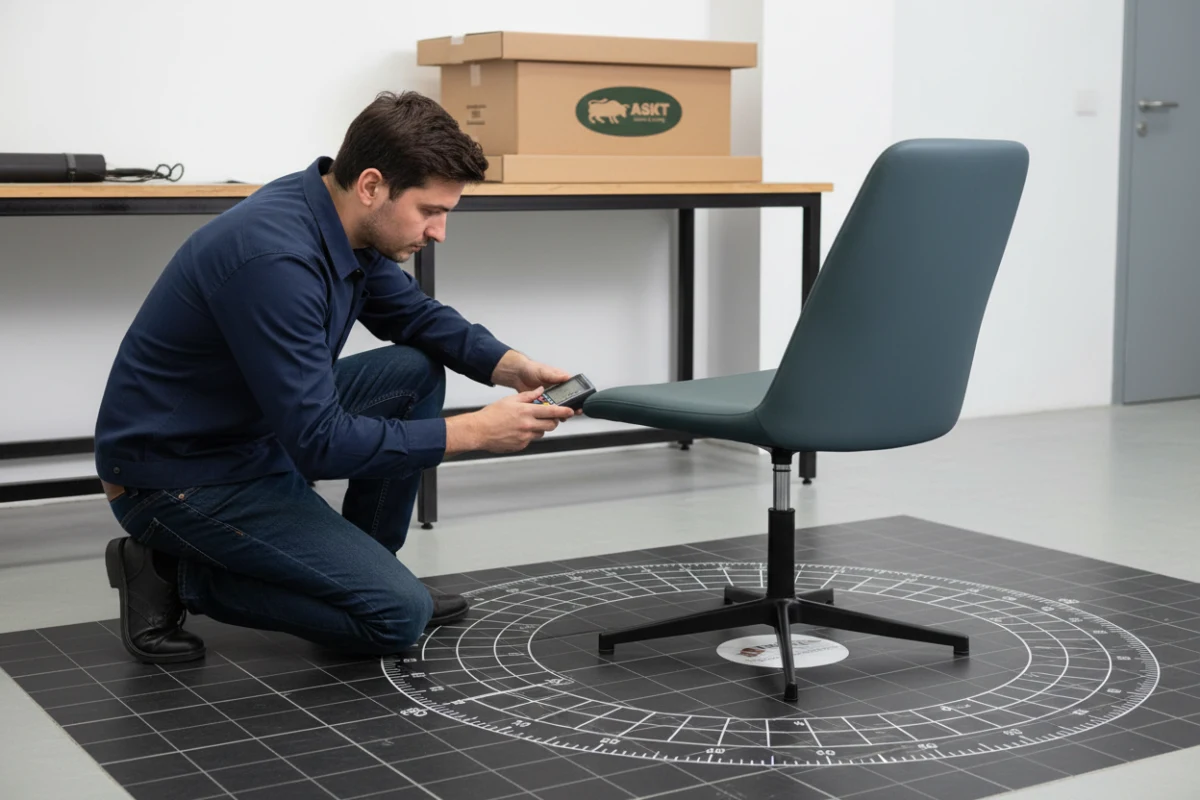
- Marking the Baseline: Establish an exact reference guideline on the floor or testing bench perpendicular to the front edge of the table, aligning it with a physical pointer on the front center of the chair seat.
- Multi-Angle Release Testing: Rotate the chair seat to 30°, 60°, and 90° to the left, release it, and record the stopping angle. Repeat the exact sequence for the right side.
- Cumulative Drift Verification: Perform 25 consecutive rapid rotations. If the resting point progressively drifts away from the 0° mark, it indicates internal spring slippage, mounting bolt movement, or premature wear in the mechanical stop notch.
2. Identifying Structural Play and Joint Wobble
- Horizontal Play (Rotational Backlash): Gently touch the seat edge and rock it left and right without engaging the spring return. The free rotational play should remain minimal, preventing any sensation of a loose joint.
- Vertical Play (Tilting Deflection): Fix a dial indicator to the static base frame with the measurement probe touching the underside of the rotating seat plate. Apply alternating vertical loads to the front and rear seat edges to verify that deflection remains within strict factory tolerances.
3. Noise and Acoustic Quality Evaluation
- Controlled Ambient Testing: Perform manual and cyclic rotations in a quiet inspection room with ambient sound levels below 40 dB.
- Diagnosing Audible Defects:
- High-pitch squeaking: Indicates unlubricated torsion spring coils rubbing against internal metal housing walls.
- Rhythmic clicking or popping: Caused by misaligned steel ball bearings, irregular raceway stamping, or a catching internal stop pin.
- Rough metallic grinding: Results from direct steel-on-steel friction caused by missing nylon wear washers or unevenly stamped mounting plates.
How do mechanism designs interact with upholstered shells and KD metal frames?
An auto-return mechanism cannot be evaluated in total isolation; its performance depends heavily on how it interacts with the surrounding dining chair components, including the metal subframe, KD leg structure, and upholstered seat shell.
When conducting pre production furniture sample testing, buyers and product development teams should evaluate the following integrated structural factors:
- Seat Base Rigidity and Deflection: When a user swivels and leans, torque is transferred directly from the seat shell through the mounting bolts into the swivel plate. If the internal seat base (whether engineered wood or metal frame) flexes excessively, it can cause the mechanism shaft to bind off-axis, leading to stiff rotation and accelerated wear.
- Clearance and Fabric Protection: The clearance between the rotating seat bottom and the static leg frame must be sufficient to prevent fabric pinching, foam compression, or powder coating abrasion during full rotational travel.
- Threaded Insert and Fastener Integrity: Rotational torque constantly exerts shear stress on the mounting screws. Pre-production testing must confirm that high-grade bolts with thread-locking compound or spring washers are utilized, preventing bolts from backing out over time.
- KD Packaging and Transit Protection: Because swivel mechanisms contain precision moving parts, packaging design must protect the unit from impact during container transit. Pre-production validation should confirm that carton drop tests and protective cushioning (such as honeycomb cardboard and corner guards) prevent bent mounting plates or deformed bearings.
What should be included in a pre-production sample sign-off checklist?
Before issuing Golden Sample approval and authorizing bulk production or container loading, purchasing managers and quality inspectors should systematically audit this pre-production sign-off checklist:
- Dimensional Accuracy: Bolt hole spacing, overall mechanism height, and steel plate thickness match approved technical CAD drawings exactly.
- Steel Gauge and Construction: Heavy-duty steel plates are utilized with clean stamping, deburred edges, and continuous, uniform structural welds.
- Corrosion Protection: Complete powder coating, electro-plating, or zinc coating is applied across all exposed steel surfaces without bare metal patches.
- Centering Accuracy: 100% of test cycles return cleanly to the 0° center baseline within the required ±2° tolerance.
- Acoustic Standards: Smooth and silent operation under both unloaded and fully loaded test conditions without squeaks, clicks, or grinding.
- Hardware and KD Fit: Fasteners thread smoothly into the frame and seat inserts without resistance, cross-threading, or loose tolerances.
- Structural Durability Report: Factory laboratory endurance records confirm successful multi-cycle testing under standard dynamic loads without spring failure or excessive play.
- Packaging Optimization: Mechanism and chair frame are securely protected inside export packaging to withstand multi-tier container stacking and rough handling during international freight.
How does ASKT support European furniture buyers with mechanism testing and OEM development?
At ASKT, we specialize in the design, engineering, and export manufacturing of contemporary dining chairs, dining tables, and contract seating collections for European furniture wholesalers, retail chains, and e-commerce brands across Germany, the Netherlands, the UK, Poland, Switzerland, and Ireland.
With over 20 years of dedicated manufacturing experience, our approach combines a deep understanding of European market quality expectations with end-to-end production transparency. When engineering auto-return swivel chairs, our technical teams conduct thorough component testing, prototype validation, and batch quality control to ensure every mechanism delivers flawless performance, silent operation, and long-term durability.
By integrating robust metal frames, precision-engineered swivel cores, high-resilience foam padding, and durable upholstery fabrics, we help B2B buyers minimize sourcing risks, eliminate warranty claims, and build profitable, reliable furniture collections.
If you are developing a new dining chair program or require comprehensive sample validation for European commercial and residential standards, Fordern Sie eine Musterprüfung oder projektspezifische Funktionsanforderungen an.