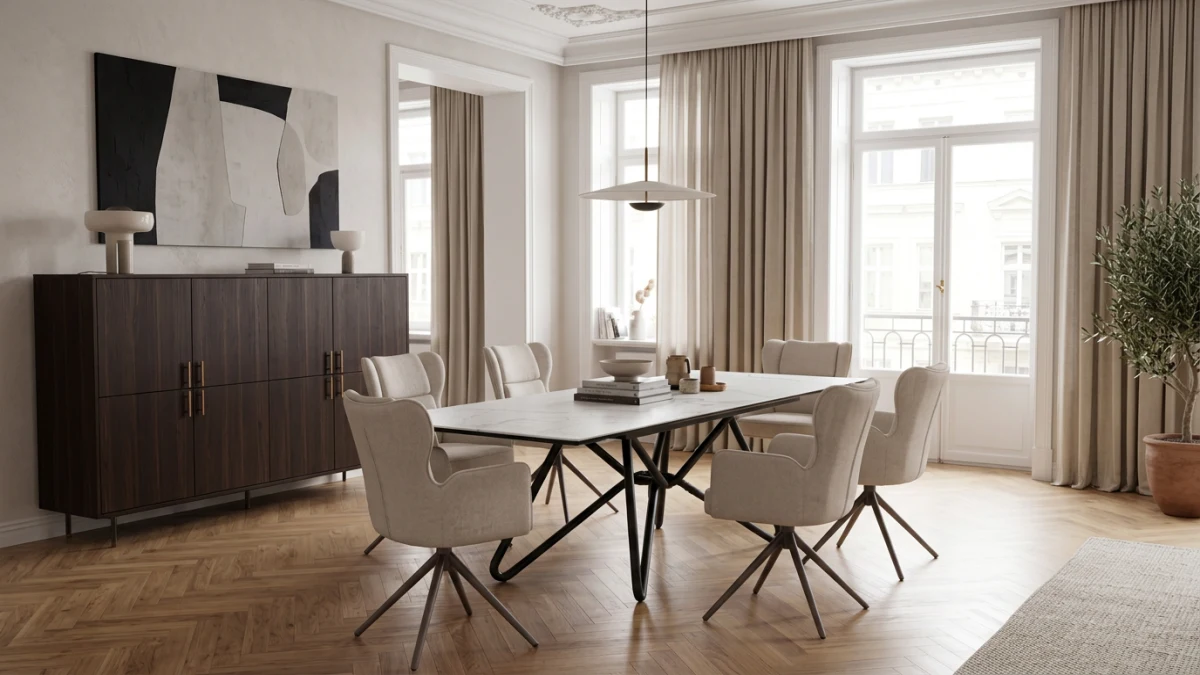
HPL vs Sintered Stone: Manufacturing Cost, Logistics, and Retail Margin Analysis for Furniture Buyers
When evaluating HPL vs sintered stone cost and retail margin performance, High-Pressure Laminate (HPL) delivers lower factory-gate procurement costs, lighter shipping weights, and lower transit breakage risks, yielding reliable 2.2x to 2.6x retail markups in volume-driven mid-market channels. Sintered stone requires higher manufacturing investment and reinforced packaging, yet commands premium European retail price points that generate 3.0x to 3.8x markups and more than double the absolute gross cash margin per unit sold.
What Are the Core Material Properties Distinguishing HPL from Sintered Stone?
For commercial furniture buyers, category managers, and retail sourcing specialists, choosing between tabletop materials requires looking beyond surface aesthetics to understand raw composition, structural behaviour, and daily performance in European households.
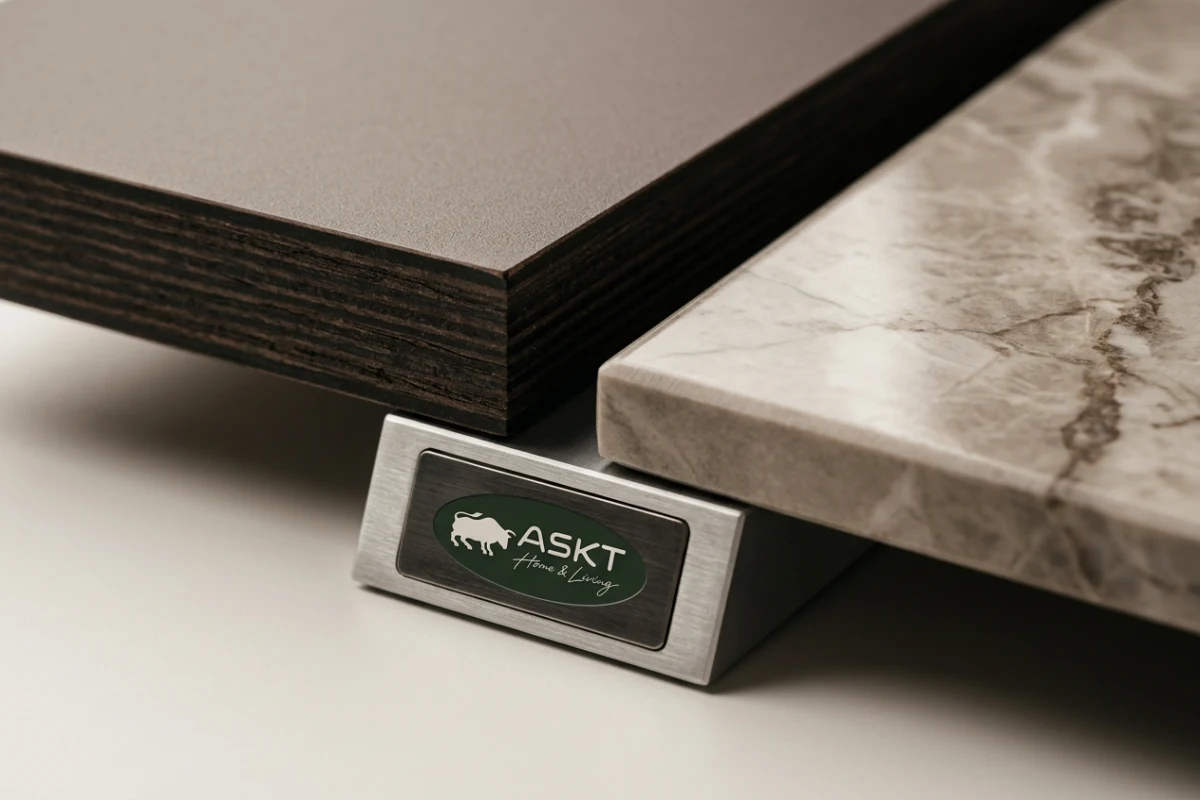
High-Pressure Laminate (HPL) is an engineered composite made of multiple layers of kraft paper impregnated with thermosetting phenolic resins, crowned with a decorative printed surface sheet and a hard-wearing melamine protective overlay. These layers are consolidated under high mechanical pressure and elevated temperatures. In dining table manufacturing, compact HPL panels (typically 10mm to 12mm thick) are self-supporting, offering dense structural stability, high flexural yield, and natural impact absorption.
Sintered stone is an inorganic engineered surface manufactured from natural mineral powders, including quartz, feldspar, clays, and mineral colour oxides. These raw materials are compacted under immense industrial press tonnages and fired in kilns at temperatures exceeding 1,200°C. This thermal fusion process binds mineral particles without liquid melting, resulting in an exceptionally dense, non-porous slab that resists high heat, direct scratching, and UV degradation.
| Material Parameter | Compact High-Pressure Laminate (HPL) | Sintered Stone Slab (6mm / 12mm) |
|---|---|---|
| Core Composition | Phenolic resin-impregnated kraft paper | Compacted natural mineral powder |
| Surface Feel | Warm, textured or smooth synthetic feel | Cool, authentic stone and ceramic tactile feel |
| Heat Resistance | Up to 180°C (resists hot cookware briefly) | Up to 1,200°C (fully flameproof and heat-resistant) |
| Scratch Resistance | High against everyday cutlery and plastics | Extreme (Mohs 6–7; knife-blade scratch-proof) |
| Porosity & Staining | Non-porous; easy-clean surface | Near-zero water absorption; impervious to liquids |
| Impact Behaviour | High flexural resilience; elastic impact yield | High rigid hardness; brittle at unsupported edges |
| Average Sheet Weight | Approx. 18–24 kg/m² (12mm compact panel) | Approx. 28–32 kg/m² (12mm solid mineral slab) |
These inherent engineering characteristics define not only how end-users experience the product over years of dining use, but also the price band, freight cost, and showroom placement suitable for each collection.
How Does the Factory-Gate Manufacturing Cost Compare Between HPL and Sintered Stone Table Tops?
Conducting a realistic HPL table top cost comparison against a sintered stone dining table wholesale quotation requires reviewing the bill of materials (BOM), machinery requirements, and secondary processing steps involved in Chinese manufacturing facilities.
For a standard 180x90cm dining table, manufacturing cost divergence stems from four critical production factors:
- Raw Material Procurement: Compact HPL sheets benefit from highly standardised, continuous pressing lines with mature supply chains. Sintered stone slabs require capital-intensive sintering kilns and premium mineral inputs, making raw slab purchasing roughly 30% to 50% more expensive per square metre than equivalent-thickness compact HPL.
- Machining and Edge Profiling: Compact HPL machines cleanly at high feed rates using standard carbide or diamond-tipped CNC router tooling. It allows chamfered, bullnose, or reverse-bevel undercut edges with low tool replacement costs. Sintered stone requires water-jet contouring, specialised diamond CNC cutting disks, and multi-stage water-cooled polishing lines to avoid micro-chipping along the edge profile, which increases cycle times and factory machining costs.
- Sub-base Backing and Substrates: Solid 12mm sintered stone can often rest on reinforced metal sub-frames, but thinner 6mm or 9mm sintered stone slabs require laminated sub-bases—such as tempered glass backing, solid engineered timber sub-plates, or honeycomb aluminium layers—to distribute point loads and satisfy European structural safety standards. In contrast, compact HPL requires no bonded substrate and accepts direct threaded metal inserts on its underside.
- Supporting Metal Frame Engineering: Because of sintered stone's significant deadweight, the underlying steel or aluminium subframe must incorporate heavier gauge wall thicknesses and structural cross-bracing to prevent long-term deflection. Compact HPL's lower mass allows leaner Knock-Down (KD) steel tube structures, reducing the metal frame cost component of the complete dining table package.
At the factory gate (FOB China), a complete 180x90cm dining table with a 12mm compact HPL top generally ranges between $85 and $125 USD, depending on frame design and finish. An equivalent dining table featuring a 12mm solid or 6mm glass-backed sintered stone top typically ranges from $135 to $210 USD, with premium marble-veined decors occupying the upper end of the price spectrum.
What Are the Key Packaging and Ocean Freight Logistics Cost Differences?
In B2B furniture procurement, import landed costs depend heavily on transport packaging volume, container payload limits, and transit damage probabilities.
Ocean Freight and Container Cube Utilisation
Container loading optimisation requires balancing container volumetric capacity against European gross vehicle weight regulations for road transport (typically 21 to 24 metric tonnes of cargo payload per 40ft High Cube container).
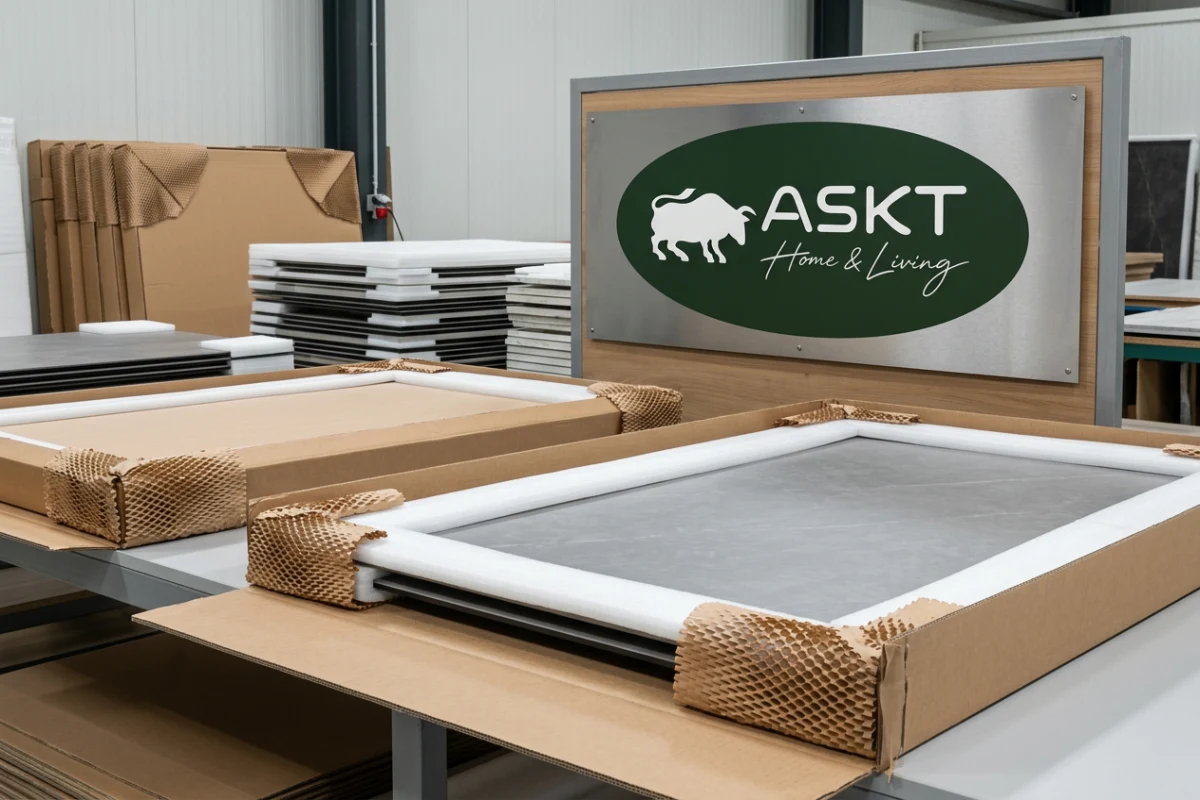
- Compact HPL Dining Tables: Compact HPL tops are slim, relatively lightweight, and structurally resilient. Factory packaging can be streamlined into compact KD flat packs using double-wall corrugated cartons and high-density honeycomb paper edge protection. A standard 40HC container can accommodate between 280 and 350 complete KD HPL dining tables before reaching road-haulage axle-weight thresholds.
- Sintered Stone Dining Tables: A 12mm solid sintered stone tabletop of 180x90cm weighs approximately 45 to 52 kg on its own. When packed inside reinforced export cartons with heavy-duty EPE foam framing or wooden perimeter crates, unit weight increases significantly. Consequently, a 40HC container usually maxes out its legal road payload weight at approximately 180 to 220 complete tables, driving up the ocean freight charge allocated to each individual unit.
Transit Breakage Risk and Buffer Management
Material fragility directly influences supply chain contingency costs and after-sales claim rates:
- HPL Resilience: Thanks to its high resin density and natural elasticity, compact HPL withstands rough intermodal transit, forklift handling, and final-mile courier movements without brittle cracking. Corner and edge damage rates typically remain below 0.5% when packed with reinforced honeycomb cardboard corners.
- Sintered Stone Shock Vulnerability: Sintered stone is extremely hard across its face but possesses ceramic brittleness at exposed, unsupported corners. Sharp impacts during transit or drop handling can cause diagonal corner fractures. Without engineered packaging—such as L-shaped rigid edge guards, thick high-density foam cushioning, and palletised or reinforced carton bases—breakage rates during container shipments and home delivery can range from 2% to 5% if packaging quality is not strictly controlled.
How Do European Retailers Calculate Furniture Retail Margin for HPL and Sintered Stone?
To understand the commercial returns of these two tabletop categories, let us examine a standard furniture retail margin calculation for a European furniture importer or retail chain sourcing direct container loads from China.
The following financial model illustrates realistic cost structures and retail outcomes in major European consumer markets (e.g., Germany, the Netherlands, or the UK) based on 40HC container shipments:
| Cost & Revenue Component | 180x90cm Compact HPL Table | 180x90cm Sintered Stone Table |
|---|---|---|
| FOB Factory Gate Price (USD) | $105.00 | $165.00 |
| Sea Freight & Port Handling per Unit (USD) | $14.00 (Basis: 300 units/40HC) | $23.00 (Basis: 190 units/40HC) |
| Import Customs & Clearance per Unit (USD) | $8.00 | $13.00 |
| Total Landed Cost (Converted to EUR) | ~€118.00 | ~€186.00 |
| Packaging Quality & Damage Reserve (EUR) | €3.00 | €12.00 |
| Net Warehouse Landed Cost (EUR) | €121.00 | €198.00 |
| Target Retail Selling Price (Inc. 19% VAT) | €349.00 | €699.00 |
| Net Retail Revenue (Excl. VAT) | €293.28 | €587.39 |
| Gross Retail Margin (€ per Unit) | €172.28 | €389.39 |
| Gross Retail Margin Percentage (%) | 58.7% | 66.3% |
| Retail Markup Multiplier on Landed Cost | 2.42x | 2.97x |
Strategic Analysis of Commercial Returns
This financial comparison highlights two distinct commercial advantages depending on retail business models:
- HPL Delivers Working Capital Efficiency and Low Operational Friction: An initial landed cost of €121 enables competitive retail pricing at €349, attracting budget-conscious homeowners, rental properties, and volume contract buyers. Inventory turns quickly, capital outlay per container is manageable, and post-sale transit claims remain negligible.
- Sintered Stone Maximises Absolute Cash Profitability: Sintered stone requires an extra €77 in landed warehouse investment per unit and demands rigorous transit packaging standards. However, each unit sold delivers €389 in gross profit—more than double the cash return of an HPL table. Because European shoppers perceive sintered stone as genuine luxury marble or architectural granite, retail price points can easily be positioned in the €699 to €899 bracket without encountering consumer resistance.
How Does Consumer Perceived Value Drive Retail Price Points and Sales Velocity?
Commercial success in European furniture markets depends on aligning material characteristics with the right consumer retail touchpoints and distribution channels.
Aesthetic Perception on the Showroom Floor
When prospective buyers walk through a brick-and-mortar furniture store, their assessment of dining table value relies on visual and tactile cues:
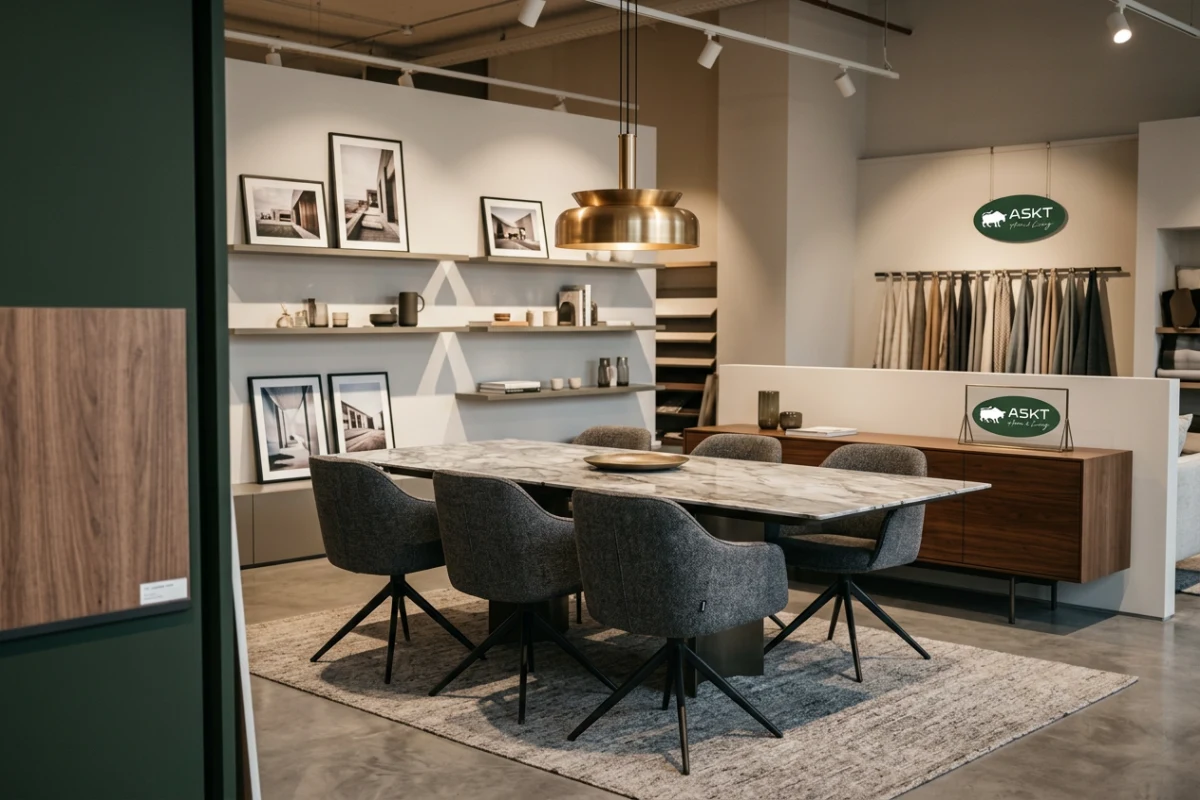
- High Visual Drama with Sintered Stone: Modern sintered stone surfaces accurately reproduce Italian Calacatta, Statuario, Noir Laurent, or concrete industrial textures with authentic veining and tactile depth. When displayed in a retail showroom under directional spotlighting alongside modern upholstered dining chairs, a sintered stone table serves as an aspirational centrepiece that justifies a premium price tag.
- Everyday Practicality with HPL: HPL communicates functional reliability. Families with young children or active households appreciate that compact HPL does not chip easily, feels pleasantly warm to the touch during daily meals, and resists aggressive cleaning agents without surface degradation.
Sales Channel and Buyer Segment Suitability
- E-Commerce and Mail-Order Retailers: Compact HPL tables excel in pure-play online retail and drop-shipping models. Their slim carton profiles reduce courier volumetric weight surcharges, while high impact resistance keeps return rates low during third-party parcel transport.
- Brick-and-Mortar Furniture Stores & Buying Groups: Sintered stone tables generate high revenue per square metre of showroom floor space. Sales staff can physically demonstrate scratch and heat resistance, and the striking visual appeal helps increase average transaction values.
- Contract, Hospitality, and Office Projects: HPL is widely favoured in commercial cafeterias, co-working spaces, and hospitality dining environments where furniture is moved frequently, wiped down continuously, and subjected to heavy daily wear.
What Are the Essential Quality Control Checklists for OEM Dining Table Sourcing from China?
When managing OEM dining table sourcing China programmes, European purchasing teams and quality managers must establish strict technical specifications to ensure consistent production quality across both material types.
Quality Verification Checklist for Sintered Stone Tables
When auditing a sintered stone dining table wholesale supplier, technical inspections should focus on four structural areas:
- Edge Chamfering and Safety Radiusing: Ensure that all perimeter cuts and cutouts undergo precision edge bevelling with a minimum 1mm to 2mm radius. Sharp, raw-cut ceramic edges are highly prone to micro-chipping during assembly and present safety hazards for end-users.
- Substrate Bonding Integrity: If sourcing 6mm or 9mm sintered stone with tempered glass or timber sub-plates, verify the adhesive chemistry. High-performance structural polyurethane or neutral silicone bonding is essential to prevent delamination during temperature and humidity fluctuations across seasons.
- Slab Density and Thickness Consistency: Confirm that slabs are produced on modern vacuum presses with consistent internal density, ensuring absence of internal air pockets or micro-fissures around CNC-machined mounting points.
- Transit Packaging and Drop-Testing: Require the manufacturer to conduct standard carton drop tests (e.g., ISTA 1A or 3A). Packaging must include thick EPE foam edge channels, reinforced rigid corner caps, and sturdy corrugated outer cartons.
Quality Verification Checklist for Compact HPL Tables
For compact HPL dining table manufacturing, quality inspections should focus on:
- Solid Core Homogeneity: Verify that the material is genuine solid compact phenolic kraft board rather than low-density melamine-faced particleboard. The bevelled edge must display a uniform, dense dark core without internal voids or layering defects.
- Threaded Insert Pull-Out Strength: Since KD dining tables use metal inserts embedded into pre-drilled holes on the underside of the HPL panel, test insert torque and tensile pull-out strength during initial sample evaluation to ensure long-term joint stability.
- Panel Flatness and Environmental Balancing: Ensure that the factory stores and machines HPL boards in temperature-controlled environments to prevent moisture-induced panel bowing before assembly.
| Procurement Parameter | Compact HPL Table Programme | Sintered Stone Table Programme |
|---|---|---|
| Core Quality Audit | Phenolic resin density and insert torque | Edge bevelling and substrate glue bonding |
| Export Packaging Standard | Compact flat-pack with honeycomb edge guards | Reinforced crate or high-density EPE foam carton |
| Transit Drop-Test Standard | Standard parcel/carton drop test | ISTA-tested heavy-drop protection |
| Subframe Requirement | Standard KD steel tube structure | Reinforced heavy-gauge frame with crossbars |
| Typical European Retail Tier | €249 – €449 (Mid-market / High-turnover) | €599 – €1,199 (Aspirational / Premium) |
Which Tabletop Material Best Fits Your Commercial Dining Furniture Portfolio?
Rather than viewing HPL and sintered stone as competing alternatives, successful European furniture importers, wholesalers, and retail buying groups often integrate both materials into a complementary, tiered dining collection.
A balanced category structure uses compact HPL tables to capture high-velocity, entry-to-mid-tier sales, rental market demand, and online drop-shipping volume where lightweight logistics and low claim rates protect net margins. Concurrently, sintered stone dining tables act as high-margin showroom anchors, elevating overall brand perception and delivering substantial cash profit per transaction from design-led retail buyers.
By collaborating with experienced OEM manufacturing partners in China that offer proven capabilities across both precision HPL machining and sintered stone fabrication, European buyers can standardise metal frame platforms while presenting diverse tabletop finishes across distinct retail price points.