HPL vs Sintered Stone Dining Tables: Sourcing Guide for European Retailers
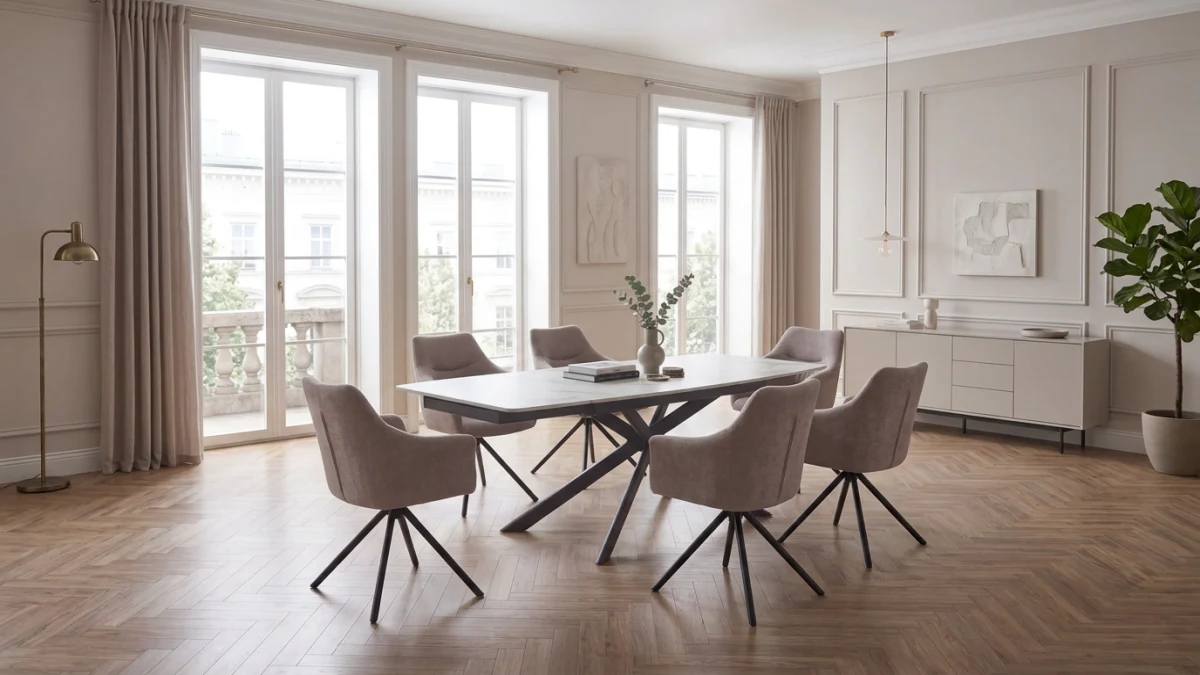
When comparing HPL vs sintered stone dining tables for European commercial collections, sintered stone delivers superior scratch, heat, and stain resistance with premium mineral aesthetics, making it ideal for higher-margin retail showrooms. Conversely, High-Pressure Laminate (HPL) offers exceptional impact resilience, lighter structural weight, and lower shipping costs, making it the more cost-effective choice for high-frequency contract spaces and volume-driven e-commerce retail programmes.
What Are the Core Material Differences Between HPL and Sintered Stone Tabletops?
To make an informed procurement decision, furniture sourcing specialists and product managers must understand how these two surface materials are manufactured and structured. While both surfaces have emerged as modern, high-performance alternatives to traditional solid timber and natural marble, their composition and manufacturing techniques result in distinctly different physical characteristics.
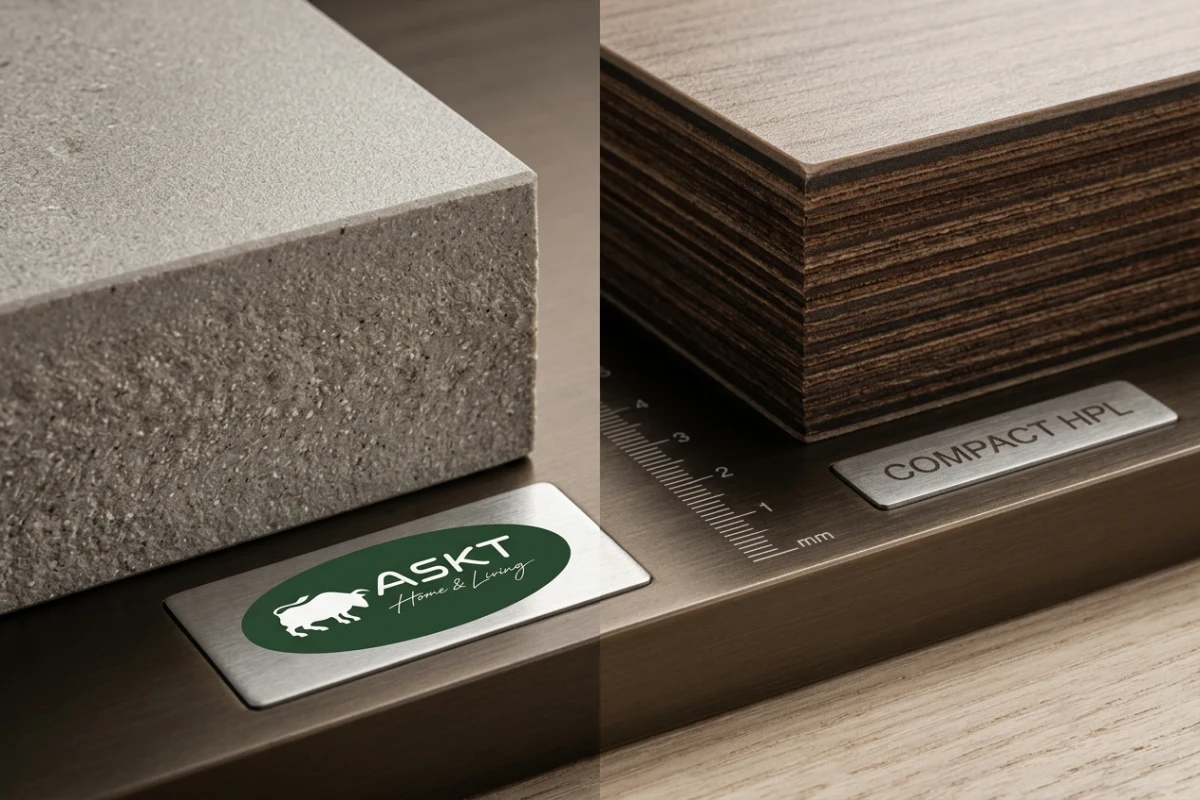
High-Pressure Laminate is an engineered composite surface produced by consolidating multiple layers of kraft paper saturated with thermosetting synthetic resins, finished with a decorative surface layer and a protective transparent overlay. These layers are pressed together under intense heat and mechanical pressure. This curing process fuses the materials into a dense, solid sheet that is highly resistant to moisture, delamination, and impact. In dining table production, HPL can be bonded onto structural substrates such as medium-density fibreboard, high-density particleboard, or manufactured as self-supporting compact laminate slabs with solid homogeneous cores.
Sintered stone, in contrast, is an advanced inorganic material manufactured from natural mineral powders, including quartz, feldspar, clay, and mineral colour pigments. These raw mineral components are compacted under extreme industrial pressing forces and fired in high-temperature kilns. This thermal manufacturing process permanently fuses the minerals into a non-porous, ultra-dense slab without the need for organic resin binders. The resulting material replicates the visual depth and mineral hardness of natural stone while eliminating natural fissures, porosity, and maintenance vulnerabilities.
From a manufacturing perspective, sintered stone is completely mineral-based and inherently UV-stable, whereas HPL is a resin-treated paper composite. For European furniture retailer sourcing, this fundamental distinction influences aesthetic perception, tactile feedback, structural weight, frame engineering, and overall retail price positioning.
How Do HPL and Sintered Stone Compare in Durability, Scratch Resistance, and Heat Tolerance?
When evaluating tabletop surfaces for retail catalogues or hospitality tenders, technical durability directly determines warranty risk, customer satisfaction, and product return rates. Both materials outperform traditional lacquered wood or untreated stone, but their mechanical performance profiles differ across daily use scenarios.
Sintered stone provides exceptional surface hardness, scratch resistance, and thermal tolerance. Because it is formed from vitrified minerals, its surface cannot be scratched by everyday dining cutlery, kitchen knives, or serving utensils. Hot serving pans and cookware taken directly from cooktops or ovens can be placed on a sintered stone dining table wholesale slab without causing surface scorching, blistering, or thermal cracking. Furthermore, because it contains virtually no open pores, it is entirely immune to acidic food stains, red wine, coffee, oils, and chemical cleaning agents.
HPL surfaces provide a different set of mechanical advantages. HPL tabletop commercial durability is characterised by high elasticity and impact resilience. The polymer-matrix composition absorbs mechanical shocks from dropped items or blunt force without cracking, shattering, or chipping. However, its scratch resistance is lower than that of mineral stone; dragging sharp metal items or rough ceramic bases across an HPL top will eventually leave fine abrasions. In terms of heat tolerance, HPL can easily handle hot tableware and warm plates, but prolonged contact with extremely hot cookware can damage the surface resin or compromise the underlying substrate bond.
| Technical Feature | High-Pressure Laminate (HPL) | Sintered Stone (Solid & Glass Backed) |
|---|---|---|
| Surface Hardness | Resilient resin surface; moderate scratch resistance | Ultra-dense mineral surface; knife and cutlery safe |
| Thermal Resistance | Handles warm tableware; damaged by direct cookware | Withstands direct hot cookware and thermal shocks |
| Stain Resistance | High stain resistance against common household spills | Total stain resistance; zero fluid absorption |
| Impact Resilience | High shock absorption; ductile core resists chipping | Rigid mineral structure; requires edge impact care |
| Material Weight | Lightweight to medium density | Heavy mineral mass; requires reinforced subframes |
| Tactile Experience | Warm, smooth touch with damped acoustic sound | Cool, solid, premium stone texture |
| Cleaning Requirements | Neutral detergent and damp microfibre cloth | Standard household cleaners; chemical immune |
For high-turnover hospitality spaces, student housing, and commercial office canteens, HPL is often chosen for its forgiving edge resilience, warm touch, and low acoustic noise. For design-led residential furniture showrooms, upscale restaurant dining rooms, and premium retail collections, sintered stone provides the stone aesthetics and stain immunity required by discerning consumers.
What Are the Container Loading and Logistics Economics of HPL vs Sintered Stone Tables?
For European furniture importers, wholesalers, and retail supply chain managers, landed cost calculations depend heavily on container packing efficiency, gross shipping weight, and transit protection requirements. The physical weight of HPL compared to sintered stone creates noticeably different supply chain realities.
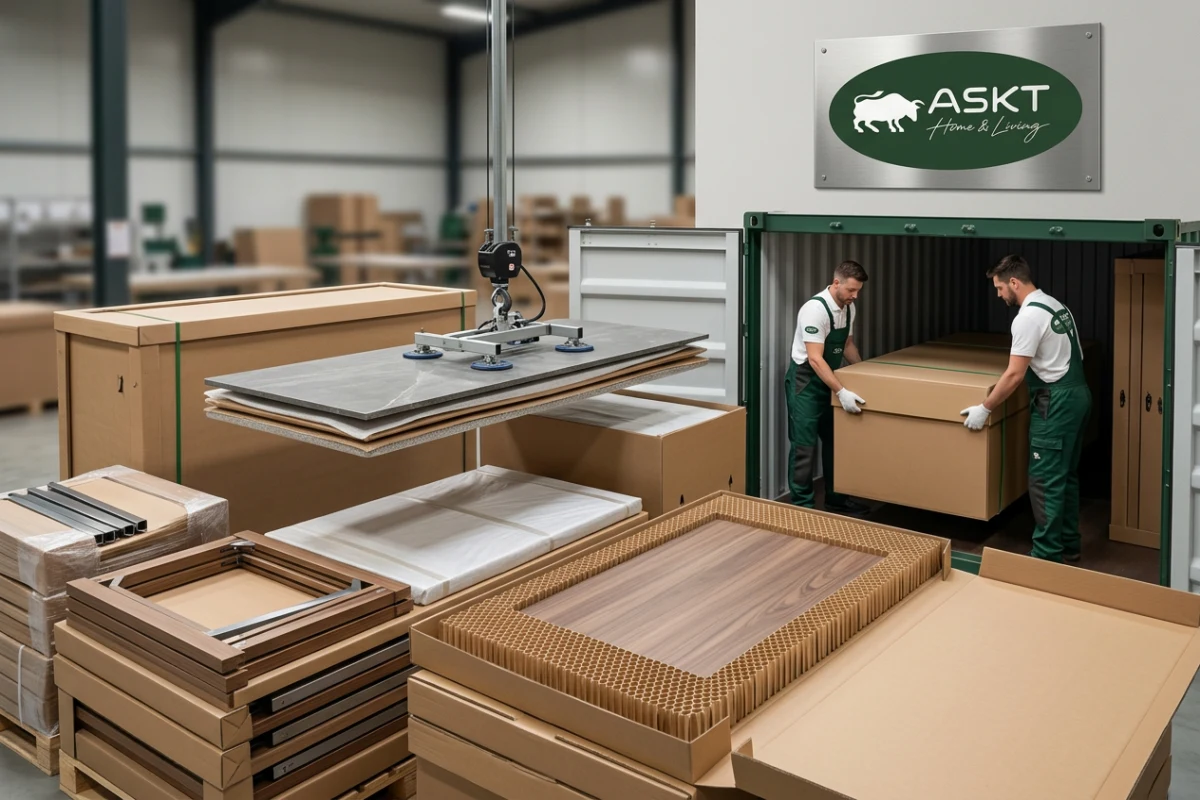
Weight is the primary logistical differentiator during international transport. A standard 180 cm by 90 cm sintered stone tabletop represents significant physical mass. When mounted on heavy-gauge steel subframes and powder-coated metal legs, the complete packaged product weight can easily exceed standard single-person handling thresholds. In standard container shipments from manufacturing facilities in China to European hub ports, shipments of heavy sintered stone dining tables frequently hit gross road-transport weight limits before the container's physical cubic space is completely filled.
Conversely, an HPL tabletop of identical dimensions weighs substantially less. This reduced tare weight allows European buyers to maximise container cubic volume without exceeding road weight restrictions. A standard container can comfortably accommodate a higher total unit count of flat-packed HPL dining tables, resulting in lower ocean freight and inland haulage costs per individual table unit.
Transit packaging design also reflects these material differences. Sintered stone requires rigid protective packaging, high-density edge protectors, and robust honeycomb paper board structures to prevent bending stress during ocean transit and warehouse handling. ASKT incorporates engineered Knock-Down (KD) metal frame assemblies and sustainable honeycomb paper packaging solutions that protect delicate stone corners while minimising single-use plastics.
HPL dining tables require less bulky packaging due to the natural flexibility and impact tolerance of the composite board. Flat-pack KD packaging for HPL tables can be configured to comply with standard parcel delivery and courier network dimensions, making HPL collections especially advantageous for e-commerce retailers offering home delivery across Europe.
How Should European Furniture Retailers Align Tabletop Choice with Commercial Price Points and Margins?
Choosing between HPL and sintered stone requires balancing factory production costs with retail pricing architecture, customer expectations, and target market segments. Both materials serve clear commercial roles across European retail channels.
Sintered stone dining tables hold a prominent position in mid-market to high-end European furniture retail collections. In mature markets such as Germany, the Netherlands, the UK, Poland, and Switzerland, retail consumers perceive sintered stone as a modern, low-maintenance alternative to natural marble or solid oak. Retail selling arguments—such as complete stain immunity, the ability to serve hot dishes directly on the table, and realistic marble veining—command attractive retail price points. This higher perceived value gives furniture retailers and importers healthy gross margin buffers to absorb logistics costs, showroom display expenses, and promotional campaigns.
HPL dining tables are essential for volume-driven retail catalogues, Scandinavian minimalist collections, and commercial contract projects. European consumers shopping in entry-to-mid retail tiers value HPL for its clean, ultra-slim silhouettes, warm tactile feel, and diverse decorative finishes, including authentic oak grain textures, concrete effects, and smooth matte solid tones. In commercial furniture tenders for hotels, educational facilities, and corporate workspaces, procurement managers frequently specify HPL because it offers budget predictability, easy maintenance, and long service life under heavy daily use.
Retailers often achieve the best commercial performance by maintaining a balanced product portfolio: offering HPL dining tables for high-volume entry-to-mid price points and fast-moving online ranges, while featuring sintered stone collections as hero showroom pieces that elevate average order values and strengthen brand positioning.
What Manufacturing and Quality Control Standards Apply to Dining Table OEM Sourcing?
Executing successful dining table OEM manufacturing for the European market demands strict adherence to European furniture standards, precise structural engineering, and thorough factory quality control procedures throughout mass production.
In structural table engineering, sintered stone slabs cannot simply be screwed directly onto a metal frame. Because sintered stone is a rigid material with minimal flexural elasticity, factory assembly must incorporate dedicated backing and support structures. Professional dining table OEM manufacturing generally uses two proven construction methods:
- Composite Glass Backing Integration: The sintered stone slab is laminated to a tempered glass sub-layer using high-strength adhesive bonding. This laminated structure increases overall flexural strength, dampens acoustic resonance when placing items on the table, and ensures structural stability.
- Perimeter Subframe and Cushion Mounting: The tabletop is installed on a precision-welded metal subframe using flexible structural silicone pads that absorb frame movement, thermal expansion, and mechanical vibration.
For HPL dining tables, manufacturing quality control focuses primarily on edge profiling and substrate sealing. Solid compact laminate tops require diamond-tipped CNC tooling to produce smooth chamfered or bevelled edge profiles. When HPL is pressed onto wood-based cores such as MDF or particleboard, clean edge-banding with water-resistant adhesives is necessary to prevent ambient moisture absorption and core swelling.
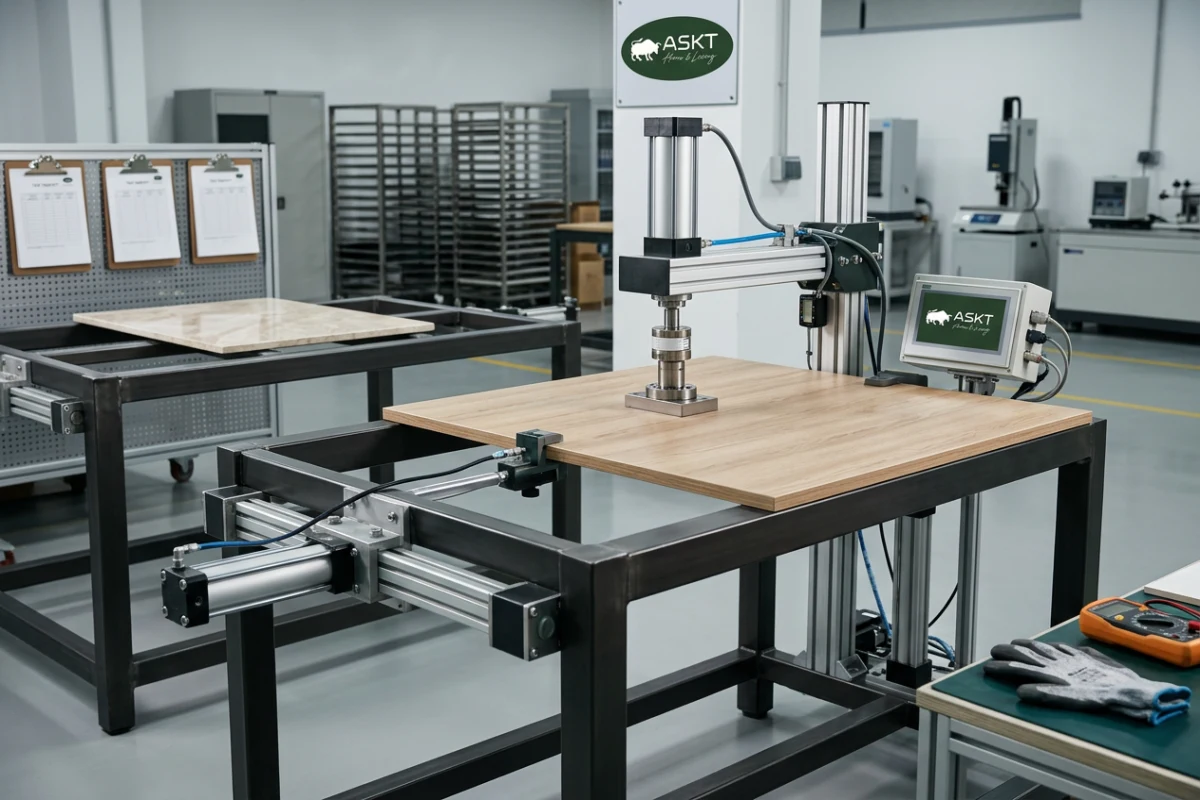
To ensure structural safety and product longevity, finished dining tables must pass rigorous mechanical testing based on European EN standards for domestic and non-domestic furniture strength, stability, and durability. Professional factory quality control routines include:
- Vertical Static Load Testing: Applying heavy downward forces to the table centre and outer edges to confirm that the frame joints, legs, and top supports hold without deformation.
- Horizontal Durability Cycling: Subjecting the assembled table to repeated horizontal back-and-forth forces to verify that metal frame welds, KD fixing bolts, and extension mechanisms do not loosen over time.
- Impact and Packaging Testing: Testing packed cartons with drop and vibration tests to verify that honeycomb protective materials safeguard table corners during transit.
- Surface Consistency and Finish Inspection: Checking batch-to-batch colour consistency, edge alignment, surface flatness, and scratch resistance prior to container loading.
Buyer Decision Matrix: Which Tabletop Material Best Fits Your Product Range?
To help purchasing managers, product developers, and retail buyers select the ideal tabletop specification for their upcoming product collections, use the following operational decision framework:
Select Sintered Stone Dining Tables When:
- Your retail collection targets mid-to-premium consumer segments seeking luxury stone and marble aesthetics.
- Your primary marketing message highlights heat resistance, scratch immunity, and stain-proof dining surfaces.
- You are developing showroom display lines, architectural metal-base tables, or premium extension dining models.
- Your distribution network is equipped to manage heavier, palletised furniture deliveries.
- You require high average order values and strong retail margin potential.
Select HPL Dining Tables When:
- You are sourcing high-volume retail lines, e-commerce flat-pack furniture, or modern minimalist collections.
- Your target buyers include contract hospitality projects, student residences, cafes, and co-working spaces.
- Maximising container loading quantity and reducing per-unit ocean freight costs are critical commercial priorities.
- You want slim, lightweight visual profiles with bevelled edges, concrete textures, or oak veneer effects.
- High impact resistance and shock-absorbing durability are necessary for heavy daily commercial use.
ASKT supports European furniture wholesalers, retail chains, and commercial purchasing teams with dedicated OEM and ODM dining table manufacturing. With over 20 years of furniture export experience, ASKT combines robust metal-frame fabrication, strict quality control procedures, and sustainable packaging optimisation to help European buyers develop commercially successful dining furniture collections.
Discover our dining table solutions for the furniture retail trade