KD Dining Chair Manufacturer China Container Loading: How Flat-Pack Design Cuts Logistics Costs for European Importers
Why KD Dining Chairs Matter for European Importers and Logistics Managers
As someone who has worked with European furniture buyers for more than 20 years, I have seen how a single structural decision can quietly reshape the economics of an entire dining chair range. That decision is whether to source fully assembled chairs or to work with a KD dining chair manufacturer in China that designs products for disassembly and optimised shipping. For wholesalers, importers and retail chains serving Germany, the Netherlands, the UK, Poland and other European markets, the difference shows up not only in freight invoices but also in warehouse handling, stock density, MOQ flexibility and overall sourcing risk.
KD, or knock-down, dining chairs are designed to be partially or fully disassembled, packed flat and assembled by the retailer, distribution centre or end customer. The basic idea is simple: remove the air that travels inside and around an assembled chair during transport. In practice, however, the savings depend on careful engineering, precise packaging, accurate carton sizing and experienced container loading planning. Done well, it is one of the most effective levers in international furniture sourcing. Done badly, it can lead to damaged goods, unclear assembly instructions and frustration on both sides.
For European buyers, the conversation often starts with logistics cost. Ocean freight, inland transport and port handling are usually calculated by volume or container slot, so anything that reduces cubic metres per chair directly reduces the landed cost per unit. But there is more to it than freight alone. Flat-pack structures can influence MOQ strategy, inventory turnover and even sustainability commitments, because denser containers mean fewer trips and lower emissions per product sold.
Cost Comparison: KD Flat-Pack vs Fully Assembled Dining Chairs
When procurement teams compare KD vs fully assembled chair shipping cost, the first number they usually look at is units per container. An assembled dining chair occupies a large, irregular footprint because of the backrest, armrests and the space between the seat and the floor. Even when stacked or nested, there are limits to how tightly assembled upholstered chairs can be packed without risking fabric damage, frame deformation or compression marks on padding.
Flat-pack KD chairs change that equation entirely. By packing the backrest, seat frame, legs and hardware in flat, stackable cartons, the manufacturer eliminates most of the empty air that travels with an assembled chair. The result is a much smaller volume per unit and a much higher number of chairs per container. For European importers who buy in container quantities, that difference alone can be enough to improve margin, support more competitive retail pricing or fund product upgrades such as better fabrics.
But freight is only the first layer of cost. Fully assembled chairs often require more individual protective wrapping, more handling by forklift or manual teams, and more warehouse space per unit once they arrive in Europe. They also limit how many reference numbers a buyer can keep in stock, because each model takes up more shelf or pallet space. KD packaging, by contrast, tends to be rectangular, stackable and easier to plan in both the container and the warehouse. That is why flat pack dining chair China logistics cost discussions should always include transport, handling, storage and damage risk, not just ocean freight rates.
There are trade-offs, of course. Fully assembled chairs can be delivered directly to retail floors or project sites with minimal handling. KD designs, on the other hand, shift some assembly work further down the supply chain, which can be an advantage for buyers with warehousing or distribution capacity, or for e-commerce brands that ship directly to consumers.
| Factor | Fully Assembled Dining Chair | KD Flat-Pack Dining Chair |
|---|---|---|
| Volume per unit | Higher due to upright shape | Lower thanks to flat packaging |
| Units per container | Fewer units | More units when optimised |
| Freight cost per unit | Higher per chair | Lower per chair |
| Packaging protection complexity | Depends on frame and upholstery | Requires careful internal protection |
| Warehouse handling | Larger, bulkier items | Stackable, standard cartons |
| Assembly work before sale | Minimal | Required at warehouse, retail or end-user level |
| Suitability for projects | Often preferred for quick deployment | Suitable if assembly support is planned |
The right choice depends on your business model. If you are a wholesaler serving furniture retailers across Europe, a higher container fill rate can directly improve your purchasing efficiency and stock flexibility. If you are a contract furniture buyer installing chairs in a hotel restaurant, you may weigh labour time on site differently. The point is not that KD is always better; the point is that you should evaluate it with real numbers, not assumptions.
How Packaging Design Impacts Container Loading Efficiency
Container loading optimisation for furniture in China is not just about stacking boxes tightly. It starts much earlier, in product design and packaging engineering. The dimensions of the carton, the way components are arranged inside it, the thickness of the protection and the stacking strength of the box all determine how many chairs can fit into a 20ft or 40ft container.
A professional KD dining chair manufacturer in China will usually design packaging around standard container internal dimensions and common pallet sizes. That means carton length, width and height are chosen to minimise leftover space along the length, width and height of the container. Small adjustments, even a few centimetres per carton, can add up to extra units per container when multiplied across thousands of cartons and dozens of shipments per year.
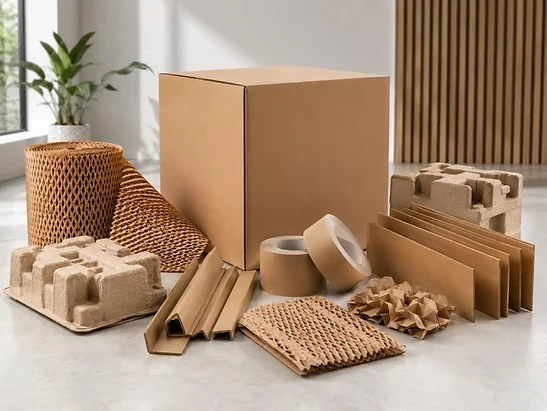
Internal packaging matters too. For KD furniture packaging for European import, protection must be reliable enough to handle long ocean voyages, multiple transfers and varying humidity levels, but it should not add unnecessary volume. At ASKT, we work with protective materials such as honeycomb paper, corner protectors and custom cardboard inserts that hold metal frames, upholstered parts and hardware in position without wasting space. This reduces both damage risk and the amount of plastic used in packaging, which aligns with European ESG expectations.
Hardware packaging is another detail that is easy to underestimate. If screw bags, leg bolts, Allen keys and instruction manuals are packed loosely, they can shift during transport, scratch surfaces or create weak points in the carton. A well-designed KD package secures small parts in a dedicated pocket or compartment, keeps them separate from upholstered surfaces, and makes the assembly process smoother for whoever puts the chair together later.
Stacking strength is equally important. The bottom cartons in a container can support considerable weight from the layers above. If the carton material, edge protectors or internal structure are not strong enough, the lower boxes can crush or deform, leading to product damage and unstable loads. A reliable manufacturer will test packaging compression and stacking performance as part of the overall quality process.
Quality and Protection Trade-Offs in KD Furniture Packaging
One of the most common concerns among European buyers is whether flat-pack design means sacrificing quality or increasing damage risk. It is a fair question. If you compress the supply chain into denser packaging, you must make sure the protection inside keeps pace with the new transport reality.
Upholstered dining chairs face specific risks in flat-pack form. Fabric can crease if folded too tightly. Foam and padding can develop compression marks if heavy components rest on them for weeks at sea. Metal legs or frame parts can scratch upholstery or wooden elements if they are not properly separated. These are not theoretical problems; they are issues that show up in real shipments when packaging is designed only for volume and not for protection.
A responsible KD dining chair manufacturer in China will address these risks through internal packaging design. For example, fabric surfaces may be protected with soft non-woven layers. Metal legs may be individually wrapped or placed in dedicated cardboard channels. Seat and backrest components may be separated by rigid inserts that prevent direct pressure on upholstered areas. Corner protectors can reinforce the weakest points of the carton, where most impact damage occurs during handling.
Sustainable packaging options can also be part of this strategy. At ASKT, we use honeycomb paper and reduced-plastic solutions where possible, because many of our European customers face increasing pressure to reduce packaging waste and meet ESG targets. The challenge is to achieve sustainability without weakening protection. When done correctly, paper-based protective structures can be surprisingly strong, and they also align with consumer and regulatory expectations in markets such as Germany, the Netherlands and the UK.
Assembly quality is another side of the trade-off. A KD chair is only as good as its connection points. Legs must fit securely, brackets must align, and hardware must be durable enough for repeated assembly or disassembly if needed. For B2B buyers, this means you should evaluate not only the packaging and container loading efficiency, but also the structural design of the joints, the quality of the hardware and the clarity of the assembly instructions. A chair that saves money on freight but creates after-sales problems is not a good long-term investment.
Choosing a Chinese KD Dining Chair Manufacturer: What to Check
If you are evaluating suppliers for a new KD dining chair range, there are several practical areas to check before you place a large order. These checks go beyond price samples and catalogue images; they help you assess whether the manufacturer truly understands flat-pack design, export packaging and the realities of European import logistics.
First, ask for detailed packaging specifications. You should know the exact carton dimensions, gross weight, net weight, units per carton, and the materials used for internal protection. If a supplier cannot provide these numbers quickly and clearly, it may not have a mature approach to container loading optimisation or quality control.
Second, review the load planning capability. Can the supplier provide 20ft and 40ft load estimates based on your specific model? Can they simulate mixed loads if you plan to combine chairs with tables or other furniture? Can they explain how weight distribution and stacking layers are decided? The ability to plan loading in advance is a sign of export experience and operational discipline.
Third, evaluate the KD structure itself. How are the legs attached? Are the brackets made of strong metal? Is the hardware standardised and easy to replace? How many steps are required for assembly? Are the instructions clear and translated properly for your market? These details affect customer satisfaction, return rates and your brand reputation in Europe.
Fourth, check quality control and testing practices. A reliable manufacturer should be able to describe how it tests structural stability, fabric performance, abrasion resistance, colour fastness and packaging drop or compression performance. At ASKT, we use defined QC workflows and material testing, including OEKO-TEX® STANDARD 100 certified fabrics, because European buyers need consistent quality across repeat orders, not just a good first sample.
Fifth, consider customization and design support. If you are a wholesaler or retail chain building your own collection, you may need custom fabrics, frame finishes, colours, sizes or branding options. A manufacturer with strong OEM and ODM capabilities can adjust both the product and the packaging to fit your market strategy, rather than forcing you to choose from a fixed catalogue.
Finally, look at the supplier's market experience. Manufacturers that regularly work with German, Dutch, British or Polish buyers tend to understand the specific expectations around quality, compliance, packaging and communication. They know what can go wrong in long-distance sourcing and they have systems in place to prevent problems instead of solving them after the fact.
How ASKT Supports Buyers with Packaging and Container Optimisation
At ASKT, we approach KD dining chairs from a whole-supply-chain perspective. We do not just design a chair and then put it in a box. We think through how it will be produced, packed, loaded, transported, unloaded, stored and assembled, because each step affects the commercial value of the product for our European partners.
Our packaging and container loading support starts early in product development. When we work on a new KD dining chair model, we consider carton dimensions from the beginning, not as an afterthought. We aim for carton sizes that make the best use of standard container and pallet dimensions, while still providing enough protection for upholstered surfaces, metal frames and wooden components. We also offer sustainable packaging options with reduced plastic and honeycomb paper protection for buyers who want to strengthen their ESG positioning.
For every standard model, we can provide clear packaging specifications, weight information and container load estimates for both 20ft and 40ft containers. For mixed orders that include dining tables, bar chairs, lounge chairs or other pieces, we can help plan the load so that space is used efficiently and heavier or more fragile items are positioned appropriately. This is part of how we help buyers reduce sourcing risk and make landed cost calculations more predictable.
We also support customisation across fabrics, colours, finishes, sizes and branding, so that buyers can build ranges that fit their own market positioning while still benefiting from efficient KD structures and container loading. Whether you are a wholesaler launching a new value line, a retail chain developing a private-label collection, or a project buyer furnishing multiple hospitality locations, the same principle applies: the product and the packaging should be designed together, not separately.
If you are currently evaluating KD dining chair suppliers or looking for ways to improve the logistics efficiency of your existing dining chair range, we recommend starting with a clear picture of packaging dimensions and load scenarios. Ask for detailed carton specifications, realistic container estimates, protection details and assembly documentation. When you have those numbers, you can make a proper comparison of total landed cost, not just ex-factory price. If you would like to discuss your specific project and see how a specialised manufacturer approaches KD packaging and container planning, you can request a packaging and loading consultation with our team. We will walk through your product requirements, target markets and logistics setup, and share practical options based on our 20 years of experience supplying dining furniture to European buyers.