
Kitchen Chair Height: A Practical Sizing and Sourcing Guide for European Furniture Buyers
Why Kitchen Chair Height Matters for Retail and Wholesale Buyers
Kitchen chair height might sound like a small detail, but for furniture buyers it is one of those details that quietly decides whether a product sells well or becomes a returns headache. A chair that is too high makes customers hunch. A chair that is too low leaves them straining to reach the table. In both cases the result is the same: discomfort, complaints and, for retailers and e-commerce brands, costly returns that eat into margins.
As someone who has worked with European furniture buyers for many years, I have seen this pattern again and again. A buyer selects a dining chair based on design, fabric and price, only to discover after the first deliveries that customers are complaining about seating height. By then it is too late to adjust the first container, and the brand is left managing negative reviews while they figure out a revised specification.
This is why kitchen chair height deserves attention early in the sourcing process, not as an afterthought. For wholesalers, retail chains and contract buyers, the right height standard supports product consistency, reduces customer complaints and makes it easier to match chairs with different dining table collections. For the European market in particular, where ergonomic expectations are high and customers are well informed about comfort, getting the basics right is a commercial advantage.
In this dining table and chair height guide we will break down what you need to know: standard kitchen chair seat height, how to calculate the correct seat to table clearance for dining chairs, how height combinations work in European kitchens, and what to check when sourcing chairs from a manufacturer.
Standard Kitchen Chair Seat Height vs Dining Table Height
Let us start with the basics. Standard kitchen chair seat height is the distance from the floor to the top of the seat cushion, measured at the front edge of the seat where most people sit. This measurement is more useful than overall chair height because backrest height varies enormously between designs, while seat height is the number that directly affects table fit and posture.
Standard kitchen chair seat height generally falls between 45 and 50 centimetres. This range covers most adult users in European markets and pairs comfortably with standard dining table heights. It is also the range you will see most often in catalogues, retail collections and contract furniture specifications across Germany, the Netherlands, the UK, Poland and other European markets.
Dining table height, by comparison, typically sits between 72 and 78 centimetres measured from the floor to the top of the tabletop. Most everyday kitchen and dining tables in Europe fall around 74 to 76 centimetres, which is widely considered a comfortable working height for eating, drinking and casual meals.

At this point you might be wondering why there is a range rather than one fixed number. The answer is that seat height has to work with cushion firmness, user height, table thickness and intended use. A soft upholstered chair compresses more when sat on, so the unloaded seat height may be slightly higher to compensate. A firm wooden seat, on the other hand, compresses very little, so the advertised height closely matches the in-use height.
For buyers this means you should never read a seat height number in isolation. You need to know how it was measured, what the cushion composition is, and what table height it is intended to match. A difference of two or three centimetres might sound small on a spec sheet, but it can change the entire feel of the chair once a customer sits down at a table.
How to Calculate the Right Seat to Table Clearance for Dining Chairs
The most important number in this whole discussion is not seat height on its own, and not table height on its own. It is the gap between the top of the seat and the underside of the table. This is what we call seat to table clearance, and it is the measurement that determines whether a person can sit comfortably with their legs under the table.
The general rule for seat to table clearance for dining chairs is 25 to 30 centimetres. That gap gives most adults enough room to sit naturally, cross their legs slightly if they want to, and get in and out of the chair without bumping their knees on the table frame or apron. Below 25 centimetres, taller users will feel cramped. Above 30 centimetres, shorter users may find the table too high to rest their arms comfortably while eating.
Calculating clearance is straightforward in theory, but in practice there are a few details that catch buyers out.
First, remember to measure from the seat top to the underside of the table, not to the tabletop surface. Many buyers subtract seat height from table top height, which gives them a larger number than the actual usable legroom. If the table has a thick top, an apron, a support frame or a sintered stone surface, the underside can be several centimetres lower than you expect.
Second, remember cushion compression. A plush upholstered chair with a soft seat may compress a few centimetres under an average adult's weight. That means the advertised seat height could be noticeably higher than the in-use seat height. For clearance calculations you should use the in-use height, not the unloaded height.
Third, consider armrests if the chair has them. Armrest height adds another layer of compatibility. If the arms are too high, the chair will not slide fully under the table, which wastes space in smaller kitchens and can make the seating position feel awkward. For chairs with arms, the top of the armrest should ideally sit below the table apron when pushed in.

Common Height Combinations for European Kitchens
European kitchens come in many styles, from compact city apartments to open-plan family kitchens and dining areas. The right kitchen chair height depends on the table it will be used with, and on the customer segment you are selling to.
For standard domestic kitchen tables between 74 and 76 centimetres high, a chair with a seat height of 46 to 48 centimetres is usually the most versatile option. This combination gives a clearance of roughly 26 to 30 centimetres, which suits the majority of adult users and works well for everyday meals, homework and casual entertaining.
For slightly higher tables, such as those with thick sintered stone tops or solid wood slabs that push the overall table height towards 77 or 78 centimetres, you may want a seat height at the upper end of the standard range, around 48 to 50 centimetres. This keeps the clearance within the comfortable zone and prevents the chair from feeling too low relative to the table surface.
For contract and hospitality settings like cafes, hotels and company canteens, consistency tends to matter more than chasing a specific number. Restaurants often choose a seat height on the slightly higher side because it makes it easier for guests to get in and out quickly, and works well with a mix of table types across the venue.
It is also worth noting the difference between kitchen dining chairs and bar stools. Bar-height seating is a separate category entirely, with seat heights typically around 65 to 75 centimetres for counter use and 75 to 85 centimetres for bar height. Those are not interchangeable with standard kitchen chairs, and mixing the two categories in a product range is one of the most common sources of customer confusion and incorrect orders.
If you are building a collection for a European market, the safest strategy is to offer one standard kitchen chair height that pairs with your main table range, and clearly communicate the measurements on packaging, product pages and in-store displays. This reduces customer choice anxiety and makes it easier for sales teams to recommend matching sets.
Beyond Seat Height: Backrest, Armrests and Floor Finishes
Kitchen chair height is important, but it is not the only measurement that affects comfort and compatibility. There are three other factors that professional buyers should always check alongside seat height.
Backrest height and angle
The backrest supports the upper body, and its height influences how supportive the chair feels for longer meals. Low-back chairs look sleek and modern, but they offer less upper-back support. High-back chairs are more supportive, but they can feel bulky in a small kitchen. For ergonomic dining chair height for Europe, the balance usually falls somewhere in the middle: enough support for comfortable dining, but not so high that the chair overwhelms the room.
The angle of the backrest also matters. A slight backward tilt of a few degrees reduces pressure on the lower back and makes the chair feel more relaxed. Chairs with completely vertical backs tend to feel formal and tiring over a long meal, which is fine for fine dining but less popular in everyday home use.
Armrest height and width
If you are sourcing chairs with armrests, make sure you check arm height against both the seat and the table. Armrests that are too high make the chair hard to push under the table. Armrests that are too low do not provide meaningful support when getting in and out of the seat, which is particularly relevant for older customers and for hospitality settings where guests move frequently.
The width between armrests is another detail worth checking. It affects how easily the chair fits around a table, how many chairs you can fit per side, and how comfortable larger users find the seat. For retail buyers, armrest dimensions are also a common source of sizing complaints, so they should always be included in product specifications.
Floor thickness and under-table space
One factor that is easy to forget is the floor. Thick rugs, carpet underlay, underfloor heating build-ups and tiled floors can all change the effective height of a chair by a small but noticeable amount. In most cases this is only a centimetre or two, but combined with cushion compression it can push clearance outside the ideal range.
For buyers this means you should keep a small tolerance in mind when specifying kitchen chair height. A chair that works perfectly on a thin tiled floor may feel slightly low on a thick carpet. For retail customers this is usually acceptable within reason, but for contract projects where floor finishes are precisely specified, you may want to adjust seat height accordingly.
How to Avoid Height Mismatches When Sourcing Dining Chairs
Height mismatches happen more often than you might think, and they almost always come down to incomplete information at the sourcing stage. A buyer sees a seat height on a spec sheet, compares it with a table height from another supplier, and assumes the two will work together. By the time they discover the clearance is too tight or too loose, production is already underway.
There are several practical steps you can take to avoid this problem.
First, always confirm how seat height is measured. Ask the manufacturer whether the measurement is taken at the front of the seat, the back of the seat, or the middle. Ask whether it includes cushion thickness, and whether it is measured with or without compression. Small differences in measurement method can explain a surprising amount of variation between suppliers.
Second, test physical samples before placing a large order. Numbers on a spreadsheet will never give you the same information as sitting in the chair at an actual table. If you already have a target table height, bring a sample chair to that table and check the clearance, the armrest fit and the overall comfort level. It is a simple exercise, but it catches far more issues than any spec sheet review.
Third, ask about production tolerance. Even the most careful factories have small variations from chair to chair. Ask what tolerance the manufacturer works to on seat height, and how they control it during production. For retail and contract buyers, consistency across a batch is just as important as the nominal height on the drawing.
Fourth, check frame design and assembly method. KD, or knock-down, chairs are assembled locally and can have slight height differences depending on how tightly the legs are fitted or whether adjustment feet are included. Make sure you understand how the final assembled height is controlled, especially if you are working with flat-pack products for the DIY or e-commerce market.
Finally, think about the product range as a whole. If you sell both tables and chairs, make sure the measurements are clearly displayed and that you recommend specific pairings. If you only sell chairs, make the recommended table height range clear on packaging and product information so customers can check compatibility before they buy.
Ergonomic Dining Chair Height for European Markets
European customers tend to be well informed about ergonomics, and comfort is one of the most common factors mentioned in furniture reviews. That means ergonomic dining chair height for Europe is not just about hitting a number on a chart — it is about designing for real use patterns across a diverse population.
From a manufacturing perspective, achieving consistent ergonomic performance requires attention at every stage. Frame geometry has to be accurate. Cushion density and thickness have to be controlled batch to batch. Fabric stretch and upholstery tension can also affect the final seat height by a small but meaningful amount.
At ASKT, our dining chair development for the European market is based on real usage research rather than generic ergonomic charts. We have studied over 1000 German household dining scenarios to understand how chairs are actually used, not just how they are supposed to be used according to a textbook. That research feeds into seat height, cushion depth, back angle and overall proportions, so buyers can be confident that the chairs will fit the everyday reality of European homes and hospitality venues.
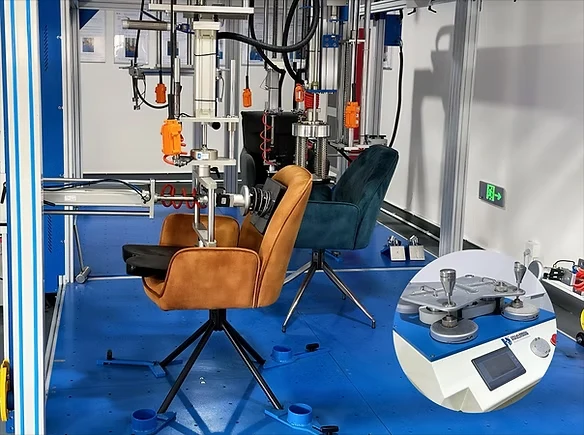
We also use controlled production processes — including automated cutting, automated welding and structured QC checks — to make sure that every chair in a batch matches the agreed height specification. For wholesale buyers, retail chains and contract projects, this consistency matters because it means fewer customer complaints, fewer returns and a more reliable product offer.
Material choice also plays a part. Our ASKT-Tex functional fabrics, for instance, are engineered to deliver consistent performance over time, including resistance to stretching and compression that could change the effective seat height after months of use. That kind of long-term dimensional stability is easy to overlook on a spec sheet, but it is one of the details that separates a product that sells well once from one that earns repeat orders and positive reviews.
Frequently Asked Questions About Kitchen Chair Height
What is the most common kitchen chair height for European homes?
The most common kitchen chair height for European homes falls between 45 and 50 centimetres measured from the floor to the top of the seat. Within that range, 46 to 48 centimetres is the most versatile option for standard dining tables between 74 and 76 centimetres high.
How much clearance do you need between a chair seat and a dining table?
For comfortable seating, aim for 25 to 30 centimetres of clearance between the top of the seat cushion and the underside of the table. This gives enough legroom for most adults while keeping the table at a comfortable height for eating.
Should all dining chairs in a set be exactly the same height?
For retail and contract use, consistent seat height across a set is important both for visual reasons and for customer comfort. Small variations of one centimetre are generally acceptable, but larger differences are noticeable to users and can lead to complaints.
Can you adjust the height of a dining chair?
Most standard dining chairs have a fixed seat height. Some chairs include small adjustable feet that can compensate for uneven floors, but these usually only change the height by a few millimetres and are not intended for major height adjustment.
What is the difference between kitchen chair height and bar stool height?
Kitchen chair height refers to standard dining chairs with seat heights of roughly 45 to 50 centimetres. Bar stools are much taller, with counter-height stools at around 65 to 75 centimetres and full bar-height stools at 75 to 85 centimetres. They are designed for different table heights and are not interchangeable.
If you are evaluating dining chair suppliers for the European market and need support with product development, sizing customization or quality control for kitchen chair height, working with an experienced manufacturing partner can help you avoid the most common sourcing pitfalls and build a collection that performs well with customers.