OEM vs ODM Dining Chairs for European Retailers: Strategic Sourcing and Procurement Guide
European furniture retailers should choose Original Equipment Manufacturing (OEM) for proprietary, brand-exclusive dining chair collections requiring custom tooling, unique dimensional engineering, and full intellectual property ownership. Conversely, Original Design Manufacturing (ODM) is optimal for lower upfront capital investment, faster market introduction, reduced minimum order quantities, and flexible private-label customization of pre-engineered base structures. Evaluating your retail distribution model, volume projections, and capital risk determines the ideal manufacturing route.
What Is the Fundamental Difference Between OEM and ODM Dining Chairs?
Understanding the distinction between Original Equipment Manufacturing (OEM) and Original Design Manufacturing (ODM) is fundamental for furniture wholesalers, retail chains, purchasing groups, and e-commerce brands operating across Germany, the Netherlands, the UK, Poland, Switzerland, Ireland, and wider European markets. Both manufacturing routes offer viable pathways to market, but they divide responsibilities for design development, tooling investment, and structural engineering differently.
In dining chair OEM manufacturing, the European buyer acts as the primary product architect. The retailer or importer provides proprietary industrial designs, 2D technical drawings, 3D CAD files, exact dimensional tolerances, and detailed bills of materials (BOM). The manufacturing partner in China acts strictly as the production and engineering executor. The factory fabricates custom tooling, builds bespoke welding jigs, sources specified upholstery materials, and executes mass assembly according to client blueprints. Under a pure OEM model, the buyer retains ownership of the industrial design rights, technical patents, and physical tooling molds.
In ODM furniture sourcing Europe, the manufacturing partner conceptualizes, engineers, prototypes, and tests dining chair collections internally. The factory's in-house product development team creates market-ready seating platforms based on European aesthetic trends, ergonomic standards, and structural durability requirements. European buyers review these ready-engineered collections and select base structures, customizing surface specifications such as upholstery fabrics, frame finishes, foam densities, stitching patterns, and private-label packaging. The manufacturer retains underlying engineering and tooling ownership, while granting geographic distribution rights or exclusive territorial licenses based on agreed commercial volumes.
| Procurement Dimension | OEM Dining Chair Model | ODM Dining Chair Model |
|---|---|---|
| Design Ownership | Buyer owns 100% of proprietary industrial designs and CAD files | Manufacturer owns underlying engineering, tooling, and structural design |
| Tooling & Mold Investment | Capital expenditure paid by buyer; tooling dedicated exclusively to buyer | Absorbed by manufacturer; amortized across production volume |
| Product Development Cycle | 16 to 26 weeks from concept drawings to commercial shipment | 4 to 8 weeks from sample selection to mass production |
| Minimum Order Quantity (MOQ) | Higher thresholds to justify dedicated tooling setups and line calibration | Lower thresholds utilizing modular chassis and standard raw materials |
| Customisation Scope | Complete structural, ergonomic, dimensional, and material freedom | Surface adaptations: fabrics, frame finishes, foam, and private-label packaging |
| Structural Compliance Risk | Buyer manages structural engineering adjustments if initial prototypes fail testing | Base chassis pre-engineered and validated against European stability standards |
How Do Tooling Investments, Development Cycles, and MOQs Compare?
Evaluating the commercial trade-offs between OEM and ODM procurement requires analyzing three interconnected operational factors: initial capital outlay for tooling, time-to-market lead times, and factory minimum order quantities (MOQs).
Tooling Costs and Capital Allocation
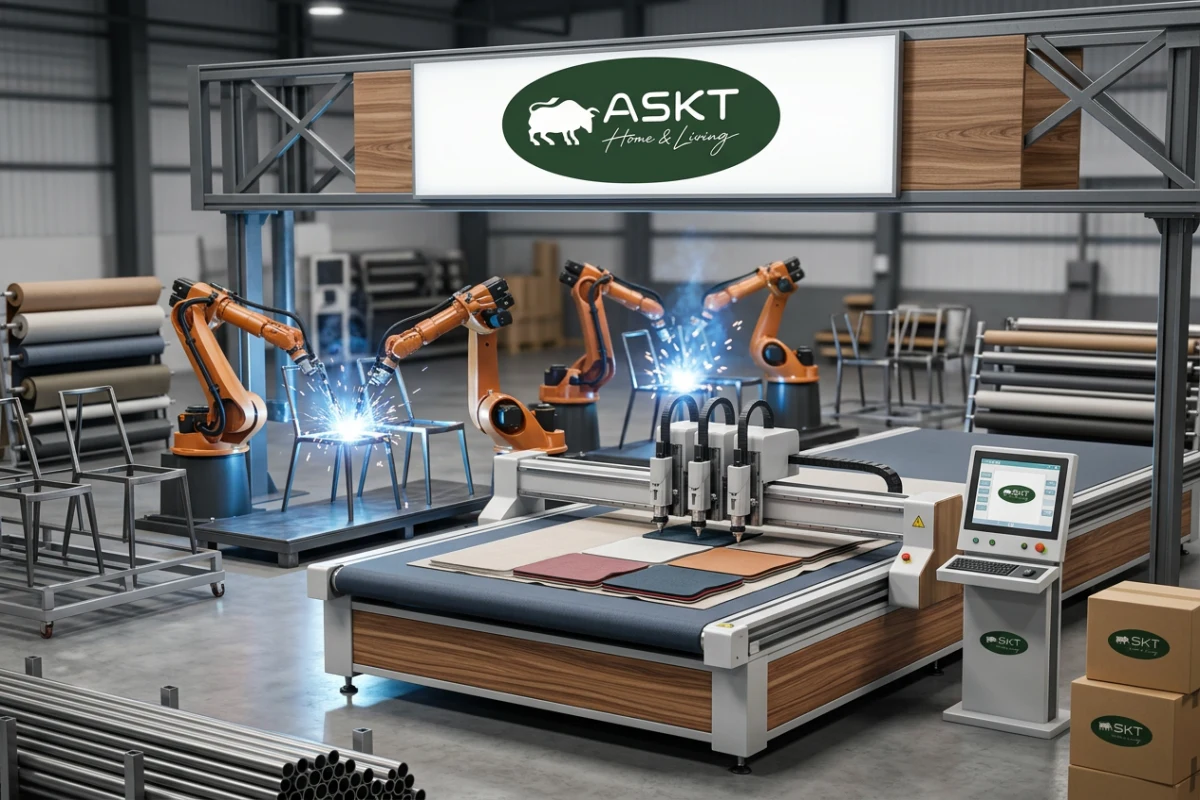
Custom dining chair development under an OEM agreement frequently involves dedicated tooling for metal stamping, custom steel tube bending, aluminum casting, or specialized wooden shell pressing. Fabricating proprietary metal dies, stamping molds, and automated welding jigs requires substantial upfront capital. For a comprehensive dining collection encompassing dining chairs, bar stools, and dining benches, cumulative tooling investments represent significant capital at risk. If a retail collection underperforms in commercial stores, the buyer absorbs the unamortized tooling expense directly.
In contrast, sourcing through an established custom dining chair supplier China on an ODM basis eliminates direct tooling invoices. The manufacturer absorbs structural engineering and tooling fabrication expenses into its general operational overhead, distributing development costs across multiple production runs. This structure allows European furniture retailers and independent buying groups to allocate capital directly toward inventory acquisition and localized retail marketing rather than pre-production factory assets.
Prototyping Lead Times and Production Cycles
The development timeline for OEM dining chairs follows a sequential, multi-stage engineering pathway:
- Engineering Evaluation & CAD Finalization: The factory translates artistic design concepts into manufacturable 3D CAD models, verifying structural joint integrity, load distribution, and knockdown (KD) hardware interfaces.
- Tooling Fabrication & Jig Construction: Dedicated stamping dies, wooden molds, and metal bending fixtures are machined and calibrated.
- First-Article Prototyping (T1 Sample): Initial physical samples are built to assess ergonomics, upholstery tailoring, welding neatness, and dimensional accuracy.
- Design Refinement & Retooling: Adjustments are made to backrest angles, seat pitch, or internal foam profiles based on buyer feedback.
- Sample Approval & Mass Run Setup: Tooling is finalized, assembly lines are configured, and bulk raw materials are procured.
This OEM product development cycle typically spans 16 to 26 weeks before commercial containers can be loaded. For ODM sourcing, the physical engineering stage is already complete. The base frame geometry, internal spring placement, and load-bearing parameters have been validated in previous production batches. The buyer focuses entirely on sample sign-off for upholstery fabrics, wood stains, powder-coating colors, and carton branding, compressing the development timeline to 4 to 8 weeks.
Minimum Order Quantities and Inventory Turnover
Because OEM manufacturing requires dedicated production line changeovers, specialized raw material sourcing, and custom jig calibration, manufacturers require higher batch MOQs per model to achieve production efficiency. For mid-sized European retailers, high MOQs increase working capital requirements and elevate warehouse inventory holding risk.
ODM manufacturing platforms often resolve this challenge through modular engineering. By utilizing standardized internal sub-assemblies—such as universal metal base frames compatible with multiple upholstered seat shells or interchangeable swivel plates—manufacturers can offer lower MOQs per SKU. European buyers can mix various fabric colors, textures, and leg finishes within a single 40ft High Cube container, optimizing retail stock turn while keeping production costs low.
How Can European Retailers Protect Intellectual Property and Maintain Design Exclusivity?
Intellectual property (IP) protection and product differentiation represent vital considerations for European purchasing directors, importers, and brand managers. Preventing direct catalog duplication is critical to protecting commercial margins against competing retailers and price discounters.
Securing Geographic Exclusivity in ODM Sourcing
A common concern among retail buyers is that selecting ODM products results in selling generic designs identical to those of market competitors. However, professional furniture private label manufacturing contracts routinely incorporate structured territorial exclusivity agreements. Under these commercial frameworks, a European importer or wholesaler secures sole distribution rights for a specific ODM model within defined geographical boundaries, such as Germany, Austria, Switzerland, or the UK.
To establish an effective ODM exclusivity agreement, buyers should formalize three core operational parameters:
- Geographic Boundaries: Specify clear country-level or regional territories where the manufacturer cannot sell the designated chair model to any other commercial entity.
- Annual Volume Commitments: Define realistic container volume or unit purchasing thresholds required to maintain active territorial exclusivity on an annual basis.
- Derivative Design Protections: Establish guidelines regarding minor aesthetic alterations (such as changing stitching styles, piping details, or leg finishes) to prevent close variants from entering the protected market through competing retail channels.
Enforcing Proprietary IP Ownership in OEM Programs
For OEM dining chair collections developed from original, brand-exclusive concepts, intellectual property ownership must be protected through comprehensive commercial and legal frameworks before technical drawings are shared with manufacturing facilities:
- Non-Disclosure and Non-Use Agreements (NNN): Ensure contracts explicitly prohibit the factory from utilizing, displaying, sharing, or repurposing proprietary design files, CAD models, or physical prototypes for third-party clients or trade exhibitions.
- Tooling Ownership Documentation: Formalize legal clauses stating that all physical tooling, molds, dies, and assembly jigs paid for by the buyer remain the exclusive intellectual and physical property of the buyer, prohibiting unauthorized production runs.
- Design Registration: Register industrial designs with appropriate intellectual property authorities, such as the European Union Intellectual Property Office (EUIPO), providing enforceable legal protection across European Union member states.
What Are the Specific Customisation Options Available Under OEM and ODM Models?
Customisation in dining furniture manufacturing is not an all-or-nothing proposition. The distinction between OEM and ODM lies primarily in whether modifications alter the underlying load-bearing chassis or focus on surface aesthetics, ergonomic upholstery layers, and packaging formats.
Structural Engineering vs Aesthetic Adaptation
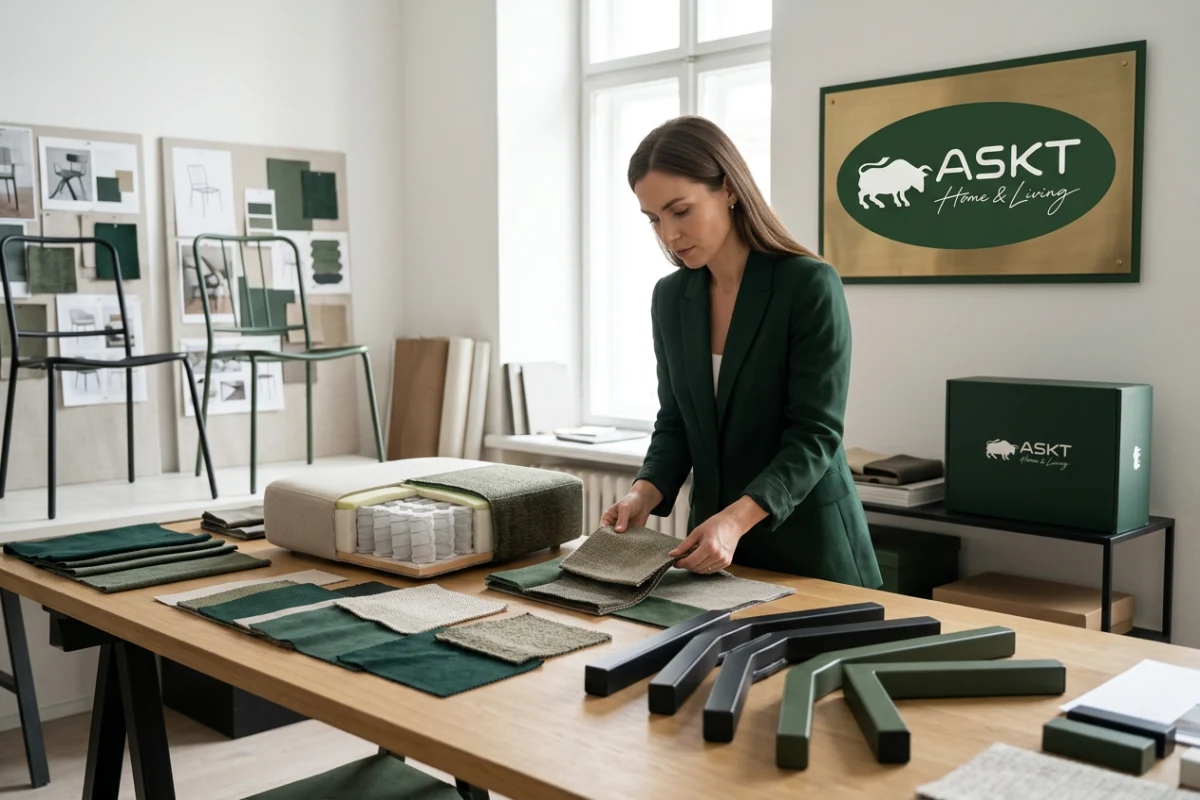
- OEM Structural Customisation: Involves complete engineering autonomy over the chair's foundation. Buyers specify custom metal tube profiles and wall thicknesses, tailored internal pocket spring coil arrangements, bespoke wooden shell pressings, unique KD interlocking brackets, and customized swivel or auto-return mechanism configurations.
- ODM Aesthetic & Private-Label Customisation: Maintains the pre-engineered, structurally validated load-bearing frame while offering extensive customization across all visible and tactile components.
Material Selection and Surface Performance
European buyers sourcing ODM dining chairs can achieve substantial product differentiation through targeted material selections:
- High-Performance Upholstery Fabrics: Retailers can select from a wide range of technical coverings, including water-repellent, easy-clean, and pet-friendly textiles engineered for stain resistance and high abrasion durability in residential and contract dining spaces.
- Foam and Cushioning Architecture: Buyers can configure high-resilience foam layers over integrated pocket spring seating cores, balancing plush initial seating comfort with long-term structural shape recovery.
- Metal Frame Finishes: Structural steel and aluminum legs can be customized with durable powder-coated finishes, including fine matte black, textured anthracite, or electroplated metallic tones suitable for modern interior palettes.
- Wood and Table-Matching Elements: For dining chairs incorporating wood elements, veneers such as natural oak or stained finishes can be coordinated directly with dining table collections and sintered stone surfaces.
- Functional Mechanisms: Standard stationary chairs can be upgraded with 360-degree smooth swivel plates or 180-degree auto-return mechanisms, allowing chairs to automatically realign neatly with the dining table edge when unoccupied.
Packaging Engineering and Logistics Optimization
Both OEM and ODM sourcing models allow full customization of packaging architectures to support various European retail distribution channels, from brick-and-mortar furniture stores to direct-to-consumer e-commerce:
- Knockdown (KD) Space Optimization: Engineering modular seat-and-leg connections allows chairs to pack flat into compact shipping cartons. Optimizing carton volume can double or triple the number of units loaded into a standard 40ft High Cube container, dramatically reducing per-unit sea freight and European road transport costs.
- Transit Protection & Sustainable Packaging: Cartons can be engineered with reinforced edge protectors, honeycomb cardboard buffers, and plastic-reduced packaging materials to minimize transit damage while aligning with European corporate sustainability initiatives.
- Private-Label Retail Presentation: Packaging can be fully customized with buyer-branded master cartons, multi-language assembly instructions, EAN-13 barcodes, and retail-specific labeling.
How Should European Retailers Evaluate OEM vs ODM for Different Business Models?
Choosing between OEM and ODM manufacturing requires evaluating your retail distribution channel, capital resources, internal design capabilities, and commercial risk tolerance.
Evaluation Guidelines for Sourcing Models
To determine the right manufacturing model, procurement teams should evaluate their operational priorities systematically:
- Step 1: Assess Internal Design and Engineering Resources
If your company maintains dedicated industrial designers and technical engineers capable of producing comprehensive CAD packages, OEM enables full execution of your proprietary aesthetic vision. If your team focuses primarily on retail merchandising, marketing, and category management, ODM allows you to leverage the factory's existing engineering infrastructure. - Step 2: Evaluate Capital Allocation and Tooling Budgets
If your balance sheet supports upfront capital investment for tooling dies and mold development across a multi-year amortization schedule, OEM provides proprietary differentiation. If your operational priority is preserving working capital for inventory depth and rapid commercial expansion, ODM eliminates upfront development costs. - Step 3: Define Time-to-Market Requirements
If launching a collection within a compressed 6- to 8-week promotional cycle is mandatory, ODM provides immediate production readiness. If you are developing a multi-year flagship program where a 4- to 6-month pre-production development cycle fits your seasonal catalog rollout, OEM is appropriate. - Step 4: Analyze Volume Projections and Container Optimization
If your retail store network can absorb multi-container production runs per model, OEM tooling costs amortize efficiently. If you operate an e-commerce platform requiring a diverse mix of fabric colors and leg finishes within single container shipments, ODM modular platforms offer superior supply chain flexibility.
Retail Chain Stores and Purchasing Groups
Large physical retail chains operating across Germany, the UK, the Netherlands, and France often utilize a balanced portfolio approach. For flagship "hero" dining chair programs designed for multi-year commercial life cycles, retail groups invest in OEM tooling to secure absolute design exclusivity and protect against price matching. For fast-turn seasonal lines or trend-driven collections, these same retailers leverage ODM sourcing to introduce contemporary fabric textures and modern frame finishes rapidly without tying up internal engineering capacity.
E-Commerce Furniture Brands and Digital Marketplaces
Online furniture retailers face strict logistical constraints: shipping box dimensions dictate courier freight tiers, customer satisfaction depends directly on seating ergonomics, and return rates must remain strictly controlled. ODM furniture sourcing Europe provides clear operational advantages for e-commerce brands. Digital merchants can select proven, drop-test-ready KD chair platforms, apply custom fabric colorways, and launch private-label SKUs with minimal capital exposure.
Contract Furniture Buyers and Hospitality Importers
Contract buyers sourcing for hotels, restaurants, and commercial projects prioritize structural durability, flame-retardant compliance, and batch consistency. Utilizing pre-engineered ODM frames that have passed standard structural load and durability testing provides certified performance and rapid production turnaround without requiring commercial project clients to fund bespoke tooling development.
How Does Manufacturing Transparency and Quality Control Mitigate Sourcing Risks?
Regardless of whether a European retailer selects an OEM or ODM procurement model, the long-term success of an offshore manufacturing program depends on supplier reliability, transparent quality control, and rigorous structural verification.
Structural Verification and European Standards
Dining chairs imported into European markets must comply with rigorous structural durability and safety benchmarks. Sourcing partners must understand the mechanical stresses placed on dining furniture in both residential and contract environments. Key technical checkpoints include:
- Frame and Joint Durability: Verifying metal tube wall thickness, weld seam penetration, and structural gusset reinforcement to ensure frames withstand repetitive vertical seat loads and horizontal backrest forces without weld fatigue.
- Ergonomics and Stability: Ensuring chair geometry provides balanced weight distribution, correct lumbar support, and lateral stability against tipping.
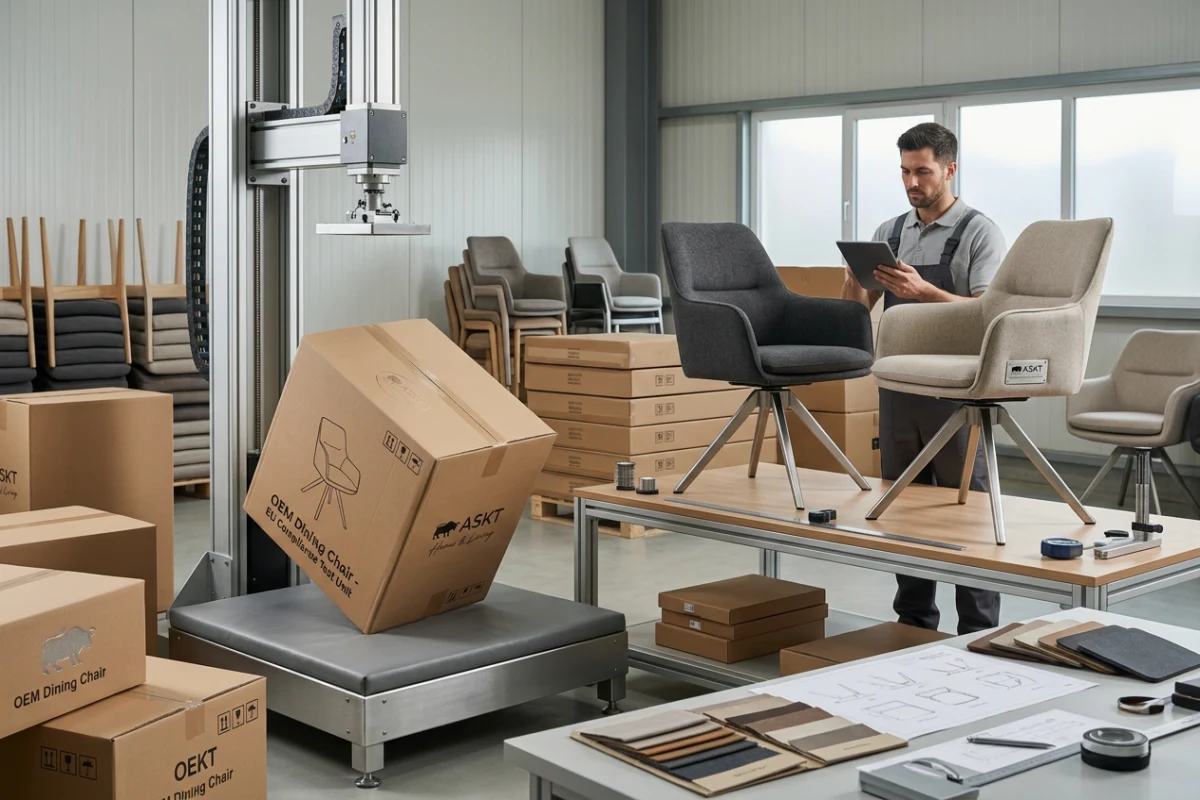
- European Testing Compliance: Conducting static load tests, cyclic durability fatigue trials, and impact drop tests aligned with recognized European standards (such as EN 12520 for domestic seating strength, durability, and safety) before mass production sign-off.
End-to-End Quality Inspection Processes
Professional B2B manufacturers implement transparent quality assurance protocols across every stage of the manufacturing workflow:
- Incoming Material Inspection (IQC): Verifying fabric abrasion resistance, color fastness, seam tensile strength, foam density, and metal tubing specifications prior to production release.
- In-Process Quality Control (IPQC): Monitoring automated cutting accuracy, robotic welding alignment, powder-coating thickness, and upholstery tension during sub-assembly.
- Pre-Shipment Inspection (FQC/OQC): Conducting dimensional checks, 100% assembly fit verification for knockdown components, surface finish audits, and carton drop testing prior to container stuffing.
- Container Loading Optimization: Ensuring accurate stacking plans, moisture protection, and secure container blocking to eliminate transit movement and packaging deformation during sea transport.
ASKT as a Strategic Sourcing Partner for European Buyers
With over 20 years of dedicated furniture manufacturing experience, ASKT functions as a trusted B2B supply chain partner for European wholesalers, retail chains, and furniture importers. Operating with a deep understanding of European design preferences and strict quality expectations, ASKT delivers end-to-end OEM and ODM manufacturing solutions across dining chairs, dining tables, bar stools, lounge chairs, dining benches, and contract furniture.
ASKT combines precision engineering with versatile customization capabilities, offering upholstered, metal-frame, swivel, and auto-return dining collections tailored to the German, Dutch, British, Polish, Swiss, and Irish markets. Whether engineering a bespoke OEM design from customer CAD blueprints or tailoring private-label ODM collections with high-performance fabrics, pocket spring seating, and sustainable knockdown packaging, ASKT prioritizes manufacturing transparency, product consistency, and risk reduction.
By focusing on robust structural engineering, optimized container loading, and proactive compliance support, ASKT helps European furniture buyers build resilient, profitable, and commercially sustainable dining furniture programs.
Frequently Asked Questions
What are the typical lead times for OEM vs ODM dining chair samples?
ODM dining chair samples typically require 7 to 14 working days because standard metal frame tooling, bending jigs, and wooden shell molds are already operational in the factory. OEM prototyping generally takes 30 to 45 days, as the factory must produce detailed engineering shop drawings, fabricate temporary or production-grade tooling dies, bend bespoke metal profiles, and assemble first-article prototypes for ergonomic and dimensional approval.
Can European retailers obtain design exclusivity on ODM dining chairs?
Yes. While the manufacturer retains ownership of the underlying structural tooling and engineering files, professional manufacturers routinely establish territorial Design Exclusivity agreements. European retailers and importers can secure sole distribution rights for specific ODM models within designated countries or geographic regions, provided agreed annual container purchasing volumes are maintained.
What compliance and structural factors should buyers check for European dining chairs?
Buyers should verify that dining chairs satisfy European safety and durability benchmarks, including EN 12520 for domestic seating strength, durability, and safety, as well as seating stability requirements. In addition, upholstery fabrics, foams, and finishes should comply with European chemical safety regulations (such as REACH), while meeting market-specific commercial or residential durability expectations.
How does knockdown (KD) design impact shipping costs between OEM and ODM?
Knockdown (KD) engineering allows chair components—such as the upholstered seat shell and metal leg assembly—to pack flat into compact master cartons. In both OEM and ODM programs, optimized KD packaging significantly increases container loading capacity compared to fully assembled chairs, substantially lowering per-unit sea freight and European inland logistics expenses.