One Design, Four SKUs: How Furniture Buyers Can Build a Smarter Dining Collection
A one design four SKUs dining collection enables furniture buyers to expand a single validated seating silhouette into four distinct commercial items—dining side chairs, upholstered dining armchairs, kitchen counter stools, and commercial bar stools—by utilizing shared seat shells, standardized mounting hardware, and matching frame finishes. This modular strategy cuts upfront tooling expenditure, reduces minimum order quantity commitments, streamlines knock-down packaging for maximum container loading, and guarantees design consistency across European residential and contract dining spaces.
Why Is a One Design Four SKUs Dining Collection Essential for European Furniture Buyers?
European furniture procurement in competitive markets such as Germany, the Netherlands, the United Kingdom, Poland, Switzerland, and Ireland requires balancing catalog variety with strict inventory control. Introducing completely distinct chair and stool models to build a diverse catalog traditionally required significant upfront capital. Sourcing teams had to fund separate tooling moulds, negotiate independent minimum order quantities (MOQs) for each frame geometry, and manage fragmented component inventories. If a specific chair model underperformed, the buyer was left with stranded stock and non-interchangeable components.
Adopting a one design four SKUs dining collection resolves these procurement challenges by utilizing shared component furniture design across multiple seating formats. Sourcing a cohesive product family built around a unified seating platform allows product managers, purchasing specialists, and retail buyers to achieve broad market reach with reduced operational complexity.
- Concentrated Tooling Investment: Buyers fund a single core seat shell mould, structural frame template, or universal mounting plate that serves four functional products, maximizing return on investment.
- Consolidated Fabric and Material Procurement: Utilizing identical upholstery materials, foam densities, and metal powder coatings across all four variants allows buyers to achieve volume tiers on raw materials.
- Flexible Container Consolidation: Knock-down (KD) engineering allows buyers to mix dining chairs, armchairs, counter stools, and bar stools within a single container order to match real-time retail demand.
- Cross-Category Merchandising: Retailers can present complete, unified interior furnishing collections suitable for modern open-plan homes where the dining area and kitchen island share a single visual space.
- Lower Market Entry Risk: Importers can test new fabric textures or frame colours across one SKU before expanding the exact material combination across the remaining three variants with zero tooling delay.
Which Four Core SKUs Create a Complete Commercial Dining Assortment?
Modern open-plan living and contemporary hospitality layouts require seating that bridges multiple functional zones while maintaining aesthetic continuity. To create a well-rounded dining program, furniture buyers structure their collections around four core seating formats tailored to standard European table and counter heights.
- The Standard Dining Side Chair (SKU 1): The core volume driver of any dining catalog. Designed with a standard seat height of approximately 46 to 48 cm to match standard dining tables (75 to 76 cm). An armless profile allows maximum seating density around compact tables and slides smoothly under table edges.
- The Upholstered Dining Armchair or Tub Chair (SKU 2): Positioned for head-of-table residential dining, premium commercial restaurants, or executive meeting areas. Utilizing the shared seat platform with integrated armrests or an expanded tub shell, it provides superior ergonomic support for extended sitting comfort, often enhanced with pocket spring seating.
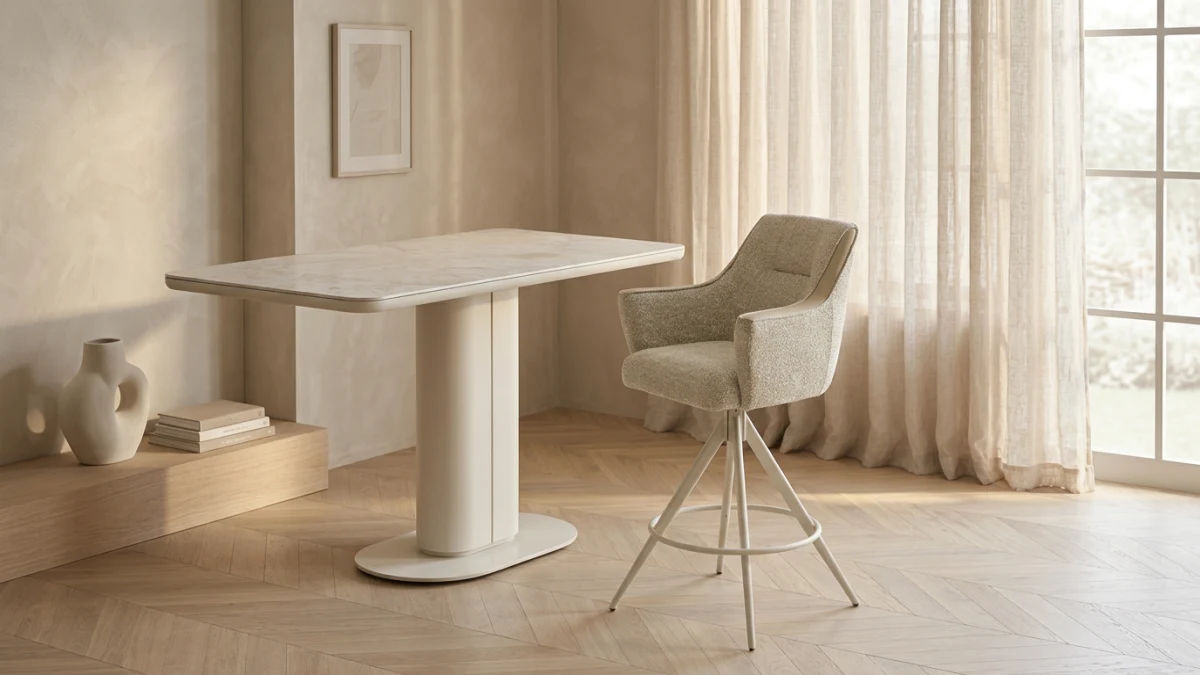
- The Kitchen Counter Stool (SKU 3): Designed specifically for standard residential kitchen islands and low hospitality counters with surface heights of 90 to 92 cm. It features a seat height of approximately 65 cm, incorporating a dedicated footrest welded at an ergonomic distance below the seat.
- The Commercial High Bar Stool (SKU 4): Engineered for high-top bar tables, commercial pub counters, and poseur tables with heights between 102 and 108 cm. With a seat height of approximately 75 cm, it uses the shared seat silhouette mounted onto an extended frame with a heavy-duty reinforced footrest.
| SKU Designation | Standard Seat Height | Matching Surface Height | Primary Target Market | Core Shared Components |
|---|---|---|---|---|
| SKU 1: Dining Side Chair | 46 – 48 cm | 75 – 76 cm | Residential Dining, Cafés | Standard Shell, Cushion, Base Fixtures |
| SKU 2: Dining Armchair | 46 – 48 cm | 75 – 76 cm | Premium Dining, Boardrooms | Base Bolt Pattern, Fabric Roll, Foam Grade |
| SKU 3: Kitchen Counter Stool | 65 cm | 90 – 92 cm | Kitchen Islands, Low Bars | Seat Upholstery, Swivel Mechanism Option |
| SKU 4: High Bar Stool | 75 cm | 102 – 108 cm | Commercial Bars, High Tables | Seat Ergonomics, Powder-Coated Metal Finish |
How Does Shared Component Furniture Design Reduce Tooling Costs and Sourcing Complexity?
The foundation of modular dining furniture sourcing lies in shared component engineering. In conventional OEM and ODM manufacturing, creating four independent seating products requires four completely separate sets of structural moulds, custom-cut plywood blanks, distinct bending fixtures, and independent packaging cartons. This increases tooling expenses and leads to complex production scheduling.
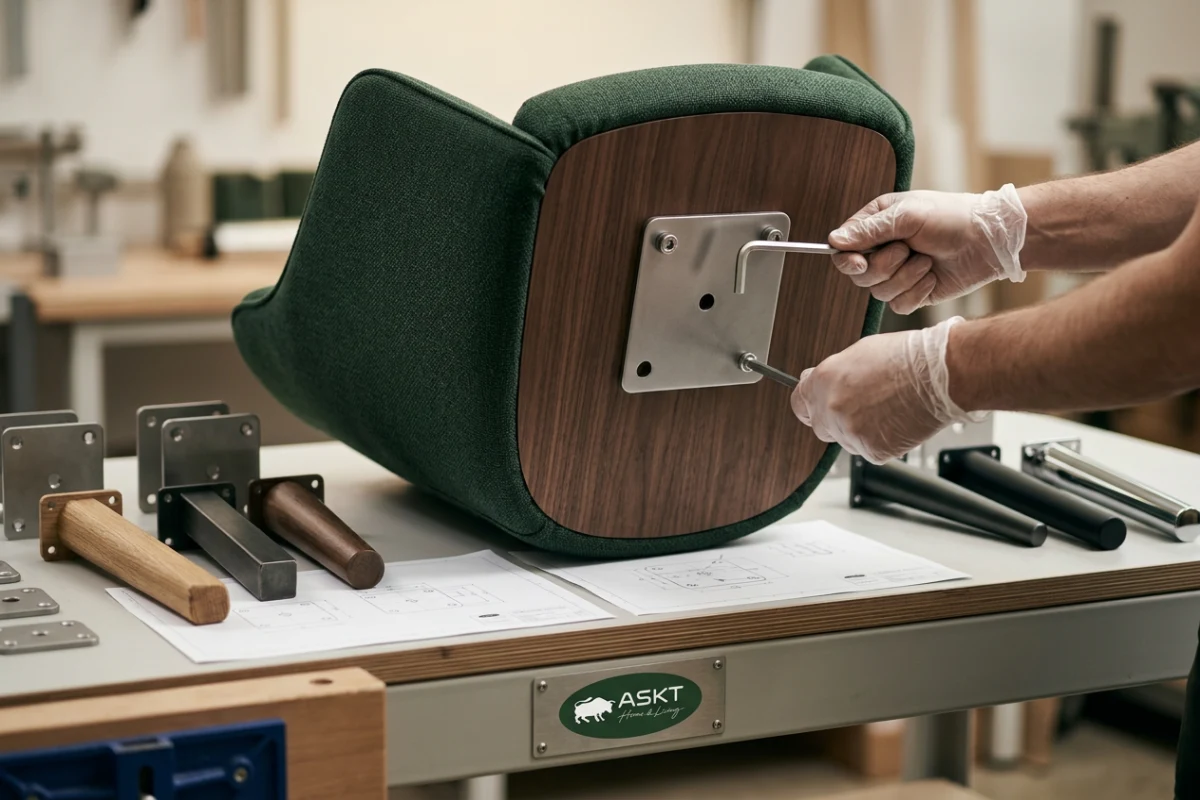
By contrast, shared component furniture design establishes standardized mechanical interfaces between the upper seating element and the lower leg or frame assembly.
- Standardized Base Mounting Pitch: Standardizing the mounting hole pitch on the underside of the seat shell allows the same upholstered seat assembly to accept a static four-legged metal frame, a spider leg frame, a 360-degree swivel plate, an auto-return swivel column, or an extended bar stool chassis without secondary drilling.
- Unified Plywood and Shell Pressing: Internal plywood structural boards or injection-moulded structural cores are pressed using a single master mould. This guarantees identical ergonomic contours, backrest recline angles, and seat curvatures across the entire four-piece collection.
- Batch Fabric Cutting and Upholstery Efficiency: Upholstery covers for side chairs and matching stools are cut from identical fabric bolts using programmed CNC cutting patterns. This maximizes textile yield, eliminates off-cut waste, and ensures identical fabric dye-lot consistency across all four models.
- Standardized Fasteners and Hardware Kits: Utilizing uniform high-tensile steel bolts, spring washers, and allen keys across all four SKUs simplifies factory assembly, reduces packaging error rates, and improves the assembly experience for the end consumer.
By centralizing structural engineering around shared components, furniture buyers eliminate redundant prototyping cycles, avoid multiple tooling charges, and significantly reduce production setup times during manufacturing runs.
How Can Buyers Successfully Execute a Dining Chair to Bar Stool Extension?
Extending a successful dining chair design into a stable counter stool and commercial bar stool requires structural calibration. A common sourcing error is simply lengthening the metal legs of a dining chair frame without adjusting the frame geometry. Elevating the center of gravity alters structural dynamics, which can create stability and durability risks if not properly engineered.
A professional dining chair to bar stool extension requires specific technical adaptations:
- Recalibrated Leg Taper and Stance Width: When seat height increases from 47 cm to 65 cm or 75 cm, the leg splay angle must be widened to expand the base footprint. This prevents tipping during ingress and egress while maintaining structural balance under heavy commercial loads.
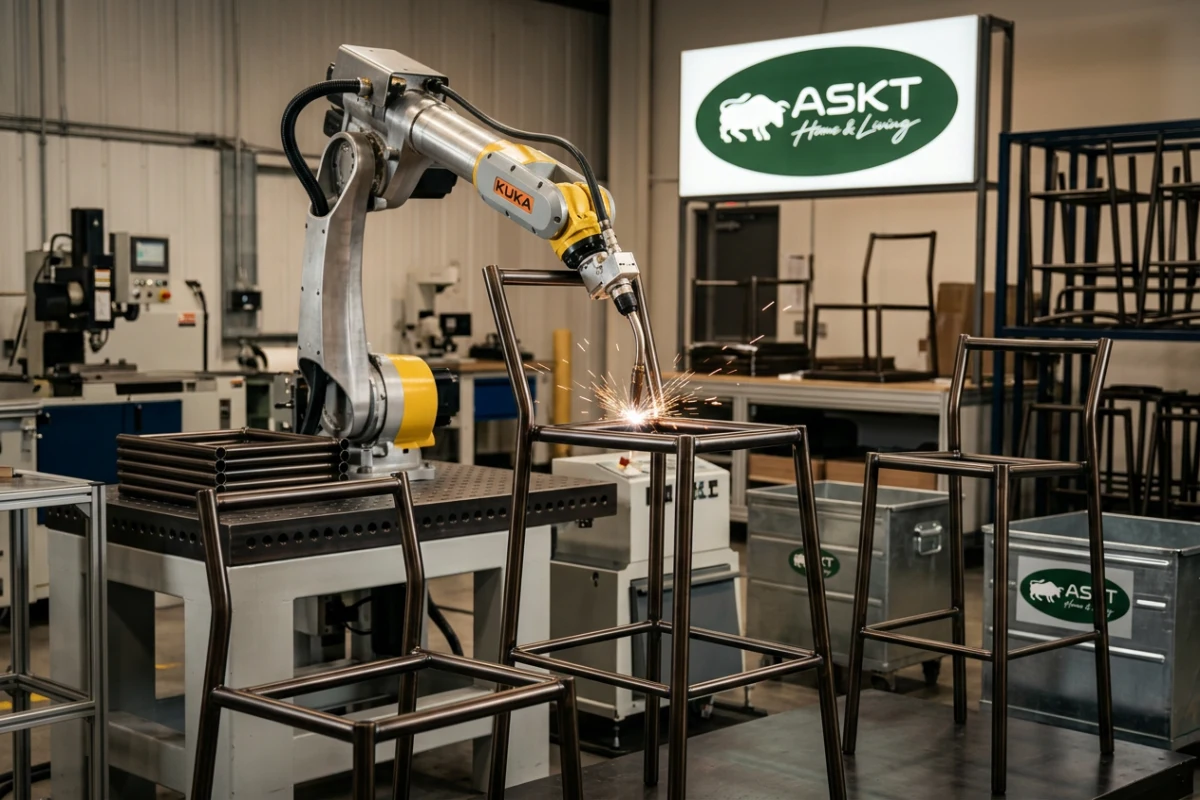
- Reinforced Footrest Integration: Elevated seating requires a rigid, load-bearing footrest. The footrest ring or crossbar must be securely welded into the leg frame approximately 20 to 25 cm below the seat line. In automated manufacturing, robotic welding ensures consistent weld penetration and structural strength.
- Proportional Backrest Balancing: A tall backrest that looks well-proportioned on a dining chair can make an elevated bar stool look heavy and shift its center of gravity backward. Modular programs often adapt the upper shell into a low-profile or medium-height backrest that preserves the core silhouette while improving visual balance and stability.
- Swivel and Auto-Return Integration: Commercial hospitality venues and modern residential kitchens often prefer rotating seating. Sourcing teams can incorporate an optional 90-degree or 180-degree auto-return swivel mechanism between the modular seat shell and the elevated base, allowing smooth movement while ensuring stools automatically return to an aligned display position.
What Logistics and Packaging Efficiencies Are Achieved Through Modular Dining Furniture Sourcing?
For European furniture importers and e-commerce brands, international freight costs and parcel delivery overhead directly dictate product profitability. Fully assembled chairs consume excessive cubic meters (CBM) in shipping containers and are vulnerable to transport damage. Modular dining collections engineered for knock-down (KD) assembly transform logistics into a competitive commercial advantage.
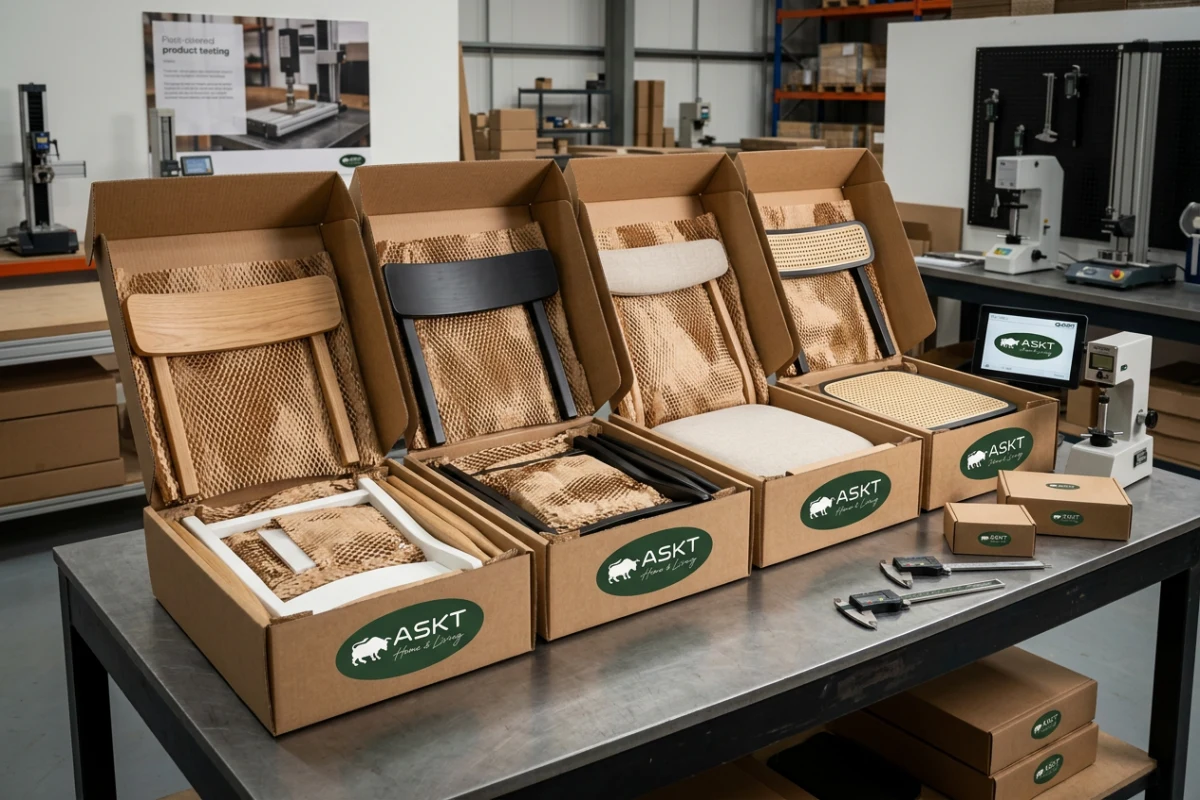
- Significant Carton CBM Reduction: Detaching the seat shell from the metal frame allows components to nest tightly inside reinforced, flat-pack cartons. This reduces packaging volume per chair by 50% to 65% compared to semi-assembled alternatives.
- Optimized Container Loading Density: A 40ft High Cube container that might only accommodate 250 to 300 pre-assembled chairs can load between 650 and 850 modular KD units. This directly reduces freight cost per unit across long-haul supply chains.
- Sustainable Packaging with Reduced Plastic Use: High-density honeycomb cardboard buffers, edge protectors, and corrugated paper sleeves replace bulky expanded polystyrene (EPS) foam. This aligns with European corporate sustainability goals and simplifies disposal for retailers and consumers.
- Standardized Carton Dimensions for Palletization: Because the four SKUs share modular components, outer master cartons can be designed with standardized modular dimensions. This simplifies pallet layout in European logistics hubs, optimizes warehouse racking, and reduces domestic pick-and-pack fulfillment costs.
| Logistics Parameter | Fully Assembled Seating | Semi-KD Seating | Modular Shared-Component KD |
|---|---|---|---|
| Average Volume per SKU | 0.28 – 0.35 CBM | 0.16 – 0.22 CBM | 0.08 – 0.12 CBM |
| 40ft HQ Container Capacity | ~240 – 280 units | ~450 – 550 units | ~650 – 850 units |
| Mixed Container Loading | Difficult (Uneven cartons) | Moderate | Highly efficient (Uniform cartons) |
| Protective Packaging | Heavy EPS foam blocks | Plastic bubble wrapping | Recyclable honeycomb paper inserts |
| Transit Damage Risk | High (Vulnerable frame joints) | Moderate | Low (Flat-packed protected components) |
Why Are Consistent Upholstery Fabrics and Metal Finishes Critical for Multi-SKU Collections?
When contract interior designers or retail consumers purchase matching dining chairs and counter stools for open-plan residential or hospitality environments, surface consistency is a core quality requirement. Sourcing different seating SKUs from separate factories frequently leads to visible batch discrepancies in fabric texture, dye lots, foam firmness, and metal coating sheen.
A unified multi-SKU collection produced under standardized quality control protocols guarantees visual and tactile consistency:
- Batch-Controlled Fabric Performance: Sourcing all four SKUs through a unified production program ensures that performance fabrics—such as waterproof, easy-clean, stain-resistant, or pet-friendly textiles—come from verified, colorfast dye lots. Specifying textiles with high Martindale abrasion ratings and verified color fastness ensures durable wear across heavy-use dining and bar seating.
- Harmonized Foam Resilience and Seating Comfort: Incorporating high-resilience upholstery foam and pocket spring seating cores guarantees identical comfort whether an end user sits at the dining table or the kitchen counter.
- Electrostatic Powder Coating Consistency: Metal leg structures, swivel plates, and footrests pass through automated pre-treatment and electrostatic powder coating lines. This creates a uniform matte, semi-gloss, or textured finish across all steel frames, preventing the color mismatches common when sourcing from disconnected suppliers.
- Material Compliance and Testing: Unified material sourcing ensures that structural frames, internal boards, foam padding, and upholstery fabrics comply with European safety, durability, and chemical standards, including relevant EN furniture testing requirements.
How Does an Agile Furniture SKU Expansion Strategy Reduce Inventory Risk and Sourcing Overhead?
A structured furniture SKU expansion strategy provides purchasing managers with commercial flexibility. In volatile consumer markets, committing large budgets to unproven standalone products ties up working capital. Sourcing a modular four-SKU collection distributes procurement risk across a balanced product mix.
- Shared Raw Material Buffer: If demand for counter stools suddenly outpaces side dining chairs, manufacturing partners can quickly route common seat shells and fabric covers into counter stool frame production without creating dead stock of obsolete parts.
- Lower Minimum Order Quantities per Variant: Factories can offer lower MOQs per SKU when the underlying components are identical across the production run. A buyer can order 200 side chairs, 100 armchairs, 100 counter stools, and 50 bar stools to complete a 450-piece container order without incurring small-batch surcharges.
- Simplified Supplier Evaluation and Quality Control: Managing one trusted manufacturing partner for an entire four-SKU collection reduces the administrative burden of conducting multiple factory audits, coordinating disconnected quality inspections, and managing disparate shipping schedules.
- Contract Tender Competitiveness: Commercial procurement teams can confidently bid on hotel, restaurant, and corporate cafeteria tenders by presenting matching seating solutions across standard dining, executive dining, lounge bar, and high-top counter zones.
What Practical OEM and ODM Development Workflow Ensures Reliable Mass Production?
Successfully bringing a customized one design four SKUs dining collection from concept to container delivery requires a structured, transparent OEM and ODM development workflow. Professional cross-border furniture sourcing depends on rigorous technical validation at each phase.
1. Conceptual Design and 3D CAD Standardization
Product managers and factory engineering teams collaborate to establish the core seat shell geometry, backrest angles, and universal mounting bolt configurations. Detailed 3D CAD models verify that frame tapers, footrest clearances, and structural gussets meet European stability and load-bearing requirements.
2. Material Specification and Swatch Approval
Upholstery fabrics, foam densities, pocket spring units, and metal powder-coating finishes are selected and documented in technical specification sheets. Physical swatch samples and metal finish swatches are signed off by the buyer to serve as quality control benchmarks for mass production.
3. Comprehensive Prototyping and Structural Testing
Physical master prototypes are fabricated for all four SKUs. Prototypes undergo rigorous in-house mechanical testing, including static seat load testing, backrest fatigue cycles, footrest downward load testing, and frame stability evaluations. Any required structural adjustments are engineered before cutting mass-production tooling.
4. KD Packaging Optimization and Drop Verification
Packaging engineers design custom master cartons utilizing protective honeycomb cardboard and molded paper edge protectors. Packed prototype boxes undergo standard drop testing and vibration simulation to ensure zero transit damage during ocean freight and final parcel handling.
5. Pilot Production Batch and Quality Inspection
A controlled pilot production run is executed to verify assembly line tolerances, robotic welding accuracy, upholstery stitch consistency, and hardware pack completeness. Detailed quality inspection reports with high-resolution photographic evidence provide full supply chain transparency before volume shipment sign-off.
By uniting design continuity, shared engineering, optimized packaging, and strict quality control, European furniture buyers can build resilient, profitable, and versatile dining collections that meet commercial demands.