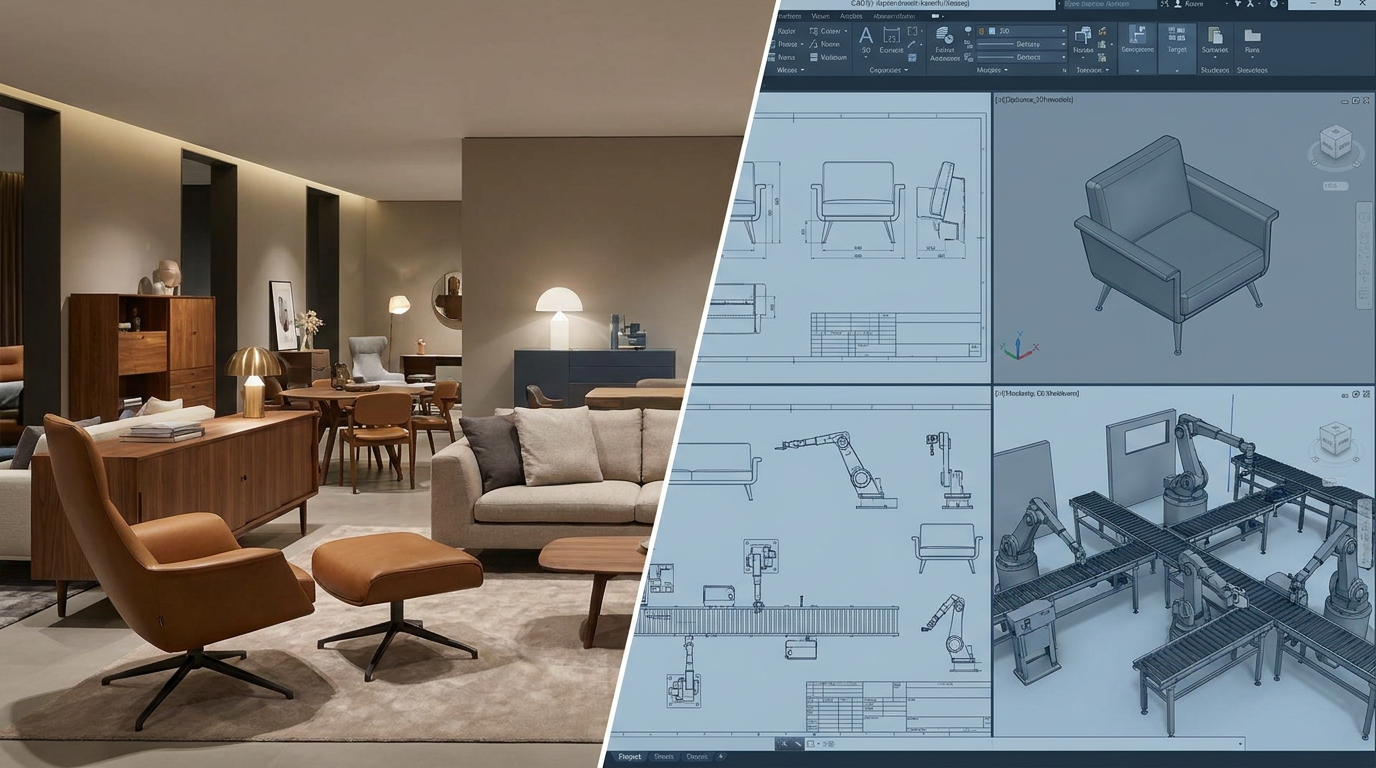
Online Furniture Sales vs Showroom Sales: A B2B Framework for Avoiding Sourcing Mistakes
Online Furniture Sales vs Showroom Sales: A B2B Framework for Avoiding Sourcing Mistakes
For Einkaufsleiter in German furniture retail.
The German furniture retail environment is currently facing unprecedented pressure. With persistent Kaufzurückhaltung (purchasing restraint) and rising operational costs, stationary trade is struggling to maintain a healthy Marge (margin) while competing with aggressive digital-first discount models. The challenge for procurement leads is no longer just about filling a Sortiment; it is about securing the bottom line against Lagerdruck (inventory pressure) and high Reklamationsquoten (complaint rates).
In this climate, the debate between sourcing via traditional showrooms versus online factory-direct channels has intensified. While showrooms offer the tactile Sitzprobe (seating test), they often carry a price premium that erodes retail margins. Conversely, online sourcing promises efficiency but introduces significant risks regarding quality and Lieferzuverlässigkeit (delivery reliability). This article provides a decision-making framework to help you navigate these trade-offs.
The Sourcing Problem: Margin vs. Security
Traditional German furniture procurement has long relied on physical showrooms and local wholesalers. This model offers security—you can touch the fabric and test the frame. However, the overhead costs of these showrooms are passed directly to you, the buyer. In a market where every percentage point of Marge is critical for survival, paying for a middleman’s showroom is becoming a luxury many retailers can no longer afford.
On the other hand, the shift toward online factory-direct sourcing is driven by the need for SKU efficiency and better pricing. Yet, without a physical touchpoint, the risk of receiving sub-standard goods increases. A high Reklamationsquote can quickly negate any initial savings made on the purchase price. The problem is finding a middle ground: the price advantage of direct sourcing combined with the quality assurance of a certified manufacturer like ASKT Furniture.
5 Fatal Mistakes in B2B Chair Sourcing
- Ignoring ISO 9001 Certification: Many online-only vendors act as mere trading companies. Without ISO 9001:2015 certification, there is no guarantee of consistent production processes, leading to unpredictable quality in large batches.
- Overestimating Liefertreue: A low price is irrelevant if the goods do not arrive in time for the seasonal Abverkauf. Many suppliers promise quick turnarounds but fail to meet the 45-day window required for stable retail planning.
- Underestimating Landed Costs: Focusing solely on the unit price without accounting for logistics, customs, and the cost of potential Reklamation (complaints) leads to a false sense of profitability.
- Rigid MOQ Requirements: Committing to massive volumes to get a discount increases Lagerdruck and ties up Cashflow. For many German retailers, a flexible MOQ of 200 pieces is the 'sweet spot' for testing new designs.
- Neglecting the Master Sample Protocol: Skipping the production-grade sample phase is the fastest way to encounter a mismatch between digital images and physical reality.
The Decision Framework: Evaluating Your Supplier
To mitigate these risks, Einkaufsleiter should use a standardized evaluation matrix when choosing between a showroom-based wholesaler and an online-capable factory like ASKT Furniture.
1. Quality Assurance and Certification
Does the supplier have a 15-year track record? ASKT Furniture, for instance, leverages over a decade and a half of manufacturing expertise to ensure that every restaurant chair or office seat meets contract-grade standards. Look for documented ISO certifications and ESPR (Ecodesign for Sustainable Products Regulation) readiness.
2. Supply Chain Agility
In the German market, the ability to react to trends is paramount. A supplier that offers a stable 45-day delivery cycle allows you to manage your Sortiment with precision, reducing the need for massive safety stocks.
3. Customization and MOQ
Can the supplier adapt to your specific project needs? The ability to provide custom finishes or fabric options at a manageable MOQ (e.g., 200 pieces) allows for a unique product offering that differentiates your store from competitors.
Comparison Matrix: Factory Direct vs. Showroom Wholesaler
| Feature | Factory Direct (e.g., ASKT) | Traditional Showroom Wholesaler |
|---|---|---|
| Marge Potential | High (Direct Pricing) | Lower (Middleman Markup) |
| Quality Verification | Certified (ISO 9001) | Physical Inspection |
| Customization | High (Direct Design) | Limited to Stock |
| Delivery Time | 45 Days (Stable) | Variable (Stock Dependent) |
| MOQ Flexibility | 200 Pieces | High or Low (Stock Dependent) |
| Risk Mitigation | Sample Protocol | Immediate Possession |
Actionable Checklist: The Procurement Lead's 10-Point Verification List
Before placing a 200+ unit order for commercial seating, ensure you have checked the following:
- Manufacturer Longevity: Does the company have at least 10-15 years of experience?
- ISO 9001 Status: Is the quality management system current and verified?
- Sample Agreement: Is there a protocol for a production-grade sample before the main run?
- Landed Cost Analysis: Have you calculated the total cost including 'Frei Haus' delivery?
- Material Specifications: Are the wood, metal, and fabric grades clearly defined in the contract?
- Lead Time Guarantee: Is the 45-day delivery window written into the terms?
- MOQ Alignment: Does the 200-piece minimum align with your current Cashflow and Lagerdruck?
- Reklamation Policy: Is there a clear process for handling defects or shipping damage?
- Sustainability Compliance: Does the product meet upcoming EU ESPR requirements?
- Communication: Is there a dedicated account manager (e.g., sunbin@asktfurniture.com) for direct updates?
FAQ: Managing Quality and Logistics from a Distance
How can I ensure product quality without a physical Sitzprobe? We recommend a 'Master Sample' protocol. ASKT Furniture provides production-grade samples that represent the exact quality of the final order. This allows you to verify comfort and durability before committing to a full container.
What happens if the Reklamationsquote is higher than expected? By choosing an ISO 9001 certified manufacturer, the inherent risk is minimized. However, a professional B2B contract should always include a clear clause for replacement or credit to protect your retail Marge.
Is a 45-day delivery realistic for global shipping? 45 days refers to the production lead time. For German retailers, total lead time planning must include the transit time to ensure the goods arrive exactly when the old Sortiment is cleared.
Conclusion: Balancing Risk and Reward
The shift away from expensive showrooms toward factory-direct online procurement is an essential step for German furniture retailers looking to protect their Marge. However, this transition must be managed with a rigorous framework that prioritizes certified quality and delivery reliability. By partnering with experienced manufacturers like ASKT Furniture, Einkaufsleiter can achieve the cost benefits of direct sourcing without sacrificing the security that their business demands.
Do you want me to send you a practical evaluation checklist or decision framework for your next seating project?