Pre-Shipment Inspection Checklist for Upholstered Dining Chairs: A B2B Procurement Guide
A comprehensive pre-shipment inspection checklist for upholstered dining chairs evaluates dimensional accuracy, frame stability, upholstery neatness, stitching integrity, swivel functionality, and export packaging before container loading. Implementing systematic upholstered dining chair quality control prevents batch defect slippage, protects retail margins, and ensures strict alignment with European commercial expectations and durability requirements.
Why is pre-shipment inspection critical for European dining chair imports?
For European furniture wholesalers, retail chains, and e-commerce importers, receiving a shipment containing structural or aesthetic defects creates severe logistical and commercial disruption. When imported goods arrive at a central warehouse or distribution centre in Germany, the Netherlands, or the UK, reverse logistics costs, customer return handling, and local sorting frequently exceed the unit value of the seating. Conducting a professional furniture pre-shipment inspection Europe standard check acts as the final gatekeeper, identifying manufacturing inconsistencies and packaging deficiencies before containers depart the factory floor.
Dining chairs experience continuous static and dynamic loading, frequent movement across hard flooring, and regular fabric abrasion during daily use. In upholstered seating, minor manufacturing oversights—such as loose seam tension, uneven foam density, or misaligned KD bolt inserts—rapidly deteriorate into structural failure or premature aesthetic wear. European retail customers and contract interior buyers hold rigorous expectations regarding sitting comfort, fabric durability, and flawless surface finishing.
Executing a structured pre-shipment inspection (PSI) allows purchasing managers and sourcing teams to verify batch consistency against approved reference samples and technical specifications. It shifts the commercial risk from the buyer's destination warehouse back to the manufacturing facility, where corrective rework, fastener adjustments, or packaging reinforcement can be executed efficiently before final container sealing.
What structural stability and dimensional checks should a dining chair inspection include?
Structural stability and dimensional precision form the foundation of dining chair safety and ergonomics. A comprehensive furniture packaging and stability testing procedure begins by verifying key functional dimensions against technical product drawings and measuring the balance of fully assembled units on a level reference surface.
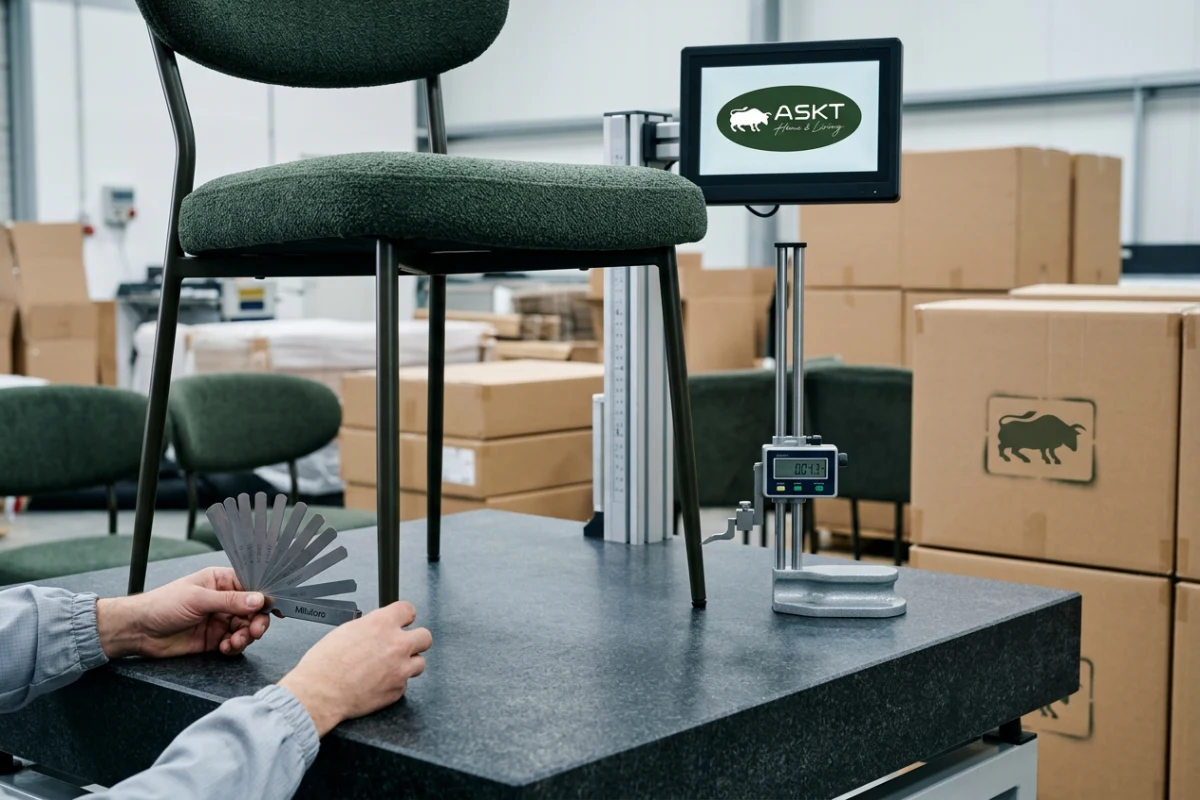
Dining chairs must sit completely flat without unweighted or weighted wobble. Even a 2 mm discrepancy in leg length or welded frame geometry creates an irritating rocking sensation on hard parquet or tiled floors, driving end-user dissatisfaction and elevating return rates across e-commerce channels.
- Seat Height and Table Clearance: Measure the vertical distance from the floor to the crown of the upholstered seat cushion. European standard dining tables require a consistent seat height between 450 mm and 480 mm to maintain comfortable thigh clearance and ergonomic posture.
- Backrest Incline and Symmetry: Verify backrest height, width, and lumbar contour angles against master technical specifications. Inspectors should check both left-to-right visual symmetry and rearward angle consistency across multiple production samples.
- Four-Leg Planar Contact and Levelling: Place the assembled chair on a flat, calibrated surface plate. Check for any diagonal rocking motion under zero load using feeler gauges, ensuring leg level variation does not exceed acceptable thresholds.
- Static Load and Proof Resistance: Apply sustained downward pressure across the seat pan to verify that frame joints, internal seat boards, and leg mounting plates withstand required proof loads without cracking, weld separation, or structural creaking.
- Dynamic Backrest Fatigue Testing: Apply repetitive horizontal rearward force against the upper backrest to confirm that internal steel frames, plywood shells, and structural fasteners absorb repeated leaning cycles without loosening.
| Inspection Parameter | Measurement Method | Standard Tolerance | Commercial Impact for Importers |
|---|---|---|---|
| Seat Height (Crown) | Calibrated height gauge from level floor | +/- 5 mm | Ensures uniform clearance with European dining tables |
| Total Width & Depth | Measuring tape along outer envelope | +/- 5 mm | Determines carton size, pallet fit, and container loading efficiency |
| Leg Level / Flatness | Feeler gauge on flat reference plate | <= 1.5 mm | Prevents wobbling and floor scratching in retail showrooms |
| Static Load Capacity | Sustained mechanical press or test weight | Full commercial rating | Eliminates safety liability and structural return risks |
How do you inspect upholstery fabrics, foam resilience, and stitching quality?
Upholstery craftsmanship directly establishes the visual appeal and perceived value of a dining chair in retail showrooms and online catalogues. Surface irregularities, fabric puckering, crooked stitching, or colour variance can trigger immediate customer hesitation. Applying a detailed pre-shipment inspection checklist for upholstered dining chairs ensures that fabrics, cushioning foams, and tailoring meet precise commercial standards.
Inspectors must examine fabric surfaces under standard neutral lighting, comparing production units directly against approved master colour swatches. For performance covers—such as waterproof, easy-clean, or pet-friendly fabrics—the inspection must confirm that material treatments have not altered the hand-feel, breathability, or surface softness of the upholstery.
- Fabric Surface and Colour Consistency: Check fabric rolls and finished shells for dye lot shading, yarn irregularities, weaving flaws, and surface pilling. Velvet, chenille, and textured weaves must maintain consistent nap direction across all chairs within the same production batch.
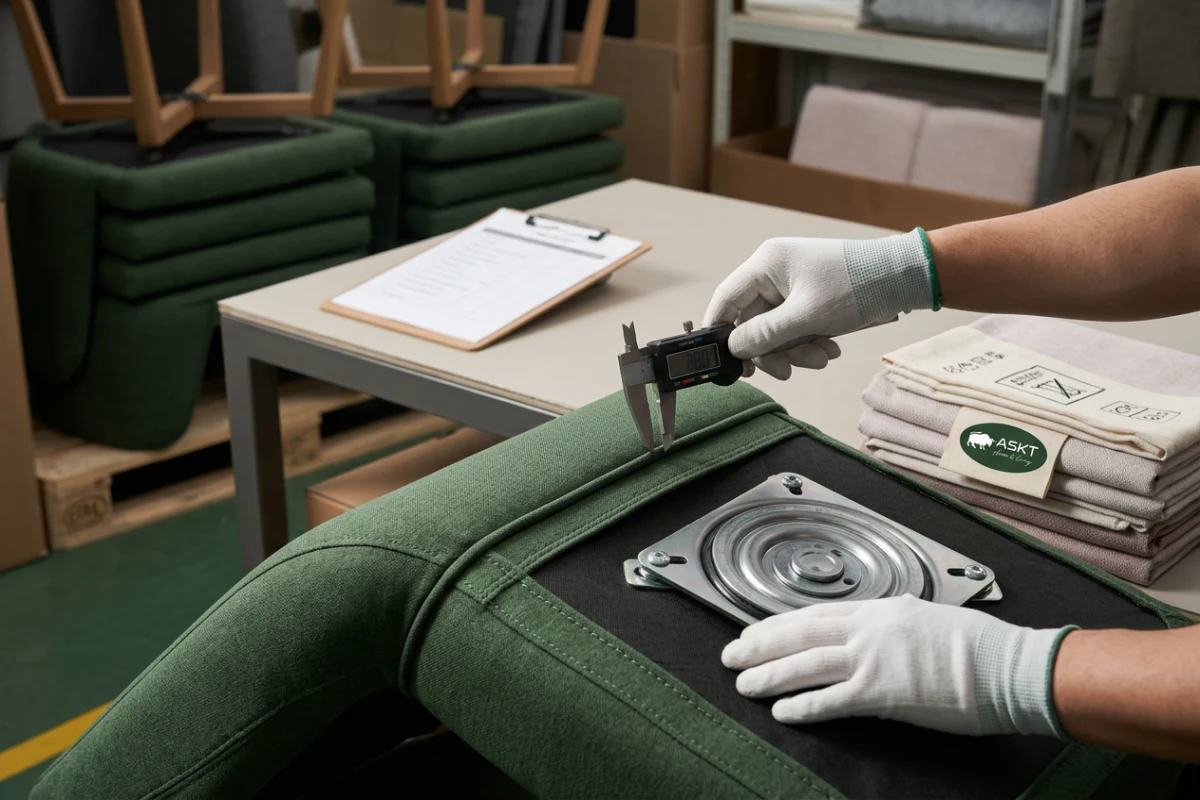
- Seam Straightness and Stitch Density: Measure stitch density along primary seams and decorative piping. Stitches must remain straight, tightly tensioned, and uniformly spaced, with reinforced double stitching applied to high-stress junctions where the seat meets the backrest.
- Foam Density and Rebound Performance: Depress the seat cushion firmly and evaluate the speed and completeness of foam recovery. High-resilience seating foam and pocket spring cores should rebound immediately to their original contour without leaving residual surface wrinkles, hollow spots, or indentations.
- Puckering and Welt Cord Alignment: Examine curved corners and tight radiuses for unwanted gathering, puckering, or uneven fabric tension. Welt lines, decorative seams, and piping must track parallel to the frame profile without wavering.
- Odour and Cleanliness: Inspect the finished upholstery for solvent or chemical adhesive odours. High-quality production lines utilize eco-friendly, low-odour water-based adhesives to ensure goods arrive fresh and ready for immediate unboxing in European homes.
What checks are required for metal frames, powder coating, and swivel mechanisms?
Metal components provide structural rigidity and modern aesthetics in contemporary dining furniture. Deficiencies in metal preparation, welding, or surface finishing lead to premature corrosion, flaking paint, or mechanical failure. Thorough upholstered dining chair quality control mandates rigorous inspection of metal subframes, exposed legs, and integrated rotation mechanisms.
- Weld Cleanliness and Joint Integrity: Examine all welded connections between leg tubes, mounting plates, and cross-braces. Welds must show full penetration, uniform bead width, zero porosity, and smooth grinding without sharp weld spatter or burrs.
- Powder Coating Adhesion and Finish Uniformity: Inspect powder-coated surfaces for uniform film thickness, smooth texture, and absence of orange peel texture, pinholes, or paint runs. Perform cross-hatch adhesion and scratch resistance checks to ensure the coating resists impact from shoes, vacuum cleaners, and cleaning equipment.
- Tube End Finishing and Floor Glides: Verify that metal tube ends are cleanly deburred and fitted with heavy-duty plastic or felt floor glides. Glides must fit tightly inside or over tube profiles so they do not dislodge during transit or regular dragging across floors.
- Swivel and Auto-Return Functionality: For dining chairs featuring 180-degree or 360-degree rotation, test the swivel mechanism across multiple full-rotation cycles. The auto-return mechanism must rotate smoothly and quietly, returning the seat shell reliably to its forward-facing centre point without binding, grinding, or excessive play along the central vertical axis.
| Metal & Mechanism Check | Inspection Method | Key Acceptance Standard | Common Defect Risk |
|---|---|---|---|
| Weld Joint Quality | 100% visual and tactile check on joints | Continuous bead, zero spatter or sharp burrs | Joint separation or consumer injury from rough edges |
| Powder Coating Quality | Visual check under bright light and scratch test | Uniform colour, full edge coverage, no bare metal | Premature rusting, paint peeling, or transit scuffing |
| Auto-Return Swivel | Multi-cycle rotation and release trial | Smooth return to 0° centre, zero axial wobble | Off-centre resting position, mechanical clicking noises |
| Floor Protector Glides | Manual extraction and pull resistance test | Securely seated, flush fit, non-marking material | Scratched hardwood floors, missing glides upon arrival |
How do you evaluate knock-down (KD) hardware and ease of assembly?
Most exported dining chairs utilize Knock-Down (KD) structures to reduce packaging dimensions and optimize ocean freight efficiency. However, KD designs introduce potential assembly challenges for retail staff and end consumers. If pre-drilled holes fail to align or bolt threads bind, product assembly becomes frustrating, resulting in negative product reviews and increased customer service inquiries.
The inspection team must conduct live assembly tests on randomly selected KD units from the production batch, simulating the exact unboxing and assembly process experienced by the customer.
- Hardware Completeness and Packaging: Verify that every carton contains the exact quantity of bolts, spring washers, flat washers, Allen keys, and spare parts specified in the bill of materials. Hardware must be vacuum-sealed in labelled blister packs or secure pouches rather than loose in the box.
- Thread Alignment and Insertion Smoothness: Test bolt engagement into internal threaded metal inserts or weld nuts. Bolts should thread smoothly by hand for the first few turns without cross-threading, excessive friction, or metal burr resistance.
- Hole Alignment Between Frame and Shell: Check that mounting holes on metal leg spiders or cantilever bases align precisely with threaded inserts in the upholstered seat shell without requiring manual bending, prying, or redrilling.
- Assembly Manual Accuracy: Inspect the included multi-language assembly instructions. Diagrams must clearly illustrate part orientations, bolt sizing, washer placement, and step-by-step tightening sequences.
What packaging protection and container loading protocols prevent transit damage?
Even a flawlessly manufactured chair can arrive compromised if export packaging fails to protect it during maritime transit and local parcel delivery. Ocean shipping exposes furniture cartons to stacking compression, container humidity, and repeated handling across ports and distribution hubs. A disciplined pre-shipment inspection includes rigorous verification of packaging materials, carton construction, and palletization schemes.
Packaging design must balance robust physical protection with European market preferences for sustainable, recyclable materials, prioritizing heavy-duty corrugated board and honeycomb paper inserts while minimizing single-use plastic waste.
- Carton Board Grade and Structural Rigidity: Verify that shipping cartons use high-grade double-wall corrugated cardboard with sufficient edge crush resistance to withstand heavy multi-layer stacking inside 40ft High Cube containers.
- Internal Cushioning and Surface Isolation: Check that upholstered seat shells and metal leg assemblies are separated by protective foam wrapping, non-woven fabric sleeves, or molded corrugated corners to prevent metal-on-fabric friction during transit.
- Hardware Pack Isolation: Ensure that metal hardware packs are taped securely to carton interiors or positioned in dedicated compartments where they cannot contact upholstered surfaces.
- Carton Markings and Barcode Verification: Check that outer carton printing matches the purchase order, including SKU numbers, product descriptions, gross/net weights, country of origin, handling symbols, and scannable EAN-13 barcodes.
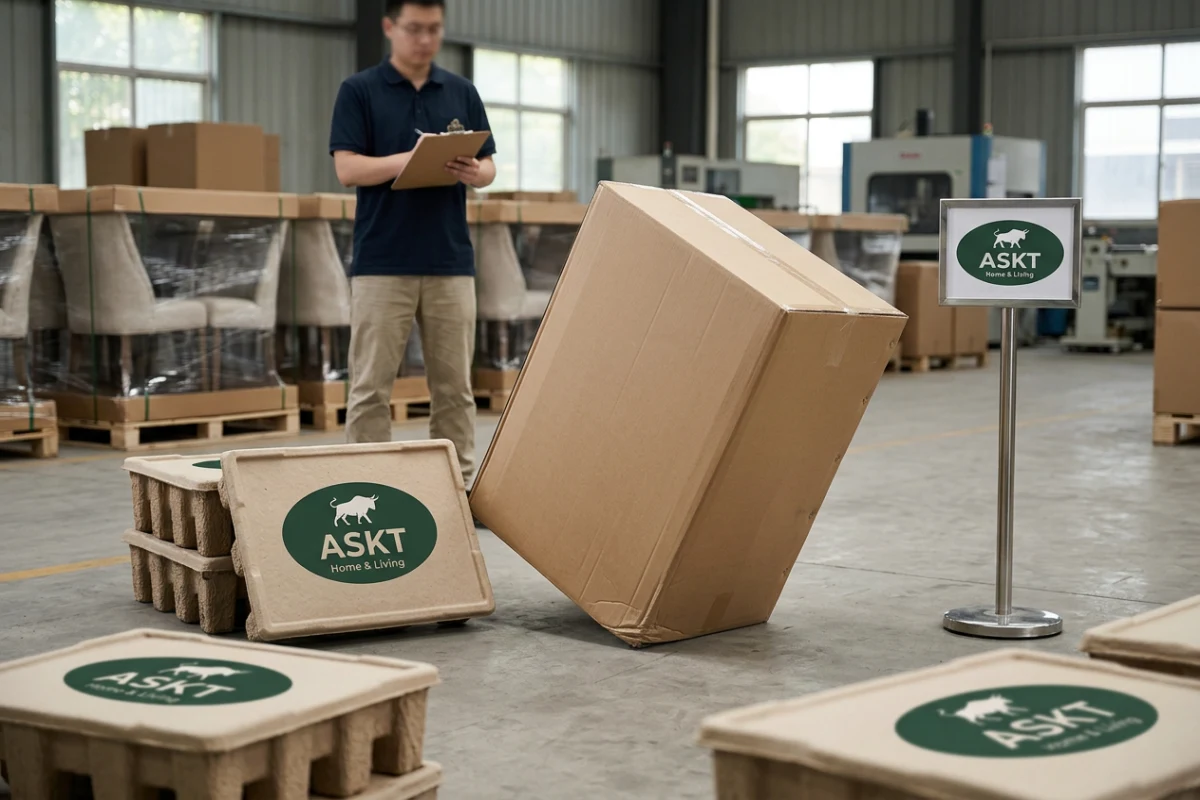
- Carton Drop Testing Protocol: Conduct carton drop tests on fully packed production units, executing corner, edge, and face drops to confirm that internal packaging absorbs kinetic shocks without damaging the chair structure or upholstery.
What dining chair defect acceptance criteria should buyers establish?
Clear, standardized dining chair defect acceptance criteria eliminate subjective disputes between factory production managers and international quality inspectors. Categorizing potential issues into Critical, Major, and Minor defects provides an objective foundation for batch release decisions under international inspection standards.
- Critical Defects: Flaws that pose safety hazards, create legal non-compliance, or render the chair dangerous to use. Critical defects result in immediate batch rejection.
- Structural weld failure or cracked internal seat frames under load.
- Exposed sharp screws, broken staples, or unground metal burrs on touch points.
- Severe balance defects causing the chair to tip over during normal sitting.
- Missing key safety or warning labels required by regional regulations.
- Major Defects: Issues that compromise product durability, reduce structural lifespan, or result in immediate retail return and customer dissatisfaction.
- Leg height mismatch causing noticeable rocking or wobbling over 1.5 mm.
- Stripped internal bolt threads or missing assembly hardware.
- Torn, stained, punctured, or noticeably puckered upholstery fabric.
- Open seams, missed stitching, or failed auto-return swivel mechanisms.
- Noticeable colour mismatch between chairs packed in the same set.
- Minor Defects: Slight cosmetic imperfections that do not impair structural stability, comfort, or safety, but deviate from premium craftsmanship standards.
- Small trimmable loose threads under the bottom dust cover.
- Minor pressure marks on velvet or textured fabrics that brush out easily.
- Slight paint touch-ups on non-visible bottom mounting brackets.
- Minor external carton scuffing that leaves the structural box intact.
| Defect Classification | Typical Inspection Threshold | Immediate Action Required | Manufacturing Remedy |
|---|---|---|---|
| Critical Defect | Zero tolerance (0 items allowed) | Immediate batch hold; quarantine entire lot | Full structural re-engineering or 100% component replacement |
| Major Defect | Strict batch tolerance (e.g. AQL 1.5 / 2.5) | Rework failed units; re-sample before container release | Re-jig welding fixtures, replace defective fabric shells |
| Minor Defect | Standard tolerance (e.g. AQL 4.0) | Factory on-line correction during final packing | Trim loose threads, steam fabric pile, clean carton exteriors |
How does ASKT support European furniture buyers with transparent quality control?
Achieving consistent quality across large-scale furniture production runs requires a combination of automated precision machinery, systematic material evaluation, and transparent quality tracking at every manufacturing stage. With over 20 years of dedicated B2B manufacturing and export experience serving wholesalers, retail chains, and contract buyers across Germany, the Netherlands, the UK, Poland, Switzerland, and Ireland, ASKT bridges large-scale manufacturing capability with stringent European quality benchmarks.
ASKT specializes in contemporary dining chairs, dining tables, bar chairs, and lounge seating, emphasizing structural reliability, refined upholstery detailing, and logistics optimization:
- Precision Manufacturing and Automated Processing: Utilizing automated fabric cutting systems, robotic welding arms, and precise CNC board drilling ensures that seat shells, metal frames, and KD hardware align consistently across thousands of production units.
- Advanced Upholstery and Performance Fabrics: ASKT offers an extensive selection of cover options, including soft velvets, textured bouclés, structured flatweaves, and high-performance easy-clean and pet-friendly fabrics engineered for high abrasion resistance and colour fastness.
- Engineered Internal Structures: From robust pocket spring seat cores providing long-lasting sitting comfort to heavy-duty auto-return swivel turntables, internal components are built to resist structural fatigue under continuous commercial and residential use.
- Logistics and Container Optimization: By engineering modular KD frames and space-efficient packaging solutions, ASKT helps European importers maximize container loading capacities, reduce per-unit shipping costs, and minimize transit damage risks.
- Transparent Quality Assurance: ASKT provides comprehensive pre-shipment inspection reporting, including dimensional verification, photo documentation, stability assessments, and drop-test validation prior to every container departure.
Whether developing bespoke OEM designs or sourcing core dining collections, partnering with an experienced, transparent manufacturer ensures dependable product consistency and protects your brand reputation in competitive retail markets.
Looking to streamline your furniture quality assurance or establish a tailored pre-shipment inspection protocol for your upcoming collection? Benötigen Sie eine projektspezifische PSI-Checkliste? Senden Sie uns Ihre Qualitätsanforderungen.