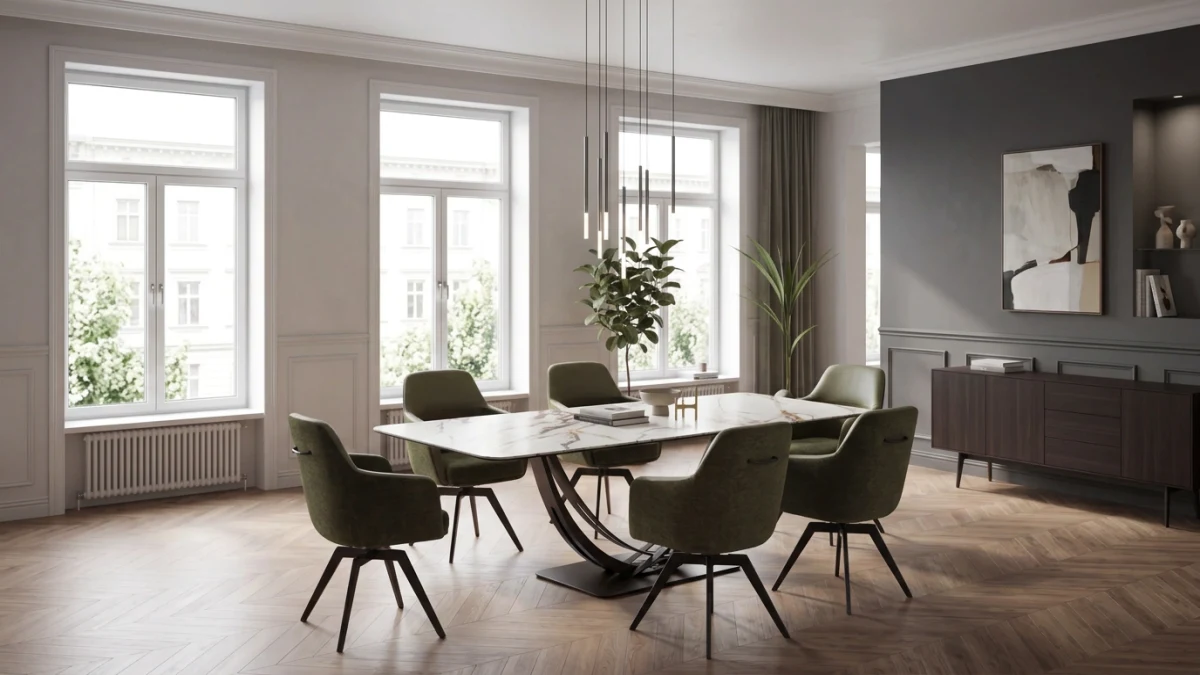
How to Build a Profitable Dining Table Collection: Sourcing and Assortment Planning Guide for Furniture Retailers
Building a profitable dining table collection for retailers requires aligning durable surface materials like sintered stone and oak veneer with defined consumer price tiers, engineering knockdown (KD) structures to maximize container loading efficiency, and standardizing chassis components across table lines. By balancing high-volume fixed models with premium extendable designs, commercial furniture buyers protect retail margins against freight volatility, minimize transit damage claims, and maintain reliable inventory turnover across European retail channels.
How Should Retailers Structure Price Tiers and Assortment Mix for Maximum Commercial Profitability?
Effective dining table assortment planning for retailers starts with a disciplined multi-tier portfolio structure. A common challenge in retail showroom management is margin cannibalization, where entry-level products undermine higher-tier sales without delivering compensatory volume. Conversely, an assortment weighted too heavily toward premium bespoke designs risks sluggish inventory turnover and excessive working capital lockup. To achieve sustained furniture retail margin optimization, commercial buyers segment their collections across three distinct tiers: entry, core, and premium.
- Entry-Level Volume Drivers: These models serve as price anchors and showroom traffic drivers. Typically featuring fixed-top surfaces with oak veneer or durable engineered wood finishes supported by streamlined powder-coated steel legs, these tables emphasize cost-effective construction and swift assembly. While gross margin percentages on entry models are comparatively modest, their fast stock rotation supports cash flow and attracts entry-level residential customers.
- Mid-Market Core Assortment: Representing the bulk of sales volume for European furniture stores and e-commerce platforms, the core tier focuses on family dining requirements. Products in this range incorporate dependable extension mechanisms, refined oak veneer grain selections, and textured powder-coated metal frames. This tier balances healthy profit margins with broad demographic appeal across suburban and urban family households.
- Premium and Flagship Margin Drivers: Positioned at the top of the collection, these tables incorporate advanced sintered stone surfaces, architectural base profiles, and synchronised extension hardware. Flagship pieces command higher unit prices and gross margins, offsetting their lower inventory turnover by generating substantial net margin per transaction.
| Collection Tier | Typical Dimensions | Core Materials & Mechanisms | Key Commercial Role | Target Retail Margin Focus |
|---|---|---|---|---|
| Entry Tier | 140 × 80 cm / 160 × 90 cm | Oak Veneer / Engineered Substrates, Basic Metal KD Legs | Footfall generation, volume sales, rapid stock turn | Volume turnover, competitive price positioning |
| Core Tier | 160 × 90 cm / 180 × 90 cm (Extendable) | Oak Veneer, Matt Lacquered Metal Bases, Butterfly Leaf | Primary revenue driver, broad family market appeal | Balanced gross margin, steady inventory velocity |
| Premium Tier | 180 × 90 cm / 200 × 100 cm (Extendable) | Sintered Stone Tops, Architectural Metal Bases, Synchronised Glides | Margin driver, design statement, upscale showroom presence | High cash margin per unit, low discounting risk |
Sourcing teams must evaluate landed product profitability rather than factory-gate purchase prices alone. Bulky furniture items absorb substantial ocean freight and domestic warehouse handling costs. Every table SKU must justify its cubic metre (CBM) consumption by delivering adequate net margin return per pallet position.
Which Core Tabletop and Frame Materials Deliver the Best Return on Investment for European Retailers?
Material selection dictates showroom appeal, consumer durability, warranty claim frequency, and long-term customer satisfaction. When developing a commercial collection, buyers frequently weigh modern surface performance against traditional timber aesthetics.
Strategic Advantages of Sintered Stone Dining Table Sourcing
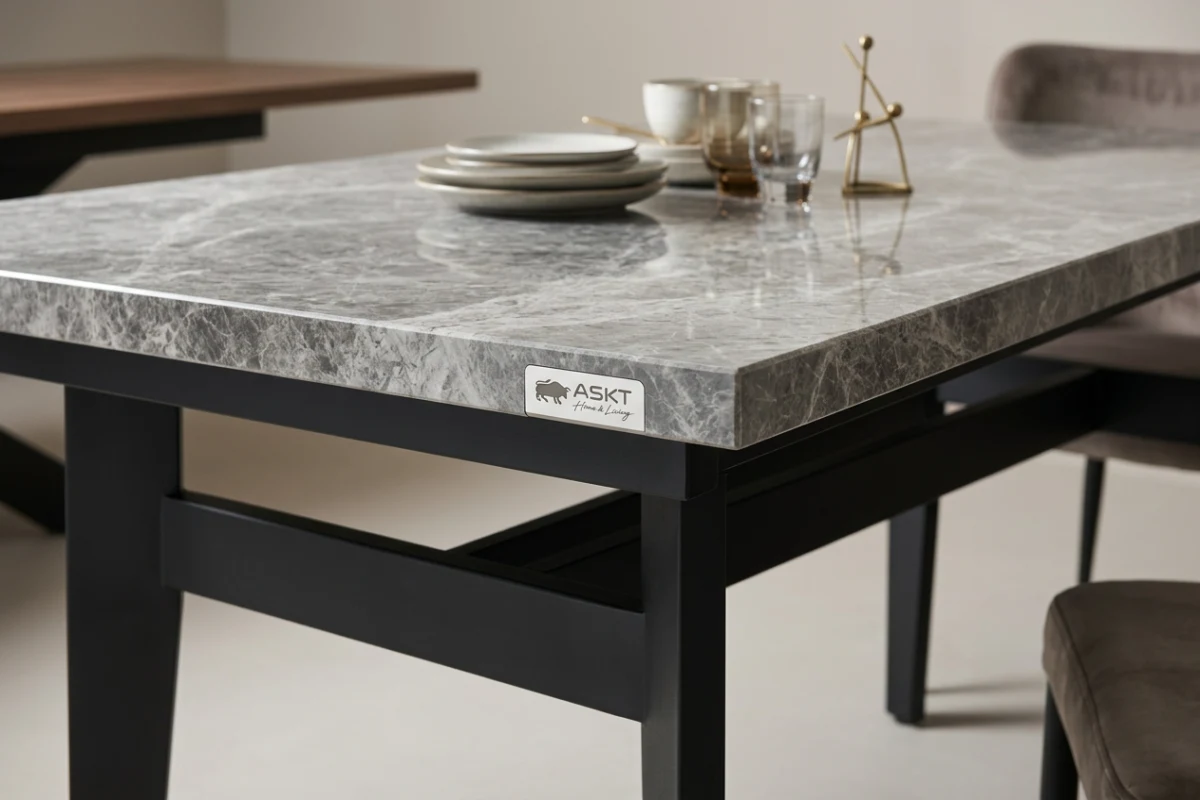
Sintered stone dining table sourcing has transformed European dining room categories. Engineered by subjecting natural mineral components to intense compaction and high-temperature thermal treatment, sintered stone slabs provide exceptional material stability for modern dining spaces:
- Superior Surface Resilience: Sintered stone surfaces resist scratches from cutlery, abrasions, and household impacts, eliminating the surface degradation common with softer materials.
- Heat and Stain Resistance: The non-porous surface structure prevents penetration by red wine, cooking oils, coffee, or household acids. Consumers can place warm dishes directly on the tabletop without discolouration or thermal shock marks.
- Low Commercial Return Rates: When properly bonded to supportive backing substrates (such as engineered timber or composite boards) and edge-cushioned for transport, sintered stone tables experience minimal after-sales claims, protecting retail profit margins.
The Enduring Appeal of Oak Veneer
While ceramic and sintered surfaces dominate contemporary minimalist settings, natural oak veneer remains a staple across Germany, the Netherlands, the UK, and Scandinavian markets. Oak veneer bonded to high-density composite substrates delivers the tactile warmth, organic grain variations, and authentic character of real wood without the structural vulnerabilities of solid timber. Solid wood boards often warp, cup, or split under changing seasonal indoor heating and humidity conditions. Quality oak veneer delivers authentic wood aesthetics while maintaining dimensional consistency across container shipments.
Metal Frames and Protective Powder Coating
Metal undercarriages and leg structures provide structural rigidity while maintaining a slim physical profile. Tubular steel and aluminium legs treated with electrostatically applied powder coating resist corrosion, chipping, and standard vacuum cleaner impacts. Standardized metal frames also allow uniform quality control during automated welding and drilling processes, ensuring that screw holes and mounting plates align precisely during customer assembly.
| Material Category | Aesthetic Style | Durability & Maintenance Profile | After-Sales Claim Risk | Key European Regional Appeal |
|---|---|---|---|---|
| Sintered Stone | Sleek, modern, architectural | Outstanding scratch, heat, and stain resistance; non-porous | Low (when supported by proper substrate backing) | DACH, Benelux, UK modern urban markets |
| Oak Veneer | Warm, organic, Scandinavian / Nordic | Natural grain tactile feel; requires lacquered protection | Moderate (susceptible to heavy liquid standing or deep gouges) | Germany, UK, Scandinavia, Netherlands |
| Powder-Coated Metal | Industrial, contemporary minimalist | High structural rigidity; resistant to impact and rust | Very Low (stable manufacturing tolerances) | Universal demand across all European markets |
How Can Assortment Dimensions and Extension Mechanisms Address European Residential Floorplans?
Assortment planning must align with regional residential architecture. European urban centres face declining average apartment floor areas, while suburban single-family homes retain open-plan kitchen and dining zones. Retailers that offer only fixed large-scale tables miss urban apartment shoppers, while exclusively compact ranges fail suburban family buyers.
Core Dimension Segments for European Housing
- Urban Compact (120 × 80 cm extending to 160 cm, or 140 × 80 cm fixed): Engineered for apartment living, terraced homes, and combined kitchen-living spaces across the UK, the Netherlands, and European metropolitan areas. Seats four diners for daily use and extends to accommodate six guests.
- Standard Household (160 × 90 cm extending to 200 cm, or 180 × 90 cm fixed): The staple dining table specification across German, Swiss, and Irish suburban residences. Accommodates six diners comfortably for everyday meals and expands for weekend social gatherings.
- Entertaining Scale (200 × 100 cm extending to 260 cm, or 220 × 100 cm fixed): Designed for spacious open-concept residential builds, dedicated dining rooms, and executive hospitality environments, seating eight to ten people.
Extension Mechanism Sourcing: Butterfly Leaves vs. End-Pull Systems
To deliver flexible table capacity without multiplying inventory stock codes, furniture retailers rely on two primary mechanical extension concepts:
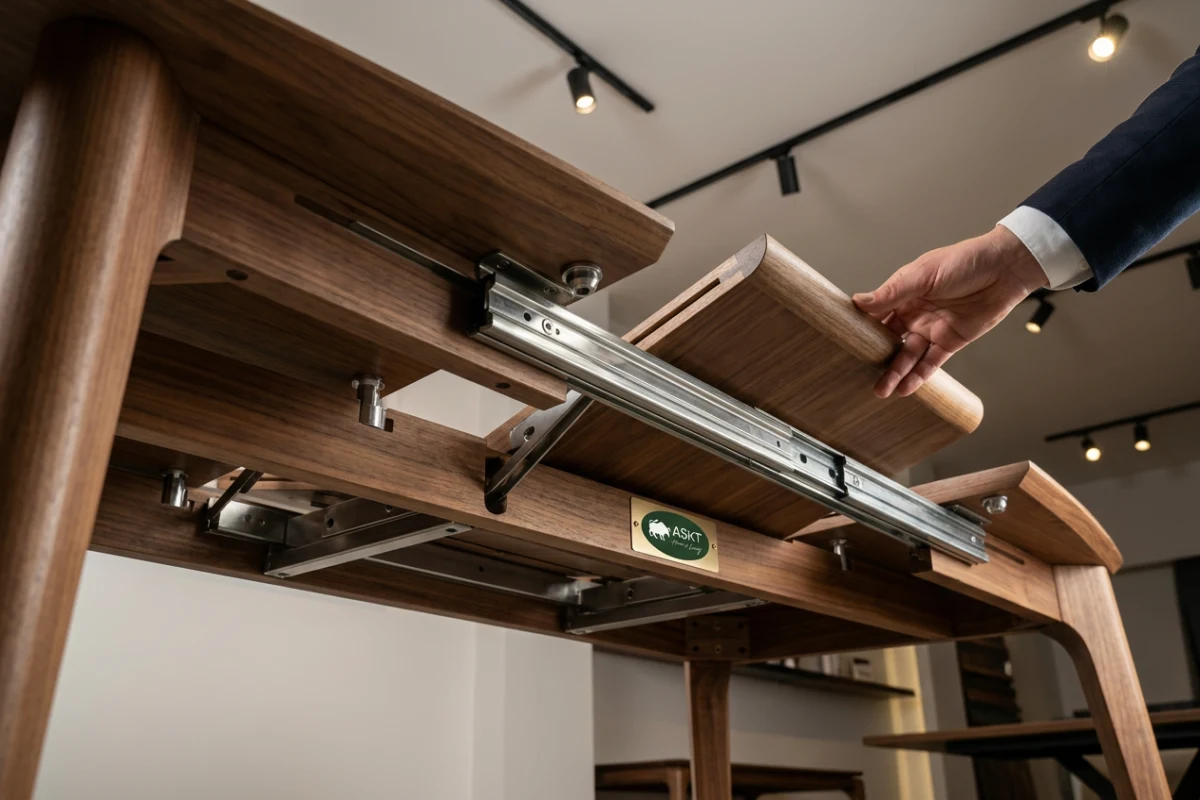
- Centre Butterfly Extension Systems: A split-top design houses a self-storing folding leaf beneath the main surface. Releasing under-table locks and separating the table halves allows the central butterfly leaf to pivot smoothly into position. This format preserves visual balance and symmetry, making it a dependable seller in mid-tier and premium collections.
- End-Pull and Telescopic Runner Systems: In this configuration, extension leaves emerge from one or both table ends on concealed metal glide tracks. In many designs, the legs slide outward with the frame, ensuring that table legs remain at the table corners and never obstruct guest seating. End-pull tables allow quick single-handed operation without disturbing table decorations at the centre of the surface.
How Can Retailers Coordinate Dining Tables and Chairs to Prevent Inventory Risk and Drive Basket Size?
One of the most frequent causes of margin erosion in furniture retail is catalog fragmentation. Sourcing tables and dining chairs from disconnected factories with mismatched metal finishes, inconsistent powder-coat textures, and conflicting wood stains leads to display disharmony, lower conversion rates, and unsold standalone stock.
Modular Design and Cross-Collection Harmony
Retailers increase transaction value by presenting curated dining collections. When dining chair metal legs share identical powder-coat textures (such as matte black sandy finishes) with dining table bases, floor sales staff can bundle complete dining sets. Coordinating fabric tones on upholstered chairs—such as textured bouclé, pet-friendly woven fabrics, or easy-clean microfibres—with the undertones of sintered stone slabs or natural oak veneers elevates the perceived quality of the entire dining department.
Chassis Standardization and SKU Rationalization
To prevent capital from being tied up in excessive unique table parts, sourcing teams adopt modular undercarriage strategies. A single engineered metal base chassis can be paired with multiple interchangeable tabletop surfaces:
- Base Chassis Type A: Compatible with Grey Marble Pattern Sintered Stone Top (160 × 90 cm).
- Base Chassis Type A: Compatible with Matte White Sintered Stone Top (160 × 90 cm).
- Base Chassis Type A: Compatible with Natural Oak Veneer Top (160 × 90 cm).
By sharing leg sets, structural rails, and hardware fittings across several tabletop options, retailers reduce factory minimum order quantities (MOQs), optimize container loading plans, and lower warehouse inventory carrying costs.
How Does Knockdown (KD) Packaging and Container Loading Optimization Protect Retail Gross Margins?
In international furniture procurement, shipping inefficient packaging destroys retail profitability. Tables that ship semi-assembled waste shipping volume, leading to high landed freight costs per unit and increased transit handling damage.
Principles of Knockdown (KD) Table Engineering
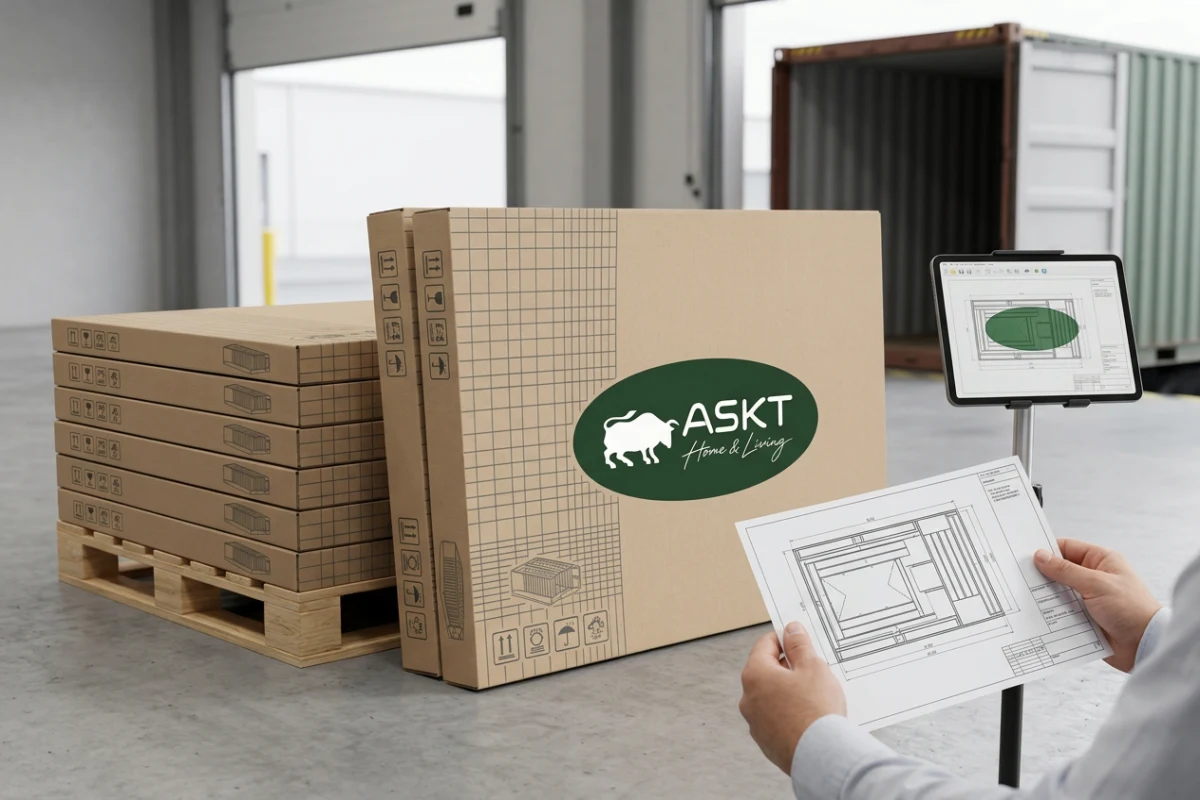
- Detachable Leg and Frame Architecture: Structural metal legs and undercarriage rails must disassemble into flat profiles that pack parallel to the tabletop within a compact master carton or a streamlined two-carton system for oversized models.
- Threaded Metal Inserts: Wood screws driven directly into timber or composite substrates weaken over repeated assembly cycles. Professional KD engineering incorporates embedded machine-threaded metal inserts in the tabletop underside, enabling smooth bolt installation and secure structural rigidity without stripping materials.
- Pre-Fitted Mechanical Sub-Assemblies: While legs remain detachable for flat packing, internal extension runners and folding leaf hinges should be pre-installed and aligned at the manufacturing plant. This minimizes consumer home assembly time to under fifteen minutes while preserving flat carton dimensions.
Sustainable Packaging Engineering and Transit Protection
European commercial buyers and end consumers increasingly demand sustainable packaging methods with reduced expanded polystyrene (EPS) plastic foam. Advanced export packaging utilizes high-density honeycomb paperboard, reinforced corner guards, and recyclable protective wraps.
To safeguard delicate surfaces and edges during container handling and domestic courier delivery, packaging must undergo rigorous testing:
- Multi-Point Drop Testing: Drop test routines evaluate carton corners, long edges, and surface panels to confirm that packaging buffers absorb shock without transferring stress to sintered stone corners or veneer edging.
- Stacking and Clamp Testing: Verifies that flat-pack cartons withstand multi-layer warehouse vertical compression without panel bowing or internal surface friction marks.
| Packaging Method | Average Units per 40HQ Container | Warehouse Stacking Efficiency | Transit Claim Risk | Landed Freight Cost Impact |
|---|---|---|---|---|
| Semi-Assembled Packaging | 120 – 160 units | Low (irregular carton footprints) | Higher edge impact exposure | High freight cost per unit, margin compression |
| Optimized KD Flat Packaging | 320 – 480 units | High (uniform flat-pack stacking) | Low (dense honeycomb & corner protection) | Low freight cost per unit, margin optimization |
What Technical Capabilities and Quality Control Processes Are Essential in a Dining Table OEM ODM Manufacturer?
Choosing the right production partner determines whether a retail furniture program scales successfully or encounters delivery delays and customer warranty disputes. When evaluating an experienced dining table OEM ODM manufacturer, retail purchasing managers must evaluate structural capabilities, customization flexibility, and quality control transparency.
Structural Testing and European Standards Awareness
A dependable manufacturing partner must design and evaluate products in accordance with European domestic furniture requirements (such as EN standards for domestic furniture strength, mechanical safety, static load capacity, and durability). Key factory evaluations include:
- Static Load and Edge Fatigue Testing: Ensuring table surfaces support sustained vertical loads and edge downward forces without joint loosening or base tipping.
- Mechanism Cycling Verification: Operating extension runners, butterfly pivot joints, and locking catches through hundreds of continuous cycles to verify smooth gliding action and runner alignment.
- Surface Durability Checks: Testing tabletop finishes against household liquid exposure, surface abrasion, and temperature changes.
Customization Flexibility for OEM and ODM Programs
An adaptable OEM/ODM supplier must accommodate retail private-label requirements:
- Dimensional Tailoring: Modifying table lengths, widths, and leg profiles to match regional floorplan demands across diverse European retail markets.
- Surface and Colour Matching: Coordinating powder-coat paint finishes (matte, sandy, or semi-gloss tones) and sourcing curated sintered stone patterns or wood stain variations.
- Private Label Packaging and Documentation: Providing custom branded outer cartons, barcode labeling, translated instruction manuals, and drop-ship packaging compliance.
Multi-Stage Quality Control Protocol
A reliable manufacturer maintains systematic quality control throughout every production stage:
- Incoming Material Inspection: Checking moisture content in wood substrates, examining sintered stone slabs for internal stress flaws or hairline surface imperfections, and verifying steel tube wall thickness.
- In-Line Production Quality Control: Monitoring automated welding joints, powder-coat adhesion and curing uniformity, and precision drilling of mounting hole locations.
- Pre-Shipment Assembly and Drop Inspection: Conducting random trial assemblies on finished units from each batch to confirm extension glide smoothness, hardware completeness, and wobble-free floor leveling.
What Sourcing Checklist Should Retail Purchasing Teams Use Before Issuing Purchase Orders?
To ensure consistent product execution and prevent unexpected supply chain disruptions, retail category buyers should run every dining table SKU through a systematic procurement checklist.
Sample Review and Functional Verification
- Sample Assembly Evaluation: Assemble the sample using standard consumer tools; verify that screw holes align cleanly and instruction manuals are clear.
- Extension Mechanism Operation: Test the extension mechanism multiple times; confirm smooth runner glide, flush leaf alignment, and secure locking.
- Surface Cleaning and Stain Resistance: Subject tabletop samples to household liquids (oil, coffee, water) to verify clean wipe-off performance without staining.
- Leg Stability and Leveling: Check base stability and ensure adjustable floor leveller glides are integrated to compensate for uneven domestic floors.
Logistical, Compliance, and Packaging Verification
- Container Load Calculation: Calculate master carton dimensions to confirm maximum unit counts per 40ft High Cube container.
- Packaging Drop Test Performance: Confirm the packaged table passes transit drop and compression evaluations using sustainable protective packing materials.
- Structural Testing Verification: Review internal factory testing records for structural safety, static load stability, and durability under cyclic use.
- Private Label Requirements: Confirm barcode labeling, customer assembly hardware blister packaging, and exterior box markings comply with warehouse distribution standards.
By maintaining rigorous material standards, engineering efficient KD packaging, and collaborating with established manufacturing partners, furniture retail buyers can develop dining table collections that deliver consistent customer satisfaction and protected retail margins.
For commercial furniture buyers seeking dependable manufacturing support, ASKT provides comprehensive OEM and ODM solutions, including sintered stone and oak veneer table engineering, rigorous quality management, and export-optimized packaging. Develop your next dining table collection with ASKT to enhance your assortment's commercial performance.