
How to Reduce Dining Table Shipping Damage: B2B Packaging & Logistics Guide
To reduce dining table shipping damage, European furniture importers must implement multi-layered tabletop perimeter reinforcement, engineered honeycomb paper buffers, knocked-down (KD) metal frame isolation, and verified pre-shipment drop testing. Implementing systematic container loading optimization further eliminates transit vibration, shifting, and compression loads during ocean transport, ensuring product consistency, eliminating costly returns, and protecting commercial margins.
What Are the Primary Root Causes of Dining Table Transport Damage in B2B Supply Chains?
International freight exposes heavy dining furniture to substantial physical stresses. Dining tables—especially large-format models featuring sintered stone, solid wood, oak veneer, or integrated extension mechanisms—combine high mass, large surface areas, and structural leverage. These characteristics make them uniquely susceptible to mechanical and environmental forces encountered throughout maritime shipping, intermodal transfers, warehousing, and final delivery.
Understanding why dining table transport damage occurs is the essential first step toward engineering effective preventative packaging and loading protocols.
- Continuous Maritime Vibration and Harmonic Resonance: Ocean transit involves weeks of sustained low-frequency vibration caused by ship engines and wave action. This continuous micro-movement creates surface friction between packaging and table finishes, loosens pre-assembled fasteners, and exacerbates micro-fissures in brittle materials such as ceramic or sintered stone slabs.
- Point Impacts During Material Handling: Throughout the supply chain, cartons are lifted, stacked, and transferred by forklifts, clamp trucks, and warehouse personnel. Accidental side collisions with pallet racking, drops from handling equipment, or aggressive placement on concrete floors generate massive point shock loads directly against carton corners and edges.
- Static and Dynamic Top-Load Compression: In international container shipping and multi-tier warehouse racking, cartons are stacked several layers high. If the bottom cartons lack sufficient vertical load resistance, the cumulative weight causes cardboard buckling, center-sag deflection, and severe crushing of underlying tabletop surfaces and frame components.
- Internal Component Migration and Surface Abrasion: Knocked-down (KD) tables package heavy powder-coated steel legs, extension rails, hardware packs, and delicate tabletops within a single master carton. Without rigid internal compartmentalization, heavy metal parts shift under dynamic transit loads, scratching finishes, denting edges, and piercing outer packaging walls.
- Container Void Shifting and Transit Shock: Unfilled void spaces inside shipping containers permit cargo to shift during vessel roll, pitch, and sudden rail or road braking. When loose cargo shifts, cartons collide violently with container corrugated steel walls or adjacent pallets, causing structural collapse.
| Damage Classification | Primary Transit Mechanism | Most Vulnerable Components / Materials | Core Supply Chain Root Cause |
|---|---|---|---|
| Corner Fractures & Chipping | Side impacts, vertical drop shocks during handling | Sintered stone, ceramic, solid oak edges | Insufficient buffer depth and low-density corner protectors |
| Surface Scratches & Abrasions | Continuous friction from micro-vibrations | Oak veneer, lacquered finishes, softwoods | Lack of protective surface film or loose KD hardware inside master carton |
| Tabletop Deflection & Cracking | Excessive top-load compression during container stacking | Engineered wood panels, wide solid timber slabs | Inadequate carton wall strength and lack of center-span support boards |
| Deformed Frames & Bent Rails | Shifting cargo mass, concentrated point pressure | Powder-coated steel sub-frames, extension mechanisms | Unsecured internal frame bundling and unpadded metal components |
| Outer Carton Puncture & Rupture | Forklift tines, shifting adjacent pallets | Packaging exterior, outer kraft liners | Substandard box board thickness and absence of reinforced corner posts |
Which Vulnerable Zones on Dining Tables Require Dedicated Packaging Protection?
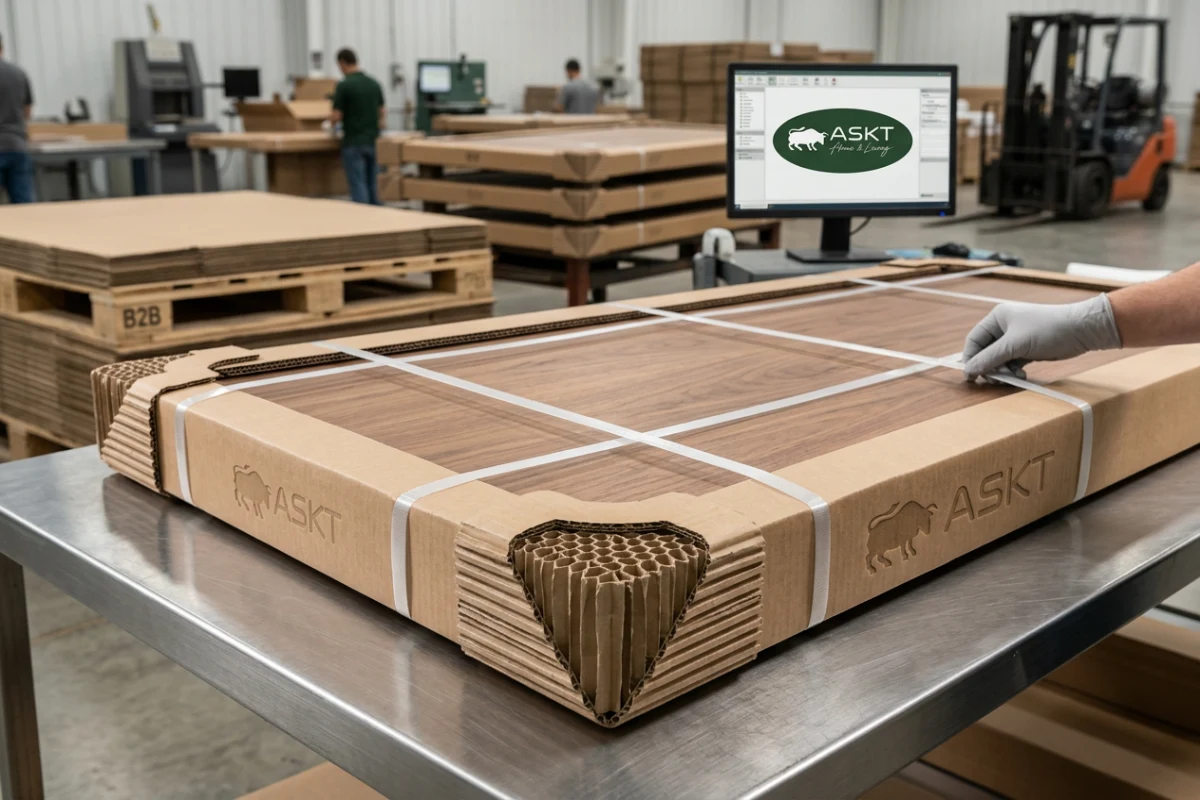
Effective dining table packaging protection requires zone-by-zone engineering. A standard corrugated box without internal structural isolation cannot protect heavy, large-span dining furniture across intercontinental logistics networks. Packaging designers and quality engineers must target four critical vulnerability zones.
1. The Four Tabletop Corners (Highest Impact Vulnerability)
Statistically, the four corners of a dining table carton absorb the greatest shock during handling accidents. When a carton is dropped or tipped onto an edge, kinetic energy concentrates instantly at the contact corner. For brittle sintered stone or sharp-edged veneer slabs, inadequate corner buffering leads to immediate chipping, cracking, or edge delamination.
To safeguard these zones, packaging must incorporate high-density molded paper pulp corners, multi-layer corrugated caps, or folded honeycomb corner blocks. These buffers must provide adequate clearance—maintaining structural separation between the outer carton wall and the table corner—so that incoming kinetic energy is absorbed and dissipated before reaching the finished product.
2. Perimeter Bevels and Long Edge Profiles
Long tabletop edges are continuously exposed to lateral impacts during container loading, cross-docking, and manual maneuvering. Furthermore, high-tension strapping on pallets can cut directly into exposed edges if protective distribution profiles are omitted.
Reinforced L-shaped edge boards and U-profile honeycomb channels should wrap the entire perimeter of the tabletop. These components distribute external pressure across a wide surface area, preventing localized denting on solid wood and stopping edge fractures on stone and ceramic surfaces.
3. The Unsupported Center Span
Large dining tables ranging from 160 cm to 240 cm or longer have wide surface areas that span across open carton space. When cartons are stacked horizontally in containers or warehouses, the center of the tabletop experiences significant bending stress if upper cartons press down without underlying support.
To prevent center sagging and transverse cracking, packaging designs should incorporate rigid longitudinal support ribs, full-coverage honeycomb separator boards, or high-density paperboard sheets above and below the table panel. This structural sandwich transfers vertical loads directly to the perimeter carton walls rather than allowing the load to rest entirely on the center of the tabletop.
4. KD Metal Substructures, Legs, and Extension Hardware
Modern dining tables are frequently engineered with knocked-down (KD) metal frames, spider legs, or telescopic extension mechanisms. These heavy steel elements possess high mass and sharp edges. If packed loosely alongside the tabletop, they act as internal battering rams during transit.
Protective protocols require that all metal legs, sub-frames, and moving extension tracks be secured inside dedicated internal corrugated sub-boxes or partitioned trays. Foam wrapping, non-woven protective sleeves, and secure corrugated dividers ensure that metal parts cannot touch finished wooden, lacquered, or stone surfaces under any circumstances.
How Do Honeycomb Paper and Sustainable Packaging Materials Protect Heavy Tabletops?
As European furniture retailers and commercial purchasing groups work to meet strict environmental and packaging waste directives, traditional expanded polystyrene (EPS) foam is increasingly being phased out. Modern B2B furniture supply chains are adopting engineered honeycomb paper and mono-material paperboard solutions that provide exceptional structural protection while aligning with European sustainability standards.
Key Engineering Advantages of Honeycomb Paper Packaging
- Superior Vertical Compressive Strength: Honeycomb paperboard utilizes a continuous hexagonal cellular core inspired by natural geometric structures. This configuration provides exceptional vertical crush resistance per gram of material, easily supporting heavy static stacking loads in multi-tier shipping configurations.
- Controlled Kinetic Shock Absorption: Under severe drop impact, the hexagonal paper cells collapse progressively and uniformly. This controlled deformation decelerates the falling carton smoothly, dissipating impact energy through structural crushing of the paper core rather than transferring a sudden shock wave into the tabletop.
- Custom Die-Cut Fitment: Honeycomb boards can be precisely die-cut and laminated into bespoke perimeter frames, corner blocks, and nesting trays that immobilize dining table components within the carton, preventing internal shifting.
- 100% Monomaterial Recyclability: Unlike composite packaging that mixes EPS foam, plastic films, and paperboard, mono-material paper-based packaging allows European commercial buyers and end consumers to recycle the entire package through standard municipal paper streams without sorting fees or landfill surcharges.
| Packaging Material Solution | Structural Compressive Strength | European Regulatory & ESG Alignment | Debris & Cleanliness | Commercial Sourcing Suitability |
|---|---|---|---|---|
| Engineered Honeycomb Paperboard | Exceptional vertical crush resistance | Fully recyclable in paper streams; zero plastic penalty | Clean handling; leaves no static crumbs or residue | Ideal for premium wooden, veneer, and sintered stone tables |
| Multi-Ply Corrugated L-Boards | High edge-impact resistance | Excellent recyclability and low environmental footprint | Clean and stable | Essential for full-perimeter edge and corner reinforcement |
| Molded Paper Pulp Profiles | Moderate to high impact absorption | Biodegradable, compostable, and easily recycled | Low dust generation | Excellent for complex three-dimensional corner geometries |
| Expanded Polystyrene (EPS) | High static rigidity but brittle | Low compliance; subject to disposal taxes and bans | Generates static cling and messy crumb debris | Phasing out across major European retail supply chains |
| Expanded Polyethylene (EPE) Foam | Flexible with good repeat impact recovery | Recyclable LDPE category, but non-paper waste | Clean surface contact | Useful for delicate surface wrap and frame separation sleeves |
How Can Importers Use Furniture Drop Testing Standards to Verify Structural Packaging Integrity?
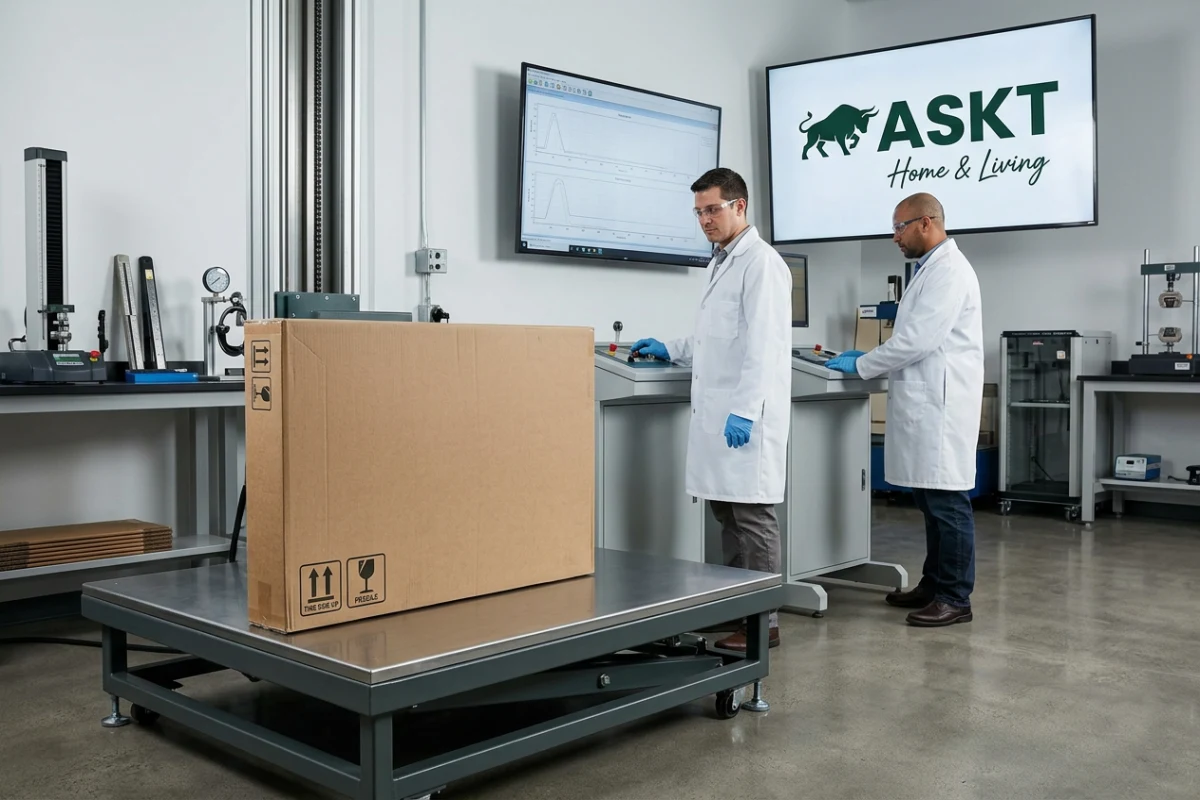
Packaging specifications should never rely on theoretical assumptions. European furniture wholesalers, retail chains, and contract buyers require empirical validation to guarantee that packaging configurations will survive international logistics. Standardized furniture drop testing standards provide a repeatable, scientific framework to assess carton durability and product protection prior to mass container dispatch.
Common Testing Frameworks (ISTA and European Protocols)
- ISTA 1A & 2A (International Safe Transit Association): Basic integrity tests designed for individually packaged products. These protocols evaluate carton resilience against standard mechanical drops and fixed-displacement vibration.
- ISTA 3A: A comprehensive simulation protocol specifically designed for packaged products moving through parcel delivery and less-than-truckload (LTL) logistics networks. ISTA 3A tests the package against random vibration profiles and multiple drops from varied orientations and drop heights calibrated to carton weight.
- EN 12521 Standards (Furniture Transit Considerations): While EN 12521 primarily governs mechanical safety, strength, and durability for domestic dining tables, modern quality control protocols adapt its structural benchmarks to verify that tables retain complete mechanical integrity following rigorous logistics stress simulations.
The Standard Sequential 10-Drop Testing Procedure
To evaluate dining table transport packaging thoroughly, production-grade packaged samples are subjected to a standardized 10-drop sequence conducted on a calibrated drop-testing platform:
- Drop 1 (Corner Impact): The carton is dropped directly onto the most vulnerable bottom corner (typically the corner containing the primary carton closure seam).
- Drops 2, 3, and 4 (Edge Impacts): The carton is dropped sequentially onto the shortest edge, the medium-length edge, and the longest edge radiating from the tested corner.
- Drops 5 through 10 (Flat Surface Impacts): The carton is dropped flat onto all six outer faces—bottom, top, right side, left side, front face, and rear face.
Standard Calibrated Drop Height Reference Scale:
- Cartons weighing under 10 kg: 760 mm drop height
- Cartons weighing 10 kg to 28 kg: 610 mm drop height
- Cartons weighing 28 kg to 45 kg: 460 mm drop height
- Cartons weighing 45 kg to 68 kg: 310 mm drop height
Objective Pass/Fail Quality Inspection Criteria
Following the drop sequence and accompanying vibration testing, the carton is opened for a detailed quality inspection. The packaging configuration is judged against strict technical benchmarks:
- Zero Structural Product Failure: The tabletop must exhibit zero fractures, cracks, joint separations, or bent metal sub-frames. Extension mechanisms must operate smoothly with perfect rail alignment.
- Zero Surface Imperfections: Sintered stone surfaces must be completely free of corner chips, micro-cracks, or edge spalling. Wood veneers and lacquered finishes must show no scuffs, rub marks, or pressure indentations.
- Acceptable Packaging Degradation: Moderate deformation, creasing, or local crushing of outer corrugated walls and internal honeycomb buffers is expected and fully acceptable. The primary role of the packaging is to absorb and expend kinetic energy so that zero destructive force reaches the furniture itself.
How Does Container Loading Optimization Prevent Cargo Movement and Carton Crushing?
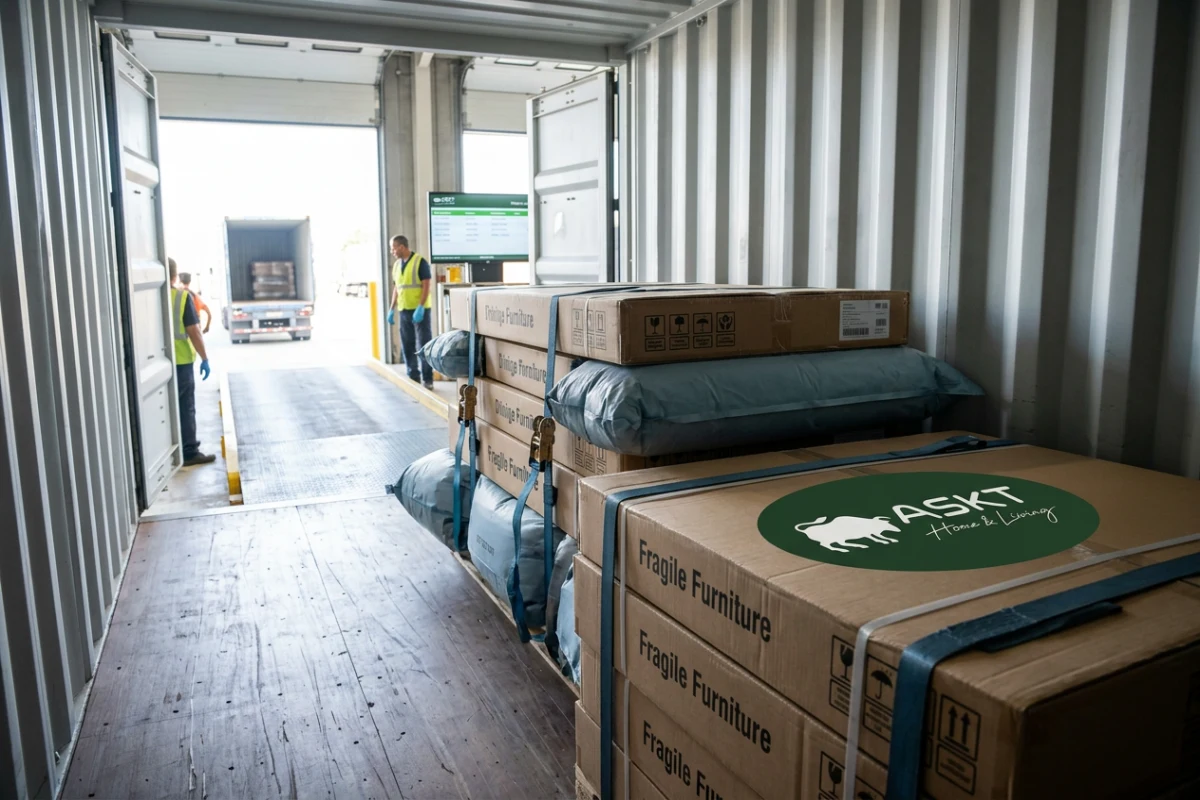
Even the most robust dining table packaging protection will fail if cartons are improperly loaded, stacked, or secured inside ocean freight containers. Container loading optimization combines geometric cargo planning, weight distribution management, and secure blocking techniques to eliminate movement during sea voyages.
Strategic Stacking Protocols by Tabletop Material
- Sintered Stone and Ceramic Dining Tables: High-density stone and ceramic tops are rigid but brittle under flexural tension. Stacking heavy stone cartons horizontally creates massive cumulative pressure on the bottom units. Sintered stone tables should either be loaded vertically in heavy-duty wooden A-frames or crated modules, or stacked horizontally with strict limits on tier height (typically no more than 4 to 6 units high depending on pallet construction).
- Veneered MDF, Plywood, and Solid Wood Tables: Wood-based tabletops are typically flat-packed in horizontal master cartons. When loading, cartons must be stacked directly in vertical columns (corner-over-corner alignment) rather than brick-interlocked. Direct vertical alignment ensures that the reinforced internal corner posts of each carton carry the downward structural load directly to the container floor.
Advanced Cargo Restraint and Stabilization Methods
- Heavy-Duty Dunnage Airbags: Void spaces between carton rows, between pallets, and between the cargo and container side walls must be filled with industrial dunnage airbags. When inflated, these bags exert uniform lateral pressure, immobilizing the cargo and preventing side-to-side rocking when the vessel encounters heavy sea conditions.
- High-Friction Anti-Slip Rubber Mats: Placing composite rubber friction mats beneath pallet bases increases floor traction, preventing entire stacks from shifting during rail shunt shocks or emergency road braking.
- Threshold Cross-Lashing and Cargo Nets: The space directly inside the container rear doors is particularly vulnerable. Cargo must be secured using heavy-duty ratchet lashings, woven composite strapping, or modular cargo restraint nets anchored to the container tie-down rings. This prevents cartons from leaning against the doors and falling outward when container seals are broken at the destination warehouse.
| Loading Strategy Factor | Unoptimized Loading Practice | Optimized B2B Logistics Protocol | Operational Risk Mitigation |
|---|---|---|---|
| Stack Alignment | Interlocking or offset carton stacking | Direct column stacking with aligned corner posts | Prevents carton crushing and center-span sagging |
| Void Management | Leaving open gaps between pallet rows | Installing commercial dunnage airbags and void fillers | Eliminates cargo rolling, tipping, and dynamic side collisions |
| Weight Distribution | Heavy tables stacked on top of lighter furniture | Heavy table cartons placed low; uniform weight distribution | Prevents crushing of lighter cargo and stabilizes container center of gravity |
| Doorway Restraint | Loose cargo stacked right up to container doors | Installing barrier cross-strapping and heavy-duty cargo nets | Prevents cargo spills and worker injury upon container door opening |
How Should Importers Protect Specific Materials Like Sintered Stone, Oak Veneer, and Extension Tables?
Different dining table materials present distinct physical vulnerabilities during international transit. A one-size-fits-all packaging approach fails to address the unique engineering properties of stone, natural wood, and mechanical extension systems.
1. Sintered Stone and Ceramic Tabletops
Sintered stone offers exceptional scratch resistance and heat tolerance, but its crystalline structure makes it susceptible to impact chipping along unreinforced edges and flexural fracture under bending loads.
- Packaging Strategy: Sintered stone slabs require full-coverage surface protection film to prevent micro-abrasions, surrounded by continuous 360-degree high-density honeycomb edge channels. Corner protectors must provide minimum clearances that isolate the slab from external shocks. For maximum protection, large slabs should be crated or strapped onto structural backer boards to resist flexural deflection.
2. Natural Oak Veneer and Solid Wood Tables
Natural wood and veneered surfaces are vulnerable to atmospheric humidity fluctuations, surface scuffing, and localized pressure bruising from heavy objects resting on the wood grain.
- Packaging Strategy: Tabletops should be wrapped in non-woven breathable fabric or smooth micro-foam sheets that prevent static friction without trapping moisture. Rigid honeycomb top and bottom distribution panels shield the delicate veneer from point pressure, while moisture-absorbing desiccant pouches inside sealed polybags prevent veneer warping and mold growth during tropical ocean crossings.
3. Extension Dining Tables with Integrated Mechanisms
Extension tables incorporate moving steel slide rails, leaf storage hinges, and auto-lock mechanisms. If the moving leaf or rail assembly moves during transit, the mechanical alignment can be permanently damaged.
- Packaging Strategy: The internal extension mechanism must be locked in a rigid closed position using transit retaining brackets or heavy-duty securing ties. Moving leaf panels must be isolated with dedicated foam separators, and extension tracks must be shielded with reinforced padding to prevent external forces from bending the guide rails.
What Packaging Quality Control and Sourcing Protocols Protect Margins for European Buyers?
Preventing dining table shipping damage is ultimately a management discipline that requires clear technical specifications and consistent quality control protocols established between European importers and manufacturing partners.
Essential Sourcing and Packaging Checklist for B2B Sourcing Teams
- Contractual Packaging Specification Sheets: Technical packaging requirements must be detailed within the purchase order documentation. Importers should define carton paperboard grades (such as heavy-duty 5-ply double-wall or 7-ply triple-wall kraft board), minimum edge crush test (ECT) values, internal honeycomb density, and corner buffer dimensions.
- Mandatory Pre-Production Drop Test Verification: Before mass packaging procurement begins, purchasing managers should require factory engineering teams to perform a certified 10-point drop test on production-ready samples, documented with complete, uncut video verification.
- Modular KD Frame Nesting Design: Sourcing teams should collaborate closely with furniture manufacturers that design modular knocked-down (KD) frames. Well-engineered KD structures nest neatly inside dedicated sub-compartments, reducing total carton volume while isolating heavy metal legs away from table surfaces.
- Pre-Shipment Packaging Inspections (PSI): Quality inspectors must verify carton integrity, tape sealing durability, strapping tension, pallet wrapping consistency, and container loading arrangements before containers leave the manufacturing facility.
By establishing engineered packaging protection, standardized drop testing, and disciplined container loading practices, European furniture wholesalers, retailers, and contract buyers can systematically reduce dining table shipping damage, eliminate customer disputes, and safeguard long-term supply chain profitability.
To discover how engineered packaging solutions, modular KD structures, and rigorous factory testing can protect your dining collections across European supply chains, optimize your table packaging together with ASKT.