Why Professional Buyers Need a Repeat Order Consistency Dining Chair Manufacturer
For European furniture wholesalers, retail chains, and commercial contract buyers, evaluating an initial dining chair sample is straightforward. The upholstery sits smoothly across the frame, the stitching follows clean lines, the powder-coated metal legs align properly, and the assembly hardware fits without friction. However, in B2B furniture sourcing, product evaluation is not a one-time event. The actual test of manufacturing capability begins when placing replenishment shipments six, twelve, or eighteen months later across multiple production cycles.
When repeat shipments arrive with visible fabric shade deviations, mismatched powder coating sheens, altered foam densities, or misaligned knock-down (KD) screw holes, the commercial consequences are severe. Retailers face customer returns, warehouse teams struggle with unsellable stock, and project contractors risk costly installation delays. In competitive markets such as Germany, the Netherlands, the UK, Poland, Switzerland, and Ireland, partnering with a dependable repeat order consistency dining chair manufacturer is essential for protecting brand reputation and safeguarding bottom-line margins.
Maintaining strict furniture batch consistency across years of continuous supply requires far more than casual assembly line checks. It demands systematic raw material control, standardized manufacturing processes, structured quality verification, and packaging engineering designed specifically for international container transport. Understanding how professional manufacturers achieve this level of repeatability allows procurement teams, product managers, and category buyers to evaluate potential supply chain partners with technical clarity.
The True Commercial Cost of Inconsistent B2B Furniture Repeat Orders
In B2B furniture replenishment, product variance is rarely a minor aesthetic issue. When bulk shipments deviate from approved reference samples, operational and financial friction ripples across the entire distribution network.
When furniture batch consistency fails, commercial buyers encounter several major challenges:
- Upholstery Shade and Texture Drift: Dye lot variations between fabric rolls make chairs from different production runs incompatible when consumers purchase supplementary seating or when retailers fulfill split-batch orders.
- Assembly and KD Hardware Inconsistencies: Slight shifts in drill hole positions, thread pitch variances, or warped mounting plates turn flat-pack KD assembly into a frustrating experience for retail customers and contract installers.
- Cushion Comfort and Ergonomic Discrepancies: Variations in foam density or pocket spring seating tension alter the sitting experience, leading to mismatched showroom displays and elevated return rates.
- Coating and Finish Variations: Inconsistent powder coating application or curing creates mismatched matte, satin, or gloss levels across metal frames, preventing seamless visual pairing across product lines.
- Inventory Segmentation Costs: Warehouses are forced to quarantine and track split batches separately, driving up administrative overhead and complicating inventory turnover.
When an importer receives a container of dining chairs that cannot sit alongside previous inventory, the only options are discounting, manual rework, or stock write-offs. A specialized repeat order consistency dining chair manufacturer eliminates these risks by locking in technical specifications, raw material origins, and production tolerances from the very first production batch.
Upstream Material Standardization: Controlling Fabrics, Foam, and Substrates
Batch-to-batch stability in dining chair manufacturing begins long before metal is cut or fabric is sewn. In upholstered furniture production, raw material variation is the single largest contributor to quality drift over time. Professional dining chair manufacturing quality control starts with disciplined supplier qualification and strict intake protocols for all textiles, foams, and internal structural boards.
Textile Management and Colour Consistency
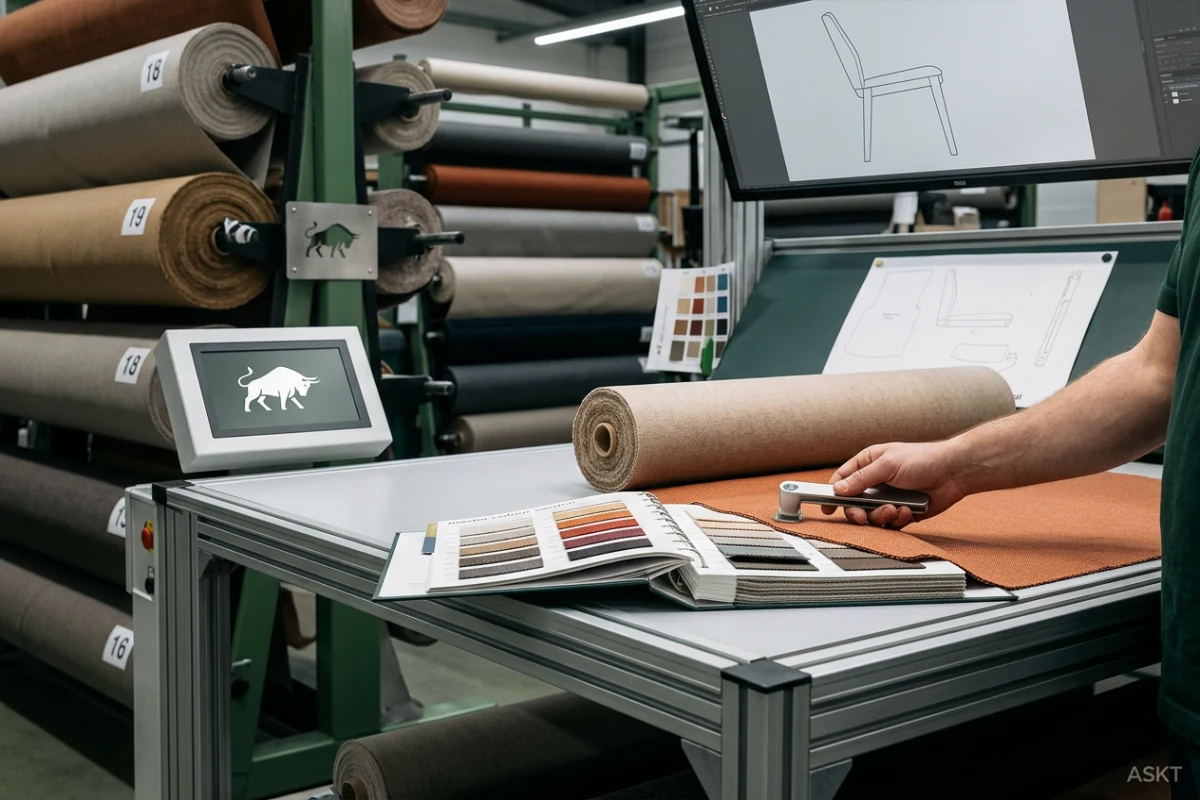
Upholstery fabrics, whether structured weaves, velvet, easy-clean textiles, or pet-friendly materials, present natural variations in fibre absorption and weave tension. To prevent noticeable colour shifts between initial production runs and subsequent B2B furniture repeat orders, manufacturers must establish rigorous fabric verification steps:
- Dye Lot Verification: Master fabric swatches from approved baseline samples must serve as permanent physical benchmarks for every incoming roll of upholstery fabric.
- Colour Fastness and Rubbing Resistance: Incoming fabrics must undergo standardized testing for colour fastness to light and dry/wet rubbing to verify that pigment retention remains identical across production seasons.
- Abrasion Resistance Monitoring: Performance fabrics specified for residential or contract use must consistently meet target abrasion rub counts across all delivered batches.
- Functional Fabric Properties: For waterproof, stain-resistant, and easy-clean fabrics, surface treatments must be audited across every roll to verify that water repellency and stain release performance remain uniform.
Foam Density and Internal Cushion Support
Seat comfort and durability depend heavily on the resilience of the internal cushioning. Over repeated manufacturing runs, uncontrolled foam formulations or improper curing can lead to premature sagging, altered firmness levels, and unhappy end users.
A dedicated repeat order consistency dining chair manufacturer maintains structural comfort through several key practices:
- Density and Firmness Tolerances: Specifying exact foam density ranges for seat cushions and backrests, ensuring that rebound elasticity does not change from one container to the next.
- Pocket Spring Seating Integration: When chairs feature integrated pocket springs beneath foam layers, the spring gauge, coil count, and encasement materials must follow fixed engineering drawings to maintain identical ergonomic support.
- Controlled Adhesive Systems: Using environmentally compliant, low-odour adhesives applied at consistent coverage rates prevents delamination and chemical off-gassing while preserving foam flexibility.
Internal Shells and Structural Foundations
Beneath the upholstery, the internal wooden shells, bent plywood components, or composite boards determine the shape, backrest curvature, and structural strength of the chair. When internal boards are cut or drilled with manual variance, the outer upholstery stretches unevenly, creating puckering and misaligned seams. Standardizing board dimensions through precision cutting templates and automated drilling machinery ensures that the internal skeleton remains completely identical across continuous production cycles.
Metal Frame Fabrication, Welding, and Powder Coating Consistency
Contemporary dining chairs for European dining rooms, commercial restaurants, and office environments frequently incorporate metal frame constructions, slim tubular legs, cantilever bases, or swivel and auto-return mechanisms. Achieving long-term dining chair supply chain reliability requires systematic control over metal preparation, welding accuracy, and surface finishing.
Metal Leg Geometry and Welding Stability
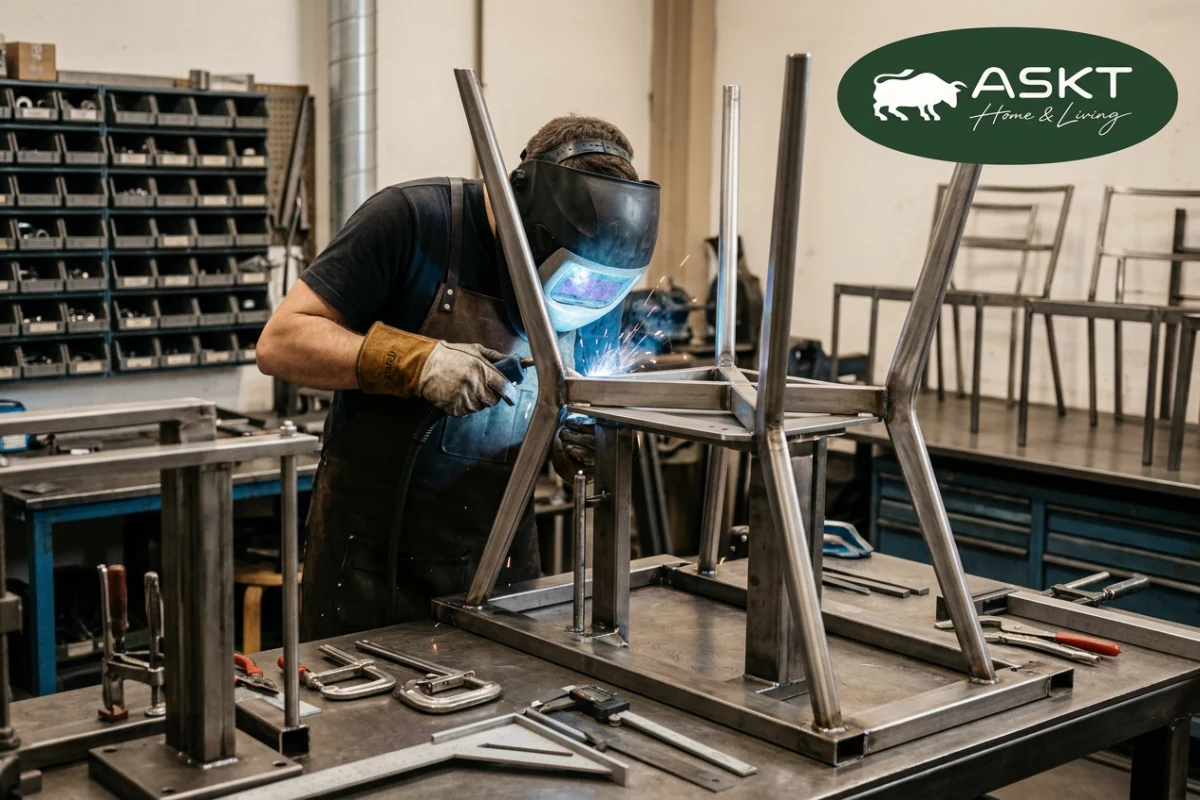
Manual welding introduces natural variations in heat application, seam penetration, and dimensional alignment. Over a production run of several thousand units, these minor human variances cause uneven leg angles, rocking bases on level floors, and mounting plate misalignments.
To ensure flawless structural stability across all repeat runs, professional manufacturing facilities employ standardized metalworking practices:
- Precision Fixtures and Tooling Jigs: Clamping metal tubes and plates into calibrated welding jigs guarantees that every leg angle, cross-brace position, and bolt hole coordinate matches the approved technical drawings.
- Controlled Welding Protocols: Standardizing weld seam length, penetration depth, and temperature avoids heat-induced metal warping and ensures uniform joint strength.
- Post-Weld Dimensional Auditing: Fabricated metal bases are checked on flat reference inspection tables to ensure that all four contact points sit level with zero wobble before entering the finishing line.
Powder Coating and Surface Finish Uniformity
Metal dining chair frames must withstand everyday mechanical contact, cleaning solutions, and floor friction. Surface finishing must deliver consistent visual aesthetics and long-term corrosion resistance across every production batch.
Maintaining surface finish consistency across B2B furniture repeat orders requires controlled multi-stage processes:
- Chemical Pre-Treatment: Metal components undergo thorough degreasing, rust removal, and surface passivation to ensure clean substrate adhesion prior to coating.
- Controlled Powder Application: Electrostatic powder coating lines maintain consistent powder spray volume and charge distribution, eliminating thin spots, runs, or surface pinholes.
- Curing Temperature and Time Management: Ovens must operate within tight temperature windows so the powder coating cures to the correct hardness, scratch resistance, and sheen level—ensuring that black matte, anthracite, or custom-coloured frames match across separate purchasing cycles.
| Production Stage | Conventional Workshop Variance | Standardized Repeat-Order Protocol | Buyer Value & Sourcing Advantage |
|---|---|---|---|
| Fabric Sourcing | Unchecked dye lots from open markets | Master-swatch dye lot control & abrasion checks | Zero shade deviation across separate production seasons |
| Foam & Cushioning | Variable density foam scraps | Specified density ratings & pocket spring standards | Identical sitting comfort and long-term sag resistance |
| Internal Boards | Hand-cut plywood with manual hole punching | Precision template cutting & automated drilling | 100% accurate upholstery lines and secure bolt threads |
| Metal Frame Welding | Freehand welding without fixed jigs | Calibrated welding fixtures and flat-table audits | Wobble-free seating bases and precise KD alignment |
| Powder Coating | Manual touch-ups with variable curing | Automated pre-treatment and controlled oven curing | Uniform surface gloss, texture, and scratch resistance |
| Export Packaging | Generic cartons with loose foam wrapping | Custom drop-tested cartons & reduced plastic use | Transit protection, lower damage rates, easy container handling |
Quality Control Workflows for Continuous Furniture Manufacturing
Achieving consistent quality across multi-year sourcing programs requires quality control to be integrated throughout every phase of production rather than treated as a brief pre-shipment check. Professional dining chair manufacturing quality control relies on structured multi-gate inspections.
1. Pre-Production Golden Sample Verification
Before mass manufacturing begins on any repeat order, production supervisors, upholstery managers, and QC inspectors must review the client-approved "Golden Sample." This baseline unit represents the definitive standard for dimensions, fabric colour, stitch density, leg alignment, and packaging specifications. Every material batch allocated for the run is cross-referenced against this benchmark.
2. In-Line Process Audits
During high-volume production runs, dedicated quality inspectors monitor sub-assemblies across individual workstations:
- Upholstery Seam and Tension Checks: Verifying stitch spacing, edge piping straightness, and uniform fabric tension across backrests and seat curves.
- Hardware and Threaded Insert Verification: Auditing the torque, depth, and thread alignment of internal mounting nuts to ensure that flat-pack KD assembly bolts thread smoothly without cross-threading.
- Swivel and Auto-Return Mechanism Testing: For chairs equipped with 360-degree swivel or 180-degree auto-return mechanisms, mechanisms are tested for smooth, silent rotation, secure bearing retention, and accurate self-centering alignment.
3. Structural Performance and EN Durability Testing
Dining chairs destined for European domestic and contract environments must withstand continuous physical stress. Manufacturers must ensure that chair designs and materials align with recognized European performance principles, including domestic and non-domestic seating standards such as EN 12520 and commercial durability expectations:
- Static and Dynamic Load Testing: Applying vertical and angled force cycles to the seat and backrest to verify frame durability and joint integrity under continuous load.
- Leg Forward and Sideways Overload Testing: Assessing the resistance of leg assemblies against lateral spreading and bending stress.
- Drop Impact Testing: Dropping weighted impactors onto the seat surface to confirm that internal boards, foam, and welds resist sudden shock loads without fracturing.
- Abrasion and Rub Testing: Conducting Martindale or colour fastness audits to ensure that the upholstery resists friction wear over extended daily use.
4. Sustainable Packaging and Container Load Optimization
Consistent manufacturing quality is wasted if products suffer transit damage inside ocean containers or during domestic European logistics. Packaging design is a fundamental pillar of dining chair supply chain reliability.
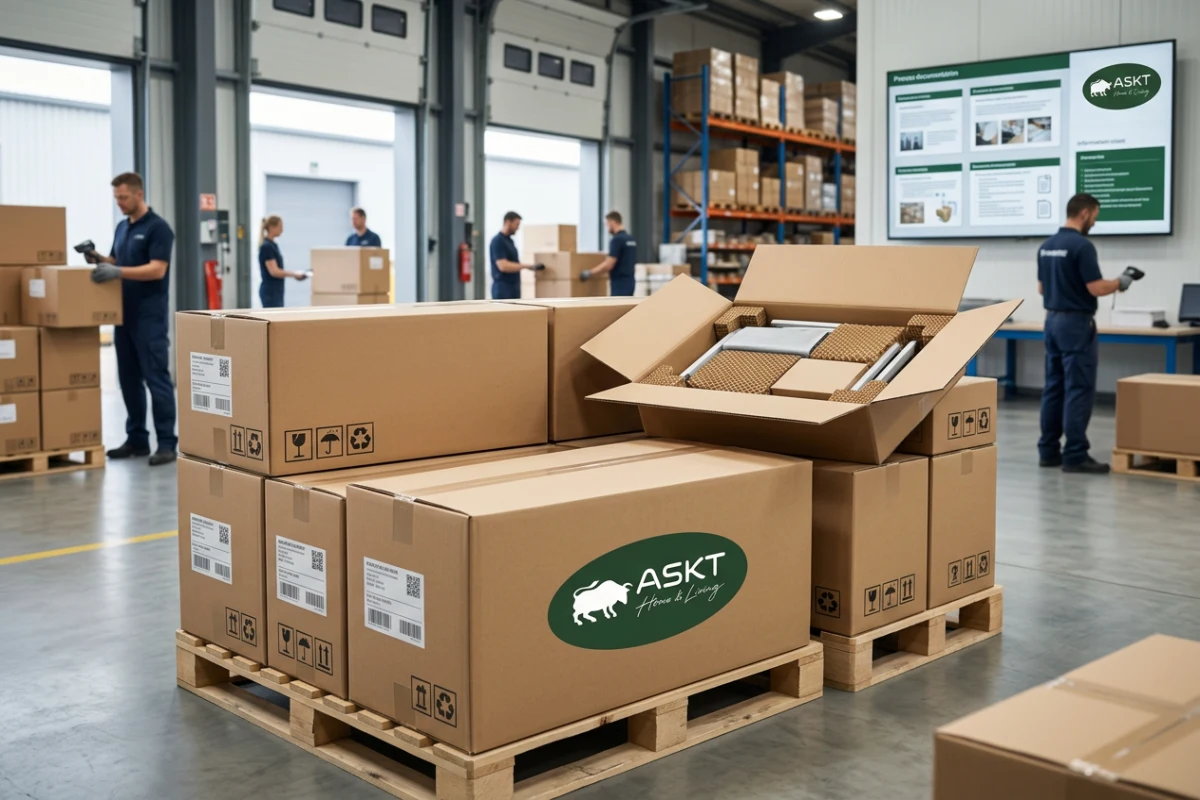
Professional manufacturers engineer packaging solutions that balance protective performance, logistics efficiency, and environmental responsibility:
- Optimized KD Engineering: Designing chair components to nest closely within master cartons, maximizing container cubic utilization and lowering ocean freight costs per unit.
- Transit Cushioning and Corner Protection: Utilizing high-strength cardboard edge protectors, honeycomb paper buffering, and custom inner inserts that secure metal legs and upholstered shells firmly in place during transit.
- Sustainable Packaging with Reduced Plastic Use: Minimizing single-use expanded plastics and non-recyclable films in favour of recyclable paper-based materials, helping European buyers satisfy strict sustainability and waste reduction regulations.
- Drop-Test Verification: Conducting standardized packaging drop tests to ensure that master cartons protect internal contents against impacts, vibrations, and compression during multi-leg transit.
Strategic Sourcing: Building Long-Term Supply Chain Reliability with ASKT
For European furniture wholesalers, retail chains, and purchasing groups, supply chain success depends on selecting a manufacturing partner that understands the operational realities of European markets. A transactional factory focuses only on completing the current order; a strategic B2B manufacturing partner invests in repeatable systems that protect your catalog year after year.
As a professional B2B dining furniture manufacturer and supply chain partner based in China with over 20 years of industry experience, ASKT specializes in contemporary indoor furniture engineered for European buyers. Focused exclusively on B2B clients, ASKT combines European design understanding with efficient, quality-driven manufacturing to deliver stable, scalable supply programs across Germany, the Netherlands, the UK, Poland, Switzerland, Ireland, and surrounding markets.
Comprehensive Customization and OEM/ODM Capability
ASKT supports furniture importers, e-commerce brands, and contract buyers through extensive OEM and ODM customization options, including:
- Tailored Upholstery and Finishes: Access to an extensive library of fabrics, easy-clean textiles, pet-friendly materials, and custom colourways.
- Versatile Frame Engineering: Metal legs, cantilever bases, 360-degree swivel frames, and 180-degree auto-return mechanisms available in diverse powder-coated finishes.
- Complementary Dining Collections: Complete dining furniture programs encompassing upholstered dining chairs, dining benches, bar chairs, lounge chairs, and dining tables with sintered stone or oak veneer tops.
- Private-Label and Custom Packaging: Tailored master carton branding, barcode labeling, assembly instruction sheets, and sustainable packaging solutions designed for container optimization and parcel logistics.
Transparency and Risk Reduction
By prioritizing transparent quality control, standardized raw material batching, and clear communication throughout the sample development and bulk production phases, ASKT helps professional buyers eliminate sourcing risks. Every manufacturing stage is structured to ensure that the fifth container delivered two years from now matches the exact specifications, comfort profile, and structural integrity of the initial baseline run.
Practical Supplier Evaluation Checklist for Furniture Sourcing Managers
When auditing a potential repeat order consistency dining chair manufacturer, procurement teams can use this practical checklist to verify whether a factory possesses the technical discipline required for long-term consistency:
- Raw Material Tracking: Does the supplier maintain master swatches and reference standards for fabric dye lots, foam densities, and metal specifications across repeat orders?
- Tooling and Jigs: Are metal frames and wooden substrates constructed using dedicated jigs, precision drilling fixtures, and standardized templates, or are operations guided manually?
- Surface Treatment Control: Does the facility operate an automated multi-stage pre-treatment and powder coating line with monitored curing temperatures and adhesion testing?
- In-House Mechanical Testing: Can the manufacturer demonstrate testing procedures for static load, dynamic fatigue, impact resistance, and fabric rub fastness aligned with European seating standards?
- Assembly and Hardware Standardization: Are threaded inserts and KD hardware audited for thread quality, insertion depth, and torque to prevent assembly issues for end consumers?
- Sustainable and Drop-Tested Packaging: Does the manufacturer optimize packaging dimensions for container loading while utilizing sustainable, drop-tested protective materials with reduced plastic usage?
- OEM/ODM and Communication Transparency: Does the engineering team provide transparent production reporting, clear sample sign-off workflows, and responsive technical support tailored to European market demands?
By applying these criteria during supplier evaluations, sourcing directors and category managers can identify manufacturing partners capable of delivering dependable product consistency, reducing operational friction, and driving sustainable commercial growth across their dining furniture programs.
If you are looking to enhance the stability, batch consistency, and logistics efficiency of your dining chair program, ASKT provides the manufacturing expertise and supply chain capabilities required to scale your collections with confidence. Contact our team to discuss long-term supply programmes and customized quality requirements.