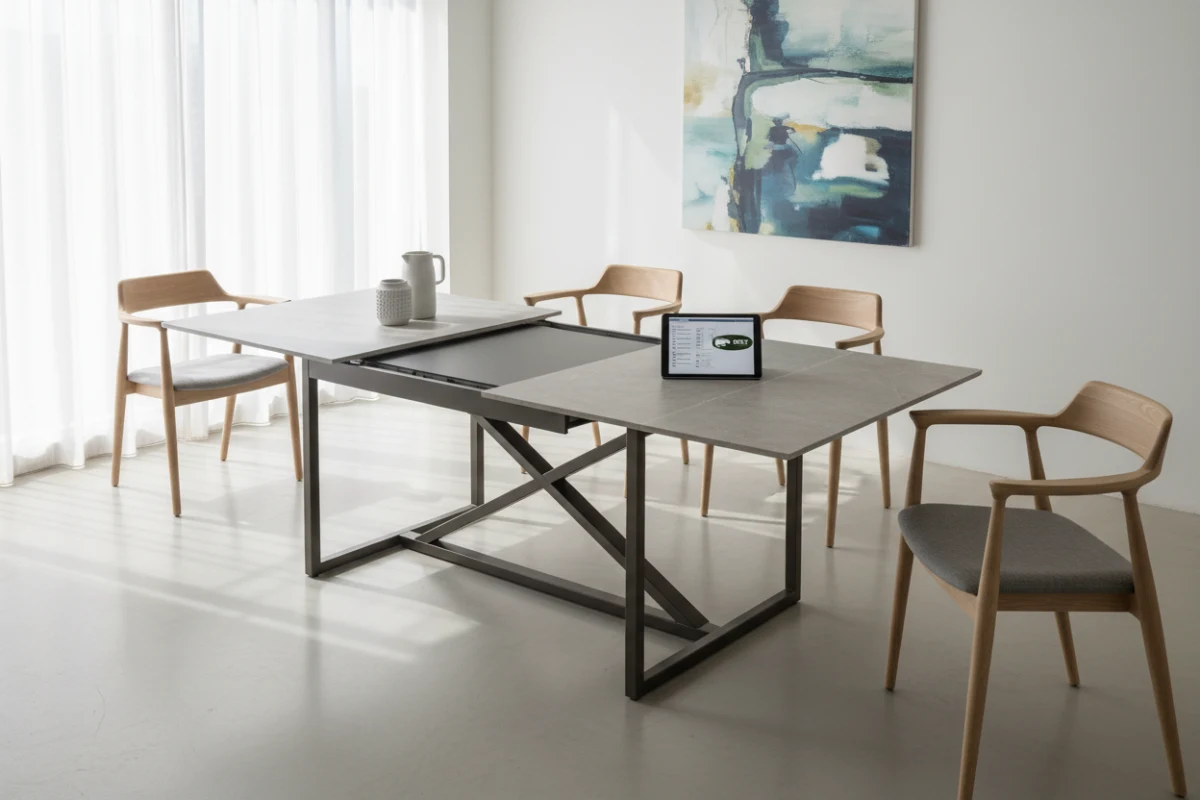
Sourcing Extendable Dining Tables from China: The Ultimate B2B Buyer QC Guide
Before sourcing extendable dining tables from China, professional B2B buyers must evaluate the engineering quality of the extension mechanism, ensure compliance with European structural stability standard EN 12521, and perform strict alignment and load-bearing testing. Focusing on these high-stress functional components, rather than just surface aesthetics, mitigates the risk of structural failure, retail returns, and high warranty costs in the European market.
Why do extendable dining tables require more rigorous quality control than fixed tables?
Unlike fixed dining tables, which act as static structures where load is distributed predictably down four legs, an extendable table is an active mechanical system dressed as static furniture. When a table is extended, the physics of the entire piece changes. The extension panels create a cantilevered load, shifting the center of gravity and concentrating intense bending moments at the joint where the mechanism attaches to the tabletop frames.
If the structural engineering is flawed, or if the raw materials are sub-standard, the table will fail. This failure rarely happens in the showroom; it happens in the consumer’s home when they lean heavily on an extended leaf during use. For a European furniture importer or retailer, a single structural failure can trigger a cascade of negative reviews, product recalls, and expensive logistics claims.
Furthermore, extendable tables are highly sensitive to material warping. A slight deviation in moisture content in an oak wood veneer, or a minor structural sag in a metal frame, might go unnoticed on a fixed table. On an extendable table, however, that same minor deviation causes panels to misalign, creating unsightly gaps or step-differences where the leaves meet, or worse, jamming the extension glide tracks completely. Therefore, implementing a specialized furniture quality control checklist during production is the only way to guarantee product consistency and long-term brand reputation.
What are the main extension mechanism types and their respective sourcing risks?
When sourcing extendable dining tables from China, understanding the engineering behind the extension tracks is vital. Different mechanisms solve different aesthetic and spatial problems, but each carries specific structural risks that must be analyzed by your quality assurance team.
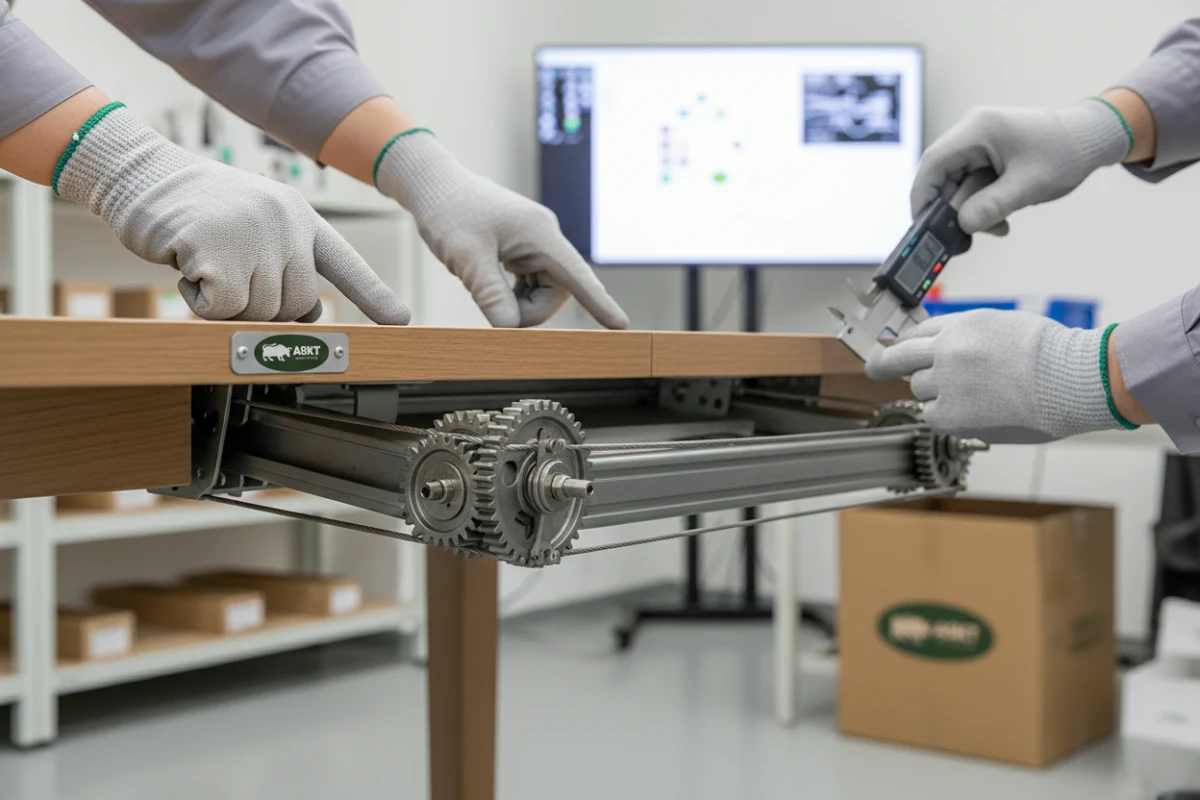
- Synchronous Butterfly Extension: In this setup, pulling one end of the table automatically glides the other end open in unison, revealing a folded "butterfly" leaf in the center. The risk is that pulleys and steel cables can slip or snap if the tension is uneven. If the hinges on the folding leaf are not perfectly recessed, the two halves of the tabletop will not slide back together seamlessly, leaving a gap. Buyers should ensure the extendable table manufacturer uses high-tensile steel cables and precision-cast steel gears rather than plastic pulleys.
- End-Pull Slide-Out Extension: These tables feature extension panels stored beneath the main top at one or both ends. The panels slide out on rails and lift or lock into place. The cantilever load is extremely high on end extensions. If the slide runners are too thin or lack proper reinforcement, the extended leaf will sag visibly under load. Buyers must inspect the gauge of the steel runner brackets. They should have a robust thickness to prevent bending under pressure.
- Automatic Rotating Extension: A modern design where rotating the main top activates gears that swing and lift hidden leaves into place automatically. The risk is extreme complexity. If the internal gears strip or get misaligned by even a fraction of a millimetre, the entire table becomes inoperable. Buyers should demand hardened alloy steel gears and ensure the mechanism is cycle-tested before final assembly.
To help your sourcing team compare these options, use this technical comparison table during your next factory audit:
| Mechanism Type | Primary Tabletop Material | Main Sourcing Risks | Ideal B2B Use Case |
|---|---|---|---|
| Synchronous Butterfly | Sintered Stone / Oak Veneer | Cable slippage, hinge misalignment, center gap | Premium residential dining collections |
| End-Pull Slide-Out | Sintered Stone / Ceramic | Track friction, cantilever sag, metal-on-ceramic scraping | Heavy-duty contract & commercial use |
| Rotary Automatic | Tempered Glass / Sintered Stone | Gear stripping, joint wear, complex repair | High-end contemporary design retail |
How does EN 12521 table testing protect buyers from structural failures in the European market?
For B2B buyers importing into Germany, the UK, the Netherlands, or other European regions, compliance with European safety standards is non-negotiable. The definitive structural standard for dining tables in these markets is the European structural safety standard. Undergoing third-party EN 12521 table testing ensures the table can withstand both vertical and horizontal forces without tipping, collapsing, or permanently deforming. This testing is particularly brutal on extendable tables because the laboratory applies load directly to the weakest points: the extended cantilevered leaves.
- Vertical Static Load Test: A heavy force is applied repeatedly to the outer edge of the extended leaf. The table must not tip over, and the mechanism must show no cracking or permanent bending.
- Horizontal Fatigue Test: The table top is subjected to lateral forces from multiple directions for thousands of cycles. This simulates the table being pushed, pulled, or dragged across dining room floors over years of use.
- Deflection Measurement: Under load, the extended panels must not bend beyond a narrow deflection threshold, ensuring a visually level and structurally sound surface.
If your manufacturer does not possess the capability to verify compliance, you run the risk of failing official safety audits conducted by European customs or consumer safety watchdogs, which can result in devastating stop-shipment orders.
What material inspections are critical for sintered stone, oak veneer, and metal frame tables?
Before production begins, your supplier audit must cover the specific material combinations used in modern extendable dining tables. Sintered stone and oak veneer are the two most popular premium surfaces, but each requires totally different preservation and engineering tactics.
- Sintered Stone Dining Tables: Sintered stone is highly valued for its scratch, heat, and stain resistance. However, it is fundamentally brittle under point impacts, especially around the edges. The underside of a sintered stone tabletop must be laminated with a reinforcing fiber mesh or high-density board backing. On extendable tables, check that the points where the extension mechanism screws into the tabletop are reinforced with embedded metal threaded inserts. Screwing directly into sintered stone or weak glue joints will cause the top to tear away from its tracks under stress.
- Oak Veneer Dining Tables: An oak veneer tabletop gives the warmth of solid wood but with better dimensional stability. However, poor core preparation is a major cause of post-sale returns. You must enforce a strict moisture content check of the MDF or plywood core before veneering. The target moisture level should be strictly monitored for tables destined for dry, heated European homes. Anything higher will cause the core to shrink and warp as it dries, which will cause the veneer to bubble and permanently misalign the extension panels.
- Metal Frame and Powder Coating Performance: The metal chassis carries the weight of both the tabletop and the mechanical slides. Check that the wall thickness of the load-bearing metal frame tubes is sufficient. For the surface finish, perform an adhesion test on the powder coating. If the powder coating peels or flakes off around the moving joints of the extension mechanism, the underlying steel will rust rapidly in humid maritime transit or coastal retail warehouses.
What should be included in an on-site extension table mechanism inspection?
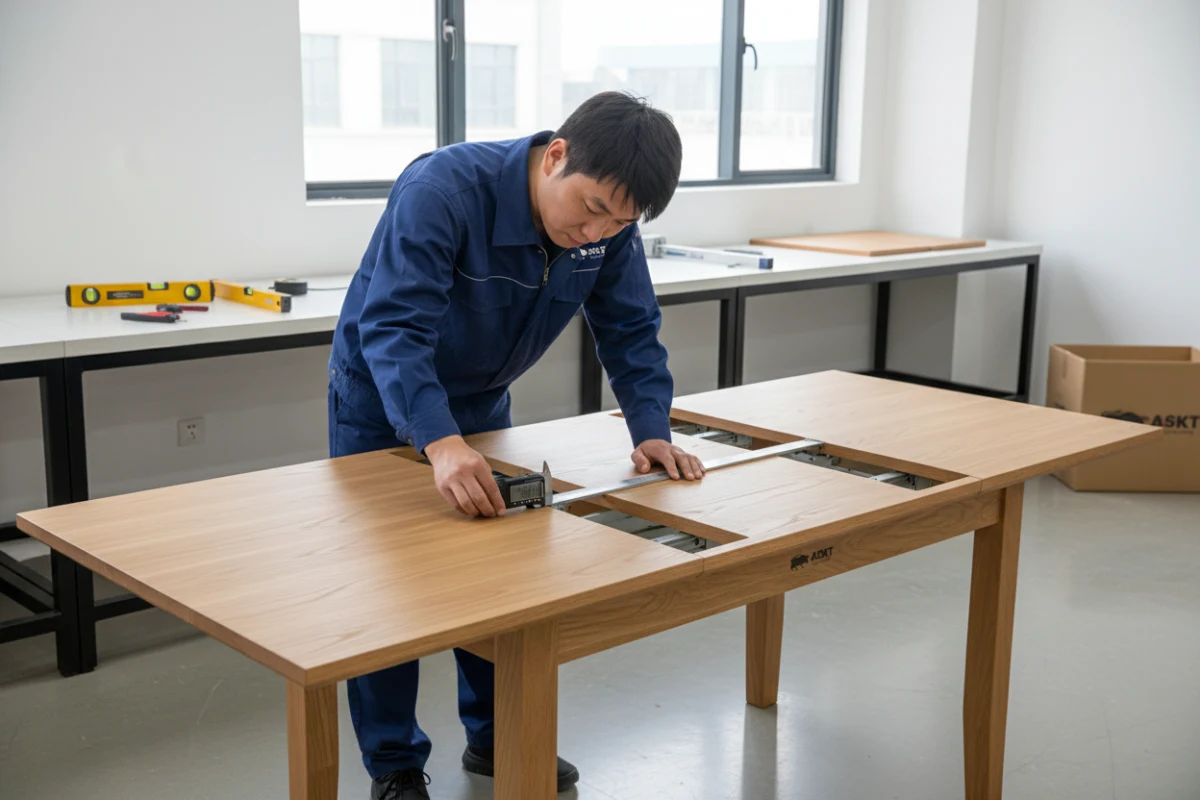
A robust pre-shipment inspection is your final line of defense. When your quality control inspector visits the factory in China, they must execute a detailed, step-by-step extension table mechanism inspection. Simply looking at the table in its closed state is a recipe for disaster.
Your on-site inspection protocol must mandate the following five mechanical checks:
- Operational Cycle Test: Every sampled table must be fully extended and closed a minimum of 20 consecutive times. The movement must be smooth, silent, and free of grinding noises or sudden resistance. If the sliding track feels sticky, it indicates misaligned tracks or poor track lubrication.
- Panel Alignment and Tolerance Audit: When the table is fully extended and locked, the gap between any two connecting panels must not exceed a strict threshold. The vertical step-difference (unevenness) between the main top and the extension leaves must be minimal. Any larger step-difference will cause wine glasses to wobble and ruin the consumer experience.
- Hinge and Bracket Tightness Check: Inspect the screws holding the mechanism to the wood or composite backing. The inspector must perform a tightness check to ensure no screws are stripped or loose due to over-tightening during high-speed factory assembly.
- Locking System Verification: Extendable tables require manual or automatic locks to prevent the panels from sliding open when users lean on the ends. The inspector must verify that the locks engage firmly and cannot be dislodged by moderate horizontal pushing.
- Under-Table Ergonomic Clearance Audit: Measure the clearance between the floor and the lowest hanging part of the folded mechanism. European consumers expect comfortable legroom. The clearance must align with your original product specification sheets to ensure standard dining chairs can slide completely under the table without knocking knees.
How do packaging protection and container loading optimization reduce transit damage?
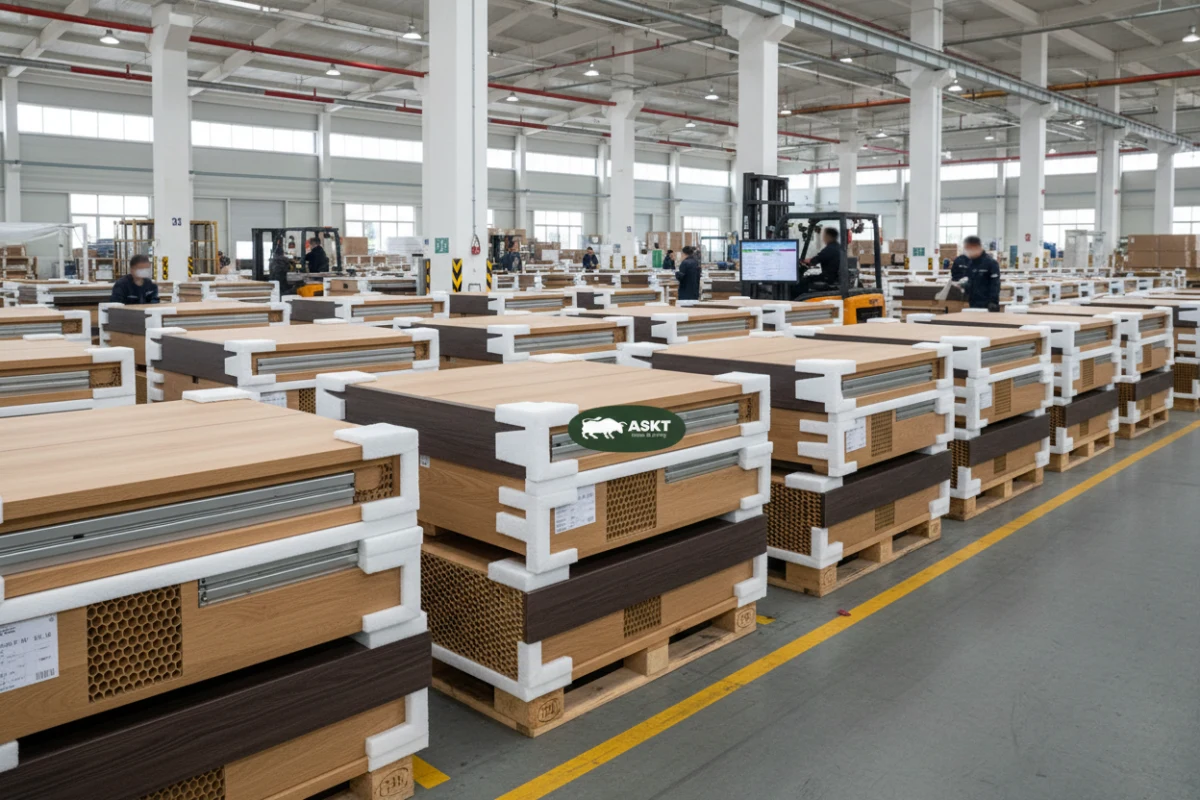
Most extendable dining tables are shipped as Knocked-Down (KD) structures to minimize shipping volume. While KD packaging significantly reduces ocean freight costs, it concentrates immense weight into flat packs. A heavy steel frame packed alongside a fragile sintered stone or oak veneer panel is a highly volatile combination during sea transit.
To prevent transit damage, the packaging must be designed and tested to withstand high drops, side impacts, and crushing forces.
- Drop Testing: Insist that the manufacturer passes a standardized drop test. The packaging should utilize thick, high-density polyethylene foam (EPE) corner protectors, and a solid sheet of protective material should shield the entire surface of the tabletop panels.
- Hardware Segregation: Heavy metal legs and extension tracks must be packed in a completely separate inner box or divided from the wooden/sintered stone top by thick structural packaging barriers. If a heavy metal leg breaks free inside the box during rough handling, it will punch through carton walls and destroy the tabletop.
- Container Loading Optimization: Because extendable tables are dense and heavy, stacking cartons too high in a shipping container can crush the bottom layers. Your loading plan must specify maximum stacking heights. Work with your supplier to design the container layout so that heavy metal frame boxes are placed on the bottom of the container, while fragile tabletops are stacked flat on top, secured by strapping bands.
How do you identify a transparent and reliable extendable table manufacturer in China?
Sourcing high-quality extendable dining tables is not about finding the lowest unit cost; it is about finding a manufacturing partner that understands the rigorous demands of the European market. A reliable partner will prioritize quality transparency over empty marketing promises.
When evaluating a potential extendable table manufacturer, look for these key indicators of operational excellence:
- European Compliance and Certifications: A trustworthy factory will have a valid BSCI (Business Social Compliance Initiative) audit report, demonstrating ethical labor practices and supply chain compliance required by major European retail chains.
- Robotic and Automated Machinery: High-quality metal fabrication requires consistency. Factories that utilize automated robotic welding arms produce consistent, clean weld beads that do not crack under load, unlike manual welding which varies from worker to worker.
- Design Exclusivity and OEM/ODM Support: A professional B2B partner will respect your intellectual property. They should offer formal design exclusivity agreements, ensuring that customized mechanism designs or proprietary shapes developed for your brand are not sold to your direct competitors.
- B2B Problem Solving Mentality: Professional manufacturers, such as ASKT, stand out by offering integrated modular designs. Our extensive experience serving the German, UK, and Dutch markets means we anticipate and solve these mechanical risks before the container ever leaves our loading docks.
To ensure your next shipment meets these rigorous mechanical and structural standards, you can Request Extendable Table QC Checklist to share with your quality control team.