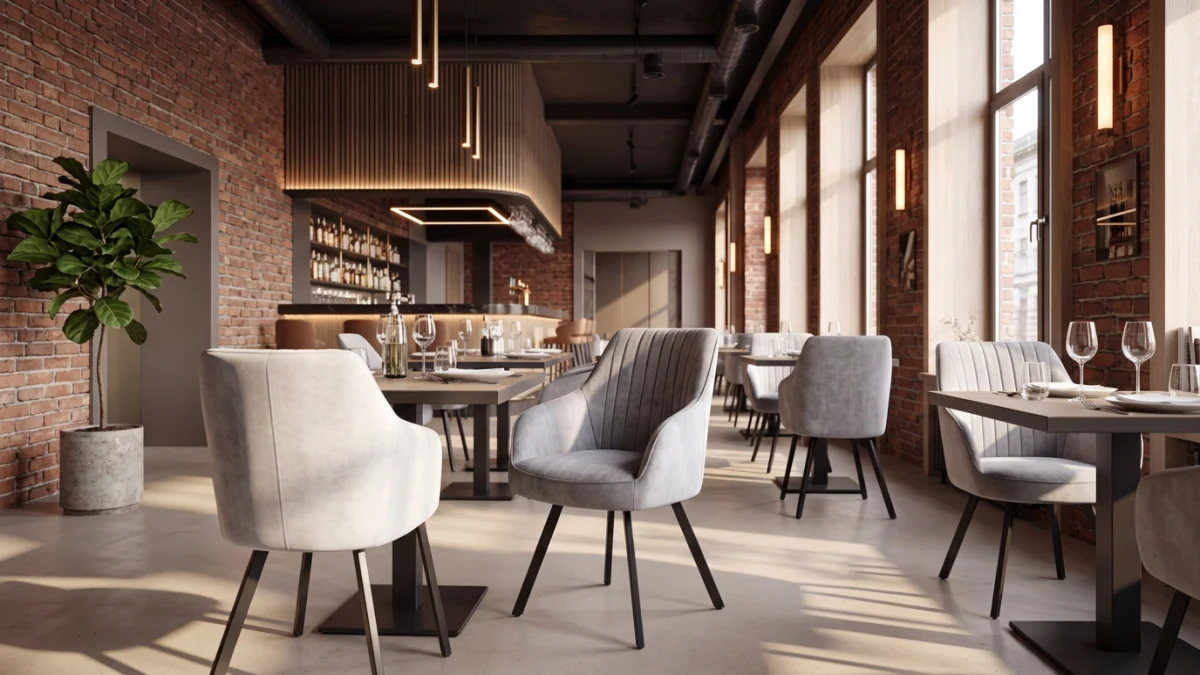
Sustainable Furniture Packaging Guide: Plastic Reduction, Honeycomb Protection, and European Compliance for B2B Importers
Sustainable furniture packaging balances transit protection and container loading efficiency with plastic-reduced materials such as honeycomb paper, corrugated buffers, and optimized Knock-Down (KD) structures to meet European market compliance. By systematically replacing non-recyclable expanded foams with engineered paper alternatives, European furniture importers, wholesalers, and retail chains reduce shipping damage, eliminate non-recyclable waste streams, lower extended producer responsibility fees, and streamline container logistics across international supply chains.
What Regulatory and Market Pressures Are Driving Sustainable Furniture Packaging in Europe?
European furniture procurement is undergoing a fundamental structural transition driven by environmental policy, regulatory directives, and commercial demand for circular economy solutions. For decades, international container shipments of dining chairs, dining tables, lounge seating, and contract furniture relied heavily on Expanded Polystyrene (EPS) foam blocks, polyethylene (PE) wrapping film, and plastic bubble sheets to prevent surface scuffing and impact damage during ocean transport. While plastic foam provided baseline cushioning, it generated enormous volumes of non-recyclable, bulky waste for European retail networks, commercial warehouses, and residential end consumers.
The regulatory environment within the European Union has shifted decisively against single-use, non-recyclable packaging. Directives and frameworks addressing packaging and packaging waste—such as the European Packaging and Packaging Waste Regulation (PPWR)—mandate aggressive reductions in overall packaging volume, restrictions on void space within shipping boxes, and the phased elimination of hard-to-recycle plastic foams. These legislative measures are reinforced by national Extended Producer Responsibility (EPR) schemes across key markets including Germany, the Netherlands, the United Kingdom, Poland, Switzerland, and Ireland. Under these schemes, furniture importers and brand owners bear escalating financial levies for every kilogram of non-recyclable plastic packaging introduced into the commercial market.
Alongside statutory mandates, European purchasing groups, retail chains, and e-commerce furniture brands face direct commercial expectations from corporate ESG commitments and consumer preferences. Wholesalers and retailers are actively auditing their overseas supply chains to eliminate problematic plastics before goods arrive at European ports. Failing to modernize packaging specifications exposes importers to tangible commercial vulnerabilities:
- Higher EPR Disposal Tariffs: Non-recyclable plastic packaging attracts significantly higher recycling fees and administrative surcharges across EU member states compared to mono-material corrugated fiberboard.
- Retail Customer Resistance: Major European home living retailers and department stores increasingly refuse delivery of bulk furniture shipments packed with loose EPS foam or unrecyclable composite plastics.
- Excessive Warehouse Handling Costs: Unpacking, sorting, and disposing of bulky foam inserts in European regional distribution centres creates substantial labour and municipal waste management overheads.
- Environmental Non-Compliance Penalties: Sourcing furniture that fails upcoming European packaging minimisation criteria risks port delays, customs scrutiny, and eventual distribution restrictions.
Developing compliant, high-performance packaging is therefore no longer just an environmental talking point; it is a vital operational safeguard for any European furniture purchasing organisation sourcing goods internationally.
How Can Furniture Importers Balance Transit Protection, Container Loading, and Plastic Reduction?
A persistent concern among furniture buyers and supply chain managers is that removing traditional plastic foam packaging may compromise transit safety, leading to higher damage rates during maritime shipping and regional handling. Furniture products such as upholstered dining chairs, heavy metal frames, sintered stone tabletops, and delicate oak veneer surfaces are subject to multi-directional mechanical stresses, dynamic ocean vibrations, stacking compression, and warehouse handling. However, professional packaging engineering proves that plastic reduction does not require sacrificing structural integrity.
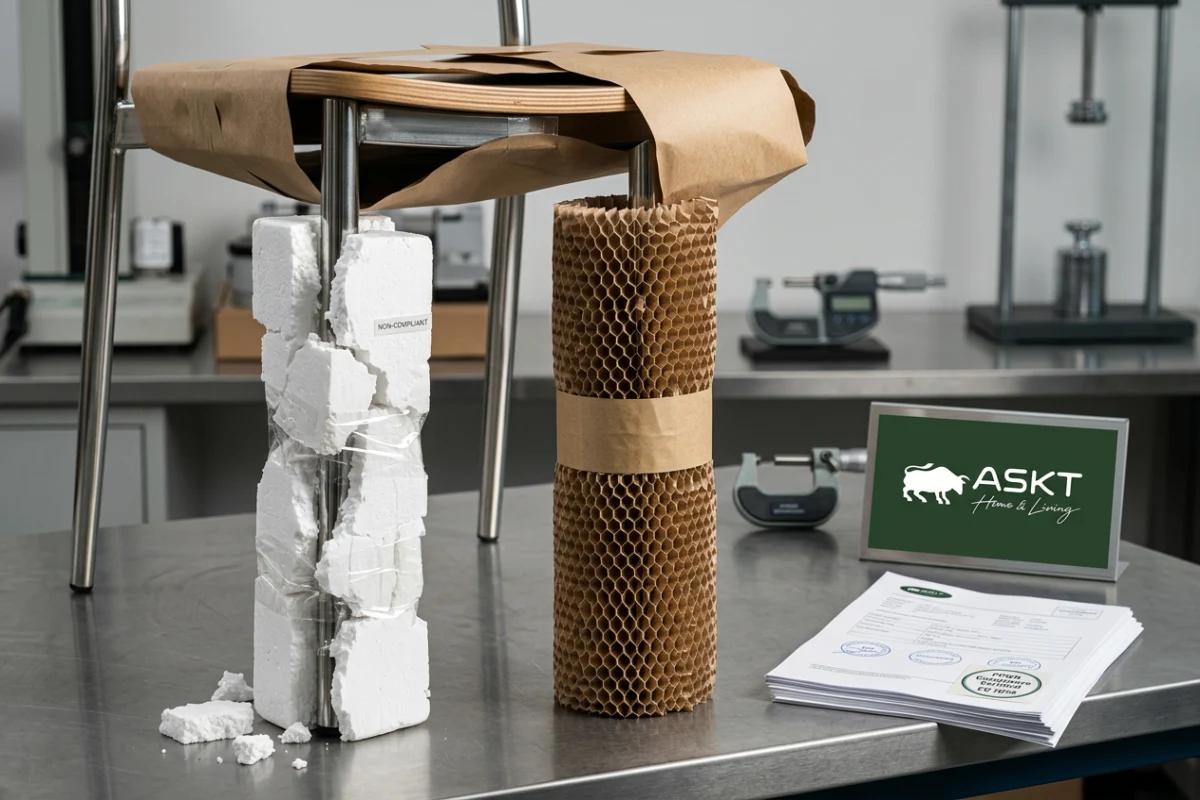
Achieving effective plastic reduced packaging furniture designs requires a holistic approach that connects product engineering, knock-down (KD) construction, and engineered paper materials. When furniture components are designed to nest tightly together, the internal volume of the master carton decreases, eliminating the void spaces that traditionally required large EPS foam blocks. Replacing loose foam cushions with rigid, custom-folded corrugated inserts and high-density paper buffers delivers predictable mechanical protection while keeping overall carton dimensions compact.
The strategic trade-offs and functional differences between traditional export packaging and sustainable, plastic-reduced alternatives are summarized in the comparison matrix below:
| Packaging Element | Traditional Export Method | Sustainable B2B Alternative | Performance and Logistics Impact |
|---|---|---|---|
| Edge and Corner Protection | Expanded Polystyrene (EPS) solid blocks | High-density honeycomb paper furniture protection caps and L-profiles | Superior multi-impact resistance; prevents edge chipping; 100% recyclable in standard paper waste streams. |
| Surface Scratch Buffering | Multi-layer PE bubble wrap and plastic sheet | Kraft paper fluting sheets and protective paper inter-leaving | Eliminates paint abrasion and powder coating burnishing during long transit vibrations without plastic films. |
| Internal Component Nesting | Loose EPS void fill and polyfoam blocks | Custom die-cut corrugated paper dividers and folded tray inserts | Locks metal frames, swivel mechanisms, and wooden legs in fixed positions; prevents metal-to-fabric transit contact. |
| Hardware and KD Accessory Packs | Single-use plastic polybags | Sealed kraft paper hardware envelopes or integrated carton sub-boxes | Keeps assembly bolts, washers, and Allen keys organized without loose plastic components. |
| Carton Structural Rigidity | Low-bursting 5-ply cartons with plastic strap reinforcement | High-bursting 5-ply or 7-ply kraft corrugated master cartons | High vertical compression strength for multi-tier ocean container stacking; maintains box shape in high humidity. |
| Carton Sealing Method | Heavy polypropylene (PP) plastic tape | Water-activated reinforced kraft paper sealing tape | Creates a tamper-evident, mono-material paper carton that can be recycled directly without stripping plastic tape. |
By implementing professional b2b furniture packaging optimization, sourcing teams achieve two critical logistics benefits at once: they eliminate non-compliant plastic waste while shrinking the overall outer cubic volume (CBM) of each carton. Reduced carton dimensions allow more units to fit into standard 40-foot High Cube (40ft HQ) containers, lowering maritime freight costs per unit and decreasing the carbon footprint per delivered chair or table.
Why Is Honeycomb Paper Furniture Protection Essential for Modern B2B Dining Furniture Export?
Honeycomb paperboard has emerged as the premier structural alternative to EPS foam in international furniture export. The material is manufactured by expanding virgin or recycled kraft paper into a continuous hexagonal cell matrix, which is then adhesively bonded between two flat, heavy-duty linerboards. This geometric configuration replicates natural honeycomb structures, creating an exceptionally strong, lightweight, and rigid composite panel capable of bearing significant mechanical loads.
In heavy dining furniture applications—including metal-frame dining chairs, upholstered dining benches, bar stools, office desks, and solid or veneer dining tables—honeycomb paper protection provides specific physical properties that directly solve long-distance transit risks:
- High Vertical Stacking and Compression Strength: The vertical orientation of the hexagonal cell walls gives honeycomb boards immense resistance to top-down crushing forces. When furniture cartons are stacked four or five tiers high inside shipping containers or warehouse pallet racks, honeycomb corner posts bear the dynamic vertical loads, preventing lower cartons from buckling.
- Progressive Energy Absorption Under Impact: When a packaged carton experiences a sudden shock—such as dropping off a pallet or shifting during rough sea transit—the hexagonal cells deform progressively. This deformation absorbs and dissipates kinetic energy away from vulnerable furniture edges, table corners, and delicate frame joints, preventing stress fractures.
- Precision Die-Cut Profiling: Honeycomb panels can be grooved, scored, slot-cut, or pre-bent into rigid V-profiles, U-channels, and corner blocks. This allows packaging engineers to create snug-fitting protective cradles that securely anchor metal chair legs, auto-return swivel bases, and sintered stone edges directly against the outer carton wall without shifting.
- Mono-Material Simplicity for Curbside Recycling: Because honeycomb packaging is composed entirely of kraft paper and water-based adhesives, European commercial buyers and end consumers can dispose of the entire inner packaging alongside the outer corrugated box in conventional paper recycling systems, eliminating waste-sorting friction.
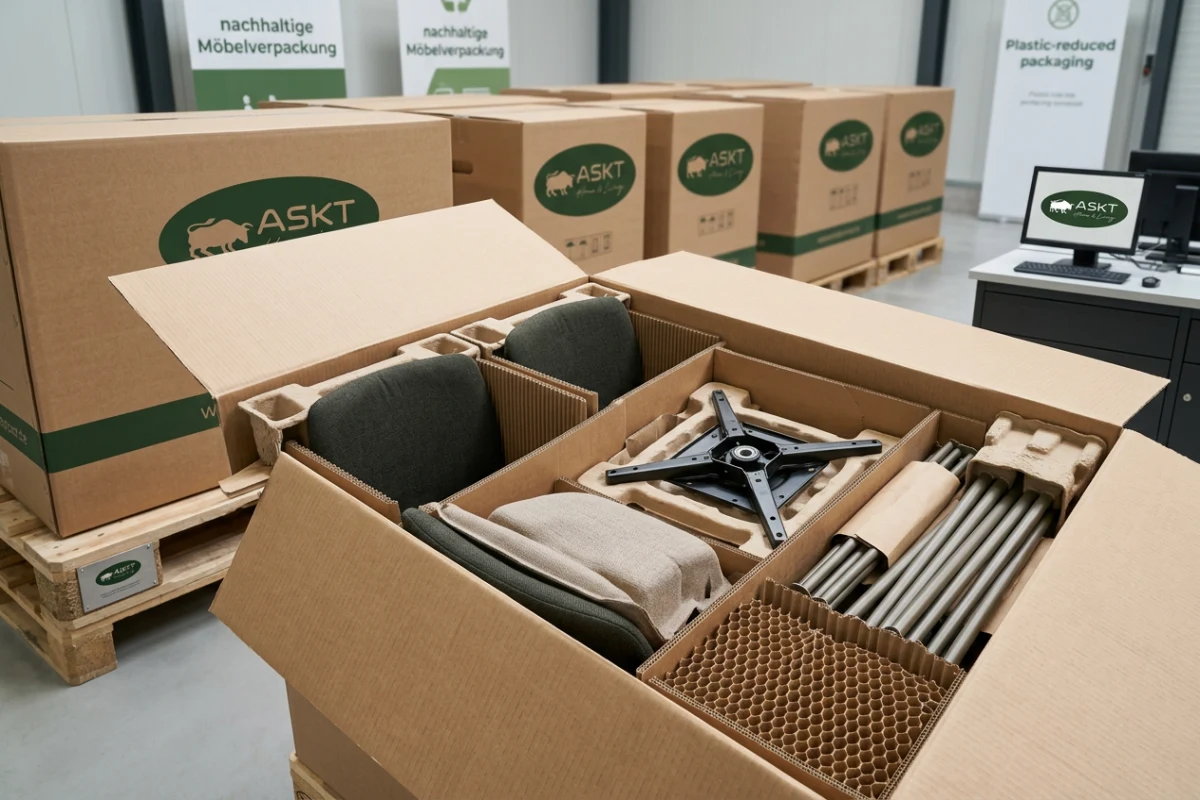
In addition to structural durability, honeycomb paper components remain stable across temperature shifts encountered during maritime transport. Unlike low-grade plastic foams that can become brittle in cold shipping routes or leave plasticiser residues on sensitive wood lacquer under humid container conditions, clean kraft paper maintains neutral contact with powder-coated metals, oak veneers, and high-performance dining chair upholstery fabrics.
How Can European Wholesalers and Retailers Implement B2B Furniture Packaging Optimization?
Transitioning an overseas furniture supply chain toward sustainable furniture packaging requires a systematic evaluation process between European purchasing teams and overseas manufacturing partners. Rather than simply requesting non-plastic packaging on a purchase order, commercial buyers should follow a structured optimization workflow during product development and sample approval.
Step 1: Product Structure Review (Evaluate KD options, nesting geometry, and component breakdown) Step 2: Component Separation Mapping (Define interior paper buffers for fabrics, metal frames, and surfaces) Step 3: Honeycomb & Corrugated Prototyping (Design die-cut inserts, corner posts, and exact carton sizing) Step 4: Mechanical & Drop Testing (Perform drop, vibration, and stacking tests on packaged prototypes) Step 5: Container Calculation & Trial Loading (Verify CBM reduction, pallet fit, and 40ft HQ loading yields) Step 6: Mass Production QA & Compliance Audit (Inspect packaging uniformity and mono-material standards on every batch)
To ensure consistent execution across production batches, European procurement managers should utilize a technical packaging checklist during supplier evaluations:
- Carton Dimension Precision: Verify that master carton dimensions leave zero excess interior void space once KD components and honeycomb buffers are in place. Minimizing interior air gaps prevents box crushing and maximizes container utilization.
- Finish-Specific Surface Protection: Ensure that all powder-coated metal legs, polished chrome swivel mechanisms, and oak veneer tabletops are wrapped with non-abrasive kraft paper or paper fluting to prevent transit scuffing caused by micro-vibrations during container transit.
- Structural Separation of Metal and Upholstered Parts: Confirm that heavy metal frame components and hardware packs are isolated in dedicated corrugated sub-trays or separated by rigid honeycomb dividers. Metal parts must never press directly against upholstered dining chair cushions or dining bench seating during storage.
- Hardware Isolation and Security: Assembly screws, bolts, leveling glides, and adjustment tools must be securely packed in sealed kraft envelopes and taped to interior cardboard trays, preventing loose metal hardware from scratching furniture surfaces.
- Drop and Stacking Verification: Every packaging redesign must undergo physical drop testing from defined heights on carton corners, edges, and flat surfaces, followed by static stacking evaluation before mass production authorization.
By embedding these evaluation steps into the initial OEM or ODM product development phase, furniture brands avoid costly packaging modifications after production lines have already commenced.
What Packaging Compliance Standards and Verification Protocols Apply to European Furniture Imports?
Importing furniture into the European Union and surrounding markets requires strict adherence to international transit durability testing and emerging regional packaging waste legislation. Professional buyers cannot rely on informal supplier assurances regarding carton strength; packaging systems must be verified using standardized engineering protocols to guarantee furniture packaging compliance europe.
Transit durability testing establishes whether a packaged furniture item can withstand the physical rigors of international multi-modal logistics. Sourcing teams typically require overseas manufacturers to execute and document specific transit simulations, including:
- Standardized Carton Drop Tests (e.g., ISTA Protocols): Packaged furniture cartons undergo a calibrated series of drop sequences—including a drop on the most vulnerable corner, three edge drops, and six flat face drops from predetermined heights based on total carton weight. The packaged unit must show zero structural damage to internal furniture frames, upholstery seams, or visible surface finishes upon inspection.
- Carton Bursting and Edge Crush Tests (ECT): Master cartons must meet certified Edge Crush Resistance standards (typically measured via ECT ratings) and bursting strength specifications to ensure that corrugated boxes do not rupture under horizontal pressure or vertical pallet stacking.
- Static Stacking Simulation: Packaged cartons are subjected to weighted compression tests that simulate multi-tier stacking inside a 40ft HQ shipping container during a multi-week ocean voyage, confirming that lower cartons maintain structural shape under dynamic humidity conditions.
- Vibration and Shaking Resistance: Packed units are evaluated on mechanical vibration platforms to verify that continuous transit harmonic frequencies do not loosen KD hardware, scuff powder-coated finishes, or abrade textured upholstery fabrics.
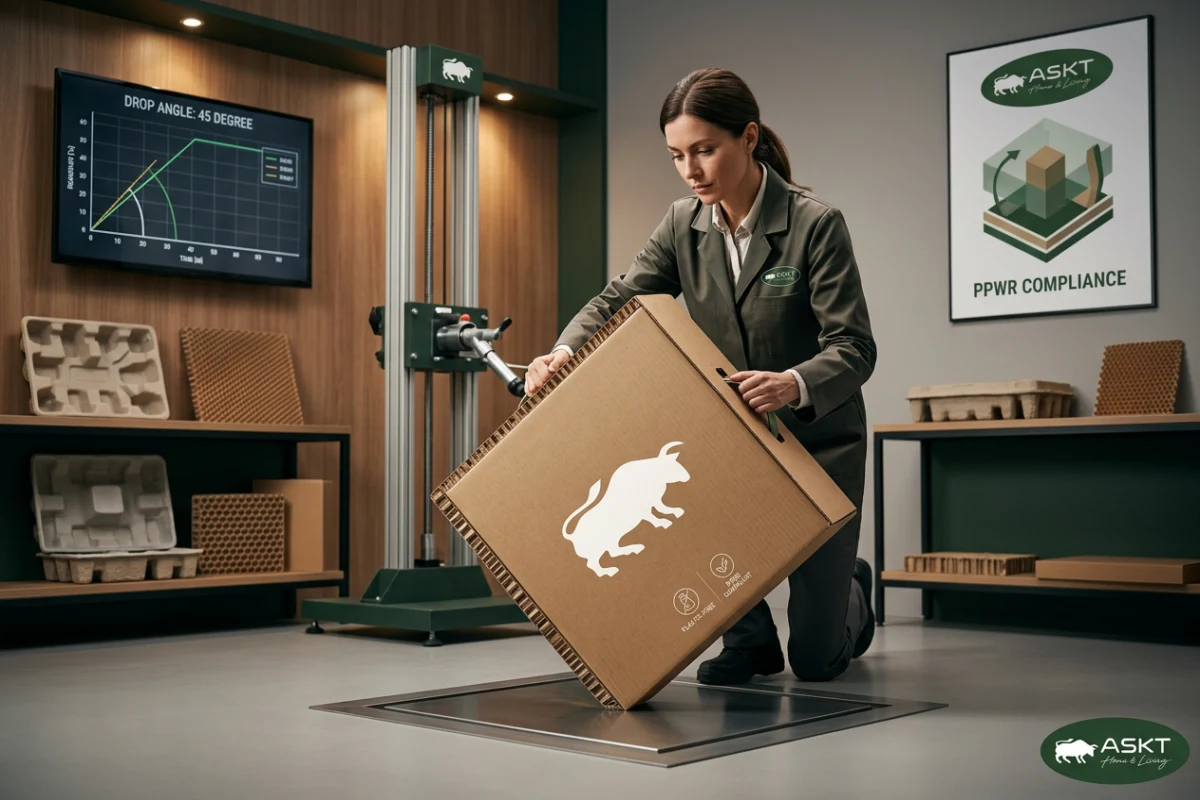
Beyond mechanical performance, compliance audits must address European recycling and material classification rules. European regulations increasingly penalize packaging that combines inseparable plastic and paper laminates. Sourcing teams must mandate mono-material paper structures where the outer corrugated carton, internal honeycomb corner protectors, corrugated trays, and sealing tapes can be deposited into European municipal recycling streams without requiring mechanical separation or chemical processing.
How Does ASKT Engineer Plastic-Reduced Packaging and Reliable Sourcing Solutions for European Buyers?
ASKT is a professional B2B furniture manufacturer and supply chain partner based in China, specializing in the design, manufacturing, and export of contemporary indoor dining furniture for the European market. With over 20 years of dedicated industry experience, ASKT supports furniture wholesalers, retail chains, purchasing groups, importers, and contract furniture buyers across Germany, the Netherlands, the UK, Poland, Switzerland, Ireland, and other European markets.
ASKT understands that professional B2B buyers require complete supply reliability, transparent quality control, strict regulatory compliance, and optimal container logistics. The company’s comprehensive dining and indoor portfolio includes:
- Dining Chairs and Bar Stools: Contemporary upholstered dining chairs, ergonomic pocket spring seating, bar chairs, and dining benches with fixed or auto-return swivel mechanisms.
- Dining Tables and Coffee Tables: Heavy-duty dining tables, sintered stone surfaces, oak veneer finishes, and precision extension mechanisms engineered for modern residential and contract settings.
- Home Office Desks and Contract Seating: Durable metal-frame desks and versatile seating solutions for commercial and hospitality projects.
Rather than treating packaging as a separate after-production task, ASKT integrates sustainable packaging engineering directly into product design. ASKT’s engineering team designs optimized KD (Knock-Down) frame structures alongside custom-molded honeycomb paper furniture protection and high-bursting corrugated interior layouts. This integrated design approach systematically eliminates single-use EPS foams and plastic bubble wraps, replacing them with recyclable, high-density paper buffers that protect delicate powder-coated metal legs, sintered stone edges, and premium upholstery.
Every packaging design developed at ASKT undergoes standardized drop testing, stacking verification, and container layout simulation. By engineering compact, form-fitting paper packaging layouts, ASKT helps European partners achieve substantial container loading optimization—fitting significantly more dining chairs and dining tables into each 40ft HQ container while maintaining comprehensive compliance with European packaging waste directives.
ASKT provides flexible OEM and ODM development services, supporting European clients with customized upholstery fabrics, frame finishes, dimensional adaptations, private-label branding, and compliant, plastic-reduced packaging engineering.
If you are looking to optimize your furniture supply chain, upgrade packaging compliance, or develop bespoke dining collections for the European market, contact ASKT to consult on sustainable, plastic-reduced packaging solutions.