
Swivel Dining Chair Mechanism Durability Test Cycles: A Practical Buyer’s Guide for European Furniture Sourcing
If you source dining chairs for a European wholesale, retail or contract furniture business, you already know that appearance and comfort only matter for as long as the product holds together. Among the many components that can fail in an upholstered dining chair, the swivel mechanism is one of the most common sources of after-sales complaints – and one of the hardest for buyers to assess from a sample photo or a short showroom test. That is why swivel dining chair mechanism durability test cycles have become such an important metric in modern B2B furniture sourcing. But what do those numbers actually mean, and how much trust should you put in them?
After two decades of manufacturing dining furniture for European markets, I have seen too many buyers treat cycle counts as a marketing checkbox rather than a real quality signal. A supplier might quote one figure, another a higher one, and the buyer simply picks the highest number at the lowest price. In reality, the value of a test result depends entirely on how the test was conducted, what it was measuring, and how well it reflects the way your customers will actually use the chair. This guide will walk you through the practical side of dining chair swivel mechanism durability testing, so you can ask better questions, compare suppliers more accurately, and reduce warranty claims down the line.
Why Swivel Mechanism Durability Matters for Professional Furniture Buyers
A swivel dining chair is a relatively simple product on the surface. You have a seat, a frame, a base, and a rotating mechanism that connects the two. But that mechanism is under constant stress. Every time someone sits down, shifts their weight, turns to talk, or pushes the chair back in, force is transferred through the swivel plate, the bearings, the mounting points and the return springs. Over months and years, even small amounts of play or wear can develop into wobble, noise, sticking or complete failure.
For a residential customer, a wobbly swivel is an annoyance. For a commercial buyer – a restaurant chain, a hotel group, or a high-traffic catering venue – a failed swivel mechanism is a direct cost. Chairs go out of service. Maintenance teams get dispatched. Customers complain. Replacements have to be shipped, sometimes across multiple sites. If the failure happens early enough, it can also erode trust in your brand and make reorders much harder to secure.
This is why swivel chair mechanism lifespan for commercial use is such a critical topic for contract furniture buyers and retail buyers alike. Retail buyers need it to set honest warranty terms. Project buyers need it to forecast total cost of ownership. Wholesalers need it to compare competing factories on something more meaningful than unit price. And everyone needs it to avoid the quiet, slow-moving issue of a product line that looks great on launch but starts failing 12 to 18 months later.
The good news is that most reputable furniture manufacturers and mechanism suppliers do carry out some form of cycle testing. The bad news is that not all testing is created equal, and cycle counts can be presented in ways that flatter the product without telling you very much about real durability. To use the data properly, you first need to understand what the test is actually doing.
How Swivel Dining Chair Mechanism Durability Tests Work in Practice
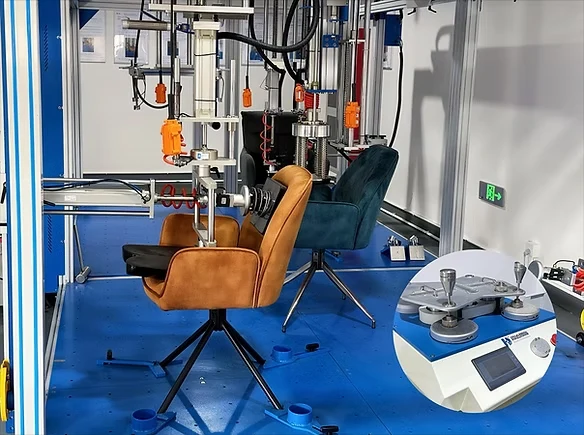
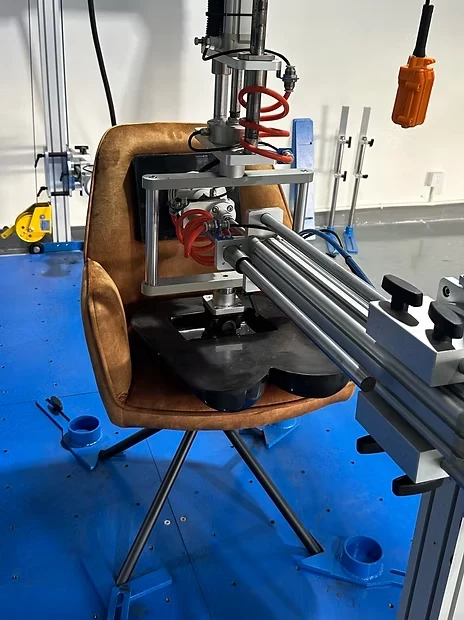
At its core, dining chair swivel mechanism durability testing is straightforward: a machine repeatedly rotates the chair seat – or applies a twisting force to it – for a set number of cycles, while a specific load sits on the seat. At the end of the test, the mechanism is inspected for wear, play, noise, structural damage or functional failure. The higher the number of cycles it survives, the more durable it is considered to be.
In practice, of course, the details matter a great deal. Three variables, in particular, determine whether a test result is meaningful or essentially worthless as a purchasing tool.
Load applied during the test
A test run with a lighter load is not the same as a test run with a heavier load. Higher loads put far more stress on bearings, mounting plates and welds, and they accelerate wear dramatically. A mechanism that survives many cycles at a lower weight might only survive a fraction of that at a heavier weight. For commercial or contract use, you want to know what load was used, because your end users will not all be average weight.
Angle and direction of rotation
Some tests rotate the mechanism a full 360 degrees in both directions. Others test a smaller arc, which is closer to the typical movement of a diner turning to speak to someone at the next table. The number of cycles on the datasheet is only comparable if you know how far the mechanism is travelling per cycle. A shorter arc cycle is not equivalent to a full 360-degree cycle, and mixing the two up can make a product look more durable than it really is.
Mounting and frame condition
A mechanism tested on a perfectly rigid test jig will often perform differently from a mechanism installed in an actual chair, where the frame itself can flex, the floor surface varies, and the mounting points may not be perfectly flat. Some suppliers test the mechanism alone; others test the complete chair assembly. For a buyer, the full-chair test is usually the more relevant one, because it captures the real-world interaction between the mechanism, the seat frame and the base.
As a general rule, before you use any cycle count to make a purchasing decision, you should be able to answer three questions: What load was applied? What was the rotation angle? Was the mechanism tested alone or in a fully assembled chair? If a supplier cannot answer those questions clearly, the number on their specification sheet is little more than a marketing figure.
What Test Cycles Actually Translate to in Real Use
One of the most common questions buyers ask is straightforward: how many cycles should a swivel dining chair last in the real world? It is a sensible question, but it does not have a simple number answer – because test cycles and real-world use are two different things.
Think of it this way. A cycle test is a controlled, repetitive, idealised motion. The chair turns the same distance every time, with the same weight, at the same speed, on the same surface. Real use is nothing like that. Some users swivel gently. Some twist sharply. Some lean to one side while rotating. Some sit down hard, shift constantly, or use the chair as a step stool despite every warning not to. Temperature, humidity, floor type, cleaning chemicals, dust and maintenance all affect how long the mechanism will keep working smoothly.
This is why swivel mechanism test cycles vs real-world use is such a tricky comparison. The test number is not a direct prediction of years of service. It is a relative performance indicator – a way to compare mechanisms and products under the same controlled conditions, so you can make informed judgments about which is likely to last longer in the field.
Using cycle counts as a relative benchmark
Despite the limitations, cycle counts are still one of the best tools we have for comparing durability across suppliers and product lines – as long as you use them as a relative benchmark, not an absolute guarantee.
For low- to medium-use residential environments, a mechanism that has passed a solid cycle test under realistic conditions is usually more than sufficient. For commercial environments such as cafes, hotel breakfast areas or staff canteens, you will want a mechanism tested to a higher standard, because the frequency of use is much higher and the user base is more varied. For high-traffic contract environments, you will want the highest durability you can reasonably source, because the cumulative number of rotations per year can be surprisingly high.
The most common mistake buyers make is assuming that doubling the cycle count means doubling the real-world lifespan. It does not work that way, because wear is not always linear, and real-world failures often come from factors the test does not simulate – impact, side loads, poor installation, lack of maintenance or accidental damage. What the cycle count does give you is confidence that the mechanism is built to a certain standard, and that it is likely to perform better under repeated use than a mechanism with a much lower test result.
Why real-world feedback still matters
No lab test, however well designed, can replace real-world feedback from actual users. That is why experienced furniture buyers always look at two things when evaluating a new swivel chair model: the test data, and the field history. If a product has been on the market for several years and has a low rate of mechanism-related returns, that is a much stronger signal than any single test number. If a product is brand new, the test data is your best available tool – but you should still plan to monitor early orders and keep track of any warranty claims that come in.
At ASKT, for example, we use durability testing as part of our overall quality control process, but we also track field performance data from European clients over time. That combination is what allows us to give buyers a realistic picture of what they can expect, rather than repeating the highest number on a mechanism supplier’s brochure.
How Durability Test Data Connects to Warranty, Quality and Customer Satisfaction
For professional buyers, the point of testing is not to win a numbers contest. The point is to manage risk. If you know how durable a swivel mechanism is likely to be, you can set more accurate warranty terms, price your product more realistically, and give your customers honest expectations about the product’s service life. All of those things add up to fewer surprise costs and a stronger long-term relationship with your own customers.
Setting realistic warranty terms
One of the fastest ways to erode profit on a furniture line is to offer a warranty that does not match the actual durability of the product. If you promise a long commercial warranty on a mechanism that is really built for light residential use, you will pay for it in claims. On the other hand, if you are too conservative with your warranty, you may lose sales to competitors who are willing to make bolder claims – even if those claims are not backed up by data.
Good durability test data allows you to take the middle path: a warranty that is honest, defensible and competitive. It also gives you something to show customers who ask why your warranty is shorter or longer than a competitor’s. When you can explain the testing behind the number, the conversation shifts from who has the biggest marketing claim to who has the most reliable evidence.
Reducing after-sales and logistics costs
Swivel mechanism failures are not just a product problem. They are a logistics problem. A failed mechanism often means the whole chair has to be replaced, because repairing it in the field is usually not cost-effective, especially if the chair is low-priced or sold in large volumes. For a European importer, the cost of handling a single warranty claim – including customer service time, replacement shipping, return logistics and disposal of the old unit – can easily exceed the original cost of the chair.
That is why investing a little more upfront in a properly tested, higher-durability mechanism almost always pays off over the life of a product line. It is a classic sourcing trade-off: lower unit cost on one side, higher risk and higher after-sales cost on the other. Cycle test data is one of the few tools you have to quantify that trade-off before you place a large order.
Key Factors That Affect Swivel Mechanism Service Life Beyond Raw Cycle Counts
Cycle counts are useful, but they are only one part of the durability story. A mechanism that passes a cycle test in the lab can still fail early in the field if other aspects of the design or manufacturing process are weak. When you are evaluating a supplier’s swivel dining chair range, pay attention to these additional factors as well.
Quality of the mounting points
The mechanism itself might be strong, but if it is attached to a flimsy seat frame or a thin base plate, the connection points will fail first. Look at how the mechanism is mounted, how many screws or bolts are used, and what kind of reinforcement is built into the seat frame. Weak mounting is one of the most common causes of early swivel problems, and it is rarely captured by a mechanism-only test.
Bearing type and lubrication
Not all bearings are the same. Some use ball bearings, others use bushings or simple rotating plates. The type of bearing, the material it is made from, and the quality of the lubrication all affect how smoothly the mechanism operates and how long it will last before developing play or noise. Higher-quality bearings generally deliver more consistent performance over time, especially under heavier loads and more frequent use.
Frame rigidity and base stability
A wobbly base or a flexing frame puts extra stress on the swivel mechanism with every movement, because the force is not distributed evenly. That is why full-chair testing is more revealing than mechanism-only testing: it shows you how the whole system performs together, not just one component in isolation. When you compare test data from different suppliers, always check whether the test was done on the complete chair or just the mechanism on a test jig.
Auto-return spring design (if applicable)
Many swivel dining chairs come with an auto-return function that rotates the seat back to a forward position when the user stands up. If the model you are sourcing includes this feature, remember that the return mechanism introduces additional components – springs, guides and friction elements – that can wear out independently of the main swivel bearing. Make sure any durability test you are shown includes the full return mechanism, not just the swivel rotation itself.
Environment and maintenance
Finally, remember that the user’s environment has a huge impact on real service life. Chairs used near kitchens, in dusty areas, or in spaces where food and drink spills are common will wear faster than chairs used in clean, dry, low-traffic dining rooms. The same is true for chairs that are never cleaned or adjusted, and chairs that are moved around frequently on hard or uneven floors. Good test data helps you set expectations, but it does not change the fact that harsher environments mean shorter lifespans.
What to Look for When Evaluating a Supplier’s Swivel Chair Durability Claims
By this point, you can probably see that a single number on a spec sheet is not enough to judge the durability of a swivel dining chair. So what should you actually look for when you are comparing suppliers? Here is a practical checklist you can use in your next sourcing conversation.
| Evaluation point | Why it matters | Good sign to look for |
|---|---|---|
| Test method description | Raw cycle counts mean nothing without context | Supplier can clearly explain load, rotation angle and test setup |
| Full chair vs mechanism-only testing | Mounting and frame flex affect real performance | Test carried out on the complete chair assembly |
| Independent or internal testing | Third-party testing is more credible | Test report from a recognised furniture testing laboratory |
| Failure criteria used | Not all tests define failure the same way | Supplier defines what counts as a fail – play, noise, structural damage or complete seizure |
| Mechanism component quality | Bearings, plates and springs determine long-term smoothness | Clear specification of bearing type, material and mounting hardware |
| Field performance history | Lab data does not always match real use | Supplier can reference similar models sold in European markets over several years |
| Spare part availability | Mechanism failures can be cheaper to fix than to replace | Supplier offers replacement mechanisms and clear service instructions |
The goal of this checklist is not to find the supplier with the highest number. It is to find the supplier who can give you the most complete, most honest picture of what their product will actually do in your market. A supplier who is transparent about testing, who explains limitations, and who can back up their claims with real market experience is almost always a better long-term partner than one who just quotes the biggest cycle number.
Frequently Asked Questions About Swivel Dining Chair Mechanism Testing
Q: What is the minimum number of test cycles I should accept for a contract-use swivel dining chair?
A: There is no universal minimum, because it depends on how the test was conducted – the load, the rotation angle, and whether the test was done on a full chair or just the mechanism. Rather than focusing on a single number, focus on whether the supplier can clearly describe the test conditions and show how their product has performed in similar commercial environments. Always compare cycle counts from different suppliers on a like-for-like basis.
Q: Can a swivel mechanism that passes a cycle test still fail early in real use?
A: Yes. A cycle test measures performance under controlled, repetitive conditions. Real-world use includes impact loads, side loads, uneven floors, spills, dust, lack of maintenance and user behaviour that no test can fully replicate. That is why cycle counts should be used as a relative durability indicator, not as a guarantee of a specific number of years of service.
Q: Is mechanism-only testing or full-chair testing more useful for a buyer?
A: Full-chair testing is generally more useful, because it captures how the mechanism interacts with the seat frame, base and mounting points under load. Many field failures happen at the connection between the mechanism and the frame, not inside the mechanism itself. Mechanism-only testing can still be valuable for comparing different mechanism suppliers, but it does not tell you the full story of the finished product.
Q: How should I use test data when setting warranty terms for my customers?
A: Use test data as a starting point, not as the final answer. Combine it with field performance data from similar products, information about the intended use environment, and your own tolerance for warranty claims. Be conservative rather than aggressive – an unexpected claim costs far more than a slightly shorter warranty statement loses in sales.
Q: Do all swivel dining chair suppliers actually carry out durability testing?
A: In practice, quality varies widely. Some manufacturers test every new mechanism design thoroughly. Others rely on data from their mechanism supplier without verifying it themselves. A few simply quote industry-standard numbers without any testing at all. The only way to know for sure is to ask for details, request test reports, and work with suppliers who are transparent about their quality control process.
Making Better Sourcing Decisions With Durability Data
Swivel dining chair mechanism durability test cycles are one of the most valuable tools you have as a B2B furniture buyer – but only if you understand what they mean and what they do not mean. They are not a guarantee of years of trouble-free use. They are not a number you can safely compare across every supplier without checking the fine print. And they are certainly not a substitute for good design, solid manufacturing and proper quality control.
What they are is a starting point. A way to ask better questions. A way to separate suppliers who take durability seriously from those who just print impressive numbers on a datasheet. And a way to make more informed decisions about the products you put your name on, the warranties you offer, and the long-term value you deliver to your customers.
If you are currently evaluating swivel dining chair options for the European market and would like to discuss how durability testing fits into a broader quality and sourcing strategy, feel free to ask for the available durability test data for our swivel dining chair models. At ASKT, we work with wholesalers, retailers and contract buyers across Europe to build dining furniture collections that balance design, comfort, durability and long-term commercial value – and we are happy to walk you through the testing behind every model we supply.