Where to Find Bar Chairs Manufacturers in China: The B2B Sourcing Guide
Sourcing Bar Stools from China: The B2B Buyer's Challenge
For European furniture wholesalers, retail chains, and contract procurement specialists, integrating premium bar seating into an existing portfolio is a highly rewarding yet demanding task. Unlike standard dining chairs, bar stools and counter-height chairs operate under unique mechanical and structural conditions. Their elevated centre of gravity, the leveraged forces applied to the base, and the dynamic stresses placed on swivel or auto-return mechanisms make them highly sensitive to manufacturing variations. A minor design oversight or structural inconsistency can quickly lead to mechanical failures, high consumer return rates, and permanent damage to a brand's reputation in key European markets like Germany, the Netherlands, or the United Kingdom. Sourcing bar stools from China requires a professional approach that values technical expertise and quality control over cheap components.
Successful procurement managers understand that professional sourcing is never purely a search for the lowest unit cost. Instead, it is a disciplined process of establishing transparency, verifying technical capability, and mitigating supply chain risk. When professional buyers ask where to find bar chairs manufacturers in China, they are not merely asking for coordinates on a map. They are searching for an experienced B2B partner capable of delivering consistent product quality, meeting strict Western European safety regulations, and providing advanced logistics solutions. In this comprehensive guide, we will break down the essential steps to identify, audit, and collaborate with a world-class manufacturing partner to streamline your supply chain.
Where to Identify Professional Seating Manufacturers in China
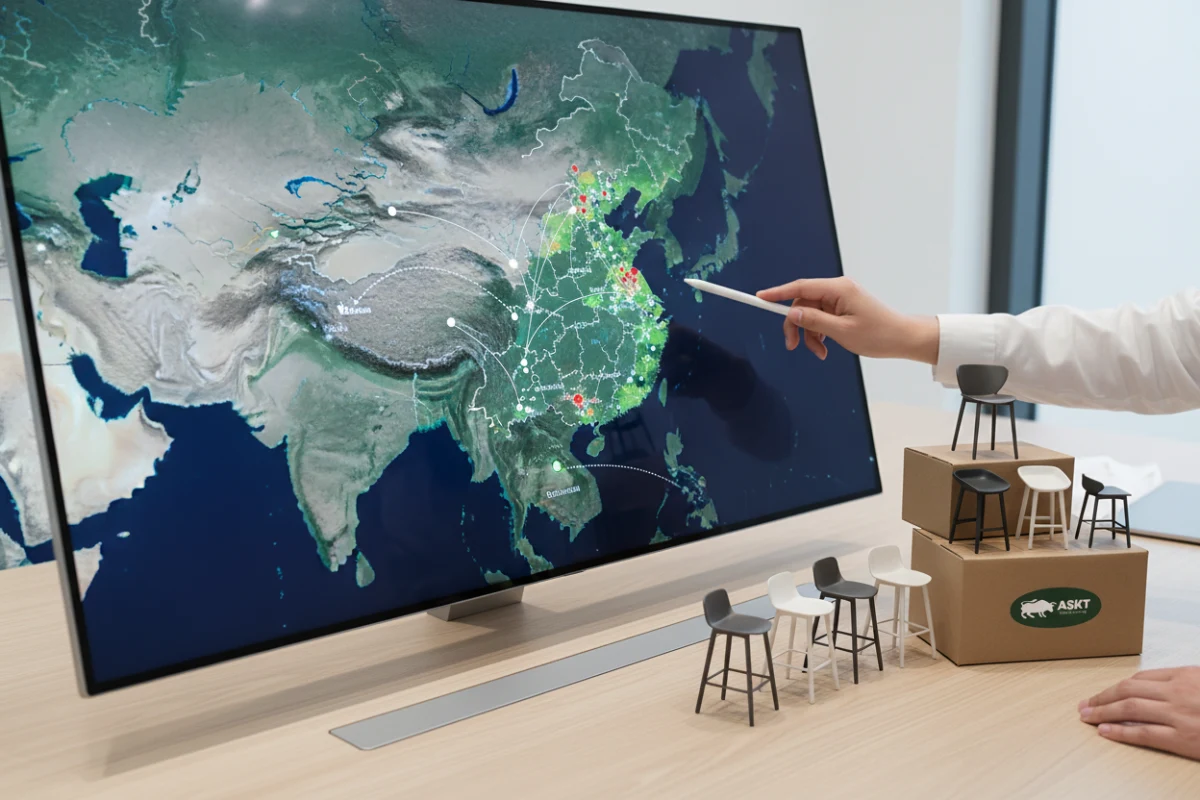
To understand where to find bar chairs manufacturers in China, you must first examine the geographic distribution of China's furniture manufacturing clusters. The country's export-oriented furniture industry is highly regionalised, with specific regions specializing in different materials, technologies, and pricing tiers. Sourcing from an established industrial cluster provides access to concentrated component supply chains, highly skilled labor, and optimized logistical infrastructure. This geographic clustering determines how efficiently a factory can source raw materials, which directly affects production lead times and cost-effectiveness.
Key Regional Manufacturing Clusters
Anji County (Zhejiang Province): The Global Seating Hub Widely recognized as a major capital for seating manufacturing, Anji specializes in office chairs, functional swivel mechanisms, and upholstered bar stools. The region is highly efficient due to its concentrated supply chain for components like gas-lifts, auto-return mechanisms, and standardized metal bases. If your portfolio relies heavily on functional, adjustable, or highly ergonomic seating, Anji is a vital geographic target when searching for where to find bar chairs manufacturers in China. Its proximity to Ningbo and Shanghai ports also ensures lower inland transport costs and streamlined logistics.
Foshan (Guangdong Province): High-End Customization and Metal Craftsmanship The Shunde district in Foshan is internationally famous for premium residential and commercial furniture. Factories in this region excel in contemporary aesthetics, custom metal fabrication, and advanced upholstery techniques. For contract furniture buyers or high-end retail chains requiring highly customized designs, sourcing bar stools from China through Guangdong suppliers offers excellent access to premium raw materials and professional design support. This region is a major hub for custom bar chair manufacturer setups.
Shengzhou and Ningbo Area (Zhejiang Province): Precision Export Operations This industrial cluster is known for combining advanced metalworking with structured B2B furniture factory China operations. Suppliers here are highly focused on the European market, with a deep understanding of European compliance standards, design aesthetics, and international shipping logistics. Their engineering-first mindset translates into high product consistency and precise manufacturing tolerances.
Bazhou (Hebei Province): High-Volume Metal Framing Located in northern China, Bazhou excels in high-volume, cost-efficient metal-frame furniture. While highly competitive on pricing, European importers sourcing from this region must maintain strict quality control regarding powder coating finishes, weld integrity, and chemical safety compliance. It is ideal for high-volume commercial seating wholesale China buyers, provided the factory's quality control systems are thoroughly audited.
Audit Checklist: Verifying BSCI Compliance and Worker Safety Standards
When evaluating potential partners, identifying where to find bar chairs manufacturers in China is only the initial step. A professional B2B manufacturer's capability is directly reflected in its workshop organization, environmental practices, and social compliance. For European buyers, auditing a Chinese supplier’s social compliance is not just a regulatory formality under corporate environmental, social, and governance (ESG) policies—it is a critical indicator of long-term operational stability and manufacturing consistency.
When selecting a custom bar chair manufacturer, always request their Business Social Compliance Initiative (BSCI) audit report. A valid BSCI certification demonstrates a factory’s commitment to fair compensation, legal working hours, and safe operational conditions. During a physical or virtual walkthrough of the factory floor, look for these key indicators of safety, process control, and worker welfare:
- Fabric-Cutting Areas: Ensure operators handling high-speed mechanical cutting machinery are equipped with and actively wearing stainless steel, metal cut-resistant gloves. This simple safety measure prevents severe workplace accidents and demonstrates operational discipline.
- Assembly and Upholstery Lines: Verify that workers are provided with proper protective overalls and that the assembly lines are organized, well-lit, and clear of clutter. Clean lines prevent accidental product damage and upholstery contamination during the final assembly stages.
- Adhesive Application Stations: High-quality manufacturers utilize eco-friendly, formaldehyde-free glues to ensure safety. Confirm that workers are equipped with professional gas masks and that the workshop is fitted with functioning VOC (Volatile Organic Compound) extraction systems. This is vital to protect workers and maintain European environmental compliance.
- Employee Training Programs: Request records of documented safety and operating procedures (SOPs). A safe and structured work environment directly minimizes the risk of sudden production stops, local regulatory penalties, and erratic product quality.
Assessing Technical Capability: Precision Automation and Manufacturing Equipment
To consistently meet the high quality standards expected by European consumers, an advanced B2B furniture factory China must invest in modern production machinery. High-level automation ensures dimensional precision, seamless welds, and structural durability across massive production runs. When evaluating potential suppliers, ask for a detailed inventory of their manufacturing equipment to compare manual methods against advanced automated systems.
| Manufacturing Step | Manual Fabrication Method | Advanced Automated System | Business Value for B2B Buyers |
|---|---|---|---|
| Fabric Preparation | Hand-cutting with manual shears | Computerised CNC batch-cutting machinery | Delivers perfect pattern consistency, eliminates material fraying, and optimises fabric yield to control costs. |
| Wooden Support Cutting | Manual band saws and drilling | Automated CNC shaping and drilling | Guarantees high-precision drilling for structural fasteners, ensuring bolts never strip during assembly or commercial use. |
| Structural Fastening | Manual hammer-driven T-nuts | Automated nailing machines for four-legged nails | Eliminates loose structural connections, preventing wobbling in upholstered seating shells over long-term use. |
| Metal Frame Fabrication | Manual hand-arc welding | Automated welding robotic arms | Produces clean, deep-penetration weld seams that eliminate mechanical weak points under torsional stress. |
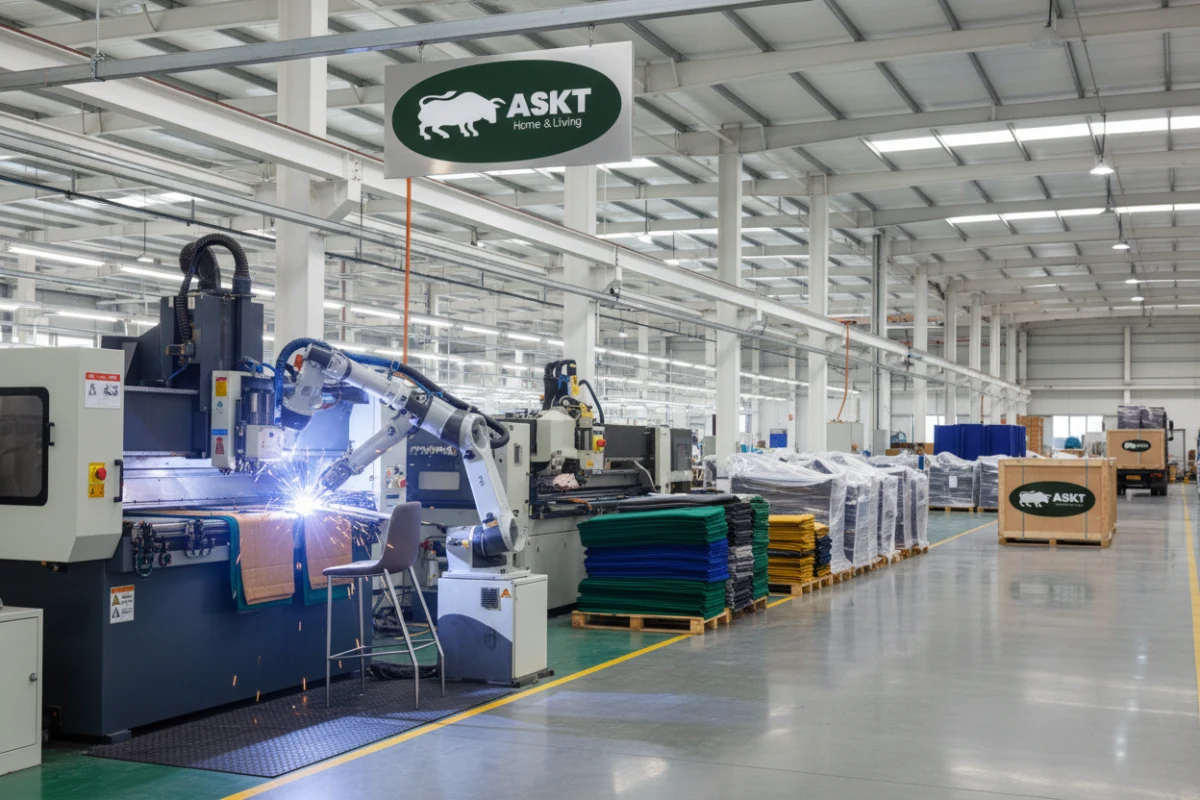
For bar seating, the structural integrity of the metal base and footrest is of paramount importance. Because bar stools have an elevated seating height, the leverage applied to the base joints is much higher than that of standard chairs. Manual welding introduces human error, leading to variations in weld penetration and structural strength. Over time, these minor variances can lead to metal fatigue and catastrophic joint failures.
In contrast, automated welding robotic arms apply precise temperature, speed, and angles consistently. For European wholesalers, this advanced capability translates directly into zero structural failures, consistent powder coating adhesion, and complete peace of mind when supplying high-traffic hospitality venues. This level of automated control is a key differentiator when evaluating a B2B furniture factory China.
Evaluating Material Integrity: Certified Fabrics and Structural Quality
A beautifully designed bar stool is of little value if its upholstery wears out prematurely or its frame fails under standard commercial loads. Sourcing premium bar stools requires looking past the surface to evaluate the underlying materials and verify independent testing certifications. This is critical for those focused on commercial seating wholesale China transactions, where high durability is a non-negotiable requirement.
Upholstery Fabric Performance
Bar seating in hospitality environments or busy residential spaces is highly vulnerable to abrasion, stains, and scratching. To protect your brand from quality complaints, look for advanced material solutions such as functional upholstery fabrics. High-performance fabrics often combine a molecular-level hydrophobic nano-coating with micro-ventilation technology, creating a seat that is highly breathable, waterproof, stain-resistant, and easy to clean while maintaining a premium feel. For families with pets, scratch-resistant fabrics prevent damage from claws, extending the product's lifespan.
When sourcing commercial seating, ensure all fabrics undergo independent certification and testing:
- Abrasion Resistance: Verify that fabrics achieve at least 40,000 rubs on the Martindale abrasion test for high-traffic commercial durability. This ensures the material remains intact even after years of continuous daily use.
- Chemical Safety: Ensure all textiles hold valid OEKO-TEX Standard 100 certifications, proving they are completely free of harmful chemicals, formaldehyde, and heavy metals. This is essential for compliance with European consumer safety regulations.
- Colour Fastness: Confirm that fabrics are tested to resist fading under interior lighting or UV exposure, maintaining their original appearance over time.
Structural Compliance and Quality Testing
Before finalizing a production order, verify that the supplier’s products comply with European safety and durability standards. Look for designs certified under EN 12520 (for domestic seating) and EN 16139 (for non-domestic or contract seating). A reliable manufacturing partner will perform rigorous, in-house quality control testing, including:
- Drop Testing: Simulating severe impacts on the seat shell to verify that structural joints do not fracture or deform under sudden weight.
- Load-Bearing Capacity Tests: Verifying that the gas-lifts, metal frames, and swivel mechanisms can withstand high static and dynamic loads without bending or losing mechanical integrity.
- Base Stability Testing: Ensuring the stool maintains its balance and does not easily tip over when lateral or backward force is applied, preventing accidental falls.
Optimising Logistics: Modular Systems and Digital Sourcing Efficiency
For European wholesalers and importers, high ocean freight rates and logistics costs are persistent challenges. Shipping pre-assembled, bulky bar stools is highly inefficient and dramatically reduces profitability. Advanced manufacturers address these issues through modular product design, packaging optimization, and digital integration.
The KINEXA Modular Component System
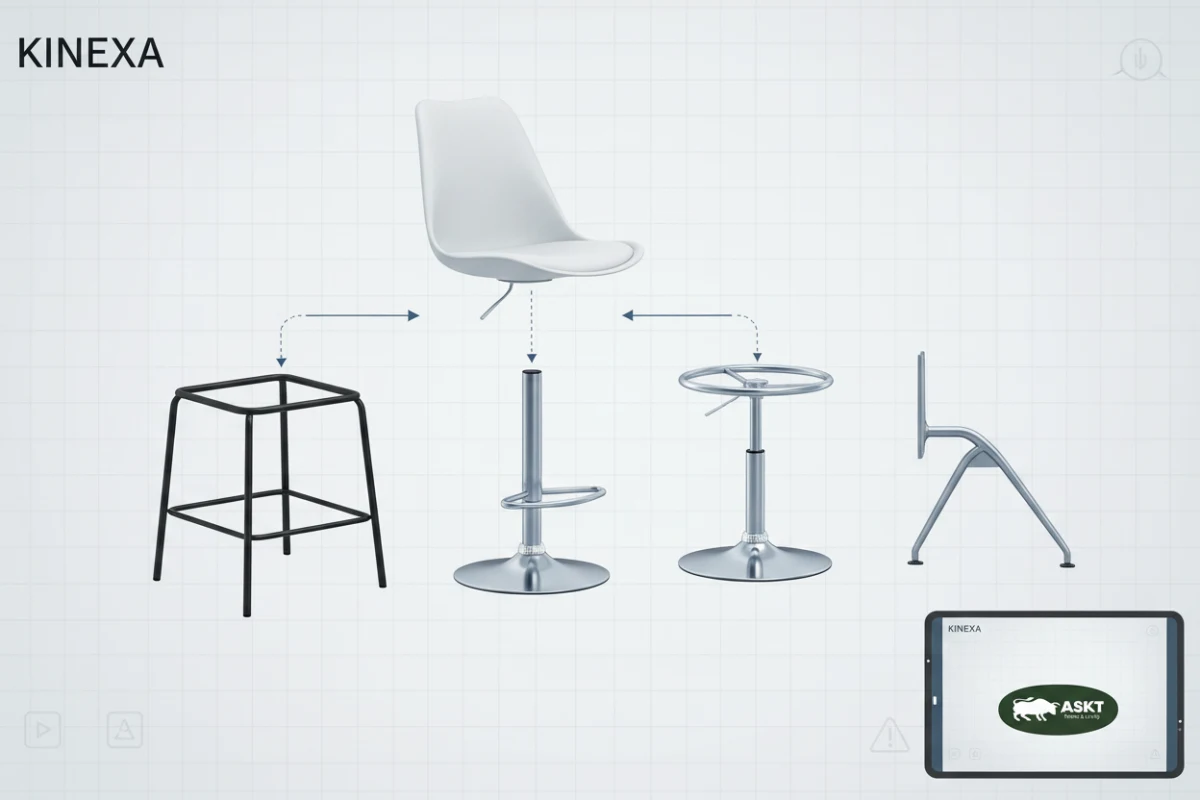
To address key B2B sourcing challenges—such as high minimum order quantities (MOQs), inventory management risks, and container space waste—innovative manufacturers utilize standardized, interchangeable systems. A prime example is the KINEXA modular system. By designing a range of standardized seat shells that can be seamlessly paired with different interchangeable metal bases, this system provides substantial business benefits:
- Lowering MOQ Requirements: Wholesalers can mix and match various seat designs and bases within a single shipping container, lowering the barrier to entry for new collections and reducing overall inventory investment.
- Optimised Container Loading: Standardized, KD (Knocked-Down) parts pack tightly together, eliminating empty space in cartons and significantly lowering the per-unit shipping cost. This ensures you are not paying to ship empty air across the ocean.
- Mitigating Inventory Risks: Buyers can stock fewer base SKUs while offering a diverse range of configurations to their retail customers, maximizing market reach with minimal storage overhead.
Under a strict 'Test first, ship second' philosophy, every modular configuration is pre-tested in-house to guarantee stability and load capacity before packing, ensuring seamless assembly and flawless performance for the end user.
Sunbin KI: Bridging the Communication Gap
Cross-border furniture sourcing can often suffer from communication delays, technical misunderstandings, and slow sample development. To overcome this, advanced B2B suppliers leverage tools like Sunbin KI—a highly specialized, conversational AI assistant developed specifically for B2B purchasing managers and product developers.
Rather than serving as a basic customer support tool, Sunbin KI functions as a technical furniture specialist. It guides buyers through structured dialogues, identifying precise requirements for fabric selections, frame dimensions, regulatory compliance, and mechanical specifications. This digital solution eliminates translation errors, provides instant access to product details, and dramatically shortens the sample development phase, making B2B sourcing remarkably fast, accurate, and completely digital.
The Strategic Path to Reliable Chinese Seating Partnerships
Navigating the process of where to find bar chairs manufacturers in China ultimately comes down to finding a supplier whose technological capabilities, quality standards, and communication processes align with your business goals. By shifting your focus from low-cost transactional suppliers to automated, socially compliant partners, you can mitigate quality risks and build a highly profitable bar seating category.
If you are evaluating dining furniture or bar stool suppliers for the European market and are looking to reduce your sourcing risks while improving product quality, we invite you to contact ASKT's specialist B2B team to explore our custom design capabilities, technical certifications, and modular container solutions.