Why Dining Chair Projects Fail After the Sample Stage: A Buyer’s Quality Control Guide
Why Dining Chair Projects Fail After the Sample Stage: A Buyer’s Quality Control Guide
For Einkaufsleiter in German furniture retail
In the current German furniture retail environment (Möbelhandel), stationary trade is under immense pressure. With sales declining by approximately 5.1% in early 2025, the margin for error has vanished. Procurement leaders are no longer just fighting for the best price; they are fighting against 'Lagerdruck' (inventory pressure) and thinning 'Marge' (margins). The most dangerous moment in the procurement cycle is not the negotiation—it is the transition from an approved sample to mass production.
Many projects that look promising at the prototyping stage fail spectacularly during the first bulk delivery. This failure directly impacts 'Lieferzuverlässigkeit' (delivery reliability) and leads to a spike in 'Reklamationsquote' (complaint rates), which is the primary silent killer of retail profitability. This guide provides the framework to bridge the gap between a 'Golden Sample' and a successful 'Abverkauf' (sell-through).
The Sample Stage Illusion: Why the First Piece Lies
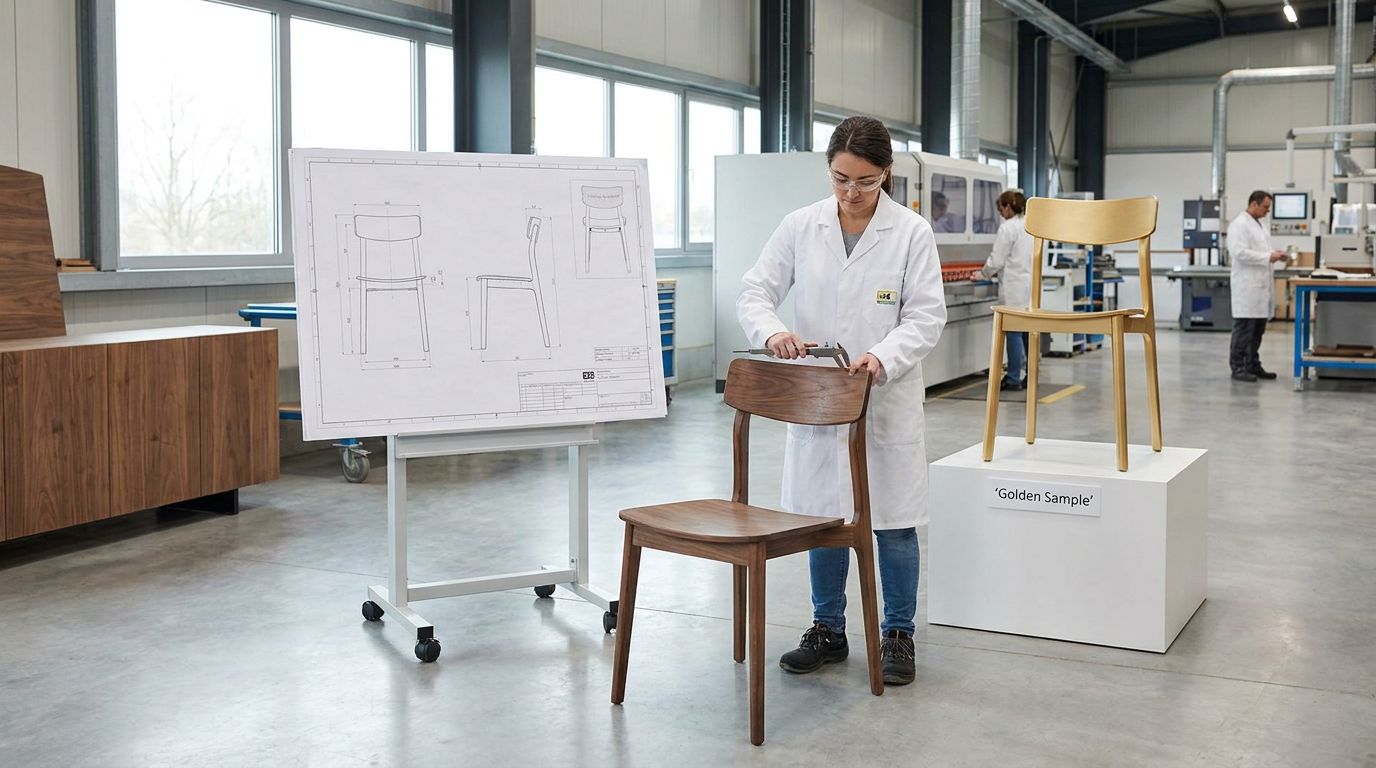
The 'Golden Sample' is often a handcrafted masterpiece. In many factories, samples are produced in a specialized sample room by senior master craftsmen using premium-grade materials that may not be available in bulk. However, mass production is an entirely different beast involving automated machinery, different glue drying times, and varied wood moisture content.
This 'Industrial Translation Gap' is where most projects fail. For a German retailer, a chair that looks right but fails structurally after three months of use in a high-traffic restaurant or home environment results in catastrophic 'Reklamation' costs that can exceed the original purchase price of the furniture.
5 Critical Mistakes Procurement Leaders Make During Scaling
- Lack of a Technical Bill of Materials (BOM): Relying on a physical sample without a detailed technical specification. If the internal structure of the chair is changed to save costs during mass production, you won't know until the chairs start breaking.
- Ignoring Material Consistency: Forgetting to specify the exact brand of lacquers, the density of foam (kg/m³), or the Martindale count of the fabric for the bulk order.
- Skipping In-Line Inspections: Waiting until the goods are at the port to inspect them. By then, if the 'Sortiment' (assortment) is wrong, your 'Cashflow' is already locked in a container of defective goods.
- Underestimating the EUDR and LkSG: Failing to verify that the mass production timber matches the certification of the sample timber, risking massive fines under the German Supply Chain Act.
- Over-reliance on Price over Process: Choosing a supplier based on a low unit price without auditing their ISO 9001 quality management systems.
The Decision Framework: Evaluating Supplier Scalability
Before placing a Purchase Order (PO) for 200 or 2,000 units, an Einkaufsleiter must judge the manufacturer's ability to replicate quality. At ASKT Furniture, we leverage over 15 years of manufacturing experience to ensure that the 'Industrial Translation' is seamless. Our ISO 9001 certified processes are designed to maintain consistency from the first prototype to the 10,000th unit.
Evaluation Matrix: Sample vs. Series Production Failure Risks
| Risk Factor | Sample Characteristics | Series Production Risk | Mitigation Strategy |
|---|---|---|---|
| Structural Integrity | Hand-fitted joints | Loose tenons due to machine speed | Demand 3D CAD exploded views |
| Surface Finish | Hand-sanded, multi-coat | 'Orange peel' or thin lacquer | Specify lacquer brand and micron thickness |
| Dimensions | 100% accurate to spec | Variance due to wood moisture | Set +/- 2mm tolerance limits |
| Fabric/Foam | Premium batch | Lower density substitution | Batch-testing and certification logs |
| Packaging | Custom reinforced | Minimalist to save shipping space | ISTA 3A drop test on mass production units |
The 10-Point Dining Chair Quality Checklist for Einkaufsleiter
To protect your 'Marge' and ensure high 'Abverkauf', use this checklist for every major dining chair project:
- Sealed Golden Sample: Retain a signed and dated sample at the buying office and one at the factory.
- Moisture Content Control: Ensure wood moisture is between 8-12% for the German climate to prevent cracking.
- EN 16139 Testing: Verify the chair meets European standards for strength, durability, and safety in non-domestic use.
- Foam Density Check: Minimum 30kg/m³ for seat cushions to prevent premature sagging.
- Joint Reinforcement: Check for corner blocks and high-quality D3 grade wood glue.
- Color Consistency: Use Pantone or RAL references rather than just 'visual match.'
- Weight Capacity: Test for a minimum of 150kg static load.
- Hardware Quality: Ensure all screws and bolts are galvanized or stainless steel with thread-locker.
- Packaging Integrity: Double-wall corrugated boxes with edge protectors to minimize 'Reklamation' from shipping damage.
- Final Audit: A 3rd party AQL 2.5/4.0 inspection before the final 70% payment is released.
FAQ: Protecting Your Marge and Reducing Reklamation
Q: Why does the bulk order often look different from the approved sample?
A: This is usually due to 'batch variation' in raw materials and the shift from manual to automated production. Working with a manufacturer like ASKT Furniture, which offers a stable 45-day lead time and flexible 200-unit MOQs, allows for better oversight and more frequent quality checkpoints.
Q: How can I reduce the Reklamationsquote in my stationary retail stores?
A: Focus on 'Structural QC.' Most complaints in the German market are related to wobbly legs or fabric pilling. Implementing a mandatory 'In-line' inspection where the first 50 units are checked against the BOM can catch these issues early.
Q: What specific testing standards are required for the German contract market?
A: For commercial spaces like restaurants and hotels, the EN 16139 (Level 1 or 2) is the benchmark. It ensures the furniture can withstand the rigors of public use, thereby protecting the retailer from liability.
Conclusion: Making the Judgment on Supplier Reliability
In the high-stakes world of German furniture retail, the difference between a profitable season and a logistical nightmare is the quality of your 'Judgment.' Choosing a partner who understands that a dining chair is not just a piece of design, but a structural asset, is critical. ASKT Furniture provides the transparency and technical rigor required to ensure your 'Sortiment' remains high-performing and your 'Reklamationsquote' remains low.
Do you want me to send you a practical evaluation checklist or our latest technical decision framework for commercial seating?