Why Dining Table Tops Warp, Crack, or Delaminate: A B2B Manufacturing and Sourcing Guide
Dining table tops warp, crack, or delaminate primarily due to unbalanced core moisture levels, inadequate veneer adhesive curing, asymmetric surface sealing, and rigid subframe engineering that restricts natural thermal and humidity expansion. When wood or engineered panels experience sudden shifts in relative humidity during sea freight or seasonal indoor heating, internal mechanical stress builds up unevenly across panel layers, resulting in cupping, deep splits, or surface veneer detachment.
Why do dining table tops warp, crack, or delaminate in retail and residential environments?
For commercial furniture buyers, wholesalers, and retail importers, tabletop stability issues represent some of the most expensive after-sales claims in the industry. When a dining table arrives in a European warehouse or reaches an end consumer and begins to bow, check, or peel after a few months of use, the commercial damage involves warranty replacements, reverse logistics, and strained customer relationships. In professional furniture manufacturing, these structural failures are rarely random accidents; they stem from physical dynamics that occur when raw materials, bonding methods, or structural designs do not match real-world climatic conditions.
To understand why dining table tops warp crack or delaminate, buyers must recognise how timber and wood-based composite materials behave in different environments. Wood is naturally hygroscopic, meaning it continuously absorbs and releases moisture vapour to reach an equilibrium moisture content with surrounding ambient air. When a tabletop is exposed to dry winter air, radiator heat, or maritime humidity, individual timber fibres expand or contract.
Tabletop defects generally fall into three distinct physical categories:
- Warping (Cupping, Bowing, and Twisting): The panel deviates from a flat plane because one side of the board expands or contracts at a different rate than the opposite side. Cupping occurs across the width of the panel, bowing occurs along the length, and twisting occurs diagonally across opposing corners.
- Splitting and Cracking: Surface checks and deep structural fractures develop when internal tensile stresses exceed the mechanical cohesion of the wood fibres or composite substrate.
- Veneer Delamination: The decorative top veneer or protective backing layer separates from the substrate core, producing raised blisters, loose edges, or visible surface bubbling.
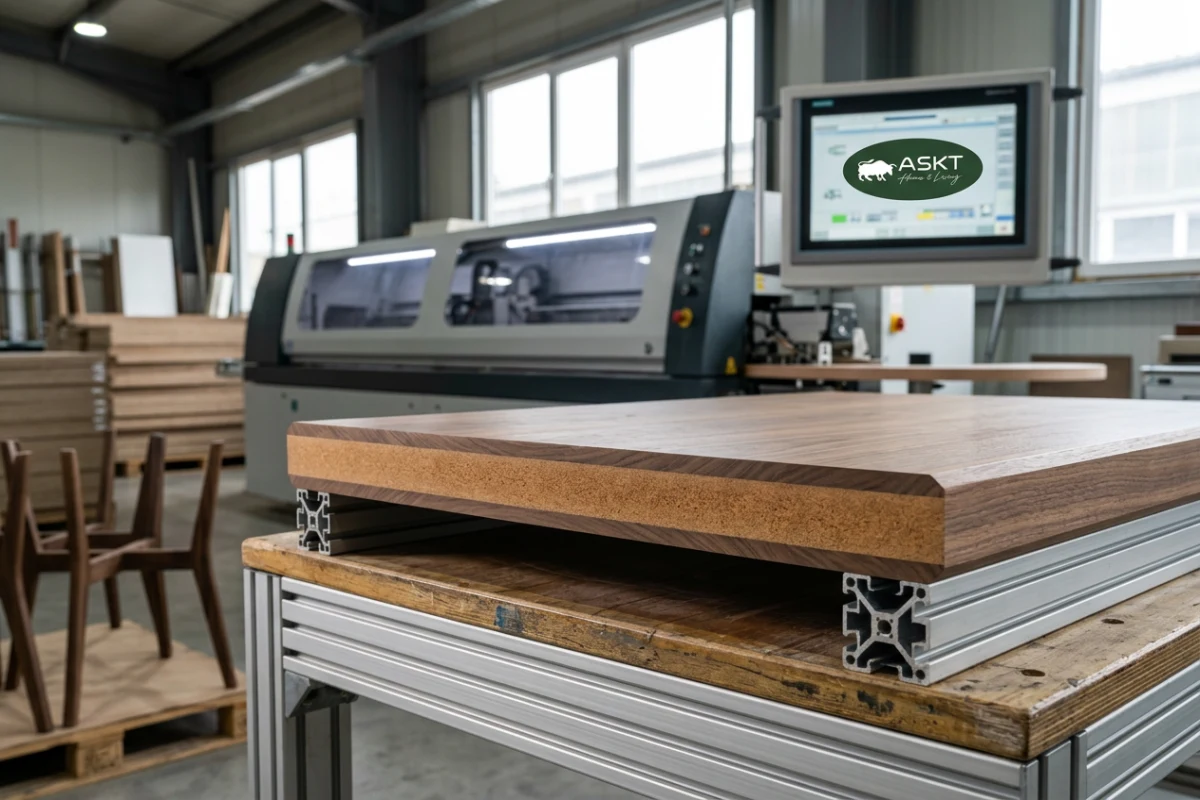
When furniture is manufactured in coastal, high-humidity manufacturing hubs and subsequently transported to European markets such as Germany, the Netherlands, the UK, or Poland, the change in indoor heating and seasonal dryness causes rapid moisture loss. If the manufacturing process has not accounted for this moisture gradient, panel failure is virtually inevitable.
What are the primary wood table top cracking causes in solid timber and engineered panels?
To evaluate structural durability during supplier selection, purchasing managers must identify the specific wood table top cracking causes associated with different panel constructions. Solid wood panels and engineered composite tops fail for different mechanical reasons, and each requires distinct manufacturing safeguards.
1. Moisture Content Mismatch and Rapid Desiccation
Timber cells hold moisture within their cell walls and internal cavities. Kiln drying must carefully reduce core moisture content to match the typical indoor equilibrium moisture content of European homes, which generally ranges between 8% and 10%. If raw lumber is processed at a higher moisture level (such as 14% to 16%), the wood will undergo drastic shrinkage once placed in centrally heated indoor spaces where winter relative humidity frequently falls below 40%. Because the outer edges of the tabletop lose moisture much faster than the inner core, steep moisture gradients create heavy surface tensile stress that tears the grain apart, producing end checks and longitudinal splits.
2. Anisotropic Shrinkage and Mixed Grain Orientation
Natural wood does not expand or contract uniformly in all directions. Longitudinal shrinkage along the grain is negligible, whereas radial shrinkage across growth rings is moderate, and tangential shrinkage along annual growth rings is substantial. When solid wood tabletops are assembled using wide timber boards with conflicting grain alignments—such as placing flat-sawn planks directly beside quarter-sawn planks—the adjacent boards pull against one another with unequal force as humidity fluctuates. This differential movement generates internal shear stress that forces joints and timber fibres to split.
3. Rigid Frame Fastening Without Expansion Allowance
A frequent design flaw in modern dining tables involves fixing wide timber or veneer tops directly to rigid steel frames with fixed, circular screw holes. When ambient humidity drops, the tabletop naturally attempts to contract across its width. If rigid steel fasteners lock the panel immovably in place, the wood is mechanically restrained from contracting. The resulting tensile load eventually forces the tabletop to fracture along the weakest grain line or adhesive seam.
| Failure Type | Primary Mechanical Cause | Typical Visual Defect | Essential Manufacturing Solution |
|---|---|---|---|
| End Checking | Rapid perimeter moisture loss | Fine hairline cracks at board ends | Deep end-grain sealing prior to lacquering |
| Longitudinal Splitting | Restrained shrinkage against steel base | Deep cracks running along glue lines | Slotted expansion screw holes and floating brackets |
| Grain Separation | Mixed tangential and radial shrinkage | Severe surface fissures across wide planks | Narrow stave lamination and grain matching |
| Substrate Tearing | Uneven expansion in low-density cores | Surface fracture telegraphing through veneer | High-density, balanced MDF or plywood cores |
How does improper adhesive application lead to table top veneer delamination?
In contemporary dining furniture collections, engineered tabletops finished with natural oak, walnut, or ash veneers make up a substantial share of European retail volume. Engineered substrates such as high-density MDF and multi-layer plywood offer superior dimensional stability compared to solid timber. However, table top veneer delamination remains a major commercial hazard if factory gluing and hot-pressing parameters are not strictly controlled.
Table top veneer delamination occurs when the adhesive interface between the decorative wood veneer and the underlying core substrate breaks down under mechanical or environmental stress. Several manufacturing errors contribute directly to this failure:
- Starved Adhesive Lines and Uneven Spread: If automated glue spreaders apply an insufficient volume of adhesive or distribute it unevenly across the substrate, dry pockets remain beneath the veneer sheet. Once exposed to environmental humidity shifts, these unbonded areas lift, resulting in visible hollow blisters.
- Adhesive Pre-Curing During Assembly: Industrial adhesives require precise assembly open times, press temperatures, and dwell times. If hot press cycle timing is mismanaged and the glue begins to cure before uniform hydraulic pressure is applied, the adhesive forms a brittle, superficial bond that lacks deep mechanical penetration into the substrate pores.
- Omission of Symmetrical Backing Veneers: A fundamental principle of panel lamination is structural symmetry. If a decorative 0.6mm natural oak veneer is applied to the top face of an engineered panel, an equivalent balancing veneer sheet must be applied to the bottom face. When suppliers attempt to lower production costs by omitting the backing layer or substituting it with lightweight paper, the top veneer exerts unequal surface tension as it dries. This imbalance pulls the board into a permanent curve and causes edge peeling.
- Trapped Solvent Vapour and Fast-Curing Topcoats: If surface lacquers or topcoats are sprayed over veneer assemblies before water-based adhesives have thoroughly cured and vented, volatile moisture and reaction gases become trapped beneath the surface. As room temperatures rise, internal vapour pressure pushes against the veneer layer, causing blister delamination.
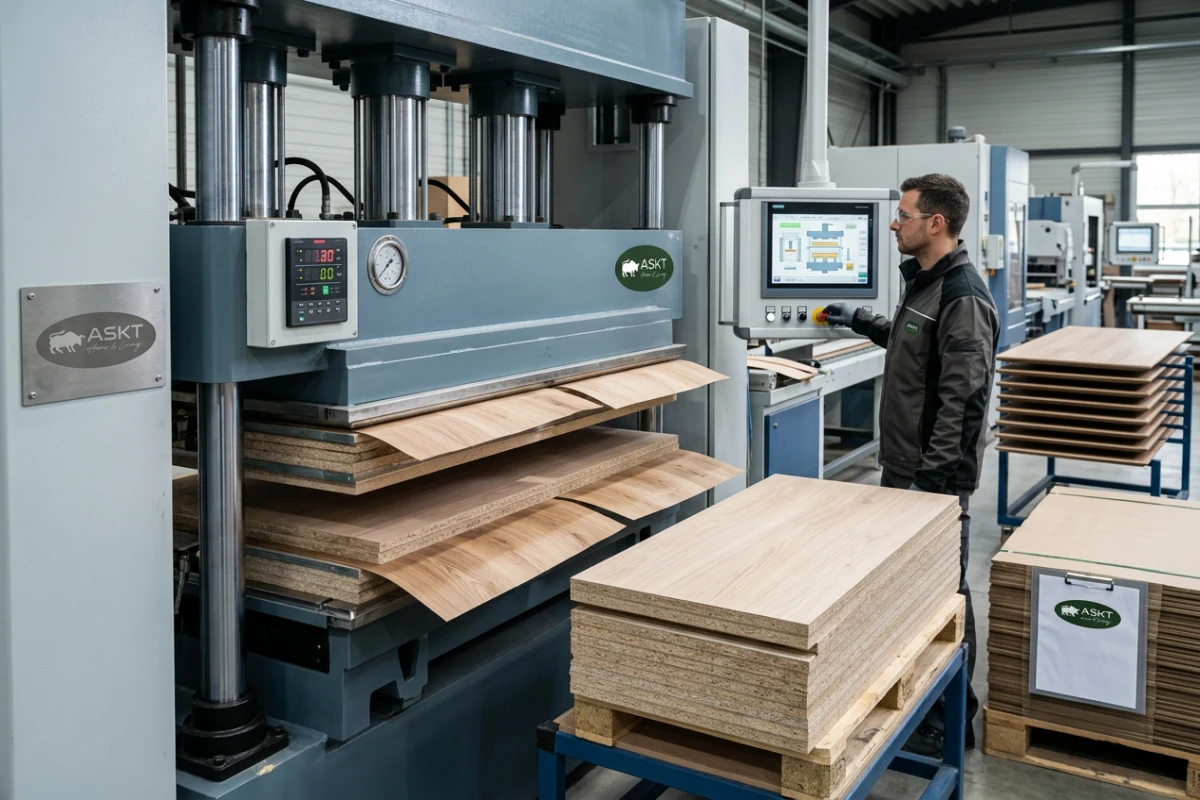
Professional manufacturing facilities prevent these bonding failures by regulating ambient temperature and humidity within lamination workshops, using calibrated adhesive application equipment, and applying balanced backing sheets to every veneered panel.
What structural engineering techniques deliver effective dining table warping prevention?
Achieving consistent dining table warping prevention requires combining proper material preparation with intelligent structural engineering. Relying solely on dry lumber or stable core boards is insufficient for large dining table spans; the table structure must be engineered to resist mechanical deflection while accommodating natural physical movement.
Embedded Steel Reinforcement Channels
For large dining tables extending between 180cm and 260cm in length, integrating embedded cold-rolled steel channels into the underside of the panel provides robust protection against longitudinal bowing and lateral cupping.
- CNC routing machines cut precise longitudinal channels into the bottom face of the substrate panel.
- Heavy-gauge steel channels are mounted flush within these recesses across the underside.
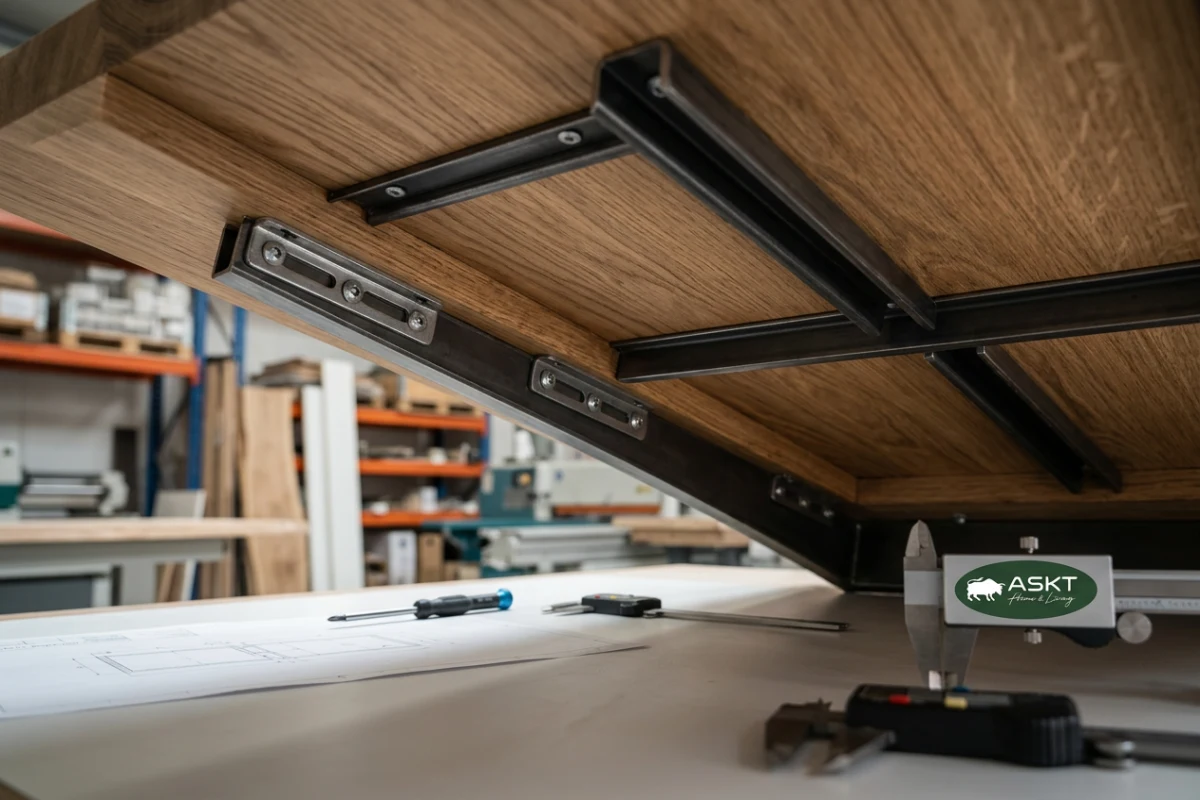
- Crucially, the steel channels are fastened using elongated slotted holes rather than tight circular holes. This configuration provides rigid vertical support to keep the tabletop flat while allowing the wood panel to slide horizontally along the slot as ambient moisture changes.
Symmetrical Double-Sided Surface Finishing
Unequal surface finishing is a common cause of progressive tabletop cupping. If the visible top surface receives multiple protective coats of polyurethane or UV-cured lacquer while the underside receives only a thin primer coat, the unfinished underside absorbs and releases moisture vapour much faster than the sealed top. This differential moisture exchange generates continuous rotational stress that warps the panel. High-quality production standards require identical moisture barrier protection on both faces of the tabletop.
Underside Stress-Relief Grooves
On thick solid wood tops or heavy composite panels, machining longitudinal stress-relief kerf cuts along the underside relieves lateral grain tension. These relief grooves interrupt continuous transverse stress lines, allowing individual sections of the wood to expand and contract microscopically without transferring twisting torque across the entire width of the table.
| Engineering Technique | Primary Defect Targeted | Working Mechanism | Recommended Application |
|---|---|---|---|
| Embedded Slotted Steel Channels | Longitudinal bowing and lateral cupping | High vertical rigidity with horizontal movement slots | Large dining tables (180cm–260cm) in veneer or solid wood |
| Symmetrical Barrier Coating | Concave and convex panel cupping | Equalised moisture sorption rates on top and bottom faces | All veneered MDF, plywood, and solid wood tabletops |
| Underside Relief Kerfing | Transverse grain tension and twisting | Stress-relief channels breaking continuous lateral force | Thick solid wood panels (35mm–50mm thickness) |
| Floating Subframe Brackets | Frame-induced splitting and joint failure | Sliding mechanical fasteners allowing natural width movement | Solid timber tops mounted to rigid metal underframes |
How do maritime transit, climate shifts, and storage impact dining table top stability?
Even when dining tables are manufactured to exact engineering drawings, maritime logistics and multi-climate supply chains subject wooden furniture to severe environmental stress. Ocean container freight from Asian production centres to European distribution hubs in Rotterdam, Hamburg, or Felixstowe takes several weeks and crosses multiple climate zones.
Inside closed shipping containers, internal temperatures can fluctuate dramatically between daytime sun exposure and cold nighttime conditions at sea. These temperature swings cause container condensation, where trapped moisture evaporates from packaging materials and condenses onto carton surfaces.
When standard packaging absorbs this moisture, several degradation mechanisms affect tabletop panels:
- Carton Softening and Load Compression: Moisture-saturated export cartons lose structural rigidity, transferring stacking weight directly onto tabletop edges and central spans, which can induce physical creep deflection during transport.
- Asymmetric Moisture Absorption in KD Packaging: In flat-packed Knock-Down (KD) dining tables, the tabletop is often packaged adjacent to metal legs or dense packaging foam. The side facing damp carton walls absorbs humidity, while the shielded side remains dry. This uneven moisture absorption causes cupping before the package is even opened at the warehouse.
- Adhesive Plasticisation under Heat and Humidity: Prolonged exposure to high container heat and elevated relative humidity can soften lower-grade thermoplastic adhesives, significantly increasing the likelihood of table top veneer delamination along thin perimeter edges.
To protect furniture integrity throughout international transit, experienced export manufacturers use heavy-duty moisture barrier inner wrapping, integrate desiccants inside cartons, and reinforce packaging with high-density honeycomb paper protectors and edge guards that resist compression and buffer against humidity.
What should professional buyers include in a furniture quality inspection table tops protocol?
To minimise commercial return rates and protect brand reputation, European retail buyers, importers, and quality managers must establish clear pre-shipment quality standards. Relying solely on aesthetic visual checks is inadequate for structural furniture components. A comprehensive furniture quality inspection table tops protocol should verify core moisture, surface geometry, bonding strength, and mechanical tolerances prior to container loading.
A thorough pre-shipment quality control checklist should focus on five core inspection areas:
1. Multi-Point Moisture Content Verification
Quality inspectors should measure core moisture levels across multiple test locations on every sampled tabletop, including outer corners and central zones, using calibrated digital moisture meters.
- Target Standard: Core moisture content should measure between 8.0% and 10.0% for European deliveries, with minimal variance between testing points across the same panel.
2. Surface Flatness and Deflection Measurement
Inspectors place a calibrated 2-metre precision straightedge longitudinally and diagonally across the panel surface, using stepped feeler gauges to measure any gap beneath the straightedge.
- Target Standard: Maximum allowable surface deflection should remain below 1.5mm per 1000mm of span across unrestrained panels and assembled subframes.
3. Veneer Adhesion Cross-Hatch Evaluation
On offline production coupons from the same pressing run, cross-hatch cutting and adhesion tape tests evaluate the mechanical bonding strength of the veneer glue line.
- Target Standard: Clean lattice cuts with zero flaking or edge separation along the scored adhesive line.
4. Edge-Banding Sealing and Environmental Resistance
All four perimeter edges and mitred corners should be inspected under bright illumination to confirm continuous adhesive coverage without glue starvation or visible seam telegraphing. Sample panels can undergo temperature cycling to ensure edge glue lines remain intact.
5. Subframe Expansion Slot Alignment
Inspectors must verify that mounting screws connecting the tabletop to metal subframes are positioned centrally within slotted holes and fitted with appropriate friction-reducing washers, ensuring unobstructed horizontal movement.
| Inspection Parameter | Inspection Method / Tool | Target Quality Standard | Risk Prevented |
|---|---|---|---|
| Core Moisture Content | Calibrated Digital Moisture Meter | 8.0% – 10.0% MC for European climates | Post-delivery shrinkage, cracking, and checking |
| Surface Flatness | 2m Precision Straightedge & Feeler Gauge | Deflection < 1.5mm per 1000mm span | Visual cupping, rocking tableware, customer returns |
| Veneer Adhesion | Cross-Hatch Cutter & Adhesion Tape | Class 0/1 (clean cuts, no flaking) | Table top veneer delamination and surface bubbling |
| Subframe Expansion | Caliper & Torque Screwdriver | Central screw placement in slotted holes | Stress cracking caused by rigid thermal contraction |
| Packaging Integrity | ISTA Drop & Impact Verification | Undamaged corners and intact vapour barrier | In-transit compression warp and moisture damage |
How can European sourcing teams evaluate manufacturer capabilities and prevent defect risks?
When sourcing dining tables for retail chains, e-commerce brands, or commercial hospitality projects, evaluating a manufacturer's technical capability early in the product development cycle is essential. High-volume dining furniture requires rigorous production discipline due to the large panel spans, mechanical cantilever forces, and daily consumer use involved.
When assessing potential OEM and ODM furniture manufacturing partners, procurement teams should evaluate several practical factory capabilities:
- Climate-Controlled Material Storage: Does the manufacturer store raw lumber, MDF boards, and delicate veneer sheets inside enclosed, humidity-monitored warehouses, or are materials exposed to ambient outdoor weather?
- Automated Machinery and Pressing Controls: Does the factory operate automated CNC routing centres, multi-daylight hydraulic hot presses with digital temperature and pressure readouts, and automated glue applicators that ensure uniform adhesive spread?
- Structural Engineering and Customization Expertise: Can the engineering team adapt KD frame connections, integrate embedded steel channels, and provide balanced veneer backing configurations tailored to European climatic requirements?
- Packaging Optimization and Container Loading: Does the supplier offer optimized flat-pack packaging designs that incorporate honeycomb protection, reduced plastic use, and moisture barrier liners to withstand maritime shipping?
- Transparent Quality Control and Documentation: Does the factory maintain rigorous in-line quality inspection checkpoints, document moisture content across production batches, and provide transparent pre-shipment inspection reporting?
By treating dining tabletop construction as an integrated engineering process—combining controlled moisture management, symmetric panel lamination, slotted expansion subframes, and systematic factory quality inspection—European furniture buyers can build resilient dining collections that eliminate costly quality claims and protect long-term commercial value.
To evaluate technical specifications or discuss custom product development for your upcoming collections, speak with ASKT about tabletop quality requirements.