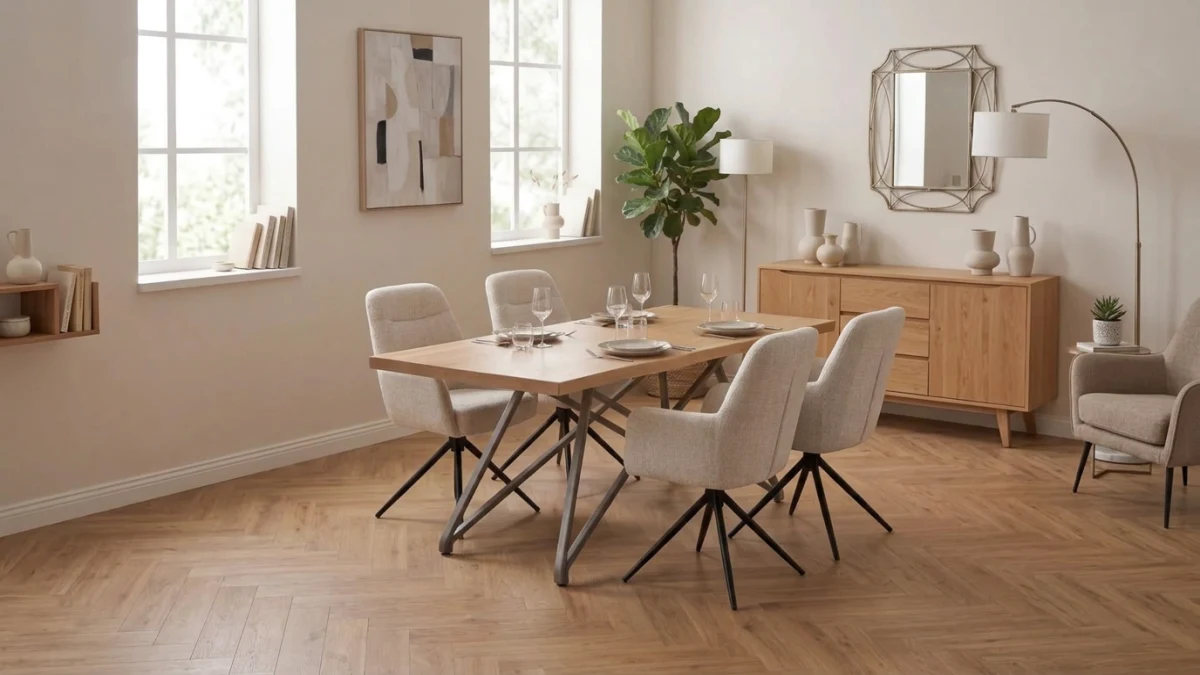
Why Dining Tables Wobble: Engineering Flaws, KD Frame Design, and Stability Testing Guide
Dining tables wobble primarily due to weak mechanical joint connections, insufficient subframe rigidity, uneven floor contact without compensation glides, or knock-down (KD) hardware fatigue under cyclic shear forces. In commercial and residential supply chains, instability usually stems from sub-gauge metal brackets, inadequate torque retention in fasteners, improper apron-to-leg triangulation, or material deflection caused by heavy table top surfaces like sintered stone or solid timber.
What Are the Primary Engineering Flaws Behind Dining Table Instability?
When evaluating why dining tables wobble, furniture engineers examine the table as a dynamic structural system. A dining table is subjected to continuous vertical loads, lateral friction, and torsional moments whenever people lean on the edges, shift tableware, or move the piece across flooring surfaces. If the structural framework cannot dissipate these dynamic forces efficiently, microscopic movement occurs at the primary stress junctions, leading to noticeable rocking and instability over time.
Several foundational engineering flaws explain the primary wobbly dining table causes observed across mass-manufactured collections:
- Inadequate Triangulation and Apron Depth: Tables relying solely on perpendicular ninety-degree corner joints without diagonal gusset plates or structural aprons lack racking resistance. When horizontal shear forces are applied, unbraced legs act as long mechanical levers, magnifying rotational torque directly against the fixing points.
- Fastener Loosening Under Cyclic Dynamic Load: Direct wood screws or undersized machine bolts into threaded inserts often suffer from micro-vibrations during daily use. Without locking spring washers, nylon-threaded patches, or serrated flange nuts, fastener pretension decays over time, creating joint play.
- Cross-Section Deflection in Legs: Thin-walled steel tubing or slender solid wood legs experience elastic deflection under lateral loads. Even if the corner joints remain completely rigid, flexible leg members produce noticeable oscillation at the tabletop surface.
- Uneven Contact Plane (Coplanarity Deficiencies): In mass production, a manufacturing tolerance deviation across a four-legged footprint causes three-point ground contact, resulting in instantaneous rocking unless compensated by precision adjustable levelling glides.
- Heavy Top Material Inertia: The adoption of heavy tabletop materials, such as sintered stone or thick ceramic slabs, elevates the table's centre of gravity. High-mass tops generate significant lateral kinetic momentum during subtle bumps, exposing any structural elasticity in the subframe.
| Engineering Failure Point | Mechanical Root Cause | Real-World Performance Impact | Sourcing Risk Level |
|---|---|---|---|
| Corner Joint Deflection | Missing corner gussets; thin stamped steel corner plates | Table sways laterally when elbows rest on tabletop | High (Direct consumer return driver) |
| Fastener Stripping | Machine screws threading into low-density core material | Complete joint separation after minimal lifecycle | Critical (Safety hazard and warranty claims) |
| Leg Tube Flexure | Sub-gauge wall thickness in structural steel or aluminium | Visible vibration and rocking during dining activities | Medium to High |
| Footprint Non-Coplanarity | Welding distortion or uneven timber curing without levellers | Four legs do not sit simultaneously on flat floors | Immediate (First-impression quality fail) |
How Does KD Dining Table Frame Design Impact Long-Term Structural Rigidity?
Knock-Down (KD) dining table frame design is essential for modern furniture logistics, allowing manufacturers to optimize container loading efficiency and reduce maritime freight expenditures for European importers. However, transforming a traditionally rigid, glued-and-tenoned piece of furniture into flat-pack modular components introduces multiple mechanical vulnerability points across detachable interfaces.
The core challenge of KD engineering lies in the transfer of dynamic loads across modular joints. In a factory-welded or mortise-and-tenoned chassis, bending moments are absorbed seamlessly through homogeneous material structures or deep glued surfaces. In KD frames, rotational torque and shear tension concentrate on metal fasteners, corner brackets, and insert nuts.
To ensure commercial dining table structural stability in KD designs, manufacturers implement advanced joinery principles:
- Structural Aprons and Integrated Perimeter Chassis: Rather than attaching legs directly into the underside of the table board, high-performance KD tables incorporate a secondary perimeter chassis. This steel or solid timber apron connects all four legs into an independent structural box before the top is secured. This design isolates the fragile tabletop material from structural racking loads.
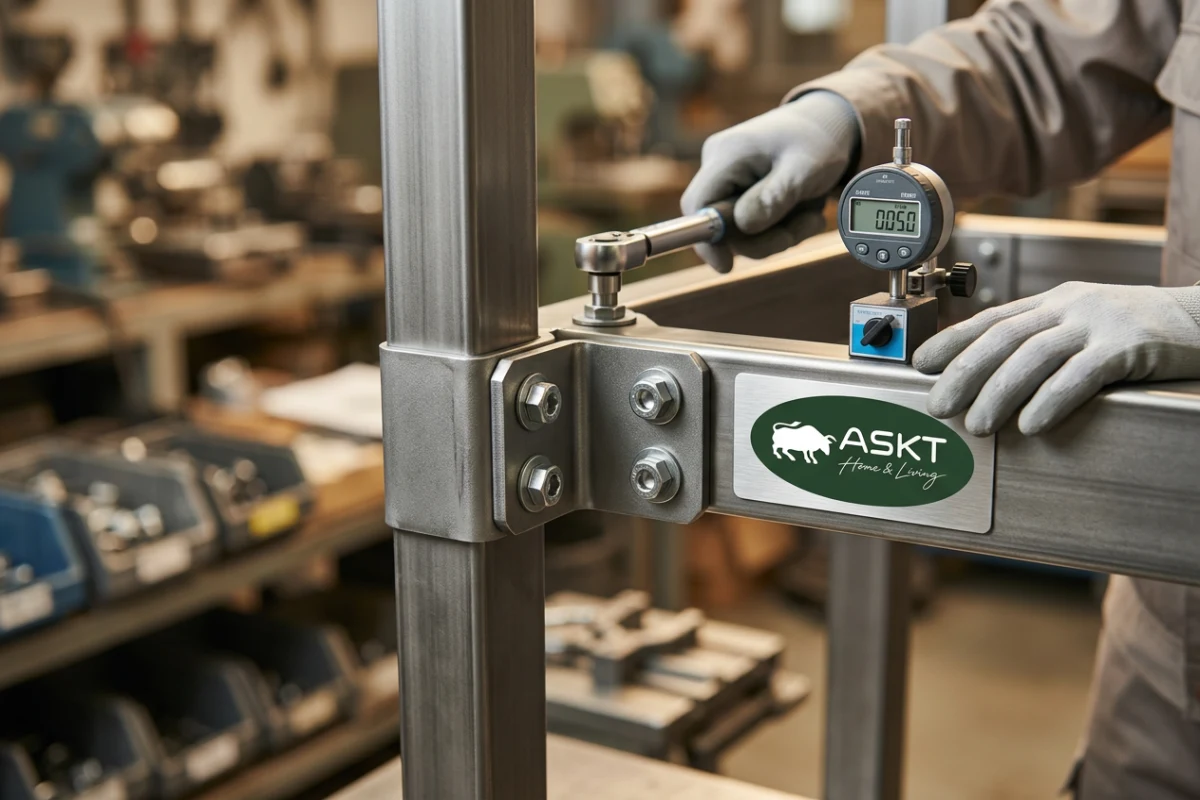
- Heavy-Duty Corner Gusset Plates: In metal and wooden KD tables, corner connections utilise heavy-gauge pre-formed steel gusset brackets. These brackets feature dual-plane anchor bolts that pull the leg diagonally inward into high-tolerance CNC-machined apron pockets, creating continuous compression that resists multidirectional swaying.
- Machined Threaded Inserts vs Direct Screw Fastening: Budget KD furniture frequently fails because self-tapping screws are driven directly into medium-density fibreboard or particleboard. High-quality European dining collections require hardened steel internally threaded bushings embedded into solid wood or structural metal tapped sleeves. High-tensile machine bolts ensure that required torque can be applied without stripping internal threads.
- Precision CNC Dowel Pin Registration: To prevent rotational twisting around a single central bolt, engineered KD joints integrate dual alignment dowels or CNC-machined locating pins. These mechanical stops absorb lateral shear stress, allowing the primary threaded fastener to focus entirely on maintaining axial clamping force.
Metal Frames vs Wood Joinery: How Do Materials Influence Table Sway and Deflection?
When sourcing dining furniture for European wholesale or retail distribution, product managers must weigh the physical trade-offs between metal frame sub-structures and traditional timber joinery. Both materials offer distinct structural behaviours when exposed to environmental fluctuations, load cycles, and commercial handling.
Structural Metal Frameworks
Metal subframes, particularly those constructed from cold-rolled carbon steel tubing or cast aluminium, provide superior structural stiffness-to-weight ratios. Steel does not expand or warp in response to relative indoor humidity variations, eliminating seasonal joint loosening. Furthermore, automated robotic welding allows the creation of fully integrated leg assemblies—such as U-bases, spider bases, or X-frames—that completely eliminate corner-joint failure risks.
However, metal frames remain susceptible to dynamic deflection if wall thicknesses are compromised during cost-reduction exercises. A table base made with lightweight tubing may appear aesthetically identical to one made with heavy-gauge steel, yet it will flex noticeably under dynamic horizontal force. Quality metal frame manufacturing also requires high-grade thermosetting powder coating to guard against corrosion and surface wear that could weaken structural integrity over years of commercial use.
Traditional and Engineered Wood Structures
Solid timber frames offer natural damping properties, absorbing mechanical vibrations effectively. Traditional wood joinery—employing mortise and tenon joints, glued corner blocks, and dowel reinforcements—delivers exceptional rigidity when assembled in a controlled factory setting.
Nevertheless, wood is anisotropic and hygroscopic; it continuously expands and contracts across its grain depending on ambient indoor climate conditions. In heated European homes during winter, central heating drops relative humidity, shrinking timber components. This shrinkage can loosen glue lines, cause micro-movement around wooden dowels, and eventually produce wobbly dining table joints. Engineered wood cores or multi-layer hardwood laminates mitigate these directional movements, provided they use high-grade moisture-resistant adhesive systems to prevent internal delamination.
| Structural Metric | Cold-Rolled Steel Subframe | Solid Hardwood Timber Chassis | Engineered Plywood Core |
|---|---|---|---|
| Rigidity and Elasticity | High stiffness; minimal deflection | High stiffness with natural vibration damping | Moderate stiffness; sensitive to long-term creep |
| Climate and Humidity Stability | Completely unaffected by relative humidity | Subject to seasonal grain expansion and shrinkage | Highly stable under controlled humidity |
| KD Joint Fatigue Resistance | High retention with steel machine bolts | Moderate; wood fibers can compress over time | Moderate; requires threaded steel inserts |
| Container Packing Density | High flat-pack modularity | Moderate to Low (Pre-assembled subframes) | High flat-pack efficiency |
| Weight and Mass Distribution | Balanced strength-to-weight ratio | Medium to Heavy mass profile | High material density |
How Is European Standard Testing Applied in Table Stability and Structural Verification?
To ensure commercial safety and eliminate consumer returns caused by unstable furniture, European markets evaluate dining table structural stability against standardised mechanical testing protocols. Professional furniture buyers use structural stability testing as their primary technical benchmark before authorising mass production shipments.
Sourcing teams should understand the primary physical testing sequences required to validate structural performance:
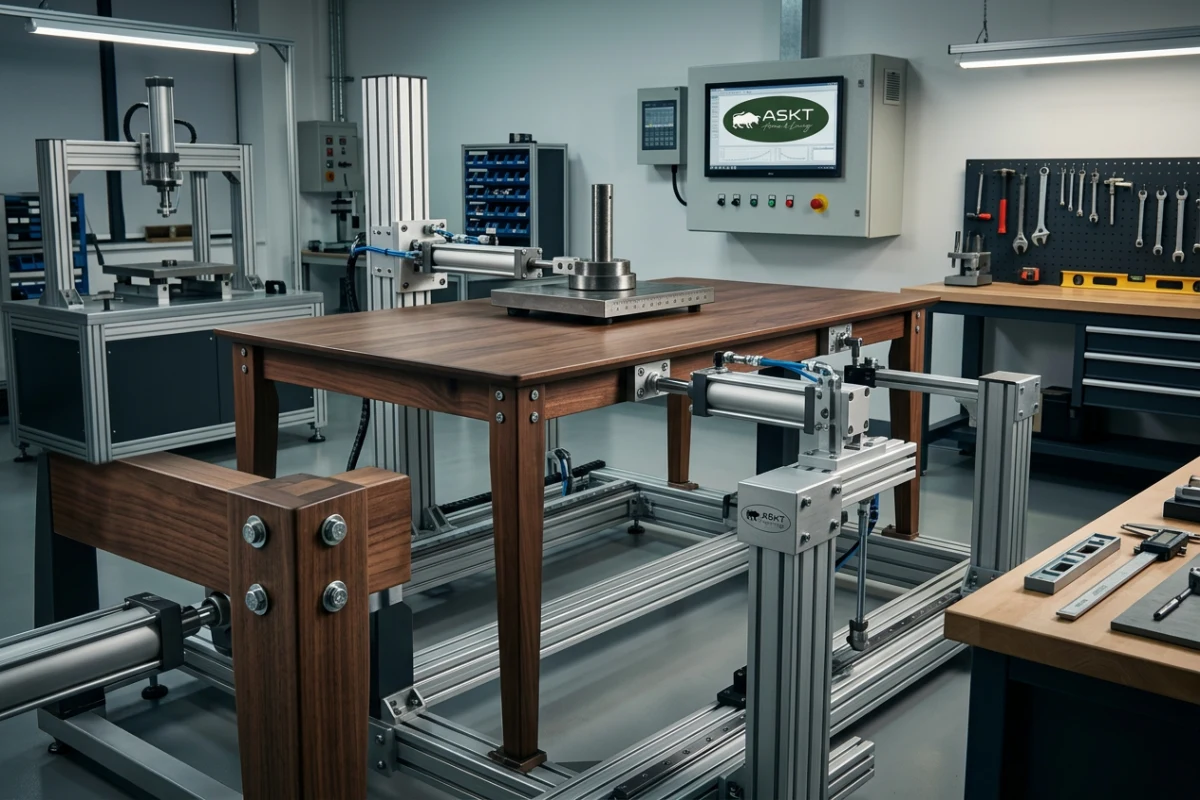
- Horizontal Static Load Testing: This test measures the table frame's ability to resist lateral racking forces without permanent deformation, joint loosening, or structural tipping. A vertical stabilisation load is placed on the tabletop surface to prevent tilting, while a pneumatic actuator applies horizontal force to the tabletop edge in both longitudinal and transverse directions. If joints deflect beyond specified thresholds or fasteners loosen, the design fails.
- Vertical Static Load and Edge Overload Testing: Simulating scenarios where users sit or lean heavily on table overhangs, this procedure applies concentrated downward forces directly to the perimeter edges and extension leaves. The test evaluates weld integrity, cantilever apron bending, and fastener retention under severe eccentric downward pressure.
- Cyclic Durability and Fatigue Testing: A mechanical testing rig applies continuous alternating horizontal forces for thousands of cycles to the table structure at a constant frequency. This test simulates years of real-world dining room use within a condensed laboratory testing window. It reveals progressive micro-looseness in KD frame joints, fastener creep, weld hairline fractures, and material fatigue that standard static inspections miss.
- Drop and Impact Resistance Testing: Impact testing assesses the resilience of tabletop surfaces and under-mount fastening hardware when subjected to sudden vertical shock loads. This ensures that heavy composite tops, such as sintered stone or tempered glass, do not shear their mounting brackets during dynamic impacts.
What Factory Quality Control Measures Prevent Table Wobbling During Mass Production?
Preventing dining table wobble requires strict, multi-stage quality control integrated directly into the manufacturing process. Relying solely on a final pre-shipment spot-check is insufficient; structural precision must be engineered at each stage of production.
In high-volume B2B manufacturing, professional supply chain partners implement five essential quality gates:
- Raw Material Gauge and Moisture Verification: For metal frames, incoming raw steel tubing is inspected with ultrasonic thickness gauges to ensure wall thickness strictly complies with engineering drawings. For solid wood and veneer substrates, timber components are checked with digital moisture meters to ensure raw moisture levels remain within optimal ranges for European climates.
- Precision CNC Punching and Automated Robotic Welding: Manual welding introduces human inconsistencies, such as unequal weld penetration, thermal distortion, and angle variances. Utilising automated robotic welding arms guarantees continuous seam penetration and consistent thermal control, preserving accurate frame alignments. Simultaneously, CNC punching machines drill fastener holes with precise tolerances, ensuring that KD assembly hardware fits together without mechanical play.
- Fixture-Based Frame Squaring and Coplanarity Jigs: All subassemblies and welded leg clusters must be clamped into rigid steel master jigs during assembly. These pneumatic welding fixtures maintain perpendicularity and level alignment across all ground contact points. Frame structures undergo digital four-point plane checks to verify that base coplanarity variation stays within strict manufacturing limits across the entire diagonal span.
- Calibrated Torque Tightening and Fastener Audits: On the assembly line, operators use calibrated torque tools to fasten all subframe hardware to exact specifications. Random inline sample audits ensure bolts cannot be loosened by manual hand torque after vibration simulation cycles.
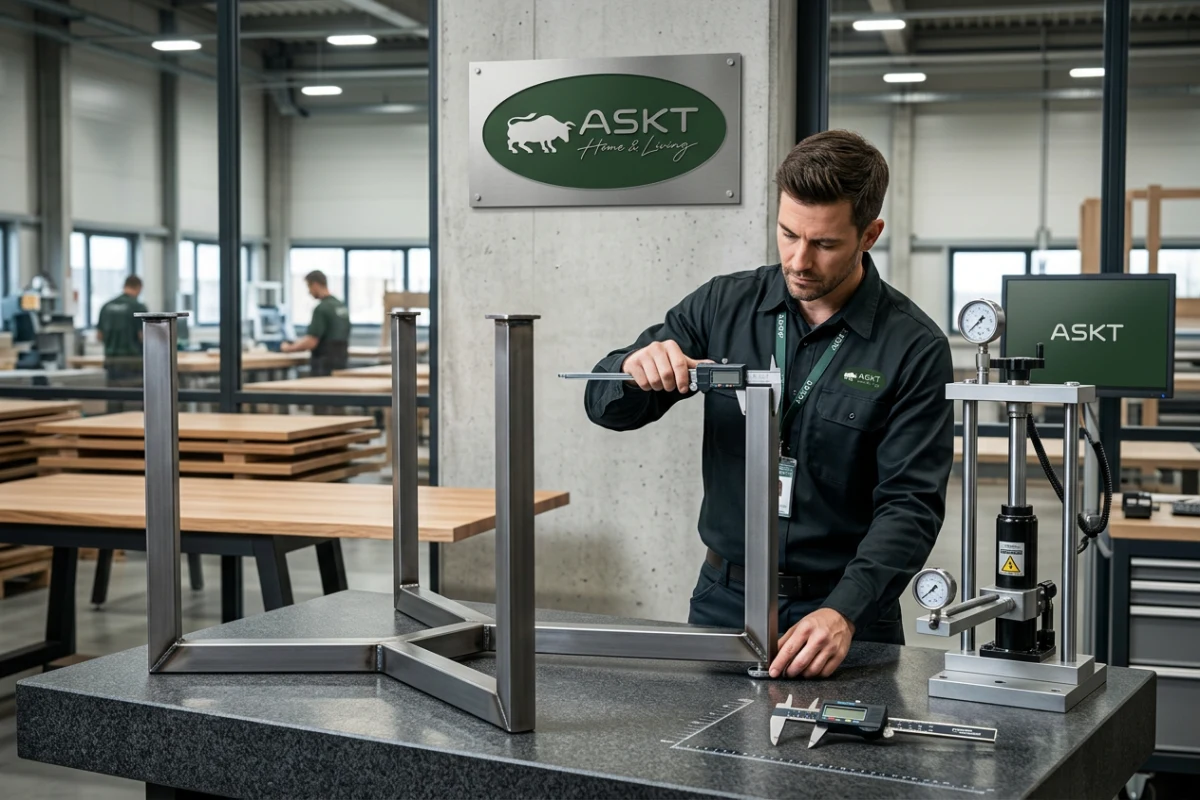
- Multi-Surface Level Testing with Adjustable Glides: Every completed table base undergoes inspection on a precision-ground granite surface plate. To compensate for variable residential floor finishes across European properties, high-density nylon adjustable levelling feet with steel threaded stems are installed on base contact points, providing micro-adjustment capability.
Sourcing Checklist: How Can Furniture Buyers Evaluate Table Stability Before Placing Bulk Orders?
For product managers, furniture wholesalers, and sourcing specialists handling container-level purchasing, assessing structural stability before placing bulk production orders is critical. A single design failure can cause high return rates, negative reviews, and costly logistics recalls.
Use this practical engineering audit checklist when reviewing table prototypes, golden samples, or off-tool production units:
- Fastener Hardware Specification: Confirm that the bill of materials specifies high-tensile steel machine bolts paired with hardened steel threaded inserts, avoiding direct wood screws in primary structural load paths.
- Metal Subframe Wall Thickness: Verify tubing wall gauge across all legs and crossbars using a digital caliper to ensure structural members meet specified load requirements, especially for heavy ceramic or sintered stone tops.
- Corner Bracing and Gusset Plates: Check that KD corner joints feature pressed steel gusset plates or multi-point diagonal cross-braces rather than simple single-screw flat brackets.
- Under-Top Support Rails: For dining tables over 160 cm in length, ensure the understructure includes longitudinal metal stiffener channels to prevent central sagging and structural deflection.
- Glide Assembly and Thread Engagement: Inspect bottom leg glides. Screwed levellers should feature adequate threaded stem engagement within a welded steel insert nut to prevent stripped threads under dragging loads.
- Dynamic Push-and-Lean Prototype Test: Apply horizontal lateral force to the long and short edges of an assembled prototype on a flat surface; observe whether joints creak, flex, or lift off the ground.
- Independent Laboratory Test Reports: Verify valid structural stability and durability test reports conducted by accredited testing institutes reflecting the exact frame construction and dimensions being sourced.
| Inspection Parameter | Pass Criterion (European B2B Standard) | Fail Criterion (High Sourcing Risk) |
|---|---|---|
| Leg-to-Frame Fastening | Dual machine bolts into embedded metal inserts | Single bolt or direct wood screws into board core |
| Chassis Diagonal Variance | Minimal diagonal variance across frame structure | Excessive diagonal variance causing twisted footprint |
| Tabletop Deflection (Center) | Negligible deflection under static central load | Noticeable sag or visible elastic bowing |
| Levelling Glide Stroke | Smooth threaded vertical travel for floor adaptation | Fixed plastic cap or non-threaded push-in plug |
| Welding Quality | Continuous, slag-free seam or uniform robotic weld | Inconsistent tack welds with visible porosity |
Summary: Securing Stable, Long-Term Dining Table Collections
Eliminating dining table wobbling is entirely achievable when engineering principles, material selection, and rigorous quality control align. By prioritising robust KD frame joint architectures, demanding heavy-duty structural gussets, verifying steel tube gauges, and enforcing compliance with established table stability testing standards, European furniture buyers can deliver durable dining furniture that performs reliably in residential and commercial settings.
If you are reviewing dining table or chair suppliers for European retail distribution or contract projects, discover our stable dining table constructions and learn how our engineering team optimises structural frames, knock-down mechanisms, and container loading efficiency for long-term commercial success.